
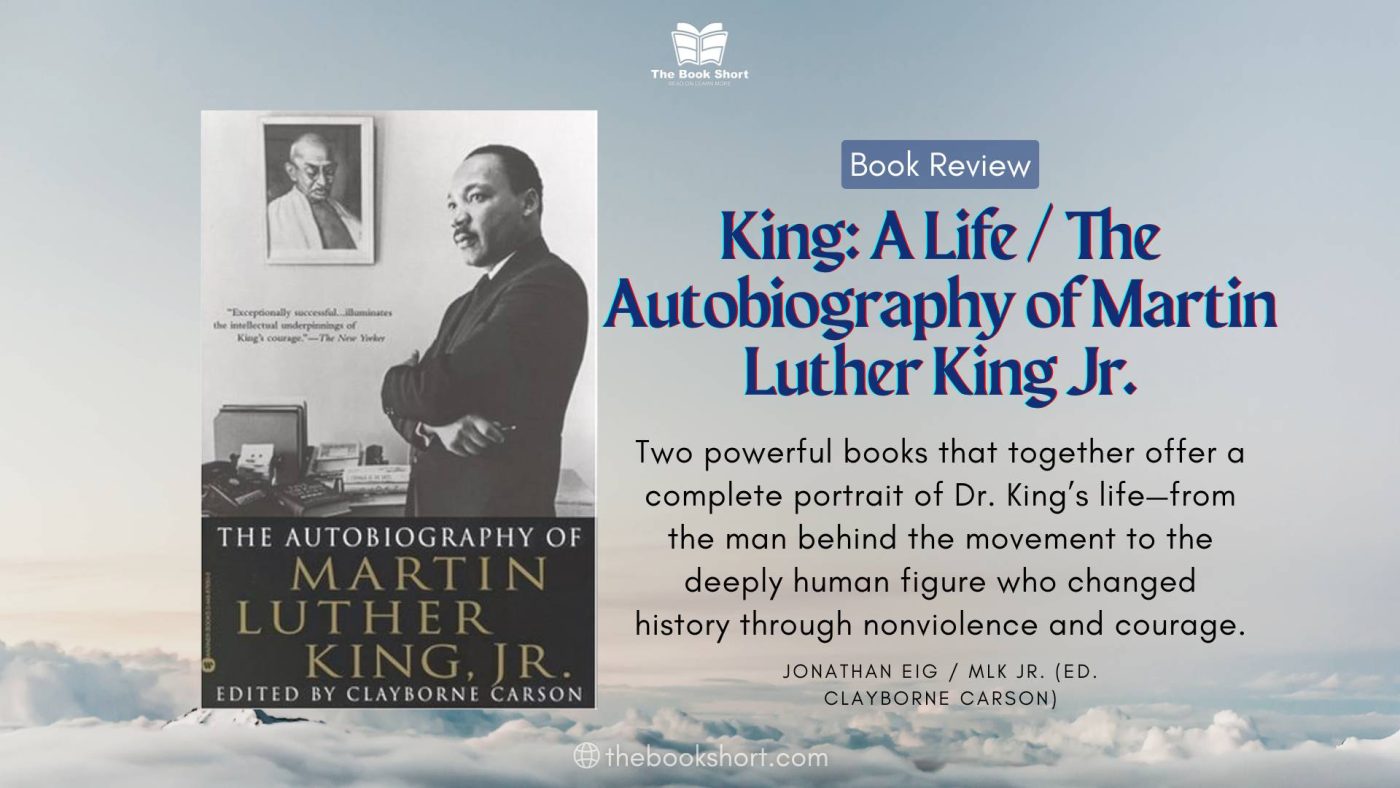
Dive deep into the profound life and enduring legacy of an American icon: a comprehensive review of Jonathan Eig’s acclaimed biography, King: A Life, revealing the complex man behind the movement.
Basic Information: King: A Life by Jonathan Eig
- Title: King: A Life
- Author: Jonathan Eig
- Year of publication: 2023
- Genre: Biography, History, Civil Rights Movement
- Number of pages: Approximately 880 (including notes and index)
- Target audience: Readers seeking an in-depth understanding of Martin Luther King Jr., the Civil Rights Movement, 20th-century American history, and rigorous, source-driven biographies.
Summary of King: A Life – Jonathan Eig’s Acclaimed MLK Biography
Jonathan Eig’s King: A Life stands as a monumental achievement, a deeply researched and compelling biography that moves beyond the familiar iconography to present a complex, nuanced portrait of Martin Luther King Jr. Drawing on an extraordinary array of source materials, including recently declassified FBI surveillance files, King’s personal letters, and extensive interviews, Eig meticulously chronicles King’s journey from his Atlanta roots to his tragic assassination in Memphis. The narrative masterfully weaves King’s personal struggles and triumphs into the broader tapestry of the 20th-century American experience, offering fresh insights into the man who became the conscience of a nation.
The book unfolds largely through a chronological structure, allowing Eig to trace King’s evolution and the escalating intensity of the Civil Rights Movement.
MLK’s Early Life and Intellectual Formation
Eig begins by exploring King’s upbringing within the relatively comfortable embrace of a prominent Black family in Atlanta, shaped significantly by his powerful father, Martin Luther King Sr. He details King’s intellectual promise, tracing his education from Morehouse College through graduate studies at Crozer Theological Seminary and Boston University, where he earned his doctorate. This section highlights the critical development of his thought, his engagement with philosophical and theological concepts – from Thoreau’s civil disobedience to Gandhi’s satyagraha and Rauschenbusch’s social gospel – that would form the bedrock of his nonviolent philosophy. Eig also sensitively portrays King’s early internal conflicts regarding his call to ministry and his relationship and marriage to Coretta Scott, emphasizing her independent spirit and significant influence on his life and activism.
Leading the Montgomery Bus Boycott
The narrative pivots to Montgomery, Alabama, where the young, relatively unknown pastor is suddenly thrust into the demanding leadership of the historic bus boycott following Rosa Parks’ courageous stand in 1955. Eig vividly recounts the 381 days of this pivotal protest, detailing the strategic challenges, the unwavering unity of the Black community, the brutal white resistance, and King’s swift emergence as a national symbol of hope and defiance. This period forged his unwavering commitment to nonviolent direct action and dramatically elevated his profile, setting the stage for the monumental struggles that lay ahead.
Founding the SCLC and Early Civil Rights Campaigns
Following the resounding success in Montgomery, King and other Southern Black religious leaders established the Southern Christian Leadership Conference (SCLC). Eig describes the nascent years of the SCLC, marked by organizational growing pains and the difficulty of replicating the precise conditions that led to victory in Montgomery. He presents campaigns like the one in Albany, Georgia, as crucial learning experiences, illustrating the tactical innovations necessitated by cunning opponents, such as Police Chief Laurie Pritchett, who strategically avoided overtly violent confrontations to blunt the movement’s moral leverage.
The Turning Point in Birmingham
The book reaches a searing climax with the 1963 Birmingham campaign. Eig recounts the horrific response orchestrated by Police Commissioner Bull Connor, the infamous images of police dogs and high-pressure fire hoses turned on peaceful demonstrators, including children, which galvanized national outrage. This section explores King’s controversial but ultimately impactful decision to involve young people in the protests and the immense pressures he faced from all sides. It also provides crucial context for and deep analysis of his profound “Letter from a Birmingham Jail,” written in solitary confinement, offering an eloquent and impassioned defense of the moral imperative and urgency of nonviolent civil disobedience.
The Historic March on Washington
Eig masterfully reconstructs the planning and execution of the 1963 March on Washington for Jobs and Freedom, a monumental demonstration that solidified public support for landmark civil rights legislation. He captures the electric atmosphere of that historic day and the enduring power of King’s iconic “I Have a Dream” speech, analyzing its rhetorical brilliance and its immediate, transformative impact on the American consciousness.
Selma and the Fight for Voting Rights
The narrative continues with the pivotal struggle for voting rights centered in Selma, Alabama. Eig details the brutal attack on marchers on the Edmund Pettus Bridge, forever known as “Bloody Sunday,” and the subsequent marches that commanded national attention and generated the political will necessary for the passage of the Voting Rights Act of 1965. This period also highlights the increasing ideological rifts within the movement, particularly with younger, more militant activists, requiring King to navigate complex internal dynamics.
Expanding the Vision: The North, Vietnam, and Economic Justice
As legislative victories were secured in the South, Eig shows King courageously broadening his focus to confront systemic issues of poverty, economic inequality, and de facto segregation in Northern cities. The challenging campaign in Chicago in 1966 is detailed, illustrating the distinct difficulties of organizing against ingrained economic injustice and housing discrimination compared to the fight against explicit legal segregation in the South.
A significant portion of the latter half of the book is dedicated to King’s increasingly vocal and controversial opposition to the Vietnam War, articulated forcefully in his 1967 “Beyond Vietnam” speech. Eig explores the considerable backlash King faced from within the movement, from political allies like President Johnson, and from the mainstream media, underscoring the moral courage required to take such an unpopular stand rooted in his convictions about militarism, poverty, and global justice.
The final years covered detail King’s deepening commitment to economic justice, culminating in the ambitious Poor People’s Campaign – a plan to bring a diverse coalition of impoverished Americans to Washington D.C. to demand fundamental economic rights. Eig portrays this as King’s attempt to build a broader, more inclusive movement addressing the fundamental economic roots of inequality beyond racial segregation.
Surveillance, Personal Humanity, and Tragic End
Throughout the narrative, Eig skillfully incorporates details gleaned from the recently accessible FBI files, offering unprecedented insight into the relentless government surveillance King endured and the malicious efforts by figures like J. Edgar Hoover to discredit and destroy him. While unflinchingly acknowledging Hoover’s destructive campaign, Eig also utilizes these files, corroborated with other sources, to provide a fuller picture of King’s personal life, including his struggles, vulnerabilities, and the immense psychological toll of his leadership. The book culminates with King’s assassination in Memphis in April 1968, detailing his final days supporting striking sanitation workers and the devastating, premature end to his transformative life.
Eig’s biography is exhaustive and illuminating, painting a complex, multifaceted picture of King: a brilliant orator and strategist, a flawed and deeply human man, a constant target of oppressive forces, and a tireless prophet of justice whose vision extended far beyond racial equality to encompass economic dignity and global peace. The book serves as a powerful testament to King’s enduring relevance and the pressing, unfinished nature of the struggles he dedicated his life to.
Analyzing Themes and Style in Jonathan Eig’s MLK Biography
Jonathan Eig’s King: A Life distinguishes itself through its rigorous research, nuanced perspective, and compelling narrative, offering a deeply analytical exploration of Martin Luther King Jr. More than a simple recounting of events, the book delves into the forces that shaped King, the evolution of his philosophy, and the intricate dynamics of the movement he helmed.
King as Character, Narrative Structure, and Central Arguments
At the heart of this sweeping narrative is Martin Luther King Jr., whom Eig portrays not as a remote, beatified figure, but as a profoundly human individual. Eig meticulously details King’s undeniable strengths – his charismatic presence, unparalleled oratorical gifts, strategic brilliance in nonviolent action, and unwavering moral conviction – alongside his very real vulnerabilities, bouts of depression, personal struggles, and the crushing burden of leadership. Coretta Scott King emerges as a figure of considerable depth and strength, presented not merely as a supportive spouse but as an active and influential partner in King’s life and the movement’s trajectory. Key figures such as Ralph Abernathy, John Lewis, and a host of political allies and adversaries, including Presidents Kennedy and Johnson and the relentless J. Edgar Hoover, are vividly rendered, providing essential context for understanding King’s decisions and the world he navigated.
The primary structure is chronological, a wise choice that effectively traces King’s personal development and the organic progression of the Civil Rights Movement. However, Eig expertly weaves thematic analysis throughout, exploring recurring challenges like securing funding, managing internal dissent, confronting relentless violence and threats, and the profound psychological cost of leading a movement under siege.
A central argument powerfully underscored by Eig is the necessity of understanding King in his full complexity – embracing both his towering public achievements and his private struggles – to truly appreciate the magnitude of his courage and the obstacles he overcame. By integrating details from FBI surveillance, Eig unflinchingly addresses uncomfortable aspects of King’s life, arguing convincingly that these human facets, far from diminishing his historical importance, underscore his vulnerability and the immense pressure he faced. Eig also compellingly highlights the increasingly radical nature of King’s later message, particularly his focus on economic inequality and vocal opposition to war, arguing that this expansive vision is often marginalized in popular memory.
Writing Style and Research Quality
Eig’s writing style is remarkably accessible and engaging for a scholarly biography of this scale. He masterfully blends meticulous historical detail with the narrative drive of a compelling story, transforming extensive research into highly readable prose. The language is clear, direct, and evocative, avoiding academic jargon while maintaining intellectual rigor. Eig possesses a gift for bringing historical moments to life, whether depicting the palpable tension of a protest march, the charged atmosphere of a courtroom, or the intimate conversations within King’s inner circle.
The content quality is exceptionally high, grounded in the unprecedented depth and breadth of Eig’s research. The incorporation of newly declassified FBI files is a significant contribution, offering fresh perspectives and either confirming or critically contextualizing previously debated aspects of King’s life and the government’s insidious efforts to disrupt the movement. Eig also draws upon a vast archive of interviews, personal papers, organizational records, and existing historical scholarship, constructing a richly layered and authoritative account. The extensive footnotes and comprehensive bibliography are testaments to the meticulousness of his work.
What truly distinguishes King: A Life from many earlier biographies, and particularly from compilations like The Autobiography of Martin Luther King Jr. (edited by Clayborne Carson), is Eig’s singular ability to synthesize such an enormous volume of material, including challenging new sources, into a coherent, deeply human, and critically analytical narrative. While Carson’s Autobiography offers unparalleled access to King’s voice and thoughts as compiled from his own writings and speeches, Eig provides the essential external context, the behind-the-scenes realities, the perspectives of countless others involved, and a critical evaluation grounded in evidence that was unavailable during King’s lifetime or when The Autobiography was compiled. Eig doesn’t simply present King’s words; he analyzes the circumstances in which they were delivered, assesses their impact using retrospective evidence, and integrates them into a larger historical picture. His candid, though sensitive, discussion of King’s personal struggles, informed by the FBI files, offers a level of detail often absent or deliberately downplayed in earlier accounts or in King’s own curated public statements.
Illuminating Quotes Central to King’s Story
While a biography draws heavily on the words of its subject, the power often lies in the biographer’s selection and context. Eig effectively utilizes King’s own words to illuminate the man and the movement. Here are examples of crucial King quotes that resonate powerfully within Eig’s narrative, reflecting the evolution of his thought and the core of his message:
- From “Letter from a Birmingham Jail”: “Injustice anywhere is a threat to justice everywhere.” – This iconic line, central to Eig’s depiction of the Birmingham campaign, encapsulates King’s understanding of the interconnectedness of liberation struggles.
- From “Letter from a Birmingham Jail”: “Freedom is never voluntarily given by the oppressor; it must be demanded by the oppressed.” – This quote highlights the active agency inherent in the nonviolent resistance strategy King championed, a theme Eig explores in detailing the movement’s campaigns.
- From the March on Washington: “I have a dream that my four little children will one day live in a nation where they will not be judged by the color of their skin but by the content of their character.” – The unforgettable lines Eig analyzes for their strategic brilliance and profound impact on the national psyche.
- From “Beyond Vietnam: A Time to Break Silence”: “A nation that continues year after year to spend more money on military defense than on programs of social uplift is approaching spiritual death.” – This powerful statement underscores the radical expansion of King’s vision in his later years, a period Eig emphasizes as crucial to understanding King’s full legacy.
Eig weaves these and countless other quotes throughout the narrative, contextualizing them within the specific historical moments they were spoken or written, demonstrating the strategic power and moral force of King’s words and how they resonated, evolved, and at times, challenged even his closest allies.
Evaluation & Expert Personal Review of King: A Life
Jonathan Eig’s King: A Life is, quite simply, an outstanding biography – a work of exceptional depth, meticulous scholarship, and remarkable balance. My personal impression is overwhelmingly positive; it immediately struck me as the definitive modern account of Martin Luther King Jr., integrating previously inaccessible information to offer the most complete and human picture of the icon available today.
One of the book’s greatest strengths is its profound success in humanizing King without ever diminishing his colossal historical significance. Eig masterfully avoids the pitfalls of hagiography, presenting King with his authentic flaws, doubts, and vulnerabilities. This unflinching portrayal paradoxically makes his achievements and sacrifices even more resonant and inspiring. The book tackles uncomfortable truths, particularly concerning the pervasive government surveillance and aspects of King’s personal life revealed through the FBI files, but does so with sensitivity, historical rigor, and a focus on how these pressures impacted the man and the movement. The integration of these files is handled responsibly, used to corroborate events and provide crucial context rather than for sensationalism.
For some readers, the sheer density and length of the book might be perceived as a disadvantage. While Eig’s prose is engaging, the level of detail is immense, covering intricate political maneuvering, complex theological debates, deeply personal struggles, and the granular details of major campaigns. It requires a significant investment of time and focus from the reader. However, for those seeking a truly deep, comprehensive understanding, this richness of detail is precisely where the book’s immense value lies.
Remarkably for a scholarly work of this magnitude, the readability level is high. Eig is a gifted storyteller who makes complex historical events and interpersonal dynamics accessible and compelling. Despite its length, the narrative flows well and never feels dry or overly academic. It is suitable for a wide audience, from serious scholars and students of American history and the Civil Rights Movement to general readers eager to move beyond the often-simplified popular image of MLK and grasp the full complexity of the man and his tumultuous era. It would undoubtedly be an invaluable text for college courses on American history, civil rights, or leadership.
The practical and emotional value of King: A Life is immense. It offers crucial lessons about effective leadership in the face of overwhelming opposition, the challenging dynamics of social change, the strategic and moral power of nonviolent resistance, the vital importance of moral conviction, and the ongoing, often grueling struggle for justice. Reading about the relentless threats, the physical dangers, the psychological toll King endured, and his unwavering commitment provides a powerful, humbling lesson in resilience, courage, and faith. It offers unparalleled insight into the strategic thinking and sacrifices behind key Civil Rights campaigns. Furthermore, Eig’s nuanced portrayal of King’s later years, highlighting his expanding focus on economic justice and global peace, feels particularly resonant and urgent today, prompting readers to consider the full, radical scope of King’s vision and its direct applicability to contemporary issues of inequality, poverty, and injustice. Reading this book can fundamentally shift one’s perspective, illustrating that historical progress is not inevitable but the hard-won result of tireless effort, strategic action, and immense personal sacrifice, driven by complex, imperfect, yet extraordinary human beings.
Comparing King: A Life with The Autobiography of Martin Luther King Jr.
To fully appreciate the contribution of Jonathan Eig’s King: A Life, it’s helpful to place it within the landscape of books about Martin Luther King Jr., particularly in comparison to The Autobiography of Martin Luther King Jr., edited by Clayborne Carson. These two works are distinct in their nature and offer complementary, rather than competing, perspectives on King’s remarkable life.
The Autobiography is not a traditional autobiography written chronologically by King himself. Instead, historian Clayborne Carson meticulously compiled it from King’s vast body of work – his letters, diaries, sermons, speeches, published writings, and interviews – weaving them together into a cohesive first-person narrative. Its profound strength lies in offering readers direct access to King’s voice, allowing him to describe his experiences, articulate his evolving thoughts, and explain his motivations in his own words. It provides an intimate, deeply personal window into pivotal moments like the Montgomery Bus Boycott, the Birmingham campaign, and the development of his philosophy of nonviolence, filtered through his own reflections and public expressions.
In contrast, Eig’s King: A Life is a third-person historical biography, researched and written decades after King’s death. While Eig certainly draws upon King’s own words and writings (the sources used by Carson), he supplements them with an extensive range of other historical materials: interviews with King’s contemporaries, memoirs and accounts from others involved in the movement and government, organizational records, and, crucially, newly available government documents, most notably the declassified FBI files detailing the extensive surveillance and efforts to undermine King.
The key differences stem from their fundamental nature, perspective, scope, and source material:
- Perspective: The Autobiography presents King’s own curated narrative and self-understanding, as assembled by a scholar using his words. King: A Life is a historian’s comprehensive interpretation and critical analysis of King’s entire life, based on a vast body of evidence, including information King himself did not reveal publicly.
- Scope: While The Autobiography covers major events and themes central to King’s public life, its scope is limited by the material King himself produced. Eig’s biography offers a much broader historical context, provides detailed insights into the actions, motivations, and perspectives of a wide array of other figures (allies, opponents, government officials), and incorporates aspects of King’s life (particularly personal vulnerabilities or the extent of surveillance) that were not publicly known or discussed by King in the sources used for the Autobiography.
- Source Material: The Autobiography is exclusively derived from King’s own documented words. Eig utilizes King’s words but builds his narrative upon a far wider foundation of evidence, including external accounts, organizational records, and government documents that offer new details and perspectives on events and King’s experiences.
Eig’s biography benefits significantly from the passage of time, allowing for a more complete, corroborated picture based on evidence that simply wasn’t accessible to King or even earlier biographers. It offers critical distance and the ability to evaluate events and King’s actions with the benefit of hindsight and a wider range of perspectives. The Autobiography, conversely, offers the irreplaceable power of King’s direct voice and his own articulation of his journey, philosophy, and spiritual convictions.
These books are not mutually exclusive; they are powerful, complementary resources. Reading The Autobiography provides a profound, intimate connection to King’s spirit, intellect, and personal reflections in his own unforgettable language. Reading Eig’s King: A Life provides the essential historical context, the full, complex humanity of the man, the immense external pressures he faced, and a deeply researched account of his entire life and legacy, enriched by sources that became available only long after his death.
If readers found King: A Life compelling and wish to delve further into MLK’s own profound thoughts and writings, The Autobiography of Martin Luther King Jr. is an essential follow-up. Other highly recommended books for readers interested in MLK and the Civil Rights Movement include:
- Bearing the Cross: Martin Luther King, Jr., and the Southern Christian Leadership Conference by David J. Garrow (a foundational, Pulitzer Prize-winning biography offering a detailed account of the movement’s major campaigns).
- Parting the Waters: America in the King Years 1954-63 and Pillar of Fire: America in the King Years 1963-65 by Taylor Branch (the first two volumes of a magisterial, highly detailed trilogy covering the King era).
Conclusion and Recommendations: Why Read Jonathan Eig’s King: A Life?
Jonathan Eig’s King: A Life is an indispensable, landmark biography, offering the most comprehensive, deeply researched, and humanizing portrait of Martin Luther King Jr. currently available. Its extraordinary value lies in its masterful synthesis of existing scholarship with newly integrated primary sources, particularly the FBI files, providing an unparalleled, nuanced understanding of King’s life, struggles, and triumphs. It successfully navigates the complexities of King’s public activism and private humanity, presenting a figure who was both uniquely gifted and profoundly relatable.
Is King: A Life worth reading? Without hesitation, yes. It is essential reading for anyone seeking to move beyond the simplified icon and understand the full scope of Martin Luther King Jr.’s life, the reality of the Civil Rights Movement, or the enduring dynamics of challenging injustice. While a substantial undertaking in length, it is richly rewarding in its insights and impact.
Who should read it? It is highly recommended for students of history, activists, community leaders, and any general reader interested in a deep, evidence-based exploration of one of history’s most significant figures. It is particularly valuable for those who may only know King through his most famous speeches and wish to appreciate the intellectual depth of his thought, the relentless challenges he faced, and the full, expansive nature of his vision for justice, equality, and peace.
Have you read Jonathan Eig’s King: A Life or The Autobiography of Martin Luther King Jr.? Share your thoughts and impressions in the comments below!