
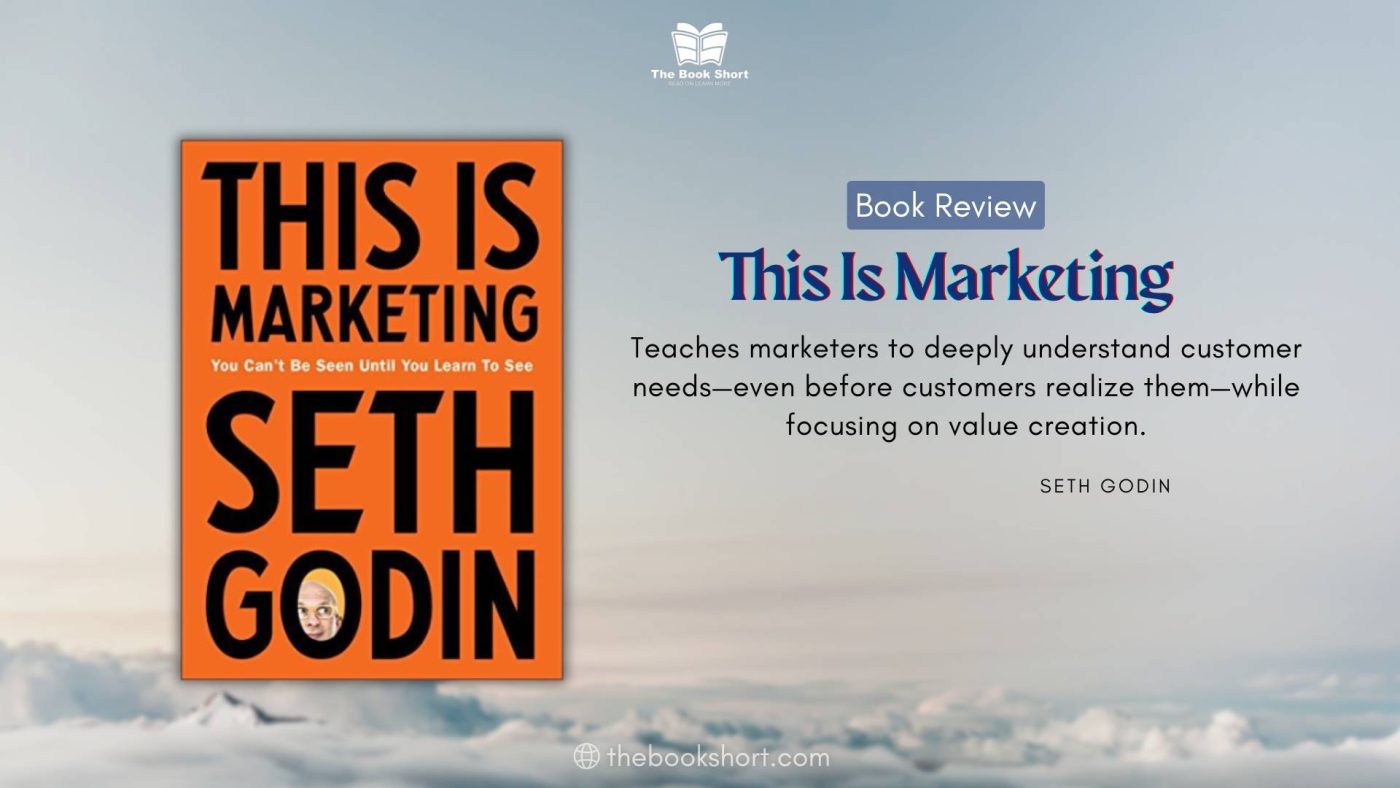
Tired of marketing that feels like shouting into the void? Seth Godin’s This Is Marketing champions a revolutionary, empathetic approach to connect with people who actually want to hear from you. It’s an essential read for modern marketers, creators, and leaders who want to do work that matters.
Book Overview: A Snapshot of This Is Marketing
- Full Title: This Is Marketing: You Can’t Be Seen Until You Learn to See
- Author: Seth Godin
- Year of Publication: 2018
- Genre: Marketing, Business, Leadership
- Number of Pages: 288
- Target Audience: Marketers, entrepreneurs, business owners, non-profit leaders, and anyone looking to create meaningful change.

This Is Marketing: You Can't Be Seen Until You Learn to See
This Is Marketing Book Summary: A Deep Dive into Godin’s Philosophy
Seth Godin’s This Is Marketing is not a tactical playbook filled with checklists for your next social media campaign. It is a philosophical manifesto designed to rebuild marketing from the ground up. Godin argues that real marketing isn’t about hype, hustle, or hacking attention. Instead, it is the generous act of helping others solve a problem—their problem. The book is a compelling invitation to shift from the noise of interruption to the resonance of empathy, from coercion to genuine connection.
The Foundational Shift: From Old Marketing to Empathetic Marketing
Godin opens with a demolition of the old marketing model: “interruption marketing.” This is the world of junk mail, pop-up ads, and unsolicited commercials—aggressive tactics designed to steal attention. He argues that in our saturated world, this approach is not only increasingly ineffective but profoundly disrespectful.
The new, effective marketing is built on a bedrock of empathy and service. It begins not with a product, but with a person. A marketer’s true job is to identify a human need and generously offer a solution. This requires us to “learn to see”—to deeply understand the desires, fears, and worldviews of our audience. The goal is no longer to find customers for your products, but to find products for your customers.
Finding Your “Smallest Viable Market”
A core principle of the book is the courageous rejection of the mass market. Godin famously states, “The relentless pursuit of mass will make you boring.” Instead of watering down your message for everyone, he urges marketers to focus on the “smallest viable market”—the core group of people who, if they love what you do, are enough to sustain your project.
- Specificity Creates Resonance: By focusing on a specific niche, you can tailor your message, product, and story to resonate powerfully with a core tribe.
- From Niche to Network: This core group, when truly served, becomes your most passionate advocate. Their authentic enthusiasm and word-of-mouth are far more potent than any ad campaign, allowing your idea to spread organically.
- The Power of “Not for You”: The bravest thing a marketer can declare is, “This is not for you.” This clarity doesn’t alienate; it builds profound trust with the people you do seek to serve.
The Modern Marketing Funnel: Earning Trust and Permission
Godin reimagines the traditional sales funnel. His model isn’t a conveyor belt for pushing prospects toward a sale; it’s a journey of earning trust and turning strangers into true fans. This path is paved with permission and generosity.
- Stranger to Friend: You earn awareness not by shouting, but by showing up consistently with value, generosity, and insight.
- Friend to Customer: After building trust over time, a friend becomes willing to take a chance, to enroll in your journey, and to make a purchase.
- Customer to Loyal Customer: A remarkable product and continued service transform a one-time transaction into a long-term, meaningful relationship.
- Loyal Customer to Evangelist: When you consistently deliver on your promise, your loyal customers become your most effective sales force, eagerly spreading the word on your behalf.
The Power of Storytelling and Status
“People don’t want what you make,” Godin writes. “They want what it will do for them. They want the way it will make them feel.” This feeling is delivered through story. Marketing, at its best, is the art of telling a story that resonates with the audience’s preexisting worldview and their desire for a better status.
Your story must connect to fundamental human drivers like:
- Affiliation: The desire to belong and be part of something bigger.
- Dominion: The need for control, power, and to level up.
- Reassurance: The deep-seated feeling of safety and security.
A great marketer understands the internal narrative their audience is living and crafts a brand story that aligns with it. The product or service becomes a souvenir—a tangible artifact of the story they now believe.
Creating Tension to Drive Change
Marketing is, by its very nature, about creating change. You are asking someone to journey from one state to another—from confused to clear, from disconnected to connected, from unwell to healthy. To inspire this movement, you must create tension.
This isn’t about inducing stress or anxiety. It’s the positive tension between “where I am now” and “where I want to be.” An effective marketer artfully highlights this gap and presents their offering as the bridge. You’re not selling a drill; you’re selling the pride of a perfectly hung picture frame. By focusing on this desired transformation and the emotional journey, your work becomes irresistible.
In-depth Book Analysis of This Is Marketing
This Is Marketing distinguishes itself from the crowded shelf of business books by relentlessly focusing on the “why” and “who” before ever touching the “how.” It’s less a tactical guide and more a strategic and moral compass, compelling readers to fundamentally rethink how they connect with the world.
Key Arguments, Structure, and Themes
Godin’s central thesis is that marketing must be an act of generous service. This single, powerful idea is the heartbeat of the book. The structure mirrors this philosophy; it isn’t a linear, step-by-step manual. Instead, it reads like a manifesto—a collection of short, potent essays, each exploring a facet of his core message. This unconventional format makes the book incredibly accessible, allowing readers to absorb profound concepts in focused, digestible chapters.
The primary themes that create a cohesive whole are:
- Empathy: The ability to see the world through your customers’ eyes is the single most critical marketing skill.
- Service: Marketing is not about extraction or exploitation; it’s about contribution. Your purpose is to solve a real problem for a specific group of people.
- Storytelling: Features and benefits are forgotten; a powerful narrative is not. A compelling story connects emotionally and builds a tribe.
- Change: Marketing is the work of making change happen. It is leadership. It’s about guiding people on a journey to a better version of themselves.
What makes Godin’s argument so resonant is its profound humanity. In an age dominated by algorithms and analytics, he pulls the focus back to people, their dreams, and the stories they tell themselves.
Writing Style & Content Quality
Seth Godin’s writing style is a masterclass in communication. It is:
- Aphoristic and Memorable: He has a rare gift for distilling deep, complex ideas into sharp, quotable phrases that stick with you long after you’ve closed the book.
- Intimate and Conversational: Reading Godin feels less like studying a textbook and more like getting advice from a wise, passionate mentor. He asks questions that force you to pause, reflect, and engage.
- Rich with Anecdote: Godin masterfully uses short stories and powerful examples—from Tesla to local bakeries to indie creators—to breathe life into his principles.
While the strategic vision is unparalleled, some readers may feel the book is light on tactical execution. Godin tells you what to do and why you must do it, but deliberately leaves the how for you to discover. This is by design. He aims to provide a timeless framework for thinking, not a temporary, paint-by-numbers kit. This makes the book’s wisdom enduring, but it could frustrate a novice looking for an immediate action plan.
Notable Quotes from This Is Marketing
- “Marketing is the generous act of helping someone solve a problem. Their problem.”
- “If you can’t state your position in eight words, you don’t have a position.”
- “The relentless pursuit of mass will make you boring.”