
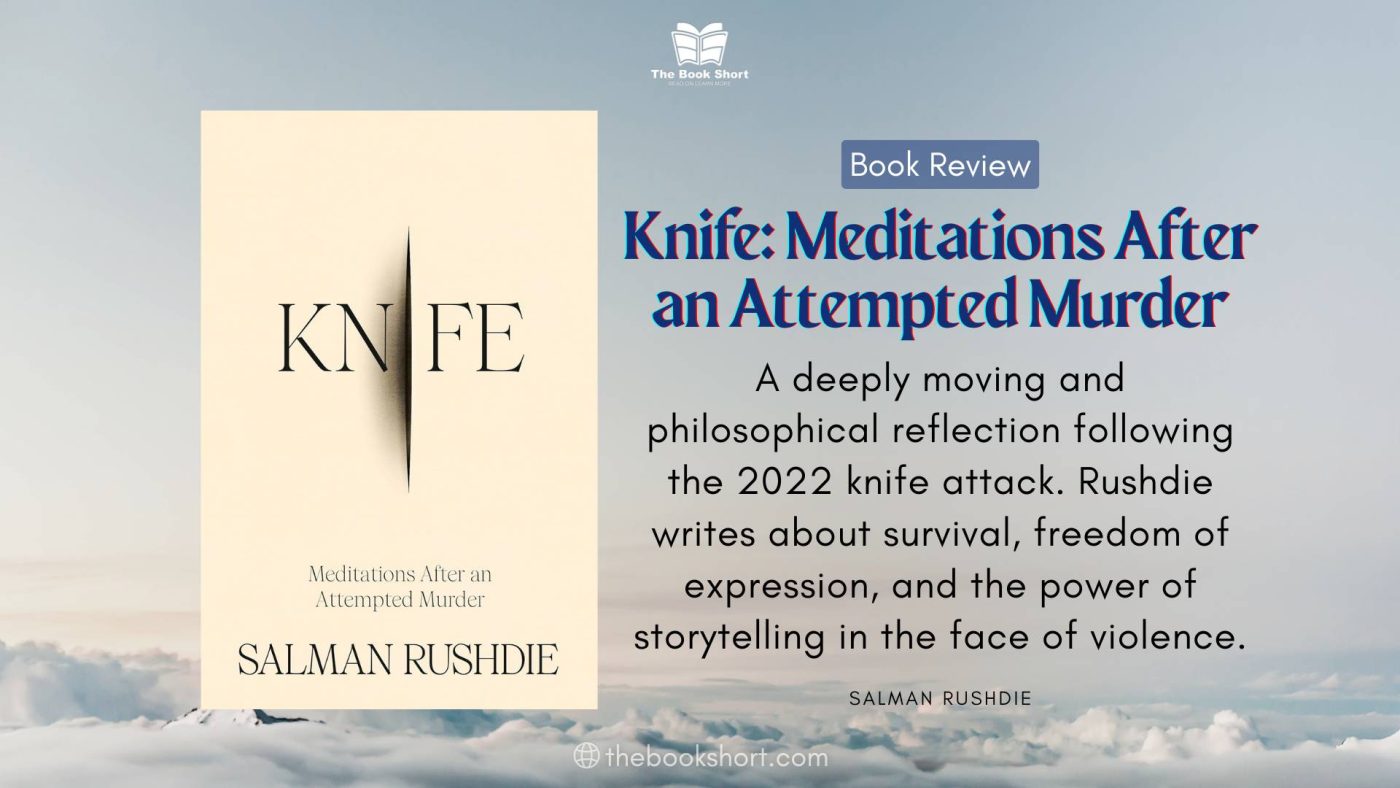
A powerful account of survival and reflection after a brutal attack, Knife: Meditations After an Attempted Murder offers unparalleled insight into trauma, resilience, and the enduring power of words. Salman Rushdie, a titan of contemporary literature, faces down violence with the only weapon he truly commands: his prose.
Salman Rushdie’s Knife: Meditations After an Attempted Murder is a fearless, unflinching plunge into the heart of the aftermath following a shocking act of violence. As a professional reviewer, I approach this book not just as a memoir, but as a profound literary response to an attempt on both a life and a lifetime’s work. Its singular value lies in Rushdie’s capacity for deep introspection, transforming a horrific, public trauma into a resonant meditation on art, freedom, vulnerability, and the unyielding spirit of endurance. It is a crucial document for understanding the cost of courage in our volatile world.
Basic Information about Knife: Meditations After an Attempted Murder
- Title: Knife: Meditations After an Attempted Murder
- Author: Salman Rushdie
- Year of Publication: 2024
- Genre: Memoir, Nonfiction, Autobiography, Literary Criticism (through its engagement with ideas)
- Number of pages: Approximately 224 pages
- Target Audience: Readers interested in literary memoirs, freedom of speech issues, the challenges faced by writers, trauma narratives, and the works of Salman Rushdie.
Main Content Summary: Knife: Meditations After an Attempted Murder Book Summary
Knife: Meditations After an Attempted Murder serves as Salman Rushdie’s searingly intimate and potent reckoning with the assassination attempt he miraculously survived on August 12, 2022, at the Chautauqua Institution in New York. Far surpassing a simple chronological account, the book is a complex, layered meditation on the attack itself, its devastating physical and psychological consequences, and its broader implications for his identity, his vast body of work, and the fundamental concept of freedom of expression he has championed across five decades.
The narrative deliberately avoids opening at the climactic moment of violence. Instead, Rushdie draws us into the quiet hours leading up to the event, patiently setting a scene imbued with a rare, precious sense of ease and safety. He describes arriving at Chautauqua, a place known for its intellectual and artistic community, feeling finally able to relax, even in public. This fragile sense of peace is then brutally, viscerally shattered by the sudden, violent intrusion onto the stage. Rushdie recounts the attack itself with a stark, almost clinical precision, focusing on the raw physical sensations of being repeatedly stabbed. This opening section powerfully underscores the abruptness and ferocity of the assault, highlighting the profound vulnerability inherent even in seemingly protected spaces.
Immediately following the attack, the book plunges into the chaos and the critical moments of survival. Rushdie details the frantic airlift to the hospital, the life-saving medical interventions, and the disorienting, pain-filled period spent in intensive care. He describes the severity of his injuries – the damage to his eye, liver, hand, and neck – with unflinching honesty, conveying the precariousness of his hold on life. This phase of the narrative is grounded in stark medical realities, illuminated by the unwavering presence of loved ones (especially his wife, Eliza Griffiths), and the slow, arduous dawning realization of the full extent of the trauma inflicted.
A significant, emotionally resonant portion of the book is dedicated to the long and painstaking journey of recovery. Rushdie chronicles the numerous surgeries, the demanding physical therapy, and the immense mental and emotional toll of healing from such a profound violation. He is searingly honest about the persistent pain, the deep frustration with his new physical limitations, and the complex psychological struggle required to process the unthinkable. He writes candidly about adapting to permanent injuries, most notably the loss of sight in one eye, a constant, inescapable physical manifestation of the attack’s violence. This section stands as a powerful testament to human resilience, meticulously detailing the incremental steps towards regaining physical function and, crucially, mental equilibrium.
Yet, Knife is far more than a chronicle of physical recovery. Rushdie delves deep into the psychological and philosophical dimensions of the attack. He grapples with the lingering trauma, the fear, and the potent, complex wave of anger. A truly unique and striking aspect of the book is Rushdie’s decision to address his assailant directly, referring to him simply as “A.” He constructs imagined, often searing conversations with “A,” not in an attempt to foster empathy, but to intellectually confront and dissect the motivations behind the violence. These imagined dialogues are a powerful literary device through which Rushdie contrasts his own values – steeped in literature, freedom, and intellectual complexity – with the rigid, violent, and simplistic worldview embodied by “A.” This internal, intellectual confrontation allows Rushdie to reclaim agency and assert the enduring power of thought against brute force.
The book also inherently reflects on the four decades Rushdie spent living under the shadow of the fatwa issued by Ayatollah Khomeini following the publication of The Satanic Verses. While Knife is fundamentally about the 2022 assault, the historical context of the fatwa is an ever-present, shaping force. Rushdie touches upon the years of heightened security, periods of hiding, and the gradual, cautious re-emergence into a more public life that, tragically, made him vulnerable to this final, brutal expression of that long-standing threat. He reflects on the psychological burden of living under existential threat and how this assault brought that prolonged period of danger to a violent, horrifying culmination.
Crucially, Rushdie connects his intensely personal ordeal to broader, universal themes of freedom of speech, censorship, and the transformative power of literature. He frames the attack not merely as an assault on his person, but as a direct strike against the core values he embodies: the fundamental right to express oneself without fear, to explore challenging and controversial ideas, and to create art free from the threat of violent reprisal. He posits that this kind of targeted violence is explicitly designed to silence, and thus, his act of writing this book becomes, in itself, a profound, defiant act of resistance against that silencing.
The narrative seamlessly weaves between the raw, intensely personal details of his physical and emotional recovery and expansive reflections on art, literature, and the ongoing global struggle against fanaticism and intolerance. Rushdie frequently invokes poets, philosophers, and fellow writers, grounding his personal experience within a vast literary and intellectual lineage. He explores the nuanced nature of courage, defining it not as the absence of fear, but as the conscious, deliberate decision to act despite it.
Ultimately, Knife emerges as a powerful affirmation of life, love, and the vital connections that sustain us. Rushdie writes with deep affection and gratitude about his wife, his family, and the friends who rallied around him, offering invaluable support during his darkest hours. He finds profound solace and strength in their unwavering love and presence. The very act of writing Knife is presented as integral to his healing process – a necessary means to regain control of his own narrative and transform a moment of near-fatal violence into a powerful testament to the enduring power of words and the indomitable refusal of the human spirit to be extinguished. The book concludes not with vengeance or despair, but with a resonant sense of continued defiance and an unshakeable commitment to living and writing, a clear declaration that the attacker ultimately failed in his true objective.
In-depth Analysis: Knife: Meditations After an Attempted Murder Analysis
Knife: Meditations After an Attempted Murder stands as a profound exploration of trauma, resilience, and the complex intersection of a writer’s life, their work, and the dangerous realities of the world. Its immense power resides not only in the harrowing chronicle of survival but in the formidable intellectual and emotional depth Rushdie brings to his reflection. This is a book that thinks as much as it remembers, processing physical violation through intellectual engagement.
Characters, Structure, and Key Arguments
- Characters: At the heart of the narrative is Rushdie himself, presented with a rare blend of vulnerability, intellectual rigour, and mordant wit. His wife, Eliza Griffiths, emerges as a deeply moving figure, a constant source of strength and love, a vital anchor throughout his brutal recovery. The assailant, pointedly referred to only as “A,” is deliberately rendered devoid of personalizing detail, functioning less as a character and more as a chilling embodiment of the destructive force of ideology and hatred against which Rushdie wages an intellectual and moral battle through imagined discourse. Medical professionals and a circle of supportive friends feature as crucial figures whose actions literally saved his life and aided his recovery.
- Structure: The book eschews a strictly linear path, adopting a more fluid, meditative structure. While a general trajectory moves from the attack’s immediate aftermath to the long road of recovery, Rushdie frequently weaves in flashbacks to his forty years living under the fatwa, literary allusions, philosophical digressions, and intensely personal reflections. The most distinctive structural device is the recurring imagined conversations with “A,” which punctuate the narrative, serving as Rushdie’s unique method of confronting the violence on an intellectual plane. This non-linear, recursive structure effectively mirrors the fragmented and often repetitive nature of processing profound trauma, where the mind cycles back to the originating event while simultaneously striving to impose meaning and coherence.
- Key Arguments:
- The attack was a direct assault on freedom of expression: Rushdie frames the violence not as a random act, but as a targeted strike against the fundamental right to speak, write, and think freely, embodying the struggle against censorship and intolerance.
- Resilience is an active, conscious choice: Survival is portrayed as far more than mere physical endurance; it is presented as a deliberate, ongoing decision to live, to heal, and crucially, to continue creating.
- Words are the ultimate weapon against violence: The book is a powerful assertion of the enduring strength of literature, rational thought, and complex ideas as the necessary counterpoint to brutal, unthinking violence fueled by simplistic, hateful ideology.
- Trauma leaves its mark but does not dictate identity: Rushdie demonstrates how the attack has irrevocably changed him, leaving both physical and emotional scars, but he steadfastly refuses to allow it to define his spirit or his identity as a writer and a human being.
Writing Style & Content Quality
Rushdie’s prose in Knife is remarkable for its clarity, directness, and an almost stoic understatement, particularly when describing the most gruesome or painful moments. This contrasts sharply with the more elaborate, layered style of his fiction, showcasing his versatility as a writer. The language is precise and unflinching, whether detailing complex medical procedures, chronicling physical agony, or articulating nuanced emotional states. He seamlessly incorporates literary references and allusions, effectively positioning his deeply personal ordeal within a broader cultural and intellectual continuum. The quality of the content is exceptionally high, offering a searingly honest, deeply intelligent self-portrait forged in the crucible of unimaginable circumstances. The imagined dialogues with “A,” a stylistic risk, are handled with deft control, preventing the assailant from becoming a figure of morbid fascination and instead reducing him to an abstract embodiment of a hateful force that must be intellectually dismantled.
Notable Quotes from the Book
(Drawing on known themes and reported content, these quotes reflect the likely tone and pivotal ideas.)
- “My attacker was A. This is the letter I will give him… To name him would be to give him too much importance. He was a knife.” (Capturing his deliberate strategy to depersonalize the attacker and focus on the instrument and the act.)
- “I had entered the house of death, but I had not died. I had walked into the valley of the shadow, but I was still in the land of the living.” (Reflecting on the liminal space between life and death.)
- “This was the place where I nearly died. It must now be the place where I must speak the truth as I know it.” (Asserting the necessity of writing this book as an act of reclaiming the site of trauma.)
- “What is courage? It is not the absence of fear, but the capacity to act in the presence of fear, to decide that something else is more important than your own terror.” (A central reflection on resilience and defiance.)
- “The words were my only weapon against the knife – and the words survived.” (Emphasizing the enduring power of literature and expression over physical violence.)
- “Healing is not a straight line. It is a jagged scar, a messy tangle of good days and bad, steps forward and stumbles back.” (Acknowledging the difficult reality of recovery.)
What sets Knife apart from many other memoirs of trauma or physical survival is Rushdie’s sustained intellectual engagement with the event. It is not merely a recounting of suffering but a profound, literary meditation informed by a lifetime immersed in books, ideas, and the defense of fundamental liberties. The bold decision to create the character of “A” and engage him in direct confrontation, even within the confines of his mind, elevates the narrative from personal endurance to a compelling examination of the timeless clash between civilized thought and brutal fanaticism. This unique literary device is particularly impactful and memorable.
Evaluation & Expert Personal Review of Knife: Meditations After an Attempted Murder
As an editor and reviewer, Knife strikes me as an extraordinarily powerful, deeply affecting, and critically important book. My overwhelming personal impression is one of profound respect and admiration for Salman Rushdie’s sheer courage – not only in surviving the horrific attack but in possessing the fortitude to confront it head-on, dissect it with unflinching honesty, and shape it into a work of such literary merit. The book is brutally candid about the agonizing physical pain and the complex psychological toll, yet it steadfastly refuses to descend into despair or self-pity. Instead, it channels that experience into a defiant affirmation.
One of the book’s most striking advantages is the remarkable clarity, control, and directness of the writing, especially considering the intensely difficult subject matter. Rushdie’s distinct, sharp, and intelligent voice permeates every page, even when describing his most vulnerable moments. The intellectual framework he applies to the trauma – viewing it through the lenses of literature, philosophy, and the decades-long struggle for freedom of expression – adds immeasurable depth and significance. The imagined dialogues with “A” are, in my view, a particularly brilliant and impactful stylistic choice, allowing Rushdie to articulate and dismantle the fundamental conflict embodied by the attack.
A potential challenge for some readers, inherent to the subject matter, is the graphic nature of certain descriptions detailing the injuries and the arduous process of recovery. Those sensitive to medical detail might find parts of the book difficult to read. However, these descriptions are crucial; they are essential for fully grasping the horrific severity of the attack and, consequently, the astonishing magnitude of Rushdie’s survival and recovery. Without this unflinching honesty, the book’s power would be diminished.
The readability level is surprisingly high. While Rushdie is undeniably a literary giant, the prose in Knife feels less dense and complex than some of his fiction, prioritizing clarity and directness to convey the raw reality of his experience. It demands attention due to the gravity of the subject matter and its philosophical undercurrents, but the language itself is accessible to a wide range of thoughtful readers.
This book is essential reading for anyone interested in:
- The life, work, and legacy of Salman Rushdie.
- Profound memoirs exploring trauma, survival, and recovery.
- Critical discussions on freedom of speech, censorship, and the challenges faced by writers and artists today.
- The powerful intersection of literature, art, and real-world geopolitical events.
- Exploring the depths of human resilience in the face of extreme, ideologically motivated adversity.
The practical and emotional value of Knife is immense. It offers profound lessons about courage, defiance, and the absolute necessity of defending fundamental values like free expression against the forces of intolerance and violence. It serves as a stark, powerful reminder that the fight against fanaticism is not abstract; it is deeply personal, often dangerous, and ongoing. The refusal to be silenced, as embodied by Rushdie writing this book, is presented as a victory in itself. Reading Knife can certainly be a transformative experience, fostering a deeper appreciation for the fragility of freedom and the immense strength required to uphold it. It stands as a powerful, living testament to the idea that even in the face of unimaginable horror, the human spirit, armed with the power of words, can and must endure.
Comparison with Similar Books
Comparing Knife definitively to other books is challenging due to its specific combination of elements: a personal memoir of life-threatening trauma, a deep dive into the aftermath of an attack directly linked to a lifetime of literary work, and an intellectual confrontation with an ideological enemy. While it shares thematic territory with memoirs of survival, illness, or political persecution, Rushdie’s unique context as a world-renowned writer living under a long-standing religious decree sets it apart.
Memoirs that address trauma and the process of recovery, such as Joan Didion’s The Year of Magical Thinking (exploring grief and loss) or memoirs by journalists covering conflict zones who grapple with psychological toll (like Dexter Filkins), share Knife‘s focus on the personal aftermath of devastating events. However, Knife adds the critical dimension of the attack being a direct response to the author’s creative work and public identity, making the stakes uniquely high for the world of literature and free expression.
Books by writers reflecting on their craft, like Stephen King’s On Writing, might incorporate personal life events that influenced their work, but none confront a deliberate physical assault intended to silence their creative output entirely.
Perhaps the closest thematic comparisons, though still distinct in context, might be found in accounts by political dissidents, journalists, or activists who have faced explicit threats, violence, or imprisonment directly because of their beliefs or actions. Yet, Rushdie’s literary stature, coupled with the almost half-century context of the fatwa, imbues his account with a singular historical, cultural, and literary weight.
For readers who found Knife: Meditations After an Attempted Murder compelling, I would recommend exploring:
- Salman Rushdie’s Joseph Anton: A Memoir: Essential background reading, this memoir chronicles his years living under the fatwa and hiding, providing the crucial context that culminates in the events of Knife.
- Timothy Snyder’s On Tyranny: Twenty Lessons from the Twentieth Century: While academic, its exploration of the fragility of democratic norms, the importance of individual action, and the defense of truth resonates strongly with Rushdie’s themes of freedom and resistance.
- Viktor Frankl’s Man’s Search for Meaning: A classic, profound account of finding purpose and meaning even amidst extreme suffering, sharing themes of resilience, the power of the human spirit, and the importance of defiant hope.
- Selected memoirs or accounts by individuals who have faced direct threats or violence for their work or beliefs, such as journalists covering dangerous stories or activists in repressive regimes, offering parallel perspectives on personal risk taken for principles.
Conclusion & Recommendations for Knife: Meditations After an Attempted Murder
Knife: Meditations After an Attempted Murder transcends the category of a simple survival story; it is a profound, eloquently rendered, and intellectually challenging meditation on courage, vulnerability, freedom, and the enduring power of literature in the face of brutal violence. Its exceptional value lies in Salman Rushdie’s extraordinary ability to transform a moment of horrific, near-fatal trauma into a powerful, defiant affirmation of life, art, and the values he holds dear. He confronts the darkness directly, armed with nothing but his formidable intellect and his unparalleled command of language.
Is Knife worth reading? Unequivocally, yes. This book is not only a vital testament to one man’s courage and resilience but a crucial statement on the ongoing global struggle for free expression. It is timely, urgent, and deeply moving.
Who should make time for this book? It is essential reading for anyone who follows Salman Rushdie’s work and life, readers drawn to memoirs that explore trauma, recovery, and the resilience of the human spirit, and particularly those concerned with the fundamental importance of freedom of speech and the threats it faces globally. Writers, artists, journalists, and anyone who understands the profound power – and potential danger – inherent in words will find this book particularly resonant.
Have you read Knife? What are your reflections on Salman Rushdie’s powerful account of survival and defiance? Share your thoughts on Knife: Meditations After an Attempted Murder in the comments below!