
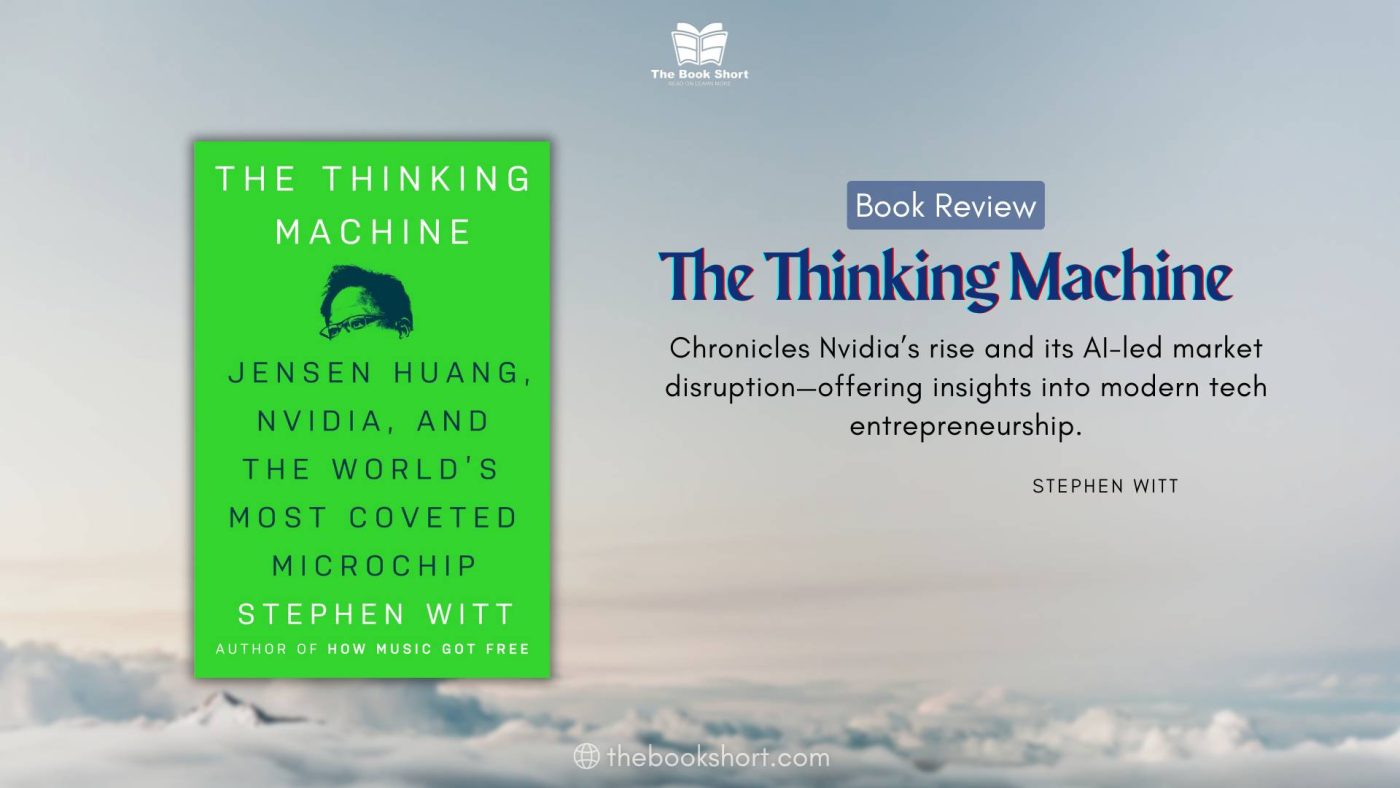
A thrilling book summary and review of The Thinking Machine, exploring the human drama behind the AI revolution and the race to build a god.
Discover the clashing ambitions and stunning breakthroughs that ignited the AI revolution. This deep-dive analysis of Stephen Witt’s The Thinking Machine unpacks the human drama at the heart of artificial intelligence, a book that masterfully transforms the dense history of AI into a narrative thriller so gripping it becomes essential reading for everyone.
Core Details: A Snapshot of The Thinking Machine
- Title: The Thinking Machine: The Quest to Build AI and Recreate the Human Mind
- Author: Stephen Witt
- Year of publication: 2024
- Genre: Non-fiction, Technology, History, Narrative Journalism
- Number of pages: 400
- Target audience: General readers interested in technology, AI enthusiasts, students of computer science, and anyone curious about the people and stories behind today’s AI boom.

The Thinking Machine: Jensen Huang, Nvidia, and the World's Most Coveted Microchip
Unpacking the Narrative: A Full Summary of The Thinking Machine
Stephen Witt’s The Thinking Machine is not a dry technical history; it’s a meticulously researched saga, propelled by the towering personalities, bitter rivalries, and watershed moments that brought us to the precipice of a new technological age. The book chronicles a decades-long quest, from the frigid obscurity of academic labs to a white-hot global arms race.
Part 1: The AI Winter and the Perseverance of the “Godfathers”
The story opens in the bleak “AI winter” of the late 20th century, a time when artificial intelligence research was a professional graveyard. Witt introduces us to the three iconoclasts who would become the reluctant “Godfathers of AI”: Geoffrey Hinton, Yann LeCun, and Yoshua Bengio. While the establishment pursued symbolic logic, these researchers clung to a different, almost heretical, faith: neural networks inspired by the architecture of the human brain.
- Geoffrey Hinton: He emerges as the intellectual and spiritual anchor of the movement. His unshakable belief in “backpropagation”—a learning algorithm for neural nets—fueled a lonely crusade against a tide of skepticism and funding droughts. Witt compellingly details Hinton’s move to Canada, a principled escape from the constraints of US military funding.
- The Struggle for Recognition: Witt vividly portrays a small, devoted community toiling on the fringes of computer science. They were a band of intellectual outcasts, weathering ridicule from an AI establishment that dismissed neural networks as elegant in theory but computationally intractable and hopelessly inefficient in practice.
Part 2: The ImageNet Breakthrough and the Rise of Deep Learning
The narrative pivots dramatically in 2012, with the ImageNet Large Scale Visual Recognition Challenge. This is the moment where the story explodes from academic theory into a high-stakes, real-world showdown.
- AlexNet: Hinton, alongside his brilliant graduate students Alex Krizhevsky and Ilya Sutskever, unleashed a deep neural network they called AlexNet. Witt builds the tension expertly, describing how their model didn’t just win the competition—it annihilated it. AlexNet identified images with an error rate so astonishingly low it sent a shockwave through the entire field, rendering decades of previous work obsolete overnight.
- The Paradigm Shift: The triumph of AlexNet was the “Big Bang” of the modern AI era. It was the irrefutable proof that deep learning was not just a viable path, but the only path forward for solving complex pattern-recognition problems. Almost instantly, the “Godfathers” and their disciples became the most coveted minds in the world.
Part 3: The Corporate Gold Rush and the Race for Talent
The success of AlexNet triggered a frenzied corporate gold rush. Witt masterfully shifts the narrative to the new battleground of Silicon Valley, chronicling the inevitable clash between the open, collaborative ideals of academia and the cutthroat commercial ambitions of Big Tech.
- Google’s Acquisition of DeepMind: A huge portion of the book is dedicated to the saga of DeepMind and its visionary founder, Demis Hassabis. Witt paints Hassabis as a modern-day Prometheus, a prodigy driven not by narrow AI applications but by the god-like ambition of building Artificial General Intelligence (AGI). The breathless, high-stakes bidding war for DeepMind, ultimately won by Google for a staggering sum, is framed as a crucial turning point in the consolidation of AI power.
- The Birth of OpenAI: The narrative then introduces the ideological schism that followed. Witt details how figures like Elon Musk and Sam Altman, alarmed by the prospect of AGI being controlled by a single for-profit entity like Google, launched a counter-movement: OpenAI. It was conceived as a non-profit research lab with a noble mission to ensure AGI would benefit all humanity, setting up the defining conflict of the modern AI race: openness versus secrecy, safety versus speed.
Part 4: The Transformer and the Dawn of Generative AI
The book’s final act illuminates the technical innovation that unlocked the generative AI we interact with daily: the transformer architecture.
- “Attention Is All You Need”: Witt brilliantly demystifies this complex concept, explaining how a revolutionary 2017 paper from Google researchers changed everything about how machines process language. This architecture, allowing a model to dynamically weigh the significance of different words in a sequence, was the master key to creating the Large Language Models (LLMs) that power services like ChatGPT.
- OpenAI’s Gambit: The book details how OpenAI ruthlessly capitalized on the transformer, betting the farm on the “scaling hypothesis”—the audacious belief that making models exponentially larger with more data and computing power would unlock qualitatively new capabilities. The public release of ChatGPT is shown as the stunning culmination of this entire history, the moment the awesome power of these models was unleashed upon an unsuspecting world.
A Deeper Dive: The Thinking Machine Book Analysis
Stephen Witt’s achievement isn’t in uncovering unknown facts, but in weaving them into a human drama of profound intellectual and emotional resonance. His analysis cuts through the technical jargon to examine the technology through the ambitions, fears, and flaws of its creators.
Characters, Structure, and Key Arguments
Witt brilliantly structures his history as a multi-act play with a cast of unforgettable protagonists. Geoffrey Hinton is the patient prophet, vindicated after decades in the wilderness. Demis Hassabis is the fiercely ambitious prodigy, chasing a god-like dream. Ilya Sutskever embodies the central tragedy of the tale, a brilliant “true believer” whose journey from Hinton’s protégé to the conflicted chief scientist of OpenAI forms the book’s moral core. This character-centric approach makes the abstract quest for AI feel deeply personal and tangible.
The book’s central argument is that the AI revolution was not a deterministic product of Moore’s Law but the result of human conviction, intense rivalry, and a series of breathtaking gambles. Witt argues persuasively that personality and ideology shaped the technology as profoundly as any algorithm. He illuminates the central tension between the open, collaborative ethos of early academic research and the secretive, zero-sum game of the corporate race that followed—a conflict that continues to define the battle for AI’s soul.
Writing Style & Content Quality
Witt’s background as a staff writer for The New Yorker shines in every sentence. His style is:
- Propulsively Narrative: He employs the tools of a novelist—suspense, character arcs, dramatic irony—to transform history into a page-turner. The bidding war for DeepMind unfolds with the pace of a thriller, and the moment AlexNet shatters records at ImageNet has the heart-pounding thrill of a cinematic climax.
- Effortlessly Accessible: Witt possesses a rare gift for translating dauntingly technical concepts (from backpropagation to the self-attention mechanism in transformers) into clear, intuitive analogies without sacrificing intellectual rigor. He makes the reader feel smart, never spoken down to.
- Deeply Researched: The narrative is built on a bedrock of extensive interviews and archival work. The dialogue and inner monologues of the key figures feel startlingly authentic because they are drawn from first-hand accounts, lending the entire book an air of unassailable authority.
What elevates The Thinking Machine above its peers is this relentless focus on the “how” and “who” behind the “what.” While other essential books explore the philosophical dangers (Superintelligence) or the geopolitical chessboard (AI Superpowers), Witt provides the indispensable human origin story that gives these abstract concerns flesh and blood.
Notable Quotes from The Thinking Machine
- On the early belief in neural nets: “They were a small band of true believers in a world of skeptics, clinging to a computational model that most of the field had left for dead.”
- On the impact of the transformer model: “It was as if a group of linguists had discovered a universal grammar for the language of data, a structure that could unlock meaning in almost any sequence.”
- On the ideological divide: “The race was no longer just about building the smartest machine. It was a battle for the soul of the technology itself: would it be an open platform for all, or a proprietary tool controlled by a few?”
My Expert Review and Personal Evaluation of The Thinking Machine
Having navigated the vast library of literature on artificial intelligence, from technical treatises to philosophical warnings, I can say that Stephen Witt’s The Thinking Machine is a singular achievement. For its profound humanity and masterful storytelling, it is the most important and compulsively readable book on the subject for our time.
Advantages:
The book’s crowning achievement is its narrative force. Witt performs a kind of literary alchemy, transmuting a potentially dry, intimidating history into a white-knuckle page-turner. By anchoring the technological saga to the ambitions, alliances, and betrayals of its key players, he gives the reader a powerful emotional entry point. You don’t need a computer science degree to feel the crushing weight of the AI winter or the electric thrill of the ImageNet breakthrough. This makes the book the perfect gateway for anyone seeking to truly understand how we arrived in a world of ChatGPTs and Midjourneys.
Witt also maintains a remarkable sense of balance. He sidesteps the twin traps of utopian hype and dystopian alarmism, instead presenting the birth of modern AI as a messy, brilliant, and deeply human endeavor—one shot through with noble intentions, petty jealousies, and seismic ethical questions.
Disadvantages:
If one were to level a critique, it’s that those already steeped in AI history won’t find major factual revelations here. The stories of Hinton, DeepMind, and OpenAI are known to insiders. However, to focus on this would be to miss the point. Witt’s genius lies not in unearthing new facts but in synthesizing them into a single, cohesive, and breathtakingly told narrative. The profound value is in the telling, not just the tale.
Readability and Practical Value:
The readability is off the charts. The prose is crystalline, the pacing is flawless, and the structure is elegantly logical. It’s that rare book that can be devoured by a tech novice and a seasoned expert with equal pleasure.
Its practical value in today’s world is immense. In a culture saturated with AI headlines, this book provides the essential, foundational context.
- Contextual Understanding: It explains why behemoths like Google and OpenAI dominate the landscape, what the specific technological leaps were, and who the architects of our new reality are.
- An Informed Mindset: Finishing this book equips you to participate more intelligently in the urgent conversations about AI ethics, safety, and governance. You will grasp that this technology is not an abstract force of nature, but the product of specific human choices, biases, and values.
- Demystification: It pulls back the curtain on AI, revealing it not as a magical black box, but as the result of decades of human struggle, sacrifice, and incandescent ingenuity.
This book is essential reading for anyone who wants to comprehend the single most important technology of our era—policymakers, entrepreneurs, artists, students, and every curious citizen.
Placing The Thinking Machine in Context: A Comparison
The Thinking Machine carves out a unique and vital space in the canon of AI literature.
- Compared to Superintelligence by Nick Bostrom: Bostrom’s book is a formidable work of analytic philosophy, rigorously exploring the long-term existential risks of AGI. It is dense, logical, and abstract. Witt’s book is the human story that sets the stage for Bostrom’s concerns. If Bostrom lays out the philosophical stakes, Witt shows you the people who placed the bet. The Thinking Machine is the accessible, real-world prequel to the questions Bostrom raises.
- Compared to AI Superpowers by Kai-Fu Lee: Lee provides a brilliant geopolitical analysis of the AI competition between the US and China, focusing on macro-level market and policy dynamics. Witt’s book is the character-driven origin story. He takes you inside the specific labs and introduces you to the individual scientists whose discoveries became the weapons in the geopolitical race Lee describes.


If you enjoyed the human drama and deep-dive narrative of The Thinking Machine, you might also enjoy:
- The Code Breaker by Walter Isaacson: Another masterful narrative that chronicles the scientific rivalries and ethical dilemmas behind the CRISPR gene-editing revolution, with a shared focus on the personalities driving world-changing breakthroughs.
- Bad Blood by John Carreyrou: If you were captivated by the high-stakes ambition and corporate intrigue of the AI race, Carreyrou’s stunning investigation into the Theranos fraud offers a chilling look at the dark side of Silicon Valley’s messianic culture.
Conclusion: Why The Thinking Machine is a Must-Read
The Thinking Machine is a landmark work of narrative non-fiction. Its singular power lies in its ability to translate the monumentally complex story of AI’s birth into a gripping, human-centric epic. It delivers the crucial context necessary to understand our present and navigate our future, reminding us that behind every line of code is a human heart, with all its brilliance, folly, and competing visions for what we might become.
Is it worth reading? Unreservedly. For those new to the subject, it is the definitive starting point. For those already familiar with the field, it weaves the threads you know into a fresh, illuminating, and unforgettable tapestry. This is the origin story of artificial intelligence that our time demands.
Have you read this book? Share your thoughts in the comments below.