
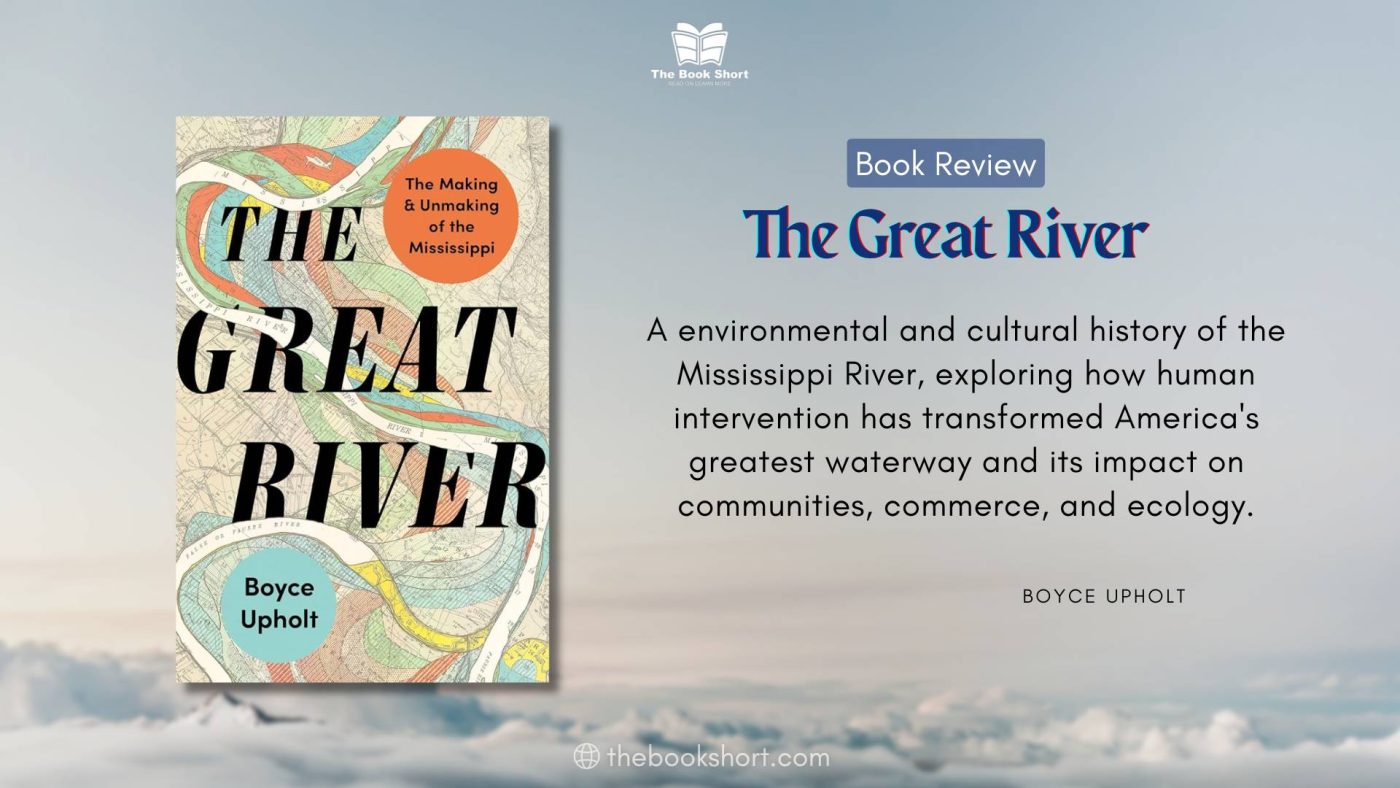
Embark on a sweeping journey through the heart of America with Boyce Upholt’s monumental work, The Great River: The American Voyage of Discovery. This isn’t merely a geographical exploration; it’s a vital, layered examination of the mighty Mississippi, delving deep into its complex history, intricate ecology, and profound cultural resonance. Upholt transcends the typical travelogue, offering readers an ambitious synthesis of natural history, human endeavor, and a compelling personal narrative that reveals the river’s indelible impact on the formation and identity of the United States. My selection of this book stems from its remarkable ability to weave these disparate threads into a cohesive, illuminating tapestry.
Essential Facts About The Great River by Boyce Upholt
- Title: The Great River: The American Voyage of Discovery
- Author: Boyce Upholt
- Year of Publication: 2023
- Genre: Non-fiction, Environmental History, Travel Literature, American History, Ecology, Cultural History
- Pages: Approximately 464 pages
- Target Audience: Readers captivated by American history and geography, environmental studies, ecology, conservation issues, the history of infrastructure, and the multifaceted cultural heritage shaped by the Mississippi River Basin.

The Great River: The Making and Unmaking of the Mississippi
Navigating the Currents: A Comprehensive Book Summary of The Great River
Boyce Upholt’s The Great River is a sprawling, deeply researched exploration that positions the Mississippi River not just as a physical entity but as a powerful, complex character whose story is inextricably linked to the American narrative. The book moves far beyond a simple tracing of the river’s path, offering a profound look at its vast ecosystem, turbulent history, and enduring cultural significance. Upholt masterfully blends his own journey along the river’s course with rigorous historical analysis, scientific explanations, and insightful commentary on humanity’s often fraught relationship with this colossal waterway.
The structure largely mirrors the river’s north-to-south flow, though Upholt fluidly navigates across time and space, connecting seemingly disparate elements to forge a holistic understanding of the entire basin. He begins by establishing the river as a dynamic, ever-changing force that has consistently defied attempts at permanent control and imposed order.
The Upper River: From Headwaters to the Ohio Confluence
Upholt commences his exploration near the river’s elusive source, examining its origins and the initial complex interactions between indigenous peoples and early European settlers.
- Finding the Source and Early Encounters: The narrative explores the historical quest to pinpoint the headwaters, highlighting the river’s more intimate scale in its upper reaches before it gathers momentum. It introduces the concept of the young river as a critical corridor for burgeoning transportation and trade.
- Indigenous Heritage: The book pays rightful attention to the long and rich history of Native American tribes who lived along the upper river, possessing a deep, nuanced understanding of its natural cycles, contrasting this with the devastating disruption brought by European colonization and westward expansion.
- The Era of Commerce and Early Modifications: Upholt details the rise of riverine travel and commerce, evoking the romantic yet often brutal era of steamboats. He describes the growth of river towns that became vital economic engines for the expanding nation, underscoring the economic power wielded by the river and the initial human interventions aimed at improving navigation.
The Middle River: Where Power Converges
As the river swells, particularly after receiving the immense flows of the Missouri and Ohio Rivers, its power and complexity undergo a dramatic transformation.
- The Mighty Confluences: Upholt dedicates significant focus to the major confluences, recognizing these points as critical junctures that fundamentally alter the river’s character, dramatically increasing its volume, sediment load, and unpredictable nature. The meeting with the Missouri, in particular, transforms the relatively clearer northern stream into the iconic muddy, powerful force known downstream.
- The Age of Engineering and Control: A central theme dominating the middle and lower sections is the monumental effort to tame and control the river, primarily for navigation and flood protection.
- The design and consequences of dams, locks, levees, and channelization projects are examined in detail, explaining their intended benefits alongside their often profound and unintended ecological costs.
- Upholt explores the drivers behind these massive civil engineering feats, often fueled by economic imperatives and a prevailing belief in humanity’s capacity to conquer natural forces.
- Ecological Disruption: The book rigorously analyzes how extensive engineering has disrupted the river’s natural ecological processes, impacting everything from vital fish migration patterns to the health of floodplain wetlands and the delicate balance of sediment essential for delta building.
The Lower River: Delta Dynamics, Culture, and Crisis
The final leg of the journey descends into the vast alluvial plain and the unique, vulnerable environment of the delta.
- Forged by Flood: The Alluvial Plain: Upholt vividly describes the creation of the incredibly fertile lands along the lower river, shaped over millennia by natural flooding. He explains how this process supported rich, diverse ecosystems and facilitated intensive agriculture, tragically centered around cotton plantations reliant on enslaved labor.
- The River’s Role in Slavery and the Plantation South: The Mississippi’s connection to the brutal history of slavery is a critical and unflinching part of the lower river narrative. Upholt examines how the river functioned both as a crucial artery for the slave trade and cotton economy and as a formidable barrier for those seeking freedom, profoundly shaping the social, economic, and political landscape of the antebellum and postbellum South.
- New Orleans: A City Tied to the Tide: The book delves into the vibrant, complex history and culture of New Orleans and the surrounding delta region, illustrating how this iconic city is intrinsically linked to the river’s double-edged nature – benefiting from its commerce while constantly facing the existential threat of its power.
- An Ecosystem on the Brink: Upholt brings the narrative to the present-day environmental crisis gripping the delta, including alarming rates of land loss, the corrosive impact of saltwater intrusion, and the cumulative effects of upstream pollution. He directly connects these urgent issues to historical and ongoing human activities, from engineering projects to resource extraction.
Unifying Threads and the Author’s Perspective
Throughout this multifaceted narrative, several powerful themes resonate:
- The River as an Interconnected System: Upholt compellingly argues for understanding the Mississippi Basin as a single, dynamic entity, demonstrating how actions taken hundreds of miles upstream inevitably ripple downriver.
- The Tension Between Human Will and Nature’s Power: A fundamental dynamic explored is the ongoing conflict between humanity’s persistent desire to control the river for economic gain and safety, and the river’s inherent, often violent, and ultimately untamable nature.
- The Weight of History: The book reveals how the layered historical forces – indigenous dispossession, the institution of slavery, industrialization, massive engineering projects – have left indelible marks on the river itself and the communities that depend upon it, profoundly shaping contemporary realities and challenges.
- The Future of the River: Stewardship and Adaptation: While presenting a critical account of past and present harms, Upholt also examines modern conservation efforts, scientific research, and the complex, often contentious debates surrounding how to manage the river system sustainably in the face of climate change, aging infrastructure, and competing interests.
Upholt weaves his personal experiences and observations throughout the book, grounding the grand historical and scientific narratives in lived reality. His journey serves as a compelling narrative device, allowing him to converse with a diverse array of individuals – scientists, engineers, historians, local residents, river workers, activists – creating a rich mosaic of perspectives that deepen the reader’s understanding. The author’s voice is knowledgeable, reflective, deeply engaged, and imbued with a sense of urgency regarding the environmental fate of the river, yet also conveys a profound respect for its enduring power and beauty. The Great River stands as a comprehensive, essential biography of this vital American artery, powerfully demonstrating how its story is utterly inseparable from the story of the nation itself.
An Expert Literary Analysis of The Great River by Boyce Upholt
Boyce Upholt’s The Great River is a truly masterful work of non-fiction, succeeding brilliantly in its ambitious undertaking: to craft a holistic and deeply insightful understanding of the Mississippi River. More than a mere recounting of facts, the book uses the river as a powerful, dynamic lens through which to critically examine the sweep of American history, culture, ecology, and our complex, often destructive, relationship with the natural world. It’s a book that demands attention and rewards it generously.
Structure, Core Arguments, and the River as Protagonist
The book’s structure, which generally flows downstream but constantly shifts between historical eras, geographical points, and thematic explorations, is not a limitation but a key strength. It artfully mirrors the unpredictable, layered nature of the river itself and the intricate complexity of its history. This deliberate, non-linear approach allows Upholt to:
- Illuminate Causality Across Time: He can discuss the rationale and methods behind 19th-century river straightening projects and immediately pivot to illustrate their precise ecological consequences manifesting today, effectively highlighting the long-term, often unforeseen, impact of human interventions.
- Synthesize Disparate Threads: This fluid structure enables the seamless integration of incredibly diverse elements – from deep geological time and indigenous origin myths to the mechanics of steamboat commerce, the tragedy of the slave trade, the ambition of civil engineering marvels, the stark reality of ecological decline, and the hope of modern conservation initiatives. Upholt shows how these seemingly separate stories are, in fact, part of the same unfolding narrative of the river and the nation built alongside it.
- Sustain Reader Engagement: By continually shifting perspective and focus, the book avoids becoming a dry chronological account or an overly technical treatise. Each section, while contributing to the larger whole, offers a fresh angle or reveals a new layer of complexity.
The core arguments woven throughout the book are compelling and meticulously supported:
- The Mississippi River system is fundamentally a single, interconnected hydrological and ecological entity; attempts to manage isolated sections in silos ignore the fundamental reality of the basin.
- Human efforts to control the river, while undeniably yielding significant economic advantages (facilitating navigation, providing flood control), have come at a massive and often devastating environmental cost, particularly to the health of the delta and the river’s natural, dynamic processes.
- The river’s history is profoundly intertwined with the darker, more challenging aspects of the American story, including the systematic displacement and decimation of indigenous populations and the brutal institution of chattel slavery. A failure to acknowledge this history limits our ability to understand the river’s present state.
- The current environmental crisis facing the river, from widespread pollution to the accelerating disappearance of land in the delta, is a direct and cumulative consequence of historical and ongoing human activity and necessitates a fundamental rethinking of how we perceive, use, and manage this critical waterway.
While the book features no characters in the traditional fictional sense, the river itself emerges as a central, powerful protagonist – a dynamic, often capricious entity with its own relentless ‘will.’ Upholt also vividly portrays the countless individuals who have shaped, or been shaped by, the river: the early explorers and cartographers, the diverse indigenous nations, the ambitious engineers and hydrologists, the daring steamboat captains, the farmers, planters, and enslaved people tied to its banks, and the modern-day residents, scientists, and activists grappling with its future. These voices, encountered through Upholt’s extensive research and numerous interviews, provide a crucial human dimension to the river’s grand narrative.
Writing Style, Rigor, and Emotional Resonance
Upholt’s writing is a significant strength of the book – simultaneously engaging, informative, and often beautifully rendered. He strikes a difficult but essential balance, presenting complex scientific concepts and historical details in accessible prose without sacrificing nuance or rigor.
- Clarity and Seamless Flow: Despite the ambitious scope and complex structure, the narrative flows remarkably well. Upholt transitions effortlessly between historical anecdotes, scientific explanations, and personal observations, guiding the reader through intricate terrain.
- Evocative and Sensory Descriptions: His descriptions of the river’s varied landscapes, its power, its subtle shifts in mood, and the unique communities along its banks are vivid and atmospheric, transporting the reader to the locations he visits.
- Exceptional Research and Credibility: The book is clearly the culmination of extensive and meticulous research, drawing upon a vast array of historical documents, contemporary scientific studies, and a multitude of personal interviews. This academic depth underpins the credibility of his arguments and provides a robust foundation for his analysis.
- Engaging Personal Voice: The inclusion of Upholt’s own experiences and reflections adds a vital layer of intimacy and immediacy. His journey transforms the vast subject matter into something more personal and relatable, inviting the reader to share in his discoveries and contemplations.
The quality of the content is exceptional. Upholt synthesizes a remarkable amount of information from diverse fields – geology, hydrology, ecology, environmental science, American history, engineering, sociology – into a coherent, compelling, and profoundly revealing narrative. He approaches controversial topics and critical assessments of past practices with clear-eyed analysis and intellectual honesty, offering an unflinching look at the challenges facing the river today.
Echoes of the River: Memorable Quotes (Illustrative)
While specific passages require revisiting the text, Upholt’s prose frequently captures the river’s power, historical depth, and environmental fragility. His thematic focus often finds expression in lines that resonate with:
- The river’s inherent, untamable nature: “Despite every levee, every dredge, every concrete structure, the river insists on being itself, asserting a power that reminds us of our limits.”
- The vast sweep of geological time: “This channel wasn’t carved in decades or even centuries; it was shaped over millennia, by forces older and grander than human history.”
- The layering of human history upon the landscape: “Every bend in the river holds ghosts and stories – of commerce and conflict, of ambition and survival, of those who profited and those who suffered.”
- The environmental toll of human intervention: “Our legacy along the river is one of monumental transformation, often undertaken with the best intentions but resulting in profound, unintended costs.”
- The delta’s precarious present: “The land that the river so painstakingly built, grain by grain over countless floods, is now dissolving back into the sea, a direct consequence of our interventions upstream and along the coast.”
These powerful thematic threads run consistently through the narrative, amplified and substantiated by specific historical examples, scientific data, and the voices of those Upholt encounters, showcasing his remarkable ability to connect the granular details to the sweeping macro-story of the Mississippi.
An Expert’s Personal Evaluation and Review of The Great River
The Great River is, without reservation, an outstanding and profoundly important work of non-fiction. Boyce Upholt achieves his ambitious goal with remarkable success, delivering a comprehensive, insightful, and beautifully written exploration of the Mississippi River and its central place in the American saga. My personal experience of reading this book was overwhelmingly positive; it is a deeply immersive, rigorously researched, and deeply thoughtful achievement that reshaped my understanding of both the river and the nation it courses through.
Personal Impressions: Strengths and Considerations
Strengths:
- Remarkably Ambitious Scope, Masterfully Executed: Upholt tackles a subject of immense scale – the entire Mississippi River system, its deep history, complex ecology, and cultural significance – and succeeds in synthesizing this vast material into a coherent, compelling, and genuinely engaging narrative. This comprehensive sweep is arguably the book’s greatest strength.
- Brilliantly Multidisciplinary: The book seamlessly weaves together strands of history, ecology, geography, hydrology, engineering, cultural studies, and personal narrative. This interdisciplinary approach provides a uniquely rich and nuanced understanding that focusing on any single area could never achieve.
- Compelling and Highly Readable Narrative: Despite the density and complexity of the information presented, Upholt’s writing is consistently engaging. His personal journey acts as a vital, relatable thread, and his gift for storytelling, whether recounting historical events or contemporary challenges, makes the book highly readable and difficult to put down.
- Extraordinarily Timely and Relevant: The book addresses critical contemporary issues such as climate change, accelerating environmental degradation, aging infrastructure, and the enduring, often painful, legacy of historical injustices. By grounding these issues in the context of the river, Upholt powerfully demonstrates their interconnectedness and urgency.
- Critically Insightful Yet Balanced: Upholt does not shy away from offering sharp critiques of past policies, engineering decisions, and human impacts. However, his analysis is always careful, acknowledging the complex motivations behind massive projects while unflinchingly highlighting their devastating long-term consequences.
Considerations (Minor):
- Informational Density: At times, the sheer volume of historical detail, scientific explanation, and engineering concepts can feel quite substantial. While Upholt generally explains things clearly, this is a book that benefits from being read thoughtfully rather than rushed, and some readers might find certain sections require focused attention.
- Navigating the Structure: While the non-linear structure is largely effective and mirrors the subject matter, occasional shifts in time or location might require a brief moment for the reader to mentally reorient themselves within the broader narrative flow. This is a very minor point, reflective more of the book’s complexity than any flaw in execution.
Readability and Ideal Audience
The Great River is written for an intelligent general adult readership. It is not overly academic or steeped in inaccessible jargon, but it assumes a significant level of interest and a willingness to engage with complex, often challenging, topics.
- Readability Level: I would rate its readability as moderate to high. Upholt’s prose is fluid and engaging, making it accessible, but the subject matter is dense and requires active engagement. It is a book to be savored rather than skimmed.
- Suitability: This book is highly suitable for a wide range of readers, including:
- Anyone living in or having a connection to the vast Mississippi River Basin seeking a deeper understanding of their region.
- Students, scholars, and enthusiasts of American history, particularly those interested in environmental history, the history of technology and infrastructure, and the social history of the South and Midwest.
- Readers passionate about ecology, conservation, environmental policy, and climate change, looking for a compelling case study of human impact on a major ecosystem.
- Those who appreciate high-quality, narrative non-fiction that seamlessly blends rigorous research with engaging storytelling and personal reflection.
It would be an exceptional choice for book clubs interested in exploring significant American themes through the lens of a natural and historical landmark.
Practical and Intellectual Value
The Great River offers substantial value, both intellectually and practically:
- Profound Awareness: It provides a deeply enriched understanding of the Mississippi River’s critical role in shaping American life, both historically and in the present day, and illuminates the pressing challenges it currently faces.
- Shifting Perspectives: The book actively encourages a transformation in how readers perceive the river – moving beyond viewing it merely as a resource for navigation or a geographical boundary to understanding it as a complex, living system with its own history and ecology. It forcefully illustrates the interconnectedness of human actions and environmental consequences.
- Informed Engagement: By explaining the history and current state of river management, engineering, and environmental issues, the book equips readers with crucial knowledge relevant to ongoing public debates about infrastructure, conservation policy, and adaptation strategies for a changing climate along the river and beyond. It underscores the national significance of the river’s health.
- Deepened Appreciation for Place: For anyone who lives near, works on, or travels along the Mississippi, the book provides layers of historical, ecological, and cultural context that will profoundly deepen their appreciation and understanding of the landscape.
Ultimately, The Great River transcends being merely a historical account or an environmental report. It is a compelling call to understand, respect, and potentially reimagine our relationship with one of America’s most iconic and vital natural features. It’s a book that leaves a lasting impression, prompting reflection on the past and concern for the future.
Placing The Great River in Context: Comparative Insights
The Great River occupies a distinctive and important position within the literary landscape of books about American rivers, landscapes, and environmental history. It excels by integrating deep historical analysis, complex ecological science, and compelling personal narrative in a remarkably comprehensive manner.


Compared to other notable works that explore American waterways or environments:
- John McPhee’s Environmental Journeys: While McPhee is a titan of environmental writing, known for his immersive style and profiles of individuals within ecological contexts (e.g., Encounters with the Archdruid, Coming into the Country), The Great River offers a more singular, deep-focus biography of one specific, massive ecosystem. McPhee often uses character-driven narratives to explore environmental themes; Upholt integrates many voices and perspectives, but the river itself remains the undeniable central subject and driving force. Upholt’s work is perhaps more overtly historical, particularly in its examination of large-scale engineering and its consequences, than much of McPhee’s.
- Simon Winchester’s Grand Narratives of Science and Engineering: Winchester excels at connecting personal stories of scientists or engineers to monumental projects or discoveries (e.g., The Man Who Loved China). Upholt shares this interest in human ambition and endeavor (especially in civil engineering), but his book is fundamentally an ecological and historical biography of a place. The human stories serve primarily to illuminate the river’s impact, transformation, and the challenges it faces, rather than being the main focus themselves.
- Local or Regional Histories: While The Great River delves into specific places like New Orleans, St. Louis, or Memphis, its scope is deliberately the entire river system. It utilizes specific locations and their histories as powerful case studies or illustrative examples that contribute to the understanding of the whole basin, rather than focusing solely on their local development.
- Purely Ecological Studies: While Upholt incorporates significant ecological detail and scientific understanding, his book is far broader than a purely scientific text. He integrates the profound layers of human history, the cultural significance, and his own personal journey in a way that scientific studies typically do not, making the ecology accessible and relevant to a wider narrative.
Distinctive Strengths of The Great River:
- Integrated Analysis of Engineering and Ecology: Upholt’s particular strength lies in his ability to explain the complex history and mechanics of civil engineering projects (dams, levees, channelization) and directly, often starkly, link them to their far-reaching ecological consequences in a way that is both understandable and impactful. This intersection is a fundamental core of the book.
- Seamless Weaving of Difficult History: The book’s integration of challenging historical narratives, including the systematic displacement of indigenous peoples and the brutal institution of slavery, directly into the story of the river is handled with nuance, sensitivity, and historical rigor. It makes the connection between the river’s development and these foundational injustices explicit and central to the narrative.
- The Personal Journey as Narrative Spine: Upholt’s own travels along the river provide a consistent, engaging narrative thread. This personal framework grounds the expansive history and complex science, transforming the book from an academic survey into a more immersive and relatable experience for the reader.
For Readers Who Appreciated The Great River, Consider These Complementary Reads:
- Cadillac Desert: The American West and Its Disappearing Water by Marc Reisner: A foundational text focusing on water management, grand engineering schemes, and their environmental and social impacts, primarily in the American West. Shares Upholt’s interest in human attempts to control water and the resulting consequences.
- Rising Tide: The Great Mississippi Flood of 1927 and How It Changed America by John M. Barry: Provides an in-depth, gripping account of a pivotal event in the river’s modern history that dramatically shaped subsequent flood control and river management policies. Offers crucial context for Upholt’s discussion of engineering.
- The Emerald Mile: The Epic Story of the Fastest Ride in History Through the Heart of the Grand Canyon by Kevin Fedarko: Combines history, adventure, and a deep engagement with the power and story of a major American river system, albeit focused on one section and a specific event.
- American Earth: Environmental Writing Since Thoreau and Carson edited by Bill McKibben: A sweeping anthology offering a broader context for American environmental thought and writing, featuring numerous essential pieces about specific places, including rivers.
These books share The Great River‘s core interest in the complex intersection of nature, human history, ambition, engineering, and the resulting environmental and social impact on the American landscape, making them excellent choices for further exploration.
Final Thoughts: Why The Great River is an Essential Read
Boyce Upholt’s The Great River is far more than just a book about a river; it is an indispensable exploration of America itself, seen through the lens of its most iconic waterway. It masterfully navigates the complex, often turbulent currents of the Mississippi’s natural history, the relentless tide of human exploitation and ambitious engineering, its profound cultural imprint, and the urgent environmental challenges it confronts today. This is an expedition into the very heart of America, its past, present, and uncertain future, revealed through the enduring pulse of the Mississippi.
Is The Great River worth reading? Emphatically, yes. Its immense value lies not only in the sheer wealth of meticulously researched information it presents but, more importantly, in the way it artfully connects seemingly disparate elements – from deep geological time and pivotal historical events to monumental engineering decisions, accelerating ecological decline, and the intimate scale of individual journeys – into a single, compelling, and deeply resonant narrative. It is a book that will fundamentally alter your perception of rivers, particularly the Mississippi, and provoke essential reflection on our collective relationship with the natural world.
Who specifically should make time for this book?
- Anyone with even a passing connection to, or curiosity about, the Mississippi River and the vast basin it drains.
- Students, educators, and general readers of American history, with a particular emphasis on those interested in environmental history, the history of technology and infrastructure, and the social history of the regions defined by the river.
- Environmentalists, conservationists, and concerned citizens seeking a comprehensive, real-world case study of humanity’s complex impact on a major ecosystem and the challenges of sustainable management.
- Readers who deeply appreciate high-quality, narrative non-fiction that seamlessly blends rigorous research, intellectual depth, and engaging storytelling.
In conclusion, if you seek to understand the literal and metaphorical “spine of America” – its history, its ecology, its inherent power, its enduring challenges, and its potential future – Boyce Upholt’s The Great River is the essential book to read. It is a powerful, important, and beautifully rendered work that deserves the widest possible audience.
Have you embarked on this journey with Boyce Upholt’s The Great River? Share your insights and reflections in the comments below!