
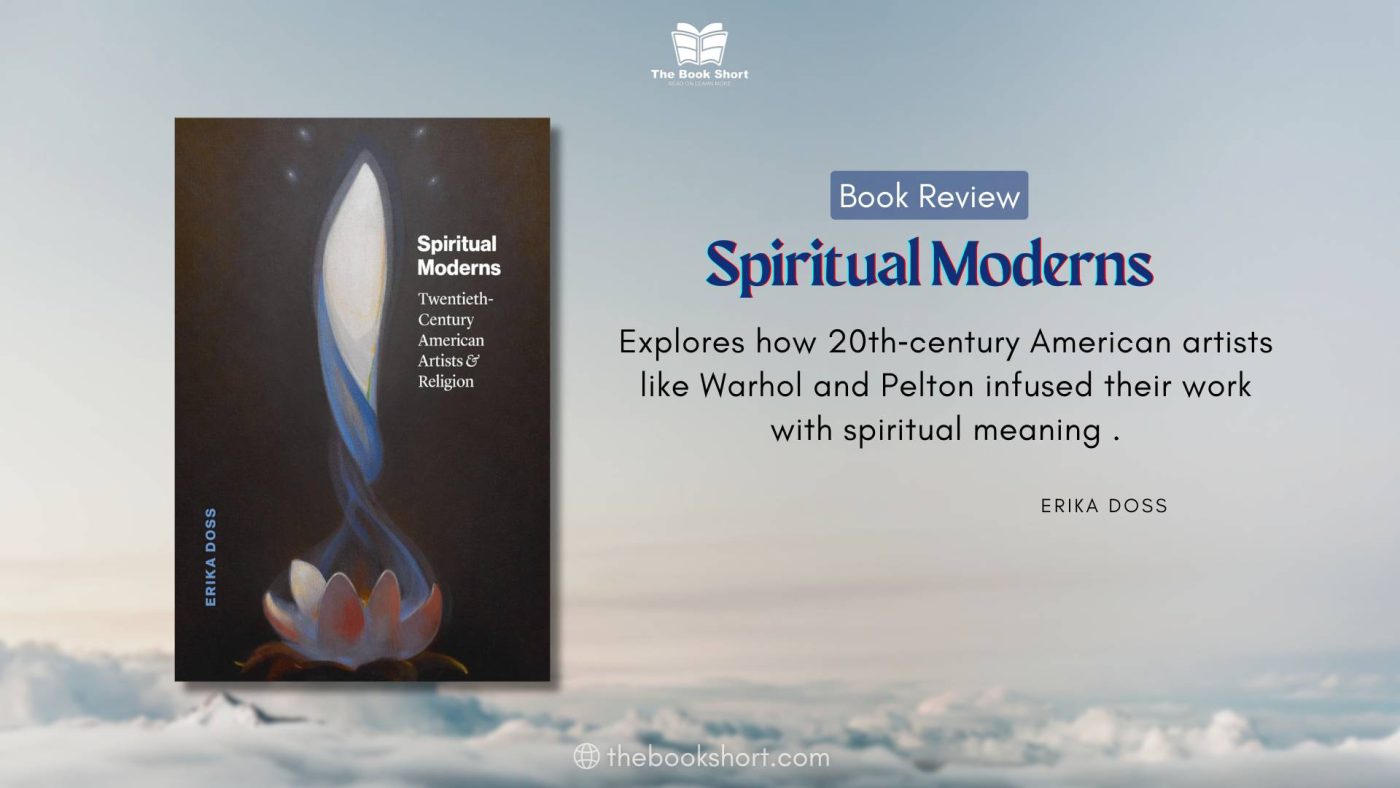
Uncover the surprising spiritual dimensions hidden within 20th-century American modern art. Erika Doss’s groundbreaking book, Spiritual Moderns, challenges conventional views, revealing how artists pursued meaning and transcendence beyond traditional religion. Dive into a unique exploration of art, belief, and the search for the ineffable in a changing world.
Basic Information About Spiritual Moderns
- Title: Spiritual Moderns: Twentieth-Century American Artists and Religion
- Author: Erika Doss
- Year of publication: 2022
- Genre: Art History, Cultural History, Religious Studies
- Number of pages: Approx. 350 pages
- Target audience: Scholars and students of art history, American studies, and religious studies; intellectually curious readers interested in modern art, American culture, and the diverse landscape of spirituality.

Spiritual Moderns: Twentieth-Century American Artists and Religion
Main Content Summary: Exploring Spirituality in 20th-Century American Art
Erika Doss’s Spiritual Moderns: Twentieth-Century American Artists and Religion offers a crucial reassessment of American modern art, challenging the long-held assumption that it was a fundamentally secular endeavor. Instead, Doss meticulously unpacks the rich, complex, and often subtle relationship between American modern artists and religious or spiritual beliefs throughout the 20th century.
The central argument posited by Doss is that spirituality, broadly defined, was a persistent and influential force within the American cultural fabric during this period, significantly shaping artistic creation, themes, and forms. She explores how artists navigated their personal convictions, the prevailing currents of secularization, and the dynamic art movements of their time to produce works that reflected, questioned, or actively sought to embody spiritual meaning.
The book is structured both thematically and chronologically, moving through distinct periods and artistic movements, illustrating how various forms of spirituality intersected with modern artistic practices.
Early 20th Century: Abstraction, Esotericism, and the Quest for the Unseen
Doss begins by examining the early decades of the century, a time of profound social upheaval and the birth of modernist movements. She highlights how many artists, particularly those venturing into abstraction, found deep resonance in esoteric spiritual traditions such as Theosophy, occultism, and other forms of mysticism. These alternative belief systems offered artists new conceptual frameworks for understanding reality, often emphasizing universal energies, hidden spiritual truths, and personal evolution – concepts they sought to translate into non-representational forms and symbolic visual languages.
- Beyond Mere Form: For these artists, abstract shapes, colors, and compositions were not merely formal experiments but potential conduits for conveying spiritual vibrations, transcendental states, or deeper realities inaccessible through traditional representation.
- Mystical Influences: Doss traces connections to European pioneers like Vasily Kandinsky (whose ideas profoundly impacted American artists) and explores how American figures such as Arthur Dove and Georgia O’Keeffe, in their unique stylistic developments, also pursued spiritual quests within their art, aiming to depict the ‘seen’ and the ‘unseen.’
Mid-Century Crossroads: Social Conscience, Faith, and Existential Searching
Moving into the mid-century, spanning periods marked by the Great Depression, World War II, and the Cold War anxieties, the book reveals different facets of spiritual engagement shaped by social crises and philosophical shifts.
- Art as Social Witness: Doss explores how artists integrated their spiritual convictions with burgeoning social and political consciousness. Influenced by movements like the “Social Gospel,” which urged applying Christian ethics to societal problems, some artists created powerful works addressing poverty, inequality, and injustice, imbuing them with a distinct moral and spiritual undertone.
- Catholicism Embraces Modernity: Countering the stereotype of traditional faiths resisting modernism, Doss presents compelling cases where Catholic artists and even institutions embraced modern forms, seeking to infuse religious art with contemporary vitality or express faith through new aesthetic languages.
- Existentialism and the Soul’s Landscape: The anxieties of the era spurred some artists to grapple with existential themes. While seemingly rooted in secular philosophy, this wrestling with fundamental questions of meaning, existence, and the human condition often intertwined with a search for spiritual grounding or understanding in a seemingly chaotic or absurd world. Doss discusses artists like Mark Rothko, whose vast, contemplative color fields aimed to evoke profound emotional and perhaps spiritual states in the viewer, engaging with themes of tragedy, ecstasy, and the sublime.
Post-War Reckoning: Abstract Expressionism as Spiritual Arena
A significant portion of the book is dedicated to Abstract Expressionism, a movement often analyzed solely through formalist or psychological lenses. Doss offers a powerful counter-narrative, arguing convincingly that for many key Abstract Expressionists, the very act of painting and the resulting monumental canvases were deeply spiritual endeavors, akin to quests for ultimate meaning.
- The Sublime and the Absolute: Artists such as Barnett Newman openly articulated the spiritual aims of their work, explicitly seeking to evoke feelings of the sublime, the transcendent, and the absolute, drawing upon philosophical and religious concepts. Newman’s iconic “zip” paintings or his series The Stations of the Cross are presented as prime examples of art directly engaging with profound spiritual territory.
- Process as Ritual: Doss suggests that the intense focus on the artistic process itself for figures like Jackson Pollock or Willem de Kooning can be understood through a lens of ritual, performance, or a raw, unmediated quest for authentic self-expression that bordered on the spiritual – the canvas becoming an arena for confronting fundamental aspects of being.
- Figurative Faith: Doss ensures the analysis extends beyond abstraction, examining figurative artists who continued to engage with traditional religious themes or express personal spirituality, demonstrating the diversity of approaches coexisting alongside dominant abstract trends.
Late 20th Century: Pluralism, Identity, and Evolving Spirituality
The concluding sections of Spiritual Moderns explore the later part of the century, characterized by increasing artistic pluralism, the rise of identity politics, and expanding concepts of spirituality influenced by Eastern religions, New Age movements, indigenous traditions, and secular humanism.
- Diverse Voices of Belief: Doss highlights how artists from increasingly varied backgrounds – including women, artists of color, and those from non-Western traditions – infused their work with their specific cultural and spiritual perspectives, challenging any singular notion of spirituality or modern art.
- Spirituality as Commentary: Many artists utilized spiritual or religious iconography and themes not only for personal expression but also as powerful tools for social critique, exploring issues of identity, community history, and shared experience through a spiritual lens.
Throughout Spiritual Moderns, Erika Doss draws upon a rich tapestry of primary sources, including artists’ letters, interviews, archival materials, and contemporary art criticism. She provides insightful, detailed analyses of numerous artworks, skillfully linking formal qualities to thematic and spiritual concerns. Spiritual Moderns compellingly demonstrates that 20th-century American modern art was far from a simple rejection of the sacred; it was, in fact, often a complex, dynamic negotiation with it, yielding diverse, profound, and enduring expressions of belief, doubt, and the persistent human search for meaning in the modern age. The book successfully repositions spirituality from a marginal influence to an intrinsic, woven element in the rich fabric of American modern art history.
In-Depth Analysis of Spiritual Moderns Book
Erika Doss’s Spiritual Moderns stands as a landmark achievement, presenting a meticulously researched and profoundly argued thesis that fundamentally reshapes our understanding of American modern art’s relationship with spirituality. Far from accepting the standard narrative of modernism’s supposed secular triumph, Doss excavates and illuminates a continuous, varied, and deeply felt engagement with religious and spiritual themes among artists throughout the 20th century. This in-depth analysis of Spiritual Moderns reveals its core strengths and contributions.
The book’s most significant contribution lies in its ability to forge meaningful connections between specific artistic movements and practices and the broader cultural and religious shifts occurring in America. Doss avoids reductive interpretations, showcasing how spirituality manifested in a kaleidoscope of ways – sometimes overtly religious, sometimes drawing from esoteric or Eastern traditions, often deeply personal, broadly humanistic, or even rooted in a secular grappling with ultimate concerns.
Key Arguments and Illuminating Structure
While broadly following a chronological path through the 20th century, the book’s structure is also intelligently thematic. Doss dedicates sections to specific movements, groups of artists, or particular modes of spiritual engagement (such as the link between abstraction and mysticism, social concerns and faith, or post-war existential spirituality). This approach allows her to develop her argument progressively, demonstrating the evolving nature of spirituality in art across different eras while providing focused case studies.
Key arguments Doss powerfully articulates include:
- Undermining the Secular Myth: Doss directly confronts the widely accepted narrative of modern art’s inherent secularity, presenting substantial evidence that counteracts this simplification and reveals a vibrant, if often hidden, spiritual dimension.
- Defining Spirituality Broadly: A crucial strength is the book’s expansive definition of spirituality. It encompasses not only adherence to traditional religious faiths but also interests in mysticism, the occult, Eastern philosophies, humanism, indigenous beliefs, and intensely personal quests for meaning, transcendence, or connection. This capacious definition is essential for capturing the diverse ways artists sought the non-material.
- Art as Spiritual Practice and Vehicle: Doss argues compellingly that for many artists, the creative process itself functioned as a form of spiritual practice or ritual, and the resulting artwork was intended to evoke spiritual or transcendent experiences in the viewer – a concept particularly relevant to the aims of Abstract Expressionism.
- Intertwined with Socio-Cultural Forces: The book effectively demonstrates that spirituality in art did not exist in a vacuum but was intimately woven into the social, political, and intellectual currents of the time, reacting to national crises, technological advancements, and shifting philosophical landscapes.
Doss supports her compelling arguments with meticulous research and numerous illuminating case studies. She doesn’t merely assert connections; she delves into specific artworks, drawing on artists’ statements, contemporary criticism, and historical context to reveal the underlying spiritual concerns and intentions, or the spiritual readings the works invited.
Writing Style & Content Quality: Scholarly Rigor Meets Insightful Prose
Doss’s writing style is a significant asset. While grounded in rigorous scholarly research and theoretical sophistication, her prose remains remarkably clear and engaging. She presents complex ideas accessibly, inviting readers into the material through vivid descriptions of artworks and compelling historical narratives.
- Clarity and Persuasiveness: The book’s central thesis is clear from the outset and built with compelling logic and evidence throughout. Doss is highly persuasive, her argument gaining undeniable force through the sheer weight and variety of evidence she brings to bear.
- Masterful Integration of Sources: She expertly weaves together artists’ own words, the reception of their work by critics, and the broader historical and cultural context. This multi-layered approach provides a deep, nuanced understanding of the art, the artists’ potential intentions, and how their work was perceived in relation to spiritual or religious themes.
- Insightful Visual Analysis: The book features reproductions of many key artworks. Doss’s analyses of these pieces are insightful, moving beyond mere description to connect formal elements – color, line, composition, scale – to the potential spiritual meanings and emotional impacts they were intended to carry or evoke.
The content quality is exceptional, reflecting deep expertise in both American art history and the history of religion and spirituality in the United States. Spiritual Moderns is a major contribution that promises to influence scholarship in both fields for years to come.
Capturing the Essence: Thematic Echoes from the Book
While specific quotes require direct access to the text, the core thematic arguments of Spiritual Moderns resonate strongly throughout its pages. These paraphrased themes capture the essence of Doss’s transformative perspective:
- On the complex reality of modernism: “Rather than a simple break with tradition, American modernism often involved a complex, evolving dialogue with spirituality and the sacred.”
- On the artist’s purpose: “For many, the studio was a laboratory of the spirit, their art a dedicated search for truth, transcendence, or a deeper connection to existence.”
- On the power of the artwork: “These creations were frequently intended to act as catalysts for contemplation, moments of awe, or encounters with the sublime, echoing spiritual experiences.”
- On the breadth of belief: “The spirituality embedded in this art wasn’t limited to conventional religion; it drew sustenance from a vast landscape of mysticism, philosophy, global traditions, and individual journeys of faith and doubt.”
These thematic echoes underscore why Spiritual Moderns is such a valuable and eye-opening study. It not only challenges ingrained assumptions about modern art but also opens up vital new avenues for interpreting some of the most significant artistic achievements of the 20th century, revealing the enduring power of the spiritual quest in the heart of modernity.
Evaluation & Expert Personal Review of Spiritual Moderns Book
From the perspective of an art historian deeply engaged with the cultural context of American art, Erika Doss’s Spiritual Moderns is nothing short of a revelation. It is a landmark study that successfully bridges the often-siloed disciplines of art history and religious/cultural studies, offering a paradigm-shifting view of 20th-century American art. My assessment is overwhelmingly positive; the book masterfully fills a critical void in scholarship and provides a much-needed counterpoint to the dominant, arguably oversimplified, narrative of modern art as a purely secular enterprise.
Compelling Advantages:
- Groundbreaking Thesis: The central argument – that spirituality was a pervasive and significant force shaping American modern art – is highly original, meticulously researched, and utterly convincing. It compels readers to look at familiar artists and movements through a fresh, illuminating lens.
- Exceptional Breadth and Depth: Doss navigates a vast chronological span and an impressive array of artists, movements, and spiritual traditions, demonstrating the widespread nature of spiritual engagement across diverse styles and philosophies. Crucially, this breadth is paired with compelling depth through detailed analyses of individual artworks and artists, providing concrete examples for her overarching claims.
- Truly Interdisciplinary: The book fluently integrates insights and methodologies from art history, religious studies, cultural history, and philosophy. This interdisciplinary approach enriches the analysis and makes the book valuable not only within art history but across a range of humanities fields.
- Rigorously Supported by Evidence: Doss’s arguments are built on a foundation of extensive archival research, close readings of artists’ writings and interviews, analysis of period criticism, and insightful visual interpretation. The sheer volume and quality of the evidence presented make her case undeniable.
Minor Considerations:
- Academic Density: As is typical of significant scholarly works, Spiritual Moderns is rich with detail and complex analysis. While Doss writes clearly, it requires a focused and dedicated reading, making it less suitable for casual browsing than for serious study.
- Emphasis on Textual Context: While Doss provides visual analysis, her interpretation of spiritual meaning heavily relies on textual evidence (artists’ statements, historical context) to infer spiritual significance. This is a valid and necessary methodology given the subject matter, but some art historians focused purely on formal analysis might find this approach less central than purely visual cues – though Doss effectively connects the two.
Readability and Ideal Audience:
The readability level is best described as advanced undergraduate to scholarly. It is clearly written but assumes a certain level of engagement with academic discourse and potentially some prior familiarity with 20th-century art or American cultural history.
- Highly Recommended for: Graduate students and scholars specializing in American art history, modernism, religious studies, American studies, and cultural history. Advanced undergraduate students conducting research in these areas will find it invaluable. It is also highly rewarding for intellectually curious general readers with a strong interest in modern art who are prepared for a scholarly, in-depth exploration.
- Less Suitable for: Readers seeking a general, introductory overview of modern art or a light read on religion.
Transformative Practical Value:
The practical value of Spiritual Moderns is significant in its capacity to alter perspectives and provide new critical tools.
- Key Takeaway: The book’s most important lesson is the necessity of looking beyond simplistic labels and appreciating the profound, complex, and often non-traditional ways in which individuals and movements grapple with questions of meaning, transcendence, and belief, even within ostensibly secular or avant-garde contexts. It underscores the enduring human need for connection to something larger than the material self.
- Application in Scholarship and Teaching: Scholars can utilize Doss’s methodologies and insights to uncover previously overlooked spiritual dimensions in other artists or movements. Educators can integrate the book into curricula to provide students with a richer, more nuanced understanding of modern art, American culture, and the fluid nature of spirituality.
- Changing the Discourse: Spiritual Moderns doesn’t just add to existing knowledge; it has the potential to change the conversation around American modernism entirely. It compels us to consider art not just as a reflection of societal change but as an active site for the negotiation of deeply held (or searched for) beliefs. It broadens our definition of what constitutes “religious” or “spiritual” art in the context of modernity.
In conclusion, Erika Doss’s Spiritual Moderns is an essential and truly transformative book. It is a testament to rigorous scholarship, critical thinking, and a deep engagement with its subject matter. For anyone interested in the fascinating intersection of art, culture, and the enduring search for meaning in 20th-century America, this book is an indispensable read that will undoubtedly leave you looking at modern art with fresh, more discerning eyes.
Comparison with Similar Books on American Art and Spirituality
Erika Doss’s Spiritual Moderns: Twentieth-Century American Artists and Religion occupies a unique and crucial space within the literature on both American art history and religious/cultural studies. While aspects of its subject matter might be touched upon elsewhere, Spiritual Moderns is distinctive in its comprehensive scope, its focus specifically on American artists across the entire 20th century, and its central, sustained argument challenging the secular modernism thesis.
- Distinction from General Art History Surveys: Standard survey texts on 20th-century American art often acknowledge artists’ personal philosophies or mention influences like Theosophy in passing. However, they typically do not dedicate significant, systematic analysis to spirituality as a pervasive, driving force or thematic concern across multiple movements. Doss’s book provides this focused, in-depth, century-long examination.
- Beyond Artist-Specific Studies: Monographs or in-depth analyses of individual artists often discussed in Spiritual Moderns (such as Mark Rothko, Barnett Newman, or Georgia O’Keeffe) might explore their explicit interests in the sublime, transcendence, or personal mysticism. However, Doss places these individual explorations within a much larger, interconnected cultural history of spirituality in America, demonstrating that these were not isolated instances but part of broader, evolving trends.
- Complementary to Religious History Texts: Works on American religious history detail the rise of secularism, the evolution of traditional faiths, and the emergence of new spiritual movements throughout the 20th century. While providing essential context, these texts rarely delve into how these shifts specifically manifested within the visual arts with the detailed analysis of form and content that Doss provides.
Given its specific focus and breadth, there are few directly comparable books that cover precisely the same ground. However, readers who find Spiritual Moderns compelling and wish to explore related themes further might find interest in the following areas:
- Other works by Erika Doss: Her prior scholarship often examines the intersection of art, culture, and belief systems in America, offering related perspectives on how art reflects broader societal values and spiritual concerns.
- Studies on Specific Artists and Spirituality: Books focusing on the lives and work of artists who were explicitly engaged with spiritual or religious themes, delving deeper into their individual journeys (e.g., biographies of Abstract Expressionists known for their spiritual aspirations, or studies on artists connected to specific faith traditions or esoteric movements).
- Histories of Spirituality or Religion in America: Texts that explore the changing landscape of belief, the rise of non-traditional spiritualities, or the impact of secularization in 20th-century America, providing crucial background for understanding the context Doss describes.
- Philosophical Texts on Art and the Sublime: Writings that explore the concept of the sublime in aesthetic theory and its pursuit in art, particularly relevant to understanding movements like Abstract Expressionism and their aspirations for transcendental experience.
Spiritual Moderns distinguishes itself by offering a synthesizing, overarching narrative that compellingly argues for the vital, albeit complex and varied, presence of spirituality woven into the very fabric of American modern art throughout the 20th century. It is a foundational text for understanding this crucial dimension of American cultural history.
Conclusion & Recommendations: Why Spiritual Moderns is a Must-Read
Erika Doss’s Spiritual Moderns: Twentieth-Century American Artists and Religion is an absolutely essential book that makes a profound and lasting contribution to our understanding of both modern American art and the complex cultural history of spirituality in the United States. Its most significant achievement lies in its rigorous and utterly convincing challenge to the long-dominant secular narrative surrounding modernism, revealing a dynamic, persistent, and incredibly diverse engagement with spiritual themes among American artists across the entirety of the 20th century. Doss compellingly demonstrates that the fundamental human search for meaning, transcendence, and connection to something beyond the material world was a vital, shaping force behind artistic creation, often manifesting in surprising and innovative ways outside the confines of traditional religion.
Yes, Spiritual Moderns is emphatically worth reading. It is a work of exceptional scholarship – meticulously researched, thoughtfully argued, and deeply insightful. It will undeniably change the way you see and interpret some of the most important artistic movements and individual artists of the last century.
This book is highly recommended for:
- Art Historians: Particularly those specializing in American art, modernism, or contemporary art. It offers a crucial new lens and body of evidence that demands integration into future scholarship.
- Scholars of Religion and Culture: To gain a nuanced understanding of how evolving spiritual trends, secularization, and belief systems manifested and were negotiated within a central sphere of modern visual culture.
- Advanced Students: In art history, American studies, religious studies, and cultural history. It serves as an excellent model of rigorous interdisciplinary research and critical analysis.
- Engaged General Readers: Those with a strong interest in modern art, American history, and the history of ideas, who are prepared to engage with scholarly analysis and are eager for a deeper, more complex understanding of the motivations and contexts behind the art they encounter.
More than just a history of art or a history of religion, Spiritual Moderns is a compelling history of how Americans have navigated, questioned, and expressed their deepest quests for meaning through the powerful language of visual culture in the modern era. It is a moving exploration of the enduring human spirit’s capacity for seeking and finding expression, even amidst radical social and artistic change.
Have you read Spiritual Moderns by Erika Doss? Share your thoughts and perspectives in the comments below!