
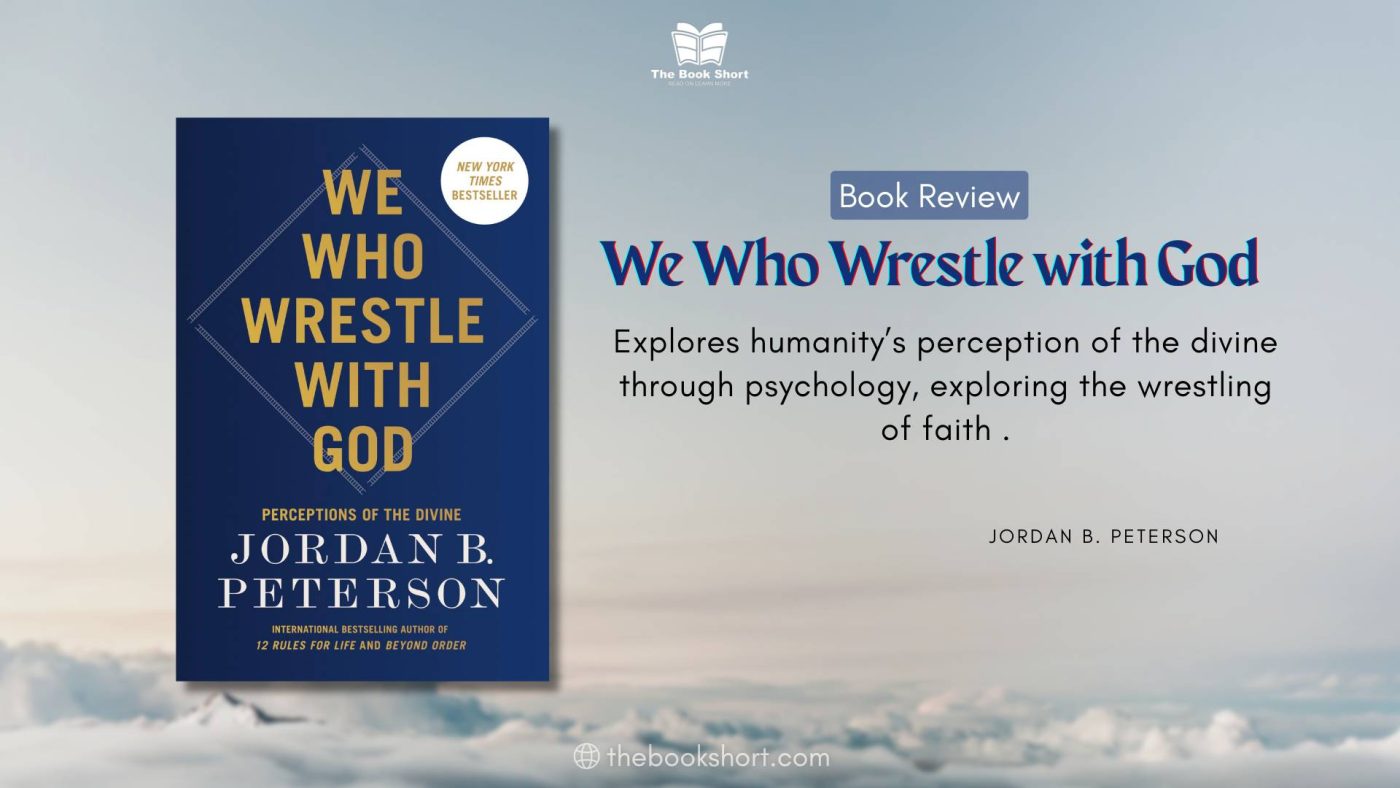
We Who Wrestle with God: A Deep Dive into Jordan Peterson’s Psychological Biblical Interpretations
Explore profound biblical stories through a psychological lens with Jordan Peterson’s “We Who Wrestle with God.” This analysis dives deep into his compelling, often challenging, interpretation of ancient narratives as maps for navigating modern existence. Jordan B. Peterson, a figure known for pushing intellectual boundaries, takes readers on an intricate journey through foundational biblical texts in his book, We Who Wrestle with God. Engaging with this work offers a unique opportunity to examine ancient wisdom traditions through a distinctive modern psychological and philosophical framework, promising insights that often elude more conventional readings.
Basic Information About We Who Wrestle with God Book
- Title: We Who Wrestle with God
- Author: Jordan B. Peterson
- Year of publication: 2024
- Genre: Philosophy, Psychology, Religious Studies, Biblical Interpretation, Mythology
- Number of pages: Varies by edition (typically around 500-600 pages)
- Target audience: Readers interested in Jordan Peterson’s work, biblical narratives, depth psychology, philosophy, religious symbolism, and the intersection of ancient wisdom with modern thought.

We Who Wrestle with God: Perceptions of the Divine
Main Content Summary of We Who Wrestle with God
In We Who Wrestle with God, Jordan Peterson delves into the deep psychological and philosophical bedrock of significant stories and figures from the Bible, primarily concentrating on the early books of the Old Testament. This work serves as a continuation and expansion of themes previously explored in his seminal Maps of Meaning and his widely popular Biblical Series lectures. The book positions itself less as a theological exploration of faith and more as a profound inquiry into how these ancient narratives encode perennial truths about the human condition: consciousness, morality, the inevitability of suffering, and the perpetual struggle to find meaning in a complex world.
Peterson approaches the biblical text not strictly as literal historical accounts, but as foundational myths – powerful, symbolic narratives that describe the enduring structure of reality, the architecture of the human psyche, and the elemental nature of good and evil. He masterfully integrates insights from depth psychology (heavily influenced by Carl Jung), evolutionary biology, neuroscience, and philosophy to unlock the layered symbolic language embedded within scripture.
The book typically follows a progression through selected biblical stories, building upon the interpretive framework established in his earlier work and lectures, dedicating substantial focus to key figures and events.
Core Themes Explored
- The Problem of Being: Peterson confronts the inherent difficulties, vulnerabilities, and suffering woven into human existence. He draws potent parallels between the chaos described in primordial biblical narratives and the unpredictable, challenging nature of lived reality.
- The Emergence of Consciousness: The narratives are interpreted as symbolic accounts detailing the painful birth of self-awareness, the recognition of vulnerability, and the profound burden of knowledge (most vividly through the story of Adam and Eve).
- The Origins of Morality and Responsibility: He explores how these ancient stories articulate the foundations of moral codes, the concept of sin not just as transgression but as a failure to align with truth, the absolute necessity of embracing personal responsibility, and the profound consequences of failing to live in accordance with a perceived moral or existential order.
- The Structure and Challenges of Society: Peterson analyzes how early biblical accounts depict the formation of social hierarchies, the perpetual challenges of building and maintaining community, and the symbolic origins of law and order required for collective flourishing.
- The Archetypal Hero’s Journey: Concepts akin to the mythological hero’s journey are applied to iconic figures like Abraham, Moses, and Jacob, highlighting the universal psychological process of confronting the unknown, overcoming internal and external obstacles, and forging a new, more integrated state of being.
- The Relationship with the Transcendent: The central metaphor of “wrestling with God,” drawn directly from the story of Jacob, serves as a powerful symbol for the human struggle to comprehend the ultimate nature of reality, to confront one’s own limitations and mortality, and to strive towards a higher ideal, a principle of truth and being. This struggle is framed not necessarily as a traditional theological concept of belief in a personal deity, but as the necessary human encounter with the transcendent, the highest attainable value, or the ultimate ground of being that demands transformation.
- The Eternal Conflict of Good vs. Evil: Peterson dissects the symbolic representation of evil, chaos, tyranny, and the forces that undermine order and being, contrasting them sharply with the principles of truth, courage, sacrifice, and responsibility that underpin meaningful existence.
Structure and Progression
While We Who Wrestle with God is not a rigid, verse-by-verse commentary, it structures its intricate arguments by focusing deeply on selected key narratives and figures, dedicating considerable space to unpacking their symbolic weight and psychological implications.
- Laying the Foundational Stone: The initial sections often revisit fundamental concepts like the primordial dynamic of chaos and order, the psychological significance of stories themselves, and the nature of symbolic language. This typically involves detailed discussions related to Genesis chapters 1-3 (Creation, the Fall of Adam and Eve, Cain and Abel), establishing the book’s framework by addressing fundamental human problems of existence, consciousness, morality, and the emergence of evil.
- Journey Through Patriarchal Narratives: Peterson devotes significant attention to figures like Noah, Abraham, Isaac, Jacob (with particular emphasis on the pivotal wrestling encounter), and Joseph. Each narrative is dissected for its profound psychological lessons:
- Noah: Grappling with overwhelming catastrophe, the necessity of preserving essential order and truth amidst destructive chaos.
- Abraham: The call to venture into the unknown, leaving behind the familiar, faith understood as the courage to act in the face of radical uncertainty.
- Jacob: The complex trickster figure, confronting one’s past, deceit, and true identity; the struggle for blessing; the “wrestling” as a demanding confrontation with the ultimate and one’s own profound limitations.
- Joseph: Enduring suffering and betrayal, navigating complex power dynamics, the transformative power of forgiveness, and the psychological integration of the shadow aspects of personality.
- Themes of Liberation and Law: Depending on the specific scope of the book, it may progress to analyze the story of Moses, exploring themes of oppression and liberation, the arduous journey through the wilderness (representing the chaotic transition), and the receiving of divine law as the essential foundation for building and maintaining a functional, moral society.
- Synthesizing Wisdom: The book typically concludes by drawing together the cumulative wisdom extracted from these ancient stories, emphasizing their enduring relevance for navigating the challenges of modern life, cultivating individual responsibility, finding meaning amidst suffering, and striving towards a noble aim.
Throughout the text, Peterson’s approach is deeply layered and interdisciplinary, forging connections between ancient religious texts, modern depth psychology, philosophy, and practical advice for living a life of meaning and purpose. This summary provides a general outline; the specific narratives covered and the depth of analysis will vary, but the overarching objective remains: to reveal the enduring psychological and existential wisdom embedded within these foundational myths of Western civilization.
In-depth Analysis of We Who Wrestle with God Book
We Who Wrestle with God stands as a demanding and intellectually rigorous work, characteristic of Jordan Peterson’s distinctive style. His core objective is to distill practical wisdom and profound psychological insight from ancient religious texts, treating them not as mere historical records but as repositories of evolved human understanding about the fundamental nature of reality and the complexities of the human condition.
Archetypes, Structure, and Defining Arguments
- “Characters” as Archetypes: The primary “characters” analyzed are not people in a conventional literary sense but iconic figures from the Bible – Adam, Eve, Cain, Abel, Noah, Abraham, Jacob, and others. Peterson interprets them as powerful archetypal figures embodying fundamental aspects of human psychology and universal experience (the naive self, the shadow, the heroic impulse, the trickster, the wise king). Their stories are meticulously examined for their deep symbolic weight and the timeless lessons they impart about confronting and navigating the inherent challenges of existence.
- Structure as Cumulative Argument: The structure is thematic and guided by the sequence of biblical narratives, yet it often moves fluidly between stories to forge connections, draw parallels, or elaborate on a specific, overarching concept (e.g., illustrating the nature of hierarchy or sacrifice using examples drawn from multiple narratives). It builds a cumulative argument, beginning with foundational problems (the interplay of chaos/order, good/evil introduced in Genesis) and progressing through subsequent narratives that illustrate how these fundamental problems are confronted, wrestled with, and potentially resolved or transformed through conscious action, sacrifice, and the pursuit of truth. The titular theme of “wrestling” provides a powerful central motif, symbolizing the active, often painful, engagement required to understand and strive towards living according to higher principles.
- Defining Arguments:
- Biblical stories are not simple historical accounts or moral fables but highly sophisticated symbolic maps of the psychological and moral landscape of human existence, refined and transmitted across millennia.
- These narratives encapsulate fundamental psychological truths about consciousness, the experience of suffering, the weight of responsibility, and the essential interplay between the forces of order and chaos in individual and collective life.
- Profound meaning in life is discovered not in comfort or ease, but through the voluntary confrontation with suffering and chaos, and the disciplined striving towards a higher ideal or principle, symbolically represented by the divine.
- The act of “wrestling with God” signifies the necessary and demanding struggle with the ultimate nature of reality, with the terrifying unknown, and with the highest possible value – a struggle essential for individual growth, psychological integration, and the health of society.
- A consequence of carelessly dismissing or actively rejecting these foundational narratives and the deep wisdom they contain is the descent into nihilism, the erosion of societal structures, and the emergence of individual pathology.
Writing Style & Content Quality
Peterson’s writing in We Who Wrestle with God is undeniably academic and dense, rich with terminology drawn from philosophy, depth psychology, and biology. He employs complex sentence structures and frequently explores intricate layers of meaning, demanding focused attention from the reader.
- Writing Style: The style is authoritative, deeply considered, and often engages directly with potential counter-arguments or perceived misunderstandings of his complex views. It requires careful, attentive reading, often necessitating pausing and re-reading. While it can be verbose, it is also profoundly personal and reflective, weaving in observations drawn from his own experiences and clinical practice. He utilizes repetition to underscore key concepts and frequently cross-references his previous work, lectures, and public discussions.
- Content Quality: The content is extraordinarily rich in ideas, drawing upon an impressive breadth of disciplines to construct its arguments. The interpretations offered are original and highly thought-provoking, providing a powerful, unique lens through which to re-examine familiar stories. However, the perceived quality is inherently subjective and depends heavily on the reader’s openness to engaging with his specific interpretative framework. His readings are highly symbolic and psychological, which often diverge significantly from traditional theological, historical, or literary approaches. Some readers find his interpretations profoundly insightful and even transformative, while others may view them as overly speculative, anachronistic, or attempting to impose a modern psychological framework onto ancient texts in an inappropriate manner. Within his chosen framework, the argumentation is rigorous and logically built, but it does require the reader to accept his core premise regarding the symbolic nature and psychological function of myth.
Notable Quotes from the Book (Illustrative)
(As specific, widely circulated quotes from We Who Wrestle with God may be limited post-publication, the following represent the characteristic style and core arguments likely found within, based on his established body of work):
- “The ancient stories are not outdated superstitions; they are sophisticated psychological maps guiding us through the timeless challenges of being.”
- “To wrestle with God is to voluntarily confront the highest ideal you can conceive, and to discover how utterly inadequate you are in its light – and yet, paradoxically, to find the strength to continue striving.”
- “Meaning is not a passive discovery, but an active creation, forged in the crucible of suffering and illuminated by the pursuit of truth.”
- “The biblical narratives portray the stark reality that the capacity for both the divine and the monstrous resides within the human heart, and that life is the stage upon which this eternal choice is played out.”
- “Chaos is the source of both terror and potential; the hero is the one who dares to venture into it and bring back the pattern of a new order.”
These sentiments, deeply embedded in Peterson’s thought, capture the essence of his approach: the symbolic power of myth, the emphasis on the demanding struggle for meaning, the inherent difficulty of existence, and the urgent call to individual responsibility and courageous action.
Overall, the analysis presented in We Who Wrestle with God is a rigorous intellectual exercise that ambitious attempts to bridge the vast gap between ancient religious wisdom and modern psychological science. It offers a powerful, albeit challenging and sometimes controversial, perspective on the fundamental nature of the human condition. Its distinctiveness lies precisely in this ambitious, interdisciplinary synthesis applied with unwavering focus to foundational Western religious texts, setting it apart from standard theological or purely academic literary analyses.
Evaluation & Expert Personal Review of We Who Wrestle with God
We Who Wrestle with God represents a significant culmination in Jordan Peterson’s decades-long exploration of religious narratives through a psychological and philosophical lens. My personal impression is that engaging with this book is both a deeply insightful and profoundly challenging experience, demanding considerable intellectual and emotional investment from the reader.
Personal Impressions
The book truly excels in offering a genuinely novel and compelling perspective on biblical stories that many readers might feel they already know. Peterson’s unique ability to synthesize concepts from depth psychology, evolutionary biology, and philosophy to illuminate the enduring relevance of these ancient texts is nothing short of impressive. The sheer depth of his analysis has the power to unlock layers of meaning and practical wisdom that are often entirely invisible in more conventional, literal, or purely theological readings. It provides a robust and intellectually satisfying framework for understanding the pervasive nature of suffering, the inescapable demand for responsibility, and the perpetual human pursuit of meaning, all framed within the urgent context of modern life.
However, it is crucial to acknowledge that the density of the prose and the intricate complexity of the arguments can, at times, feel overwhelming. Peterson’s distinct, often didactic, voice and his tendency for lengthy, deeply layered explorations mean that this book is far from offering easy answers or providing a light reading experience. There are moments where the connections he draws can feel speculative, or perhaps overly dependent on his specific, sometimes idiosyncratic, interpretative framework. This aspect might pose a barrier for readers who do not share his foundational assumptions about the nature of myth, symbolism, or the applicability of modern psychology to ancient texts. Furthermore, the sheer volume of complex ideas packed into each section can lead to intellectual fatigue if not approached with patience and focus.
Readability Level and Suitability
The readability level of We Who Wrestle with God is undoubtedly advanced. This book is not designed for casual reading, nor is it an ideal starting point for someone entirely unfamiliar with Peterson’s previous work, his distinctive vocabulary, or academic discourse in psychology and philosophy. It demands a high level of literacy, intellectual curiosity, patience, and a genuine willingness to grapple with abstract concepts and intricate interdisciplinary connections.
- This book is highly suitable for:
- Readers already familiar with Jordan Peterson’s Maps of Meaning or his Biblical Series lectures and eager to delve deeper.
- Individuals with a strong existing interest in depth psychology (particularly Jungian approaches) or the philosophy of meaning.
- Students, academics, or curious lay readers specifically interested in the rich intersection of religion, psychology, mythology, and philosophy.
- People actively wrestling with profound existential questions of meaning, suffering, and responsibility who are open to unconventional, non-traditional interpretations of religious and mythological texts.
- This book is likely less suitable for:
- Readers seeking a simple introduction to biblical stories or a basic summary of their plots.
- Those looking for theological instruction or spiritual guidance rooted in a specific, traditional religious doctrine.
- Individuals who strongly prefer light, easily accessible prose and straightforward narratives.
- Readers fundamentally opposed to the idea of interpreting religious texts through a symbolic, psychological, or mythological lens.
Practical Value
The most significant practical value of We Who Wrestle with God lies in its potent capacity to fundamentally alter one’s perspective on life’s inherent challenges and to provide a conceptual toolkit for confronting them with greater courage and understanding.
- Key Lessons Imparted: The book powerfully reinforces the vital importance of confronting chaos, uncertainty, and suffering voluntarily, rather than avoiding it. It stresses the absolute necessity of striving towards speaking the truth (or at least refraining from lying) as a foundational principle for navigating reality. It underscores the profound, inescapable weight of individual responsibility in shaping one’s life and the world. And it eloquently argues for the transformative value of identifying and aiming for a higher ideal or noble purpose. It frames the central act of “wrestling,” symbolized by Jacob’s struggle, not as a purely adversarial battle against the divine, but as a necessary, demanding engagement with the ultimate, with the highest possible good, and with the difficult, often painful, demands that reality places upon us. This struggle is the very engine of growth and transformation.
- Application to Life: The lessons are not merely theoretical; they serve as a potent call to introspection and action. Readers are implicitly prompted to examine their own lives, their struggles, and their relationships through the lens of these ancient narratives, identifying archetypal patterns at play. The strong emphasis on taking responsibility and cultivating truthfulness provides a clear, albeit often arduous, path for personal development, ethical conduct, and building a more meaningful existence.
- Cultivating a Transformed Mindset: For many readers, engaging deeply with this book can profoundly alter their understanding of biblical stories, elevating them from perceived literal history or simple moral tales to complex, multi-layered symbolic maps of reality and the human psyche. It can instill a far greater appreciation for the depth, complexity, and enduring wisdom embedded within ancient traditions. Crucially, it offers a robust intellectual and psychological framework for confronting the specter of nihilism and actively forging meaning in an increasingly complex and fragmented world. The title itself encapsulates the demanded mindset shift: life is not a passive experience to be endured, but an active, demanding, and potentially transformative wrestling match with the highest potential of being.
In summary, We Who Wrestle with God is a demanding but potentially transformative read for the prepared and receptive audience. Its primary value resides in its unique, powerful psychological interpretation of biblical myth and its resonant call to confront the challenges of existence with courage, truth, and responsibility.
Comparison with Similar Books
Placing We Who Wrestle with God within the broader landscape of literature requires looking at works that bridge psychology, mythology, and spirituality, though Peterson’s specific synthesis and polemical style grant his work a fairly unique position.
- Works Exploring Similar Themes and Approaches:
- Joseph Campbell: The Hero with a Thousand Faces. Campbell’s groundbreaking work on the monomyth (the universal hero’s journey) is a foundational influence on Peterson’s thinking. Campbell analyzed myths and religious stories from diverse cultures worldwide, including biblical narratives, through a Jungian psychological lens, focusing on universal psychological patterns and stages of human development. Peterson’s book can be seen as a deeply focused application of a Campbellian/Jungian framework to a specific, central set of Western myths (the Bible), but with a significantly greater emphasis on the practical, ethical demands of responsibility, the psychological meaning of suffering, and the conscious emergence of order from chaos as core life lessons.
- Carl Jung: Various works, particularly Answer to Job or Symbols of Transformation. Jung himself extensively analyzed biblical stories, alchemical symbols, and other religious imagery through the lens of the unconscious mind, archetypes, and the process of individuation (becoming a psychologically integrated individual). Peterson draws heavily and explicitly on Jung’s core concepts (such as the shadow, the anima/animus, the archetype of the hero, the collective unconscious) but applies them specifically to construct a powerful argument about moral responsibility, the structure of reality, and the existential necessity of confronting chaos, often in a more directive and prescriptive manner than Jung’s more analytical approach.
- Erich Neumann: The Origins and History of Consciousness. A key student of Jung, Neumann provided a detailed Jungian interpretation of the development of human consciousness through symbolic mythological stages, starting with primal unity represented by the Great Mother archetype and progressing towards the differentiation represented by the hero myth and the father archetype. Peterson’s analysis of the early chapters of Genesis, particularly the transition from primordial chaos to conscious awareness and the subsequent expulsion from Eden, echoes some of these developmental themes of consciousness emerging from an undifferentiated state.


- Key Distinguishing Characteristics: While drawing heavily from the intellectual lineage of Campbell and Jung, Peterson’s We Who Wrestle with God is distinct due to several factors:
- Stronger Emphasis on Personal Responsibility and Action: Unlike Jung’s more purely analytical and descriptive psychology, Peterson’s work is significantly more focused on the ethical imperative and practical steps derived from these myths – how they provide a blueprint for navigating life ethically, effectively, and courageously.
- Integration of Evolutionary Biology and Neuroscience: Peterson explicitly seeks to ground his psychological and mythological interpretations within a modern scientific understanding of the brain, behavior, and evolutionary processes, a dimension less prominent in classical Jungian or Campbellian scholarship.
- Intertwined with Polemical and Cultural Commentary: The analysis of the biblical text is often deeply intertwined with Peterson’s broader critiques of modern cultural trends, identity politics, and the perceived dangers of nihilism and ideological extremism, giving the book a more contemporary, urgent, and sometimes controversial edge compared to the more purely academic or therapeutic focus of Campbell or Jung.
- Intense Focus on the Bible: Unlike Campbell’s sweeping global survey of mythology, Peterson commits to extracting maximum depth, psychological complexity, and practical wisdom from one specific, foundational text of Western culture – the Bible.
- If Readers Appreciated We Who Wrestle with God, They Might Also Find Value in:
- Maps of Meaning: The Architecture of Belief by Jordan B. Peterson (His foundational work detailing the interpretive method applied in We Who Wrestle with God).
- The Hero with a Thousand Faces by Joseph Campbell (For a broader exploration of the universal mythological patterns that underpin Peterson’s analysis).
- Man’s Search for Meaning by Viktor Frankl (Offers a powerful account of finding meaning and responsibility in the face of unimaginable suffering, resonating strongly with key themes in Peterson’s work, albeit from an existential rather than mythological-psychological perspective).
- Selected works by Carl Jung (e.g., Psychology and Religion: West and East or The Archetypes and the Collective Unconscious) for a deeper dive into the core psychological framework Peterson extensively utilizes.
Ultimately, Peterson’s We Who Wrestle with God stands out for its ambitious and often audacious synthesis of ancient religious narrative, depth psychology, and modern scientific/philosophical thought, applied with a direct, urgent message about the profound importance of grappling consciously and courageously with life’s most fundamental questions and highest ideals.
Conclusion & Recommendations
We Who Wrestle with God by Jordan B. Peterson is a profound, demanding, and ultimately rewarding exploration of biblical narratives. It offers a unique and powerful psychological and philosophical interpretation of these ancient texts, arguing for their continued vital relevance. Its outstanding value lies in its ability to compellingly re-contextualize familiar stories not as simple historical accounts, but as deep wells of evolved wisdom about the human condition, the nature of suffering, the structure of reality, and the inescapable necessity of confronting existence with courage, truth, and responsibility.
Is it worth reading? Absolutely, for the right reader prepared for a deep intellectual engagement. It provides a compelling and often transformative framework for understanding why these stories have resonated across millennia and how they offer essential guidance for navigating the complexities and inherent suffering of modern existence. It is an intellectually stimulating journey that has the potential to profoundly alter one’s perspective on the power of myth, the nature of meaning, and the bedrock of morality.
Who should read it? This book is highly recommended for individuals already familiar with and interested in Jordan Peterson’s body of work, serious students of psychology, philosophy, or religion who are open to bold, interdisciplinary approaches, and anyone grappling with significant existential questions who possesses the patience and willingness to engage with dense, complex, and multifaceted material. It is emphatically not a casual read, but an invitation to a serious, sustained engagement with foundational ideas about what it means to be human.
Have you read We Who Wrestle with God? Share your thoughts, impressions, and perhaps your own wrestling matches with the text in the comments below!