
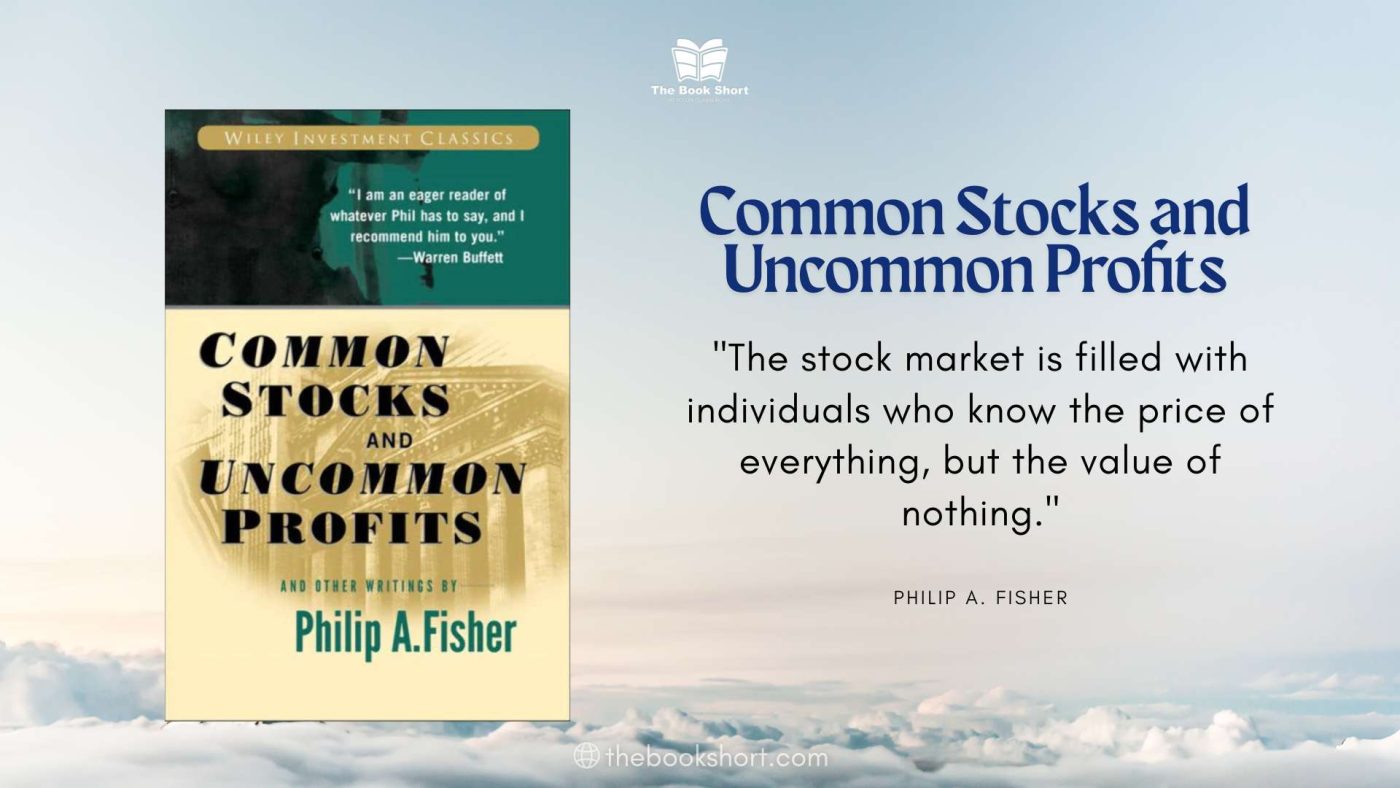
Unlocking investment secrets: Discover Philip Fisher’s timeless growth stock approach. Learn why qualitative analysis matters for “uncommon profits.”
Understanding Common Stocks and Uncommon Profits: A Timeless Investment Guide
Common Stocks and Uncommon Profits by Philip A. Fisher is a cornerstone text for growth investors. This analysis delves into its influential philosophy, revealing why it remains a vital read for anyone seeking enduring investment success beyond just numbers.
Basic Information about Common Stocks and Uncommon Profits
- Title: Common Stocks and Uncommon Profits and Other Writings
- Author: Philip A. Fisher
- Year of original publication: 1958 (Includes later essays in expanded editions)
- Genre: Investment, Finance, Business
- Number of pages: Approximately 300 (depending on edition)
- Target audience: Individual investors, institutional investors, finance professionals, business students seeking a qualitative approach to stock selection.
Main Content Summary of Common Stocks and Uncommon Profits
Philip A. Fisher’s seminal work, Common Stocks and Uncommon Profits, is a classic in investment literature, particularly influential for proponents of growth investing. Published originally in 1958, the book outlines Fisher’s qualitative approach to identifying companies with outstanding growth potential, distinguishing it from the purely quantitative focus often associated with value investing at the time.
The book is primarily divided into three parts:
Part One: Common Stocks and Uncommon Profits
This is the core of Fisher’s philosophy. Here, he lays out his meticulous method for selecting growth stocks, emphasizing the importance of qualitative factors over mere statistics. The central concept is identifying companies that possess the potential for sustained growth in sales and profits for many years to come. Fisher argues that truly superior returns come from investing in these “uncommon” companies and holding them for the long term, allowing compounding to work its magic.
Fisher introduces his famous “Fifteen Points to Look For” in a common stock. These points are not just financial metrics but cover a wide range of business aspects, including:
- Management Quality:
- Is the company organized to make products or services which will continue to gain in sales suitability at least for some years ahead?
- Does the management have a determination to continue to develop products or processes that will still further increase sales potential when the pull of currently attractive items has lessened?
- How effective are the company’s sales efforts?
- Does the company have a worthwhile research and development program?
- Does the company have a competent executive staff?
- Has the company adequate cost analysis and accounting controls?
- Are there other aspects of the business, peculiar to the particular industry, which will give the investor important clues as to how good the company may be in relation to its competition?
- Business Characteristics & Prospects:
- What is the profit margin of the company?
- What is the company’s asset management like? (Focus on turnover)
- Does the company have labor relations?
- Does the company have good executive relations?
- Does the company have a policy of frankness to investors on bad as well as good news?
- Long-Term Profit Potential & Attitude:
- Does the company have a short-range or long-range outlook in regard to profits?
- In the foreseeable future, will the growth of the company require sufficient equity financing so that the large number of shares then outstanding will largely cancel out the existing shareholders’ benefit from this prospective growth?
These points require deep investigation, often involving talking to people knowledgeable about the company – customers, suppliers, even competitors and former employees. This investigative approach is a hallmark of Fisher’s method, which he termed “scuttlebutt.”
Fisher stresses that an investor need not find companies that excel in all fifteen points but should seek those strong in the areas most critical for future growth and competitive advantage. He also discusses when to buy and sell, advocating for holding periods measured in years, not months, and advising against selling solely based on minor fluctuations or general market downturns. Selling should occur only if the company’s fundamental prospects deteriorate or if a truly better opportunity arises.
Part Two: Conservative Investors Sleep Well
This part focuses on applying Fisher’s principles in a way that provides security and peace of mind for the investor. He argues that true conservatism in investing comes not from favoring traditionally “safe” investments like bonds during certain times, but from selecting superior common stocks carefully based on his qualitative criteria. A truly strong company, identified through thorough research, offers both growth potential and a margin of safety. He contrasts this with “statistical conservatism,” which relies purely on balance sheet strength and historical earnings but might miss the potential for future decline or lack of growth.
Part Three: Stock Market Investment Philosophy
This section compiles essays written later in Fisher’s career, offering further insights and reflections on his investment philosophy in light of changing market conditions. These essays reinforce the core principles of seeking quality growth companies, the importance of patience, avoiding speculative fads, and the psychological aspects of investing. He reiterates the value of his “scuttlebutt” method and discusses common investor mistakes, such as over-diversification or focusing too much on cyclical factors rather than fundamental quality.
Across all parts, Fisher’s central message is clear: superior investment results come from identifying and holding companies with exceptional management, strong competitive advantages, and the ability to sustain high rates of growth over extended periods, often discovered through diligent, qualitative research.
In-depth Analysis of Common Stocks and Uncommon Profits
Common Stocks and Uncommon Profits stands out for its pioneering emphasis on qualitative analysis and its “scuttlebutt” research method. While many contemporary investment texts focused on quantitative metrics, asset values, and historical earnings (like value investing popularized by Graham), Fisher argued compellingly that the future potential of a company is driven by factors less visible on a balance sheet: the quality of management, the strength of R&D, marketing effectiveness, labor relations, and long-term vision.
Characters / structure / key arguments
The “characters” in this book are essentially the companies Fisher seeks – those rare entities with “uncommon profits” potential. The structure is logical: Part One introduces the core philosophy and the detailed checklist (“Fifteen Points”), Part Two discusses how this approach aligns with conservative investing, and Part Three provides supplementary essays reinforcing and expanding on the core themes.
Fisher’s key arguments revolve around:
- Qualitative over purely Quantitative: Financial statements are important, but understanding the people, culture, processes, and future potential is paramount for long-term growth.
- The Power of Sustained Growth: Finding companies that can grow significantly year after year is the path to superior, “uncommon” profits.
- The “Scuttlebutt” Method: Deep, investigative research, including talking to people involved with or affected by the company, is crucial for uncovering the qualitative factors that drive future success.
- Long-Term Holding: Once a truly excellent company is found, the best strategy is often to hold it for many years, benefiting from compound growth and avoiding unnecessary trading costs and taxes.
- Focus and Patience: Concentrating investments in a relatively small number of truly outstanding companies is preferable to broad diversification, and patience is required to let these investments mature.
Writing style & content quality
Fisher’s writing style is clear, direct, and conversational, albeit reflecting the era in which it was written (1950s-1960s). He uses analogies and real-world examples (though the company names are sometimes disguised) to illustrate his points. The language is accessible to determined investors, although some terms and business concepts might require a basic understanding of finance. The content quality is exceptionally high in terms of its insight into business quality and management. Fisher provides a detailed framework (the Fifteen Points) that is practical and actionable, even if the “scuttlebutt” method requires significant effort.
What truly stands out is the book’s foresight. In an age dominated by tangible assets and current earnings, Fisher emphasized innovation, management culture, and long-term market potential – concepts that are now considered critical in evaluating modern businesses, especially technology and service companies. His focus on understanding the business rather than just the stock price was revolutionary.
Notable quotes from the book
- “The ability to make ‘uncommon profits’ over a long period requires a combination of many factors, but high on the list is the ability to make things that will sell in increasing volume for many years ahead.”
- “The business background of a company… is far more important than its financial position.”
- “If the job has been correctly done when a common stock is purchased, the time to sell it is almost never.”
- “The fellow who knows a great deal about a great many things will always be more interesting than the fellow who knows a great deal about only one thing.” (Relating to the breadth of knowledge needed for scuttlebutt)
- “It is the business of the investor to realize that while the most glittering prospects can be quickly dimmed, it is also equally true that from time to time the most unpromising situations can develop into unusual successes.”
These quotes encapsulate Fisher’s emphasis on qualitative analysis, long-term perspective, and the importance of thorough research into the fundamental business itself.
Evaluation & Expert Personal Review
Common Stocks and Uncommon Profits is a book that fundamentally shifted my perspective on investing. My personal impression is that while some of the specific industry examples feel dated, the core principles Fisher espouses about evaluating a business’s quality and future growth potential are timeless.
Advantages:
- Timeless Philosophy: The focus on management quality, innovation, and competitive advantage is more relevant than ever in today’s fast-changing economy.
- Actionable Framework: The Fifteen Points provide a concrete checklist for analyzing companies qualitatively.
- Emphasis on Research: Fisher’s “scuttlebutt” method highlights the critical need to look beyond financial statements and understand the real-world operations and reputation of a company.
- Long-Term Mindset: Strongly advocates for patience and compounding, which is crucial for building wealth.
Disadvantages:
- Dated Examples: Some of the specific companies and industries discussed are no longer relevant or exist, requiring the reader to translate the principles to modern contexts.
- Effort Required: The “scuttlebutt” method is demanding and may be difficult for individual investors without extensive networks or resources.
- Writing Style: While clear, the prose is from the mid-20th century and might feel slightly formal or slow-paced to modern readers.
Readability Level: The book is moderately challenging. It requires focus and a willingness to understand business concepts beyond basic financial ratios. It’s suitable for serious investors, business students, or anyone committed to understanding the deeper aspects of company analysis.
Practical Value: Enormous. Reading this book instills a discipline of looking beyond headlines and price movements to understand the underlying business. It changes the mindset from speculating on price to investing in quality. The lessons on management evaluation, R&D importance, and the value of a long-term perspective are directly applicable to analyzing any company today. It encourages a more fundamental, patient, and informed approach to stock picking.
Comparison with Similar Books
Common Stocks and Uncommon Profits occupies a unique space in investment literature. While often mentioned alongside Benjamin Graham’s The Intelligent Investor, it serves as a crucial complement rather than a replacement. Graham is the father of value investing, focusing heavily on quantitative metrics, margin of safety based on asset values, and treating stocks as pieces of a business. Fisher, while respecting the business concept, focuses on growth potential driven by qualitative factors – essentially, finding the best businesses rather than just undervalued ones.
If readers liked Common Stocks and Uncommon Profits, they might also enjoy:
- The Intelligent Investor by Benjamin Graham: For understanding the foundational principles of value investing and market psychology.
- One Up On Wall Street by Peter Lynch: While more recent and focused on finding growth opportunities through everyday observation, Lynch shares Fisher’s emphasis on understanding the business and conducting thorough research (his “story” concept is akin to Fisher’s qualitative analysis).
- Built to Last: Successful Habits of Visionary Companies by Jim Collins & Jerry Porras: While not an investment book per se, it analyzes the characteristics of truly great, enduring companies, aligning well with Fisher’s search for qualitative excellence and long-term vision.
Fisher’s book is essential for anyone wanting to balance the quantitative analysis of value investing with a deep understanding of the qualitative factors that drive long-term growth and competitive advantage.
Conclusion & Recommendations
Common Stocks and Uncommon Profits is an enduring classic because it provides a powerful framework for identifying businesses poised for exceptional, sustained growth. Its outstanding value lies in shifting the investor’s focus from short-term price movements and basic statistics to the crucial qualitative elements of a company: its management, innovation, culture, and long-term vision.
Yes, it is absolutely worth reading for any serious investor. It is particularly recommended for:
- Investors interested in growth stocks.
- Those who feel overly reliant on financial ratios alone.
- Anyone seeking a deeper understanding of what makes a business truly exceptional.
- Investors willing to put in the effort required for thorough research.
While not the easiest read, the profound insights and practical framework offered make it an indispensable guide for achieving “uncommon profits” through intelligent, long-term investing.
Have you read this book? Share your thoughts on Philip Fisher’s approach in the comments below!