
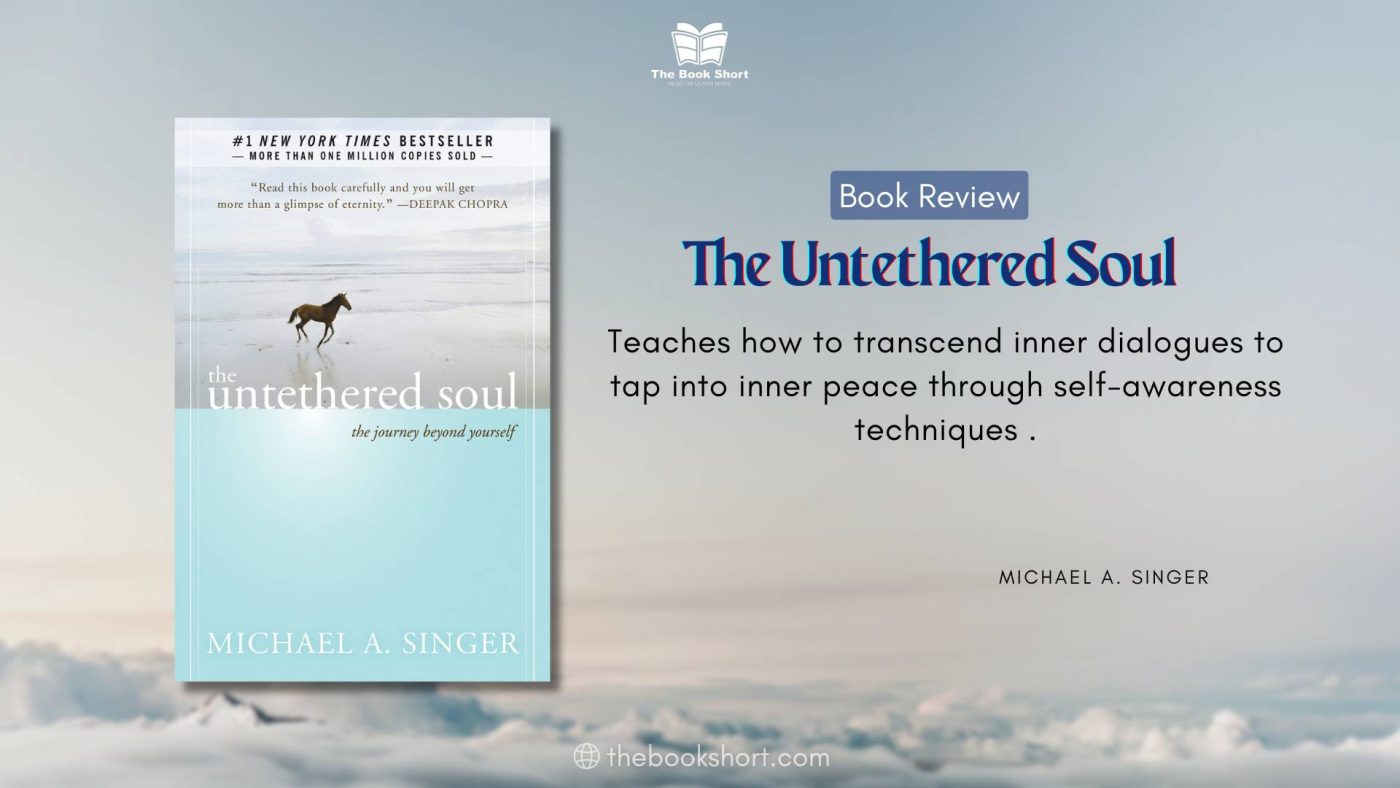
Embark on a profound and liberating journey into the nature of consciousness with Michael A. Singer’s widely acclaimed and transformative work, The Untethered Soul: The Journey Beyond Yourself. This isn’t just a book; it’s an invitation to explore the deepest questions about who you are beyond the constant chatter of your mind. Singer offers a powerful, accessible exploration of how to live fully in the present moment and release the self-imposed limitations of the ego that keep us from true peace and joy.
I chose to delve into The Untethered Soul not only because of its massive impact and status as a modern spiritual classic but also for its remarkable ability to take complex spiritual and psychological concepts and present them with breathtaking simplicity and directness. Its unique value lies in demystifying the often-daunting process of self-realization, offering practical insights that resonate deeply with anyone seeking genuine freedom from internal struggles and a deeper connection to life itself.
Basic Information about The Untethered Soul Book
- Title: The Untethered Soul: The Journey Beyond Yourself
- Author: Michael A. Singer
- Year of publication: 2007
- Genre: Spirituality, Self-Help, Philosophy, Personal Growth
- Number of pages: Approximately 200-240 (varies by edition)
- Target audience: Individuals seeking to understand their inner world, manage challenging thoughts and emotions, explore consciousness, practice mindfulness or meditation, and achieve lasting inner peace and spiritual freedom.

The Untethered Soul: The Journey Beyond Yourself
The Untethered Soul Summary: Freeing Yourself from the Mind’s Grip
The Untethered Soul by Michael A. Singer serves as a profound spiritual and philosophical guide, navigating the reader through the intricacies of consciousness, the concept of the self, and the path to inner freedom. The book compellingly argues that lasting peace comes not from changing the external world, but from understanding and transcending the relentless inner voice – what Singer vividly terms the “roommate” in your head. Structured progressively, the book unfolds like a map, each part building on the last to reveal the true nature of awareness and reality.
At its core, the book posits a revolutionary idea: you are not your thoughts or emotions; you are the pure consciousness that observes them. Singer skillfully guides readers to shift their perspective, encouraging them to witness their inner lives from a detached, objective viewpoint, identifying instead with the ever-present “Self” – the silent awareness untouched by the mind’s incessant noise and drama.
Part 1: The Voice Inside Your Head – Meeting Your Inner Roommate
Singer opens the conversation by introducing the ubiquitous internal narrator – the ceaseless stream of thoughts, opinions, judgments, worries, and emotions that dominates our mental space. He introduces this voice as the “roommate,” a constant presence that often dictates our perception of reality, fueling suffering through its anxieties, criticisms, and fears.
- Identifying the Inner Voice: The first crucial step is simple observation. Singer urges the reader to just listen to this voice without getting swept away or passing judgment. Recognizing that you hear the voice fundamentally proves that there is a part of you distinct from it – the consciousness, the witness, the one who is aware.
- The Illusion of Control: The book clearly illustrates how our attempts to control, quiet, or suppress this inner voice or unpleasant feelings are ultimately futile and often amplify their power. Singer reveals that true freedom emerges not from vanquishing the voice, but from learning to coexist with the entire spectrum of thoughts and emotions without being consumed or defined by them.
- Finding the Seat of Consciousness: This section provides foundational guidance on shifting identity. Singer helps the reader disengage from identifying solely with the thought-generating mind and anchor themselves in the silent, observing consciousness. This fundamental reorientation is presented as the essential starting point for the entire journey beyond the limited self.
Part 2: The Energy of Being – Releasing Blockages
Moving deeper, this part explores the dynamic flow of psychic and emotional energy within us. Singer describes how we instinctively build internal structures, defenses, and boundaries based on past hurts, fears, and unresolved experiences, effectively blocking the natural, vibrant flow of life energy and creating inner tension, contraction, and resistance.
- Building Inner Structures: We erect “walls” or “shelters” around our hearts and being, believing they protect us from pain. While understandable, these structures paradoxically prevent us from fully experiencing the richness and vulnerability of life, severely limiting our capacity for genuine joy, connection, and spontaneity.
- The Closed Heart: Singer describes the state of the “closed heart” – an unconscious posture of contraction and resistance to vulnerability and experience. He highlights how maintaining this state consumes vast amounts of vital energy, leaving us feeling depleted and guarded.
- Releasing Blockages Through Awareness: The path toward liberation, Singer explains, involves consciously releasing these inner blockages. By simply observing our reactions, resistance, and the physical sensations they produce without judgment or the need to change them, we create the space for trapped energy to flow freely. This process leads to a profound sense of release, expansion, and openness.
Part 3: The Shackles of the Self – Understanding the Ego
Here, Singer delves into the intricate construction and reinforcement of the ego, which he refers to as the “self-concept” – the composite collection of thoughts, feelings, memories, beliefs, and experiences we mistakenly identify with as our fixed identity. This part illuminates how our personal history and mental narratives weave the intricate illusion of a separate, solid, and inherently limited self.
- The Process of Objectification: The mind, Singer explains, incessantly objectifies experiences, constantly creating internal models and narratives about the world and, crucially, about ourselves. We then become deeply attached to these mental constructs, clinging to them as if they are the absolute, unchanging truth of who we are.
- The Weight of the Past: Unprocessed past experiences, emotional wounds, and ingrained psychological residue create a heavy, often invisible burden that we unconsciously carry. This historical weight directly influences our present reactions, perceptions, and behaviors, dramatically limiting our freedom to respond freshly to life.
- Liberation Through Conscious Awareness: By bringing sustained, conscious awareness to these ingrained patterns, attachments, and the ego’s constant machinations, we can begin to loosen their powerful grip. The fundamental practice remains observation: witnessing the ego’s performance without becoming entangled in its drama or believing its stories.
Part 4: Beyond the Self – Living in Flow
This pivotal section transitions from understanding the problem to exploring the solution, offering perspectives and approaches for moving beyond the confines of the ego and accessing a state of true spiritual freedom. Singer powerfully emphasizes the practice of surrendering to life’s unfolding flow and embracing whatever arises in each moment with radical acceptance and an open heart.
- Cultivating the Witness Consciousness: Reconnecting with and anchoring oneself in the witness – the part of us that simply observes reality as it is, without resistance or reaction – is presented as paramount. This detachment allows us to experience life directly, unfiltered by the ego’s biases, fears, and desires.
- Surrendering to the Moment: Singer encourages a practice of profound acceptance of the present moment, regardless of its content. Resistance to “what is happening” is identified as the primary source of suffering. Surrender, in this context, is not passive resignation, but an active choice to relax into reality and allow life to flow through you.
- Living in the Flow: When we release the deep-seated need to control everything and cease resisting reality as it presents itself, we naturally align with a larger, intelligent universal energy or flow. This state is characterized by ease, presence, spontaneity, and a profound sense of being supported by life itself.
Part 5: Heavenly Dwellings – The Experience of Liberation
The final part beautifully describes the elevated state of being that becomes accessible when we successfully transcend the limitations of the ego and learn to live from the perspective of pure consciousness. It speaks to the tangible experience of liberation, accessing unconditional joy, and feeling a profound sense of connection to something far greater than the individual self.
- The Liberated State: This state is one of deep, unwavering inner peace, crystal clarity, and freedom from the tyranny of constant mental turmoil and emotional reactivity. It doesn’t mean the absence of challenges, but the ability to meet life’s inevitable ups and downs from a stable, equanimous place of presence.
- Accessing Unconditional Happiness: Singer suggests that true happiness isn’t something found outside ourselves or dependent on favorable external circumstances. Instead, he proposes it is the natural, underlying state of being that emerges effortlessly when the mind’s distracting noise and the ego’s demands are quieted.
- Embracing the Universe: By successfully untethering from the limited, contracted sense of self, we open ourselves to a deeper, more expansive connection with the universe, life, and what some might call the divine. This allows for experiences of unity, awe, wonder, and boundless love.
Throughout The Untethered Soul, Singer employs remarkably simple, direct language and utilizes powerful, relatable metaphors to illuminate complex spiritual truths. He consistently brings the reader’s focus back to the practices of observation and surrender, positioning them as the primary tools for self-realization and accessing inner freedom. The transformative journey outlined is not about achieving a fixed, perfect state, but about the continuous, moment-by-moment practice of returning to conscious awareness and gently releasing the restrictive grip of the inner self.
The Untethered Soul Analysis: Unpacking Singer’s Core Message and Impact
The Untethered Soul distinguishes itself less as a prescriptive self-help manual and more as a profound philosophical guide that catalyses a fundamental, radical shift in perspective. Michael A. Singer’s central message is delivered with compelling clarity and reinforced throughout: your true identity resides in the consciousness that experiences life, not in the fleeting, noisy stream of thoughts and emotions generated by the mind.
Key Arguments, Structure, and the ‘Non-Character’
The book’s structure is one of its great strengths – it’s logical, progressive, and deeply intuitive. It begins by pinpointing the core problem (the constant internal dialogue and the suffering it engenders), systematically explores how we build inner defenses and the nature of the ego, and culminates in describing the state of liberation while offering the essential practice (primarily observation and surrender).
- Key Argument 1: The Primacy of the Witness: This is Singer’s most crucial and transformative argument – the absolute distinction between the pure ‘Self’ (consciousness, awareness, the witness) and the ‘mind’ (the relentless flow of thoughts, emotions, egoic narratives). Singer argues unequivocally that identifying with the mind is the root cause of human suffering and internal conflict.
- Key Argument 2: Understanding the Inner Roommate: The concept of the “roommate” is arguably the book’s most memorable and effective metaphor. It vividly personifies the relentless, often critical internal dialogue, highlighting its pervasive impact on our lives. Learning to observe this “roommate” without entanglement or belief is presented as the fundamental key to inner freedom.
- Key Argument 3: The Power of Surrender: Singer defines surrender not as weakness or giving up, but as an active, courageous release of resistance to the present moment and to the flow of life as it is. This includes surrendering to difficult emotions, energetic blockages within the body, and the ego’s desperate need for control and certainty.
- Structure: The book follows a clear, cumulative progression. Each section builds upon the insights of the last, deepening the reader’s understanding of their inner landscape, the mechanisms of suffering, and the path to liberation. It flows thematically rather than being divided into rigid chapters.
- Characters: The book contains no fictional characters. The primary “character” under examination is the reader’s own internal world – their consciousness and the manifestations of their internal voice and ego. Singer invites the reader to step back and become the curious observer of this inner landscape.
Writing Style & Content Quality – Simple Language, Profound Truths
Singer’s writing style is remarkably simple, direct, and deeply conversational, almost as if he is speaking directly to you. He deliberately avoids spiritual jargon, academic terminology, or complex philosophical debates, rendering the profound concepts accessible to a vast and diverse audience.
- Simplicity and Clarity: His use of relatable metaphors – the roommate, the thorn, building castle walls, the flow of a river – are extraordinarily effective in illustrating abstract spiritual and psychological ideas in a way that resonates on an intuitive level. This radical simplicity is a key to the book’s impact.
- Repetition and Reinforcement: Key concepts, such as the importance of maintaining the witness perspective and the practice of surrender, are revisited and reinforced throughout the book. While some might perceive this as repetitive, it serves a vital purpose: drilling these fundamental insights deep into the reader’s consciousness, helping to anchor the core message amidst the noise of the mind.
- Content Quality: The content is both profoundly insightful and immediately practical. While its roots lie in ancient spiritual philosophies (echoing themes found in Eastern traditions like Buddhism and Yoga, though not explicitly centered on them), it is presented in a universal way that is directly applicable to contemporary psychological and emotional struggles. The arguments are presented logically, moving from identifying the universal human problem of internal suffering to outlining a clear, actionable path towards liberation.
Notable Quotes from The Untethered Soul
These quotes encapsulate the essence of Singer’s teachings and often serve as powerful anchors for readers:
- “You are not the voice of the mind. You are the one who hears it.” (The absolute core premise)
- “There is nothing more important to true growth than realizing that you are not the voice of the mind—you are the one who hears it.” (Reinforcing the primary, transformative lesson)
- “In case you haven’t noticed, you have a mental roommate living inside your head.” (Introducing the central, memorable metaphor for the egoic mind)
- “The moment you stop trying to avoid the pain, the energy will be freed up and it will rise.” (Explaining the mechanism of releasing blocked emotional energy through acceptance)
- “Eventually you will see that the real cause of problems is not life itself or other people. The real cause is your own mind.” (A radical, empowering shift in understanding the source of suffering)
- “There is no reason to constantly be struggling with your inner state.” (Offering a powerful message of hope and an alternative to perpetual internal conflict)
- “Just remember, you are the one who is aware of the voice.” (A simple, constant reminder to return to the perspective of the witness)
The enduring power of The Untethered Soul lies in its ability to distil millennia-old wisdom about consciousness, ego, and liberation and present it in a fresh, universally palatable, and profoundly actionable modern context. Singer doesn’t claim to invent new truths but masterfully illuminates existing ones in a way that makes them understandable, accessible, and deeply relevant for contemporary readers grappling with mental noise, emotional reactivity, and a limited sense of self.
Evaluation & Personal Review of The Untethered Soul: Is it the Right Book for You?
My personal experience with The Untethered Soul was genuinely transformative. I found it to be a profoundly impactful book that offered a remarkably clear, direct, and fresh perspective on spiritual concepts I had encountered before, but never articulated with such simple elegance. Its greatest strength, in my view, is its unwavering directness and radical simplicity. Singer bypasses complexity and presents the core ideas of detachment, witness consciousness, and surrender in a way that feels not just accessible, but immediately applicable and deeply liberating.
One potential point of note, though I wouldn’t frame it as a significant disadvantage, is the book’s repetitive nature for readers already well-versed in concepts of mindfulness, non-duality, or witness consciousness. However, I personally found the repetition highly effective – it served as a powerful, necessary reinforcement, helping to anchor these subtle yet profound ideas deep within my awareness amidst the constant pull of the “roommate.” There are no significant flaws in the core message or its presentation that would detract from its immense value.
- Readability Level: The book is exceptionally readable. The language is refreshingly simple, the sentences are clear and concise, and even the deepest concepts are explained using wonderfully relatable analogies that make them easy to grasp. It requires absolutely no prior knowledge of spirituality, meditation, or philosophy, making it perfectly suitable for complete beginners while still offering profound insights for those further along the path.
- Who is the book suitable for? This book is an invaluable resource for:
- Anyone feeling overwhelmed, stressed, or controlled by their thoughts and emotions.
- Those seeking practical, non-clinical tools for managing anxiety, fear, or mental clutter.
- Individuals curious about mindfulness, meditation, the nature of consciousness, or different spiritual paths.
- People who feel stuck, limited, or defined by their past experiences or a rigid self-identity.
- Readers yearning for a deeper understanding of spiritual freedom and lasting inner peace.
- It might be less suitable for someone strictly looking for a rigid, step-by-step workbook or clinical psychological advice.
- Practical Value & Transformative Potential: The practical value of The Untethered Soul lies fundamentally in the radical shift in mindset it inspires and illuminates. While it doesn’t offer a structured program of specific meditation techniques or exercises, it provides the absolutely essential foundational understanding of why any such practice is valuable and what you are ultimately aiming for (identifying as awareness, not mind).
- Key Lessons: The primary, life-changing lessons are: the distinction between you (consciousness) and your thoughts (the roommate), the profound insight of the witness perspective, understanding how energy blockages manifest, and the transformative power of surrendering resistance.
- Core Application: The central practice the book advocates is remarkably simple yet challenging: conscious observation. Singer teaches you how to watch your thoughts, emotions, physical sensations, and energetic reactions without getting lost in them, without judgment, without the need to change them. This practice of witnessing is applicable and available in every single moment of daily life.
- Change in Mindset: Reading and internalizing the teachings of The Untethered Soul can fundamentally alter how you perceive and relate to your own mind, emotions, and life experiences. It offers a tangible path out of the seemingly endless cycle of internal conflict and resistance towards a state of greater acceptance, freedom, and ease. It helps you deeply realize that suffering often originates not from external circumstances, but from your internal reaction and resistance to them. This paradigm shift – from being your thoughts and emotions to simply observing them – is the bedrock of significant personal transformation and the gateway to profound inner peace.
Comparing The Untethered Soul with Similar Books on Consciousness and Ego
The Untethered Soul holds a unique and prominent place in the crowded landscape of self-help and spirituality due to its singular, laser focus on the experience of the witness consciousness and its remarkably accessible language. While many books touch upon themes like ego, presence, and mindfulness, Singer dedicates the entire book to exploring the profound implications of shifting one’s identification from the mind to the observing awareness.
Compared to books that are heavily focused on specific practical meditation techniques (such as Jon Kabat-Zinn’s Wherever You Go, There You Are), The Untethered Soul excels at providing the essential philosophical framework and deep motivation for why such practices are so valuable, rather than offering detailed instructions on how to perform them step-by-step.
Compared to more academic philosophical texts or densely worded spiritual writings, Singer’s prose is exceptionally clear, direct, and largely free of jargon, making it vastly more approachable for a general audience. He effectively distills complex, ancient ideas into simple, digestible, yet profoundly powerful truths.
While Eckhart Tolle’s seminal work, The Power of Now, also centers powerfully on presence and transcending the egoic mind, Singer’s approach feels slightly more direct and explicit in identifying the “witness” as the unchanging core of our being. Both books are highly complementary and are often read together by seekers. Singer’s “inner roommate” metaphor, in particular, is a uniquely effective and simple tool for grasping the concept of the separate mental noise.


For readers who resonated deeply with The Untethered Soul‘s clear message on transcending the ego and identifying with consciousness for greater peace, these related books might also be highly beneficial:
- The Power of Now: A Guide to Spiritual Enlightenment by Eckhart Tolle (A fundamental text on presence, surrender, and overcoming the mind).
- Stillness Speaks by Eckhart Tolle (A more concise, aphoristic collection of teachings building on The Power of Now).
- Why Buddhism is True: The Science and Philosophy of Meditation and Enlightenment by Robert Wright (Explores many similar concepts about the nature of self and suffering from a secular perspective informed by evolutionary psychology and meditation research).
- Aware: The Science and Practice of Presence by Dr. Daniel Siegel (Offers a scientific exploration of the neurobiology behind integration and presence, providing a biological context for the state Singer describes).
- Letting Go: The Pathway of Surrender by David R. Hawkins (Focuses explicitly and practically on the process of surrendering emotional blockages and resistance as a path to higher states of consciousness).
Conclusion & Recommendations: Why The Untethered Soul is a Must-Read for Inner Freedom
The Untethered Soul offers extraordinary value and transformative potential for anyone genuinely seeking inner freedom, peace, and a deeper understanding of who they are beyond the limitations imposed by their thoughts and emotions. Its greatest strength lies in its brilliant ability to simplify profound spiritual truths into universally accessible concepts, centering on the fundamental distinction between the relentless inner voice and the silent consciousness that observes it.
Is it worth reading? With resounding certainty, absolutely yes. For countless readers, myself included, this book serves as a powerful catalyst, a gateway to a completely new way of relating to their inner world. It provides the essential foundational insight needed to embark on or deepen a path of self-realization, offering a clear route towards liberation from the pervasive suffering created by the uncontrolled mind.
Who should read it? This book is enthusiastically recommended for:
- Anyone who feels trapped, anxious, or constantly controlled by the chatter and drama of their thoughts or emotions.
- People drawn to spirituality, meditation, or mindfulness but feeling unsure of where to start or needing clear motivation.
- Individuals seeking a direct, practical, and non-denominational guide to achieving genuine inner peace and emotional freedom.
- Readers who are open to a radical yet simple philosophical shift in how they perceive themselves and their relationship with reality.
Have you experienced the insights of The Untethered Soul? Share your thoughts and what resonated most with you in the comments below!