
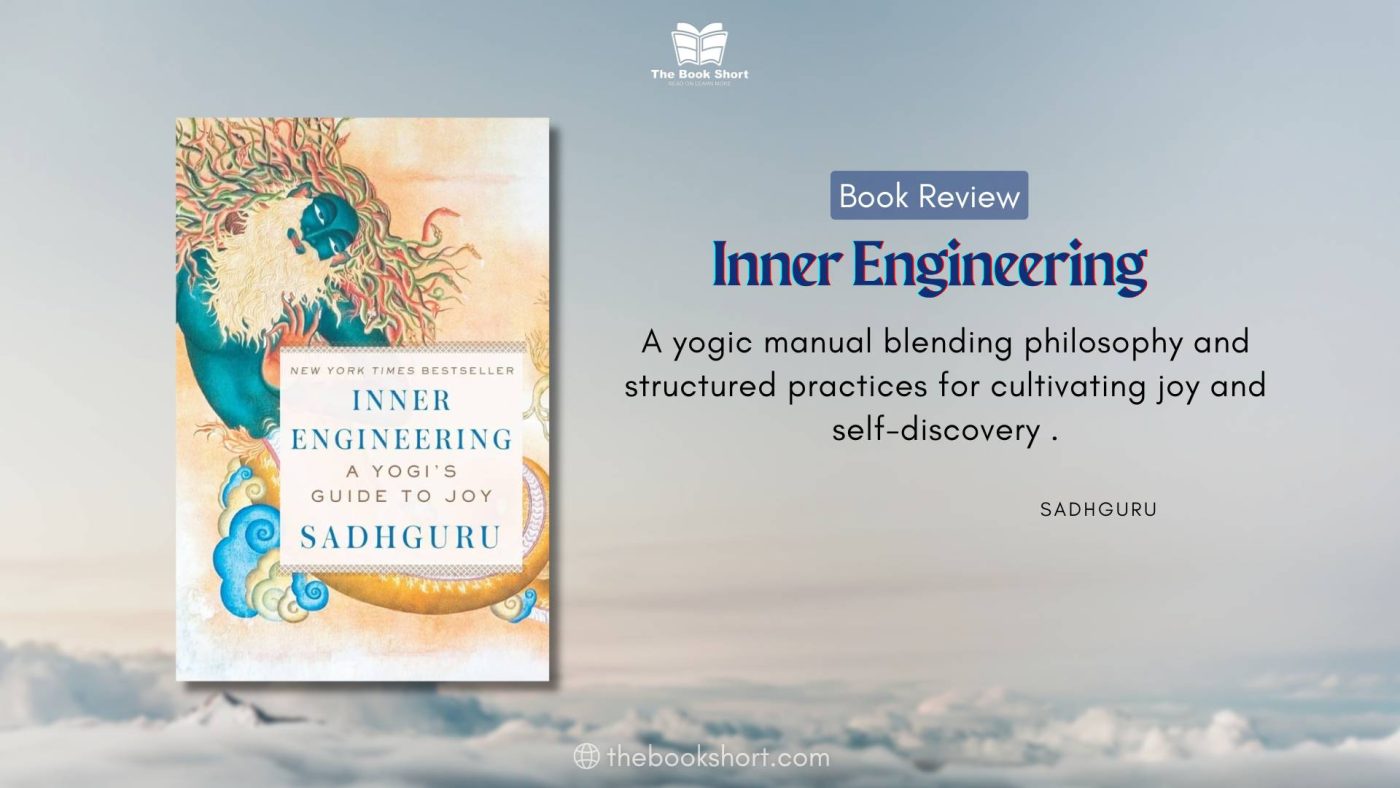
Unlock your inner potential and discover a pathway to lasting joy. Explore this Inner Engineering book summary and review to find Sadhguru’s powerful tools for self-transformation and emotional well-being.
Feeling restless, overwhelmed, or simply searching for deeper purpose and peace in a chaotic world? Inner Engineering: A Yogi’s Guide to Joy by Sadhguru Jaggi Vasudev offers a compelling invitation to shift your perspective entirely. It promises not just temporary fixes but practical, profound wisdom drawn from ancient yogic science, tailored for the challenges of modern life. This isn’t just a book to read; it’s a guide designed to help you consciously sculpt the life you truly desire, starting from the most crucial place: within yourself. Its unique blend of timeless insights and actionable methods makes it an essential read for anyone yearning for genuine inner change and a path to experience life in its fullest dimension.
Inner Engineering Book: Basic Information
- Title: Inner Engineering: A Yogi’s Guide to Joy
- Author: Sadhguru Jaggi Vasudev
- Year of Publication: 2016
- Genre: Self-help, Spirituality, Yoga, Mindfulness, Personal Development, Eastern Philosophy
- Number of Pages: Approximately 272 (varies by edition)
- Target Audience: Individuals seeking practical methods for personal growth, emotional well-being, and spiritual exploration, regardless of background. Ideal for those looking for self-transformation tools rooted in ancient wisdom.

Inner Engineering: A Yogi's Guide to Joy
Inner Engineering Book Summary
Inner Engineering: A Yogi’s Guide to Joy transcends the typical self-help format. It functions as a user’s manual for the most sophisticated machine on the planet – the human being. Sadhguru, a widely recognized mystic and yogi, presents a powerful system rooted in classical yogic science, yet translated into a language accessible and relevant to the modern mind. The book’s fundamental promise is to empower individuals to become conscious architects of their inner state, moving beyond being slaves to compulsive reactions towards living with conscious choice and finding inner peace.
The book unfolds much like an exploratory journey, meticulously dismantling common human struggles and illuminating the latent potential within each of us.
Part 1: The Dilemma
Sadhguru confronts the fundamental human predicaments head-on: the pervasive presence of stress, suffering, and the relentless, often fruitless, search for happiness in the external world. He posits a radical, yet simple, truth: most of our problems originate not from outside circumstances, but from our own internal landscape – our inability to skillfully manage our thoughts, emotions, and life energies. He challenges the deeply ingrained belief that joy is something to be acquired from external sources, asserting that true, lasting joy is our fundamental nature, an inner state that can be cultivated. This foundational section compellingly highlights the urgent necessity of “inner engineering” as a vital skill for navigating the complexities and contradictions of life.
- The Source of Suffering: Understand that while pain is physical, suffering is primarily a psychological creation.
- Beyond Fleeting Happiness: Explore the distinction between transient pleasure and a profound, lasting state of joy.
- Embracing Responsibility: Recognize that your experience of life is shaped by your internal response, not merely by external events.
Part 2: The Body
This section delves into the physical body with a yogic perspective, seeing it not merely as a biological entity but as a dynamic system intertwined with energy and intelligence. Sadhguru discusses the profound impact of seemingly simple aspects like food, sleep, and physical posture on our inner state. He introduces foundational concepts from yogic anatomy, such as the pancha bhutas (five elements), illustrating how aligning our physical existence with natural rhythms is crucial for vitality and well-being.
- Conscious Nourishment: Explore the energetic impact of the food we consume.
- Rest and Rejuvenation: Understand the deeper dimensions of sleep beyond mere physical recovery.
- Respecting the Vehicle: Learn how to optimize the physical body as a foundation for higher possibilities.
Part 3: The Mind
Sadhguru turns his focus to the often-unruly nature of the mind, frequently likened to a “monkey mind” due to its incessant activity and lack of focus. He illuminates how our thoughts and emotional patterns are largely habitual and driven by deep-seated impressions (samskaras). This part offers profound insights into the mind’s mechanisms and underscores the importance of gaining distance from its constant chatter to prevent it from dictating our life experience. He emphasizes the transformative power of perception – how our interpretation of reality fundamentally shapes our inner world.
- Understanding the Mind: Observe the relentless patterns of thought without getting entangled.
- Breaking Compulsive Cycles: Gain awareness of mental habits that limit potential.
- The Power of Perception: Realize how shifting your perspective can transform your experience of life.
Part 4: The Energy
This section serves as a vital bridge, introducing the concept of life energy (prana) and the subtle energetic anatomy within the human system (including chakras and nadis). Sadhguru explains that true mastery over oneself is intrinsically linked to gaining mastery over one’s energy. He asserts that energy is the fundamental force animating physical, mental, and emotional processes. By learning to access, channel, and direct this energy, one can unlock immense potential, cultivating a state of deep inner stability and vibrancy.
- Decoding Prana: Understanding the vital life force and its flow.
- Subtle Energetic System: An accessible introduction to nadis and chakras.
- Energy Management Techniques: The key to unlocking profound inner mastery and vitality.
Part 5: The Yoga
Here lies the practical heart of the book, where Sadhguru introduces core yogic practices as a direct means to apply the insights gained. He clarifies that “yoga” in its profound sense is not merely physical postures (asanas) but a comprehensive technology designed to bring the entire system – body, mind, and energy – into perfect alignment and ultimately, union (which is the literal meaning of ‘yoga’). He introduces the principles behind powerful energy-based practices like Shambhavi Mahamudra Kriya (explaining its potential and the necessity for initiation) and outlines the different classical paths of yoga (Jnana, Karma, Bhakti, Kriya). The emphasis throughout this part is on consistent yogic practice as the indispensable pathway to consciously engineer one’s inner state.
- Yoga as a Science: Explore yoga as a precise technology for self-transformation, not just exercise.
- The Four Paths: Understand different approaches to union (knowledge, action, devotion, energy).
- Introduction to Kriya: Learn about the principles of energy-based practices and their transformative power (mentioning Shambhavi’s significance).
Part 6: The Journey
The concluding section gracefully weaves together all the preceding concepts, framing Inner Engineering as an ongoing process of self-discovery and conscious evolution. Sadhguru paints a compelling picture of the possibility of living a life defined by conscious creation rather than being driven by accidental reactions. He touches upon the ultimate potential of human existence – realizing one’s absolute nature and experiencing life in its most profound dimension. This part serves as both encouragement and a powerful vision for the liberating possibilities that unfold when one wholeheartedly commits to the path of inner transformation.
- Living Consciously: Cultivating the ability to respond rather than merely react to life.
- Exploring Ultimate Potential: Glimpsing states of being beyond the ordinary human experience.
- Engineering a Life of Joy: A vision for consciously cultivating lasting bliss and vitality from within.
Throughout these sections, Sadhguru masterfully employs relatable anecdotes, potent analogies, and clear, logical arguments to demystify complex concepts. The overarching message is that the human system is indeed the most intricate mechanism on the planet, and “Inner Engineering” offers the essential blueprint – the user manual – for operating it at its optimal capacity, leading naturally to a life imbued with health, joy, and vibrant vitality. The book serves as a powerful call to action, urging readers to transition from being passive passengers in their own lives to becoming the conscious, empowered drivers of their inner experience.
Inner Engineering Book Analysis
Sadhguru’s Inner Engineering distinguishes itself significantly within the vast landscape of self-help literature by firmly rooting its methodologies in time-tested ancient yogic science, moving beyond contemporary psychological frameworks or purely motivational strategies. The central, powerful argument is that genuine well-being and joy are not external achievements to be pursued or acquired, but rather an intrinsic, internal state that is fully within our capacity to consciously create, cultivate, and sustain.
Key Arguments & Structure
The bedrock message is that suffering is fundamentally a consequence of our inner state, particularly the untamed mind and unmanaged energies, and that critically, we possess the inherent capacity to engineer this state for our profound benefit. The book systematically and logically unpacks common misunderstandings surrounding happiness, stress, anxiety, and the often-underestimated human potential.
The structure is elegantly logical and builds progressively:
- Identifying the Universal Problem: Clearly articulates the shared human dilemma of suffering that persists despite material comforts.
- Understanding the Internal Mechanism: Explores the physical body, the thinking mind, and the subtle energy system as interconnected, operable components.
- Presenting the Ancient Solution: Introduces yogic science as a powerful technology for gaining mastery over this internal system.
- Pointing Towards Practical Application: Highlights specific practices (particularly Kriya Yoga principles) as potent tools for achieving inner transformation.
- Envisioning the Possible Future: Describes the liberating potential of living a life of profound joy and vitality.
This systematic progression renders complex yogic philosophies remarkably digestible for a modern, often skeptical, audience. While the book provides the essential theoretical foundation and a deep understanding of the principles, it openly states that the most transformative tools (like Shambhavi Mahamudra) require personal transmission. This strategic approach subtly encourages readers to explore the full Inner Engineering program offered by Sadhguru’s Isha Foundation, framing the book as an essential prerequisite for deeper engagement.
Writing Style & Content Quality
Sadhguru’s writing style is undeniably one of the book’s strengths: it’s direct, compelling, and possesses a distinctly engaging, conversational quality. It’s frequently punctuated with sharp wit, profound insights, and relatable anecdotes drawn from his vast experience and interactions with people worldwide. He possesses a remarkable ability to use simple, accessible language to illuminate incredibly profound and subtle concepts, making the wisdom of yoga and spiritual growth accessible to a very broad audience, regardless of their prior knowledge. His use of analogies, like comparing the human system to a “supercomputer,” is particularly effective in bridging ancient wisdom with contemporary understanding.
The content quality is exceptional in its ability to present a cohesive, logical philosophy and a clear framework for radical self-transformation. However, it is crucial to appreciate that the book articulates a specific yogic perspective rooted in Sadhguru’s lineage and experiential understanding. While it resonates with many universal principles found in classical yoga traditions, it is undeniably interpreted and presented through his unique lens. The book’s power lies in its crystalline clarity, its unwavering focus on practical, actionable insights, and its ability to inspire, even if the most potent practices are not fully detailed within its pages.
What Stands Out
What truly elevates Inner Engineering above many other books in its category is its central emphasis on the concept of engineering. It deliberately moves away from mere philosophical musings or motivational platitudes. Instead, it presents the human system as a sophisticated mechanism with specific, discoverable principles and levers that, when understood and operated correctly, can yield predictable and profound results. This framing, which highlights the ‘technology’ aspect of yoga for well-being, instills in the reader a powerful sense of agency and control over their inner environment, fundamentally shifting them away from a posture of victimhood towards conscious creation. The logical, sometimes almost scientific, explanations offered for concepts often perceived as mystical make it particularly appealing to a rational, modern mind. The promise offered is not abstract happiness, but tangible states of health, clarity, vitality, and deep inner peace achievable through diligent, specific methods.
Notable Quotes from the Book
These quotes resonate with the book’s core philosophy and serve as powerful reminders:
- “Suffering is not a result of external situations, but of the way you are within yourself.” (Emphasizing personal responsibility for inner state)
- “Your life is your doing. You are the architect of your destiny.” (Highlighting conscious creation and personal agency)
- “Joy is not something you get from somewhere. It is who you are.” (Revealing joy as an intrinsic state, not an external pursuit)
- “Yoga is not a religion, philosophy or ideology. It is a technology for inner wellbeing.” (Positioning yoga as a practical technology for self-transformation)
- “If you manage your energy, you manage everything.” (Underscoring the importance of energy management for holistic well-being)
This analysis confirms that the book compellingly advocates for prioritizing inner work and provides a robust, structured approach based on ancient wisdom, presented in a modern, highly accessible, and actionable format.
Evaluation & Expert Personal Review: Inner Engineering Book
Engaging with Inner Engineering felt like encountering a refreshing clarity in a often-muddled space. Having explored various mindfulness and self-help methodologies, Sadhguru’s unflinching directness and his powerful framing of the human system as a technology resonated deeply. The book doesn’t merely advise you to ‘be positive’ or ‘meditate’; it meticulously unpacks the why behind inner struggles and, more importantly, lays a convincing foundation for the how – through conscious mastery of your body, mind, and energy.
Personal Impressions
Advantages:
- Logical & Compelling Framework: Sadhguru constructs a remarkably logical argument for the necessity of inner engineering, using simple yet potent examples that make complex yogic philosophy relatable and convincing.
- Empowering Message: The core message profoundly empowers the reader, squarely placing the responsibility and the capacity for well-being and joy back into the individual’s hands.
- Gateway to Practice: While it doesn’t provide the full instructions for the core Kriya, it brilliantly articulates the need for and the potential power of energy-based practices, serving as a powerful motivator for deeper exploration.
- Demystifies Yoga: The book successfully reframes yoga from being perceived as mere physical exercise or a religious practice into a sophisticated science or technology for profound inner alignment and well-being.
- Engaging & Authentic Voice: Sadhguru’s unique voice – insightful, witty, challenging, and deeply authentic – shines through, making the reading experience consistently engaging and inspiring.
Disadvantages:
- Serves as an Introduction: The book functions, in part, as a comprehensive introduction to the full Inner Engineering program offered by the Isha Foundation. Accessing the most transformative practice (Shambhavi Mahamudra) requires further commitment beyond the book itself, which might frustrate readers seeking immediate, complete instructions within the book alone.
- Experience-Based Assertions: Some explanations, particularly concerning the subtle energy body and the effects of practices, are presented as assertions rooted in yogic experience and tradition rather than relying solely on conventional scientific evidence. Readers seeking only empirically verifiable data might find this aspect challenging.
- Simplification: While crucial for accessibility, some topics might be presented with a degree of simplification. Readers with extensive backgrounds in Western psychology, philosophy, or comparative religion might notice this.
Readability Level & Suitability
The book is highly accessible and exceptionally readable. Written in clear, relatively straightforward English, it successfully avoids unnecessary jargon. Complex concepts are introduced gradually and illuminated with relatable anecdotes and powerful analogies, making them easy to grasp.
Suitable for:
- Anyone experiencing persistent stress, anxiety, or a sense of unfulfilled potential despite external circumstances.
- Individuals intrigued by yoga and meditation but seeking a rational, non-religious, and highly practical approach.
- People interested in exploring the mind-body-energy connection from a holistic, energetic perspective.
- Those actively searching for actionable strategies for managing emotions, thoughts, and stress.
- Readers open to exploring ancient Eastern wisdom presented in a compelling, contemporary context focused on tangible self-transformation.
Less suitable for:
- Readers specifically seeking a purely academic, peer-reviewed psychological text on consciousness or well-being.
- Those whose primary interest is detailed instruction on complex Hatha Yoga postures or specific meditation techniques (the book focuses on Kriya principles and energy management, not physical poses).
Practical Value
The profound practical value of Inner Engineering lies in its capacity to catalyze a fundamental shift in perspective and powerfully inspire action.
- Transformative Mindset: It offers a radical re-framing of suffering and happiness, firmly placing the agency and capacity for well-being within the individual.
- Cultivating Awareness: The book is a potent tool for encouraging introspection, self-observation, and a heightened conscious awareness of one’s internal landscape – thoughts, emotions, and physical sensations.
- Foundation for Practice: While the full Kriya isn’t detailed, the book provides a powerful, logical argument for the necessity and efficacy of energy-based practices as a path to inner mastery. The preparatory concepts and steps outlined are valuable in themselves.
- Immediate Applicability: Principles such as taking personal responsibility for one’s internal state, understanding the mechanics of the mind, and conscious use of body and energy can be immediately integrated into daily life, potentially improving interactions, decision-making, and overall emotional well-being.
In summary, Inner Engineering is a remarkably impactful and accessible introduction to the profound possibility of consciously shaping one’s internal reality. It serves as an exceptional starting point for anyone genuinely committed to personal growth and spiritual exploration through the powerful lens of yogic science, even with the understanding that the deepest tools require engagement beyond the book’s covers.
Inner Engineering Book Comparison with Similar Books
Inner Engineering firmly belongs to the categories of self-help, spirituality, and personal development, yet it carves out a distinctive and compelling niche primarily through its core framing of yogic science as a technology for well-being.
Compared to purely motivational or positive-thinking books (e.g., works by Tony Robbins or Napoleon Hill), Sadhguru’s approach delves far deeper than merely altering thought patterns or setting goals. It addresses the fundamental energy system and advocates for disciplined, structured yogic practices as the means to achieve lasting change.
Compared to traditional philosophical or religious texts, Inner Engineering is overtly practical, secular in its presentation, and less concerned with dogma. It successfully translates ancient wisdom into a modern, results-oriented framework focused on inner transformation.
Compared to books focused solely on mindfulness or meditation (like those by Jon Kabat-Zinn), while there’s overlap in cultivating awareness and present moment focus, Inner Engineering places a significant, unique emphasis on the energetic dimension and the potential for profound shifts through Kriya (energy-based) practices – a focus less common in mainstream Western mindfulness literature.
Compared to books primarily centered on Hatha Yoga (physical postures), Inner Engineering positions physical yoga primarily as preparatory. Its focus is less on the complexity of asanas and more on the ultimate purpose of yoga as inner alignment, union, and energy management.


If readers connected with Inner Engineering, they might also find value in exploring:
- Autobiography of a Yogi by Paramahansa Yogananda: Offers a broader historical and spiritual context for various yogic traditions, including a detailed account of Kriya Yoga lineages.
- The Power of Now by Eckhart Tolle: Provides a powerful, complementary focus on cultivating presence, awareness, and transcending the limitations of the egoic mind.
- Spiritual Liberation by Michael Bernard Beckwith: Another inspiring work emphasizing personal agency, conscious creation, and the power of inner work, though from a different spiritual path perspective.
- Select works or talks by contemporary spiritual teachers who bridge ancient spiritual insights with modern life, potentially including accessible texts on energy concepts or consciousness, though Sadhguru’s specific “engineering” metaphor and Kriya focus remain quite distinctive.
Ultimately, Inner Engineering offers a compelling, highly actionable, and profoundly insightful entry point into the transformative potential of yogic science for enhancing well-being in contemporary life. It stands out for its exceptional clarity, logical progression, and powerful argument for the inherent human capacity for conscious inner creation.
Inner Engineering Book: Conclusion & Recommendations
Inner Engineering: A Yogi’s Guide to Joy by Sadhguru is an exceptional and truly valuable contribution that distills profound yogic wisdom into an accessible, practical guide for modern living. Its outstanding value lies in its revolutionary premise: presenting inner well-being and joy not as elusive states dependent on luck or external circumstance, but as tangible possibilities achievable through conscious effort and intelligent design – a process Sadhguru masterfully terms “inner engineering.”
The book provides a crystalline clear, logical framework for understanding the interconnectedness of the human system (body, mind, and energy) and builds a powerful case for why taking conscious charge of our inner state is the single most crucial factor in cultivating a joyful, healthy, and truly fulfilling life. It deeply empowers the reader by highlighting their inherent capacity to actively create their life experience, liberating them from the feeling of being a passive recipient of life’s inevitable ups and downs.
Is it worth reading? Unequivocally, yes. For anyone who is genuinely seeking deep, lasting self-transformation beyond superficial adjustments, this book offers a profoundly different perspective and a clear pathway forward. It thoughtfully challenges conventional wisdom about happiness and suffering and compellingly points towards practical, powerful solutions rooted in an ancient, time-tested science of well-being.
Who should read it? This book is highly and enthusiastically recommended for:
- Individuals experiencing stress, anxiety, or a pervasive feeling of not living life to their fullest, most vibrant potential.
- Those interested in exploring meditation and yoga but seeking a rational, secular, non-dogmatic, and results-oriented approach.
- People curious about how ancient Eastern philosophy and spirituality can be directly applied to practical self-improvement and emotional management.
- Anyone willing to wholeheartedly take responsibility for their own well-being and explore potent, accessible tools for fostering deep inner change.
While the most powerful, energy-based practices hinted at within the book necessitate further engagement beyond its pages, Inner Engineering is remarkably successful in laying the essential groundwork, igniting hope, and fundamentally shifting the reader’s perspective towards the exhilarating possibility of consciously engineering a life filled with joy, vitality, and inner peace. It stands as a powerful invitation to turn inward and discover the ultimate technology for well-being – the incredible potential residing within the human self.
Have you read this book and experienced its insights? Share your thoughts and reflections in the comments below!