
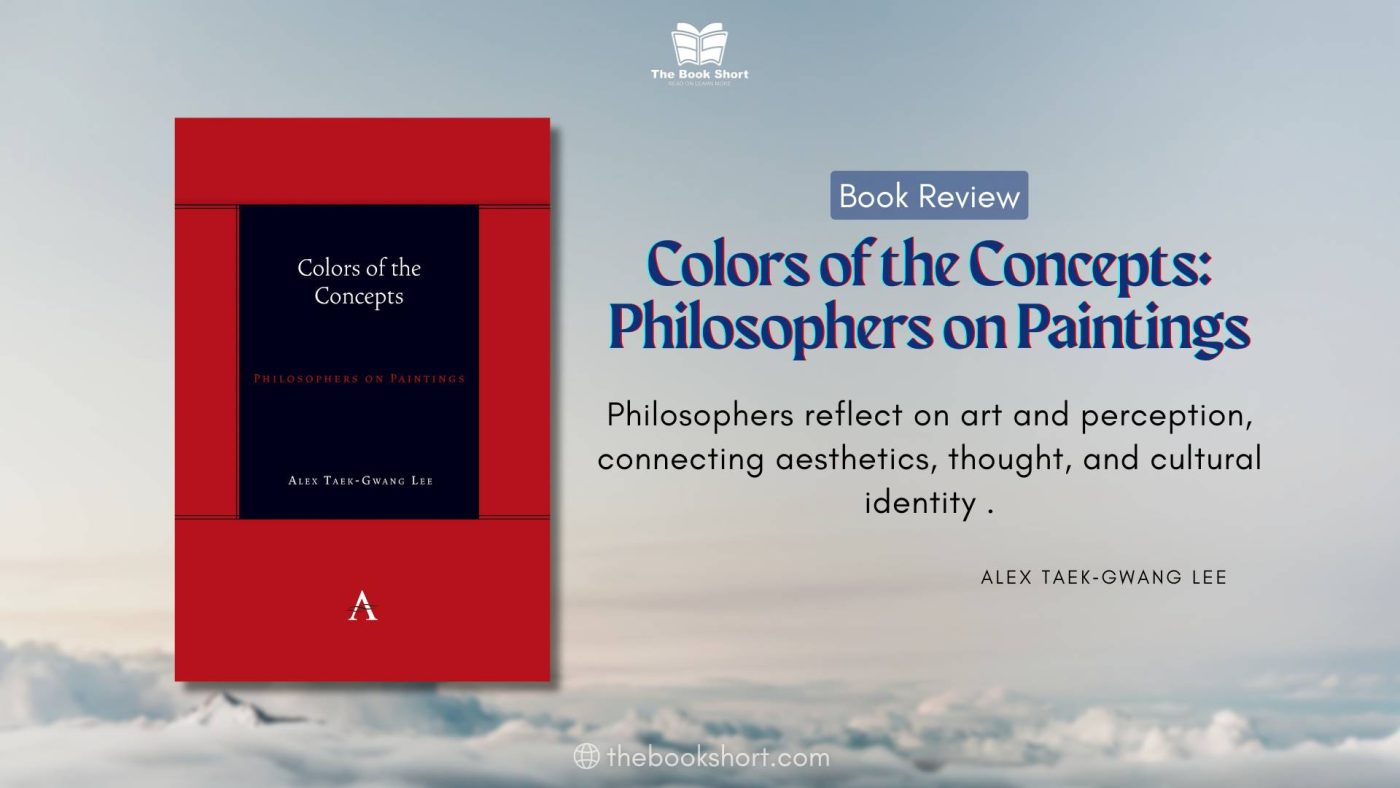
Colors of the Concepts: Philosophers on Paintings by Alex Taek‑Gwang Lee – A Deep Dive
Philosophy and art—two realms often discussed in parallel, yet rarely woven together as intimately and dynamically as in Alex Taek‑Gwang Lee’s Colors of the Concepts: Philosophers on Paintings. As a reviewer fascinated by the dialogue between abstract thought and visual experience, I was drawn to this book for its compelling premise: exploring profound philosophical ideas not through abstract argument alone, but through the tangible, vibrant experience of paintings. Its unique approach promises a rich intellectual tapestry, offering fresh perspectives on both disciplines and how they inform one another.
Essential Information About Colors of the Concepts: Philosophers on Paintings
Getting started with a book that bridges such significant fields requires grounding. Here are the key details about this fascinating work:
- Title: Colors of the Concepts: Philosophers on Paintings
- Author: Alex Taek‑Gwang Lee
- Year of Publication: 2023 (This is the primary recent edition, crucial for understanding its contemporary relevance)
- Genre: Philosophy, Art Theory, Cultural Studies, Aesthetics
- Number of Pages: Approximately 272 pages (Note: Page counts can vary slightly by edition, but this gives a good estimate of its scope)
- Target Audience: Scholars, graduate students, and advanced undergraduates in philosophy, art history, and cultural studies; serious art enthusiasts interested in theoretical approaches; readers engaged with the intersection of critical theory and visual culture.

Colors of the Concepts: Philosophers on Paintings (Anthem symploke Studies in Theory, 1)
Colors of the Concepts: Philosophers on Paintings Summary
Alex Taek-Gwang Lee’s Colors of the Concepts: Philosophers on Paintings invites readers on a remarkable intellectual journey, meticulously demonstrating how enduring philosophical concepts, both classical and contemporary, can profoundly illuminate our understanding of paintings. More powerfully, the book argues that paintings themselves offer unique, sensory insights into complex philosophical ideas. Lee constructs a compelling bridge between these often-separated disciplines, asserting that the visual experience of art is not merely a static object for philosophical contemplation but a vital, active engine for conceptual thought and discovery.
The book’s core argument is refreshingly reciprocal: paintings are not passive recipients of philosophical interpretation, nor are philosophical ideas simply tools for decoding pre-existing artistic meanings. Instead, they are engaged in a dynamic dialogue, actively generating and reflecting philosophical concepts. Lee expertly selects a diverse range of influential philosophers and pairs their key ideas with specific paintings or artistic movements, revealing unexpected connections and deepening our appreciation for the subtle ways mind and image intertwine.
Typically, the book is structured around pivotal philosophical concepts or thinkers. Each chapter or section serves as a focused exploration, applying a particular conceptual lens to visual art. While the precise arrangement flows organically, the general movement involves examining how different philosophical frameworks approach fundamental aspects of painting, such as representation, perception, time, space, subjectivity, and the elusive sublime.
A central thread masterfully woven throughout is the intricate relationship between image and idea. Lee delves deeply into how paintings, through their form, color palettes, composition, and subject matter, don’t just represent reality but actively embody or challenge philosophical notions about truth, appearance, and the nature of being. For instance, a chapter might draw connections between Platonic ideas of forms and mimesis and the ideals seen in Renaissance painting, or perhaps explore Hegelian concepts of spirit and historical evolution by examining works across different historical epochs.
The book also significantly addresses the subjective, embodied experience of viewing art. Philosophical discussions around perception, consciousness, and the viewer’s active role are brought to bear on how we engage with paintings on a fundamental level. This could involve applying phenomenology, as explored by thinkers like Merleau-Ponty, to understand the very act of looking and seeing, or using psychoanalytic theory to interpret the unconscious dimensions embedded in or evoked by artwork, perhaps referencing figures like Freud or Lacan to dissect the complex interplay between the painting and the viewer’s internal world.
Crucially, Colors of the Concepts acknowledges the historical and cultural embeddedness of both philosophy and painting. Neither discipline exists in a vacuum; concepts and artistic styles evolve in constant dialogue with their historical moments. This allows Lee to examine how specific philosophical trends influenced artistic movements (consider Enlightenment thought and Neoclassicism) or how certain paintings emerged as profound visual responses to pressing philosophical questions of their time (like existentialism’s resonance with Abstract Expressionism).
Furthermore, Lee demonstrates a strong engagement with contemporary thought, including critical theory, post-structuralism, and the work of thinkers like Deleuze, Guattari, Foucault, or Rancière. Applying these more recent philosophical perspectives to paintings offers a powerful means to deconstruct traditional interpretations, question established hierarchies, and explore complex themes of power, identity, and resistance within visual culture. This might involve analyzing how contemporary art challenges traditional notions of authorship, authenticity, or even the definition of painting itself, viewed through the lens of postmodern or contemporary philosophy.
Specific examples of philosophers and artists discussed are vital to the book’s structure and provide concrete anchor points for the theoretical discussions. While the exact pairings are best discovered through reading the book itself, typical connections one might expect include:
- Plato/Aristotle: Linked to classical or Renaissance art and enduring debates about mimesis and representation.
- Kant: Applied to aesthetics, the sublime, and the interpretation of Romantic landscapes.
- Hegel: Used to understand the historical progression and teleology of art forms.
- Nietzsche: Explored through the Dionysian/Apollonian tension in art or the modernist questioning of traditional values.
- Heidegger: Applied to understanding the essence of art, truth as unconcealment, perhaps famously referencing his analysis of Van Gogh’s peasant shoes.
- Merleau-Ponty: Connected to the embodied experience of perception and painting, especially relevant for artists like Cézanne who explored visual phenomena.
- Deleuze/Guattari: Linked to concepts like the “fold,” sensation, or “becoming” in contemporary art, potentially resonating with abstract or process-based painting.
- Rancière: Employed to analyze the “distribution of the sensible,” the political dimensions inherent in aesthetics, and the rethinking of spectatorship.
The book goes far beyond simply summarizing these philosophies or analyzing the paintings in isolation. Its profound strength lies in the dynamic, living interaction it posits. Lee compellingly argues that paintings provide concrete, sensory anchors for often abstract philosophical concepts, making them more accessible, relatable, and revealing aspects previously unnoticed. Conversely, philosophical concepts offer powerful, nuanced frameworks for interpreting the layers of meaning, intention, and effect within a painting, moving beyond purely formal analysis or historical description.
In essence, Colors of the Concepts doesn’t just propose a method; it embodies a way of seeing and thinking – reading paintings philosophically and reading philosophy through paintings. It posits that great works of art are vibrant reservoirs of conceptual thought, and that philosophical ideas gain essential depth, texture, and color when brought into intimate dialogue with the visual world. The summary highlights a compelling journey through diverse intellectual and visual landscapes, unified by the central, generative question: how do painting and philosophy mutually inform, challenge, and enrich one another? The book aims to equip readers with a new way of seeing, one where every brushstroke potentially resonates with a philosophical question, and every philosophical concept finds a dynamic, visual echo.
In-depth Analysis of Colors of the Concepts: Philosophers on Paintings
Alex Taek-Gwang Lee’s Colors of the Concepts: Philosophers on Paintings is a remarkable and compelling work that stands out in the crowded field of art theory and philosophy. It distinguishes itself by rigorously pursuing the intersection of philosophy and visual art, specifically painting, not merely as a subject of aesthetic theory applied to art, but as a living, breathing site of active conceptual engagement. The book’s central, powerful thesis is that paintings are not passive subjects awaiting philosophical interpretation; rather, they are active participants capable of shaping and even generating philosophical thought. Similarly, philosophical ideas are not just external lenses but find their very substance and “color” within the visual realm of painting.
The author’s key argument is beautifully articulated: philosophical concepts have “colors” – they gain substance, nuance, vitality, and sensory richness when viewed through the immersive lens of paintings. Simultaneously, paintings possess inherent “concepts” – they embody complex ideas, modes of thought, and philosophical questions that can be articulated and profoundly understood through the language and frameworks of philosophy. This dynamic, mutual activation is the intellectual engine driving the book’s insightful analysis.
The structure of the book is typically organized either thematically around key concepts (like representation, perception) or by philosopher, dedicating sections or chapters to exploring how specific philosophical traditions or key thinkers interact with particular works, styles, or historical periods of painting. This provides a clear, navigable framework, guiding the reader through often complex theoretical terrain with the crucial support of concrete artistic examples. The constant movement back and forth from abstract concept to visual painting and back again reinforces the book’s core argument about their intertwined, interdependent nature.
What truly distinguishes Colors of the Concepts from many other books in aesthetics or art history is its specific, unwavering focus on paintings as primary, active interlocutors for philosophical concepts. Many valuable works discuss the philosophy of art or use art as illuminating examples within broader philosophical discourse. Lee, however, positions paintings as almost collaborators in philosophical inquiry, suggesting that the very act of painting and the immersive experience of viewing are inherently conceptual processes. This feels less like a philosophical theory about art and more like a deep, sustained exploration of philosophy manifesting in art, and art giving form to philosophy. The deliberate emphasis on paintings provides a specific constraint and focus, allowing for detailed, visually grounded analysis woven directly into the conceptual discussion, avoiding the diffusion that can occur when discussing “art” in general.
Writing Style & Content Quality
Alex Taek-Gwang Lee’s writing style is undeniably academic and intellectually rigorous, yet it consistently strives for clarity, a necessary endeavor given the inherent complexity of the subjects tackled. He navigates sophisticated philosophical arguments and intricate art historical details with remarkable expertise and command. While the language can be dense at times, demanding focused attention and thoughtful engagement from the reader, it is generally precise, purposeful, and devoid of unnecessary jargon where possible. Crucially, Lee effectively translates abstract philosophical jargon into compelling discussions grounded in tangible visual elements, making the profound connections between mind and image feel concrete and accessible.
The content quality is exceptionally high, reflecting a deep and wide-ranging engagement with both foundational philosophical texts and cutting-edge art historical and theoretical scholarship. The author demonstrates a robust command of the diverse philosophical traditions he employs, seamlessly moving from classical metaphysics to phenomenology, critical theory, and contemporary continental thought. His selection of paintings is not arbitrary; each work is chosen not just as a famous example but as a piece that genuinely resonates with and illuminates the specific philosophical points being made. The true strength lies in the careful, nuanced articulation of how, for instance, Deleuze’s concept of the “fold” might be perceived in the intricate drapery of a Baroque painting, or how Rancière’s challenging ideas about the “distribution of the sensible” can fundamentally alter our understanding and appreciation of abstract art.
Key Concepts Explored in Colors of the Concepts
While specific quotes would require direct access to the text, several notable, overarching concepts are clearly central to Lee’s unique approach and are articulated throughout the book:
- The Painting as a Site of Conceptual Immanence: This powerful idea suggests that philosophical ideas are not merely imposed upon paintings from the outside, but are inherent, embedded within the visual structure, materials, and the very experience of engaging with the artwork.
- The “Coloring of Concepts”: This evocative phrase captures the essence of Lee’s argument – that abstract ideas gain sensory depth, vital specificity, and unique nuance when brought into direct relation with visual phenomena like color, form, light, and texture within a painting.
- The Conceptual Life of Paintings: This concept posits that paintings are not static objects but active participants in thought, capable of generating new understandings, posing philosophical questions, and revealing insights rather than just illustrating existing ones. They possess a kind of intellectual agency.
- Painting as a Philosophical Practice: Lee suggests that the very act of creating and viewing a painting can be understood and engaged with as a mode of philosophical inquiry or experience, where visual exploration leads to conceptual understanding.
These concepts collectively highlight the book’s innovative, non-traditional approach, positioning the interaction between philosophy and painting as a dynamic, mutually generative process rather than a simple one-way street of application or interpretation. The analysis consistently circles back to this central, compelling idea, demonstrating its profound application across a wide array of thinkers and artistic examples.
Evaluation & Expert Personal Review of Colors of the Concepts: Philosophers on Paintings
Alex Taek-Gwang Lee’s Colors of the Concepts: Philosophers on Paintings is, in my estimation, a deeply rewarding and significant read for anyone genuinely interested in the fertile, complex ground where philosophy and art not only meet but merge. My personal impression of this book is overwhelmingly positive, particularly regarding the sheer ambition, intellectual rigor, and successful execution of its central project. The core concept itself – positing paintings not merely as subjects for philosophical thought, but as active participants in philosophical inquiry – feels genuinely fresh, innovative, and highly significant within the field. It deliberately moves beyond the more standard application of aesthetic theory to art and instead proposes a far more dynamic, reciprocal, and vibrant relationship.
The primary, outstanding advantage of the book is its success in vividly demonstrating this proposed reciprocity. Lee doesn’t simply assert that philosophy is relevant to art; he shows you how, through detailed, often surprising, and always insightful analyses of specific paintings using a diverse array of philosophical lenses. This cross-disciplinary approach is intellectually stimulating on multiple levels and truly opens up new avenues for both appreciating the profound depth of art and grasping the often-abstract nature of complex philosophical ideas. It genuinely made me pause, rethink, and ultimately look at certain familiar paintings and philosophical thinkers in fundamentally different ways.
A potential disadvantage, inherent in the very nature of the subject matter and the author’s commitment to intellectual depth, is the readability level. This is unequivocally not a light or introductory text. The book assumes a certain level of pre-existing familiarity with both art history (particularly specific movements and works) and a range of philosophical concepts, spanning from classical metaphysics to contemporary continental thought. Readers new to, say, Deleuzian concepts, Lacanian psychoanalysis, or even Kantian aesthetics might find certain sections challenging, even with the anchors provided by the visual examples. The prose, while commendably clear within its academic context, demands careful attention, intellectual persistence, and a genuine willingness to grapple with abstract and complex ideas.
Therefore, Colors of the Concepts is most suitably aimed at:
- Graduate students, researchers, and scholars in philosophy, art history, art theory, and cultural studies.
- Highly motivated advanced undergraduate students in these related fields.
- Serious, dedicated art enthusiasts with a strong interest in theoretical and philosophical approaches to visual art.
- Readers who actively seek out challenging, interdisciplinary intellectual work that bridges divides between humanities disciplines.
Conversely, it is likely less suitable for casual readers seeking a general introduction to either philosophy or art, or those looking for a simple, uncritical art appreciation guide focusing solely on historical context or formal description.
The practical value of Colors of the Concepts extends far beyond academic discourse; it lies in its capacity to fundamentally transform how we think and how we see. It offers powerful, concrete tools for analysis, effectively teaching readers how to look into paintings for layers of conceptual depth and how to understand abstract philosophical ideas through concrete, sensory visual phenomena. This isn’t just theoretical knowledge confined to the page; it has the potential to change the very act of visiting a museum, engaging with contemporary art, or even reading a philosophical text. It fosters a mindset that actively seeks connections across seemingly disparate fields, encouraging a richer, more integrated understanding of culture, thought, and the human experience. The book provides a sophisticated methodology for critical, philosophical engagement with visual culture, powerfully demonstrating how philosophical concepts can unlock profound layers of meaning beyond traditional formal analysis or historical placement. It equips the dedicated reader with an invaluable conceptual toolkit to analyze and appreciate art in a deeply intellectual, resonant way.
Comparison with Similar Books on Philosophy and Art
Colors of the Concepts: Philosophers on Paintings carves out a distinctive and valuable space within the existing literature on the relationship between philosophy and art. While many books delve into aesthetics (the branch of philosophy explicitly concerned with beauty, taste, and art theory) or offer philosophical interpretations of art objects, Lee’s specific focus on the mutual, active conceptual exchange specifically illuminated through paintings sets it apart.
Consider books like Arthur Danto’s seminal The Transfiguration of the Commonplace, which compellingly examines the philosophical criteria by which something comes to be considered “art,” particularly in the context of modern and conceptual art. While foundational in connecting philosophy and art, Danto’s focus often leans towards ontology (the nature of being) and the “artworld” as a conceptual framework. Lee, conversely, delves more intimately into the content, experience, and conceptual potential inherent within the visual elements and structure of specific paintings themselves as active sites of thought.
Similarly, classic and contemporary works on aesthetics by philosophers such as Kant, Hegel, Heidegger, or contemporary writers often use art as a means to illustrate pre-existing philosophical theories about beauty, the sublime, the nature of representation, or the historical development of consciousness or spirit. Lee, while engaging deeply with these thinkers, frequently reverses the gaze, using the paintings themselves as vibrant springboards for philosophical insight and even as challenging agents that can push the boundaries of established philosophical ideas.
Perhaps closer comparisons could be made with books that explore the work of specific philosophers in profound relation to art, such as detailed studies focusing on Heidegger’s influential essay “The Origin of the Work of Art” or Merleau-Ponty’s phenomenological writings on Cézanne and perception. However, Colors of the Concepts distinguishes itself by bringing together a significantly wider array of philosophers and diverse paintings, offering a broader, synthetic panorama of these complex interactions rather than focusing intensely on a single thinker or specific relationship.
Another point of comparison could be made with critical theory approaches to art history, which utilize philosophical frameworks (like Marxism, psychoanalysis, post-structuralism) to deconstruct and analyze art’s social, political, and psychological dimensions. While Lee’s work engages with critical theory, it feels more fundamentally rooted in a direct philosophical exposition alongside detailed art analysis, seeking a mutual illumination rather than solely using theory as a framework for deconstruction, though deconstruction is certainly a tool employed.


For readers who found Colors of the Concepts particularly engaging due to its rigorous interdisciplinary approach and the detailed application of philosophical ideas to visual art, several other titles might offer similar intellectual satisfaction, though with different emphases:
- Arthur Danto, The Transfiguration of the Commonplace: Essential for understanding a key philosophical argument about the nature and status of art in the 20th century.
- Maurice Merleau-Ponty, “Cézanne’s Doubt” (essay) or sections of Phenomenology of Perception: Offers a profound philosophical exploration of perception, embodiment, and vision directly relevant to the act of painting and viewing.
- Martin Heidegger, “The Origin of the Work of Art”: A challenging but foundational essay exploring the essence and truth-revealing power of the work of art.
- Georges Didi-Huberman’s works (e.g., Before the Image, Beyond the End): Many of his writings compellingly combine deep philosophical engagement (drawing heavily on phenomenology, critical theory, and psychoanalysis) with intensely detailed, insightful analysis of specific images.
- Gilles Deleuze, Francis Bacon: The Logic of Sensation: A singular, dedicated philosophical analysis of the work of a single painter through the unique lens of Deleuze’s philosophy.
These suggested readings share the common thread of applying rigorous, complex philosophical thought to visual art, pushing beyond simple appreciation or historical description. However, Colors of the Concepts stands out for its unique framing of paintings as active participants in philosophical dialogue and its specific argument for their capacity to “color” or give substance to abstract concepts.
Conclusion & Recommendations
Colors of the Concepts: Philosophers on Paintings by Alex Taek-Gwang Lee represents a significant and highly valuable contribution to the ongoing, vital dialogue between philosophy and art. Its outstanding value lies in its unique, compelling, and rigorously executed argument that paintings are not merely passive objects for philosophical scrutiny but active participants that can profoundly color and deepen our understanding of complex abstract concepts. Simultaneously, philosophical ideas provide essential frameworks, keys that unlock the layers of conceptual richness inherently present within paintings.
This book is absolutely, unequivocally worth reading for anyone with a serious, sustained interest in either philosophy or art, and especially for those who are drawn to or benefit from genuinely interdisciplinary approaches that reveal hidden connections between different fields of knowledge. It actively challenges conventional, siloed ways of viewing both disciplines, offering a powerful methodology for uncovering the deep intellectual dimensions of visual art and revealing the sensory, lived “colors” within abstract philosophical thought.
It is highly recommended for scholars, graduate students, and advanced undergraduate students specializing in philosophy, art history, art theory, and cultural studies. It is also exceptionally suitable for dedicated art enthusiasts with a strong theoretical or philosophical bent who are eager to deepen their engagement with art beyond formal or historical analysis. While it demands intellectual effort and is challenging at times, the intellectual rewards are substantial, providing a fresh, dynamic perspective that can enrich both academic study and personal appreciation for years to come.
Have you embarked on this intellectual journey through the colors of concepts? Share your thoughts and impressions of the book in the comments below!