
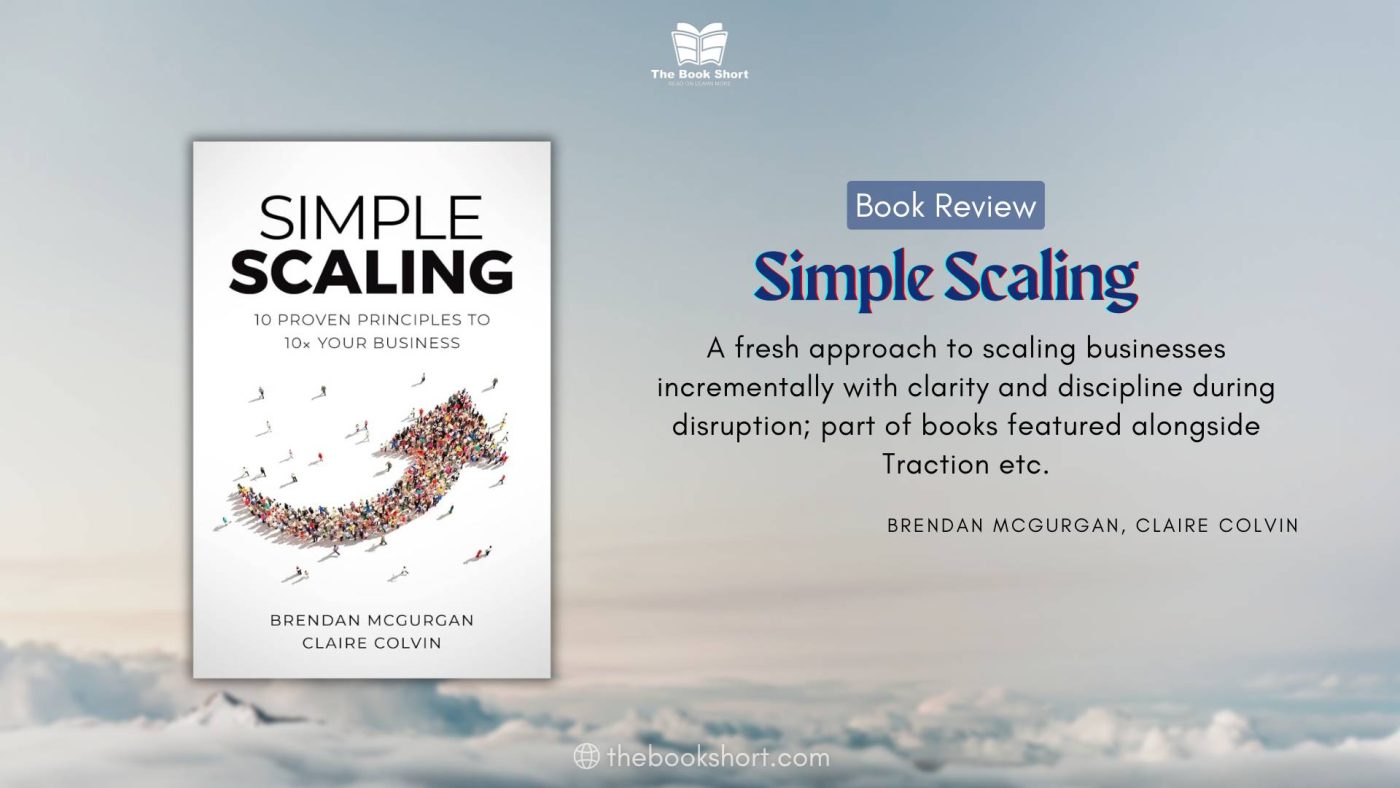
Unlock sustainable growth with our Simple Scaling book summary. This review breaks down the powerful, no-nonsense framework for scaling your business beyond the £10m ceiling.
Are you a CEO drowning in the complexity of most scaling frameworks? This “Simple Scaling” book analysis explores a refreshingly direct guide for leaders with ambition. I was drawn to this book because it rejects abstract theory in favor of a clear, actionable roadmap. Its true value lies in a structured, battle-tested approach, designed by founders who have personally navigated the treacherous journey from scrappy startup to disciplined scale-up. It’s an essential read for any leader ready to pursue exponential, sustainable growth.
Key Information: A Simple Scaling Book Overview
- Full Title: Simple Scaling: 10 Proven Principles to 10x Your Business
- Author: Brendan McGurgan, Claire Colvin
- Year of Publication: 2022
- Genre: Business, Entrepreneurship, Leadership, Management
- Number of Pages: 288
- Target Audience: CEOs, founders, and leadership teams of businesses aiming to break through the £1m-£10m revenue plateaus.

Simple Scaling: Ten Proven Principles to 10x Your Business
A Comprehensive Summary of the Simple Scaling Book
“Simple Scaling” by Brendan McGurgan and Claire Colvin is far more than a book; it’s a meticulously crafted playbook for business leaders trapped in the chaotic “messy middle” of growth. The authors distill decades of hard-won experience as entrepreneurs and advisors into a single, cohesive framework: the ScaleX™ Model. This model is anchored by 10 proven principles designed to help businesses shatter growth ceilings and achieve 10x results. The book is logically structured around these principles, offering a step-by-step guide to architecting a truly scalable and resilient enterprise.
Its core argument is that scaling isn’t about chasing a single “silver bullet.” It demands a holistic, disciplined systemisation across every function of the business. McGurgan and Colvin provide the tools, metrics, and crucial mindset shifts required to execute this approach with confidence and clarity.
Part 1: The Foundation of Scale – Mindset and Strategy
Before any operational gears can turn, the initial chapters zero in on the leader’s role and the company’s strategic bedrock. McGurgan and Colvin argue persuasively that scaling starts and ends with the CEO.
- Principle 1: The Scalable CEO: The book’s opening salvo is a powerful one: a business cannot outgrow its leader. This section masterfully details the profound transition a founder must make from a hands-on “doer” to a strategic leader of leaders. Key themes include the art of delegation, focusing only on high-value activities, and cultivating the emotional resilience needed to withstand the immense pressures of growth. The CEO must evolve to work on the business, not just get lost in it.
- Principle 2: The Strategic Imperative: This chapter provides a blueprint for forging a strategy that is clear, compelling, and easy to communicate. The authors guide readers in defining a magnetic vision, identifying a core ideal customer, and cementing a unique value proposition. They stress that a robust strategy is a filter for every future decision, ensuring the entire organization pulls in the same direction. Without this sharp focus, all other scaling efforts are wasted.
Part 2: Building the Growth Engine – The ScaleX™ Model Pillars
The heart of the book is a deep dive into the core pillars of the ScaleX™ Model. Each principle represents a vital business function that must be optimized and systemized for scale.
The Financial Framework (Principle 3)
Finance is positioned not as a back-office function, but as the universal language of the business and the fuel for growth. The authors elevate the conversation beyond basic accounting to the strategic financial levers that truly drive a scaling company.
- Key Concepts:
- Cash Flow vs. Profit: Reinforcing that “cash is king,” they provide practical tools for creating robust cash flow forecasts to avoid the most common cause of business failure.
- Unit Economics: Mastering the profitability of a single customer by calculating Lifetime Value (LTV) vs. Customer Acquisition Cost (CAC).
- Funding for Growth: A pragmatic guide on when, why, and how to seek investment without sacrificing control of your vision.
The People Powerhouse (Principle 4)
This section powerfully argues that a company’s only true sustainable advantage is its people. The central challenge of scaling is to consistently find, develop, and retain “A-Players” who are deeply aligned with the company’s culture and values.
- Key Actions:
- Recruitment: Building a disciplined, repeatable hiring process designed to attract and identify top-tier talent.
- Onboarding: Designing a structured onboarding experience that rapidly immerses new hires in the culture and accelerates their time-to-impact.
- Performance Management: Establishing radical clarity around roles, responsibilities, and KPIs to foster a culture of accountability and high performance.
The Sales Machine (Principle 5)
Sustainable scaling demands a predictable, repeatable sales process that moves beyond founder-led selling. This chapter details precisely how to construct a high-performing sales engine that generates consistent revenue.
- Building Blocks:
- Developing and documenting a structured sales methodology.
- Implementing a CRM and using data to manage the sales pipeline with ruthless efficiency.
- Creating a smart compensation plan that incentivizes and motivates the right behaviors.
The Marketing Engine (Principle 6)
Marketing must transform from a series of random acts into a strategic, data-driven function that generates a predictable flow of qualified leads for the sales team.
- Focus Areas:
- Brand Positioning: Carving out a clear, distinct identity that answers the question: “Why should a customer choose us?”
- Lead Generation: Building a multi-channel marketing plan to reliably fill the top of the sales funnel.
- Metrics that Matter: Moving beyond vanity metrics to track vital KPIs like Marketing Qualified Leads (MQLs) and conversion rates to prove ROI.
The Operational Platform (Principle 7)
As a business grows, so does its complexity. This principle is about creating the systems and processes that allow the business to operate with efficiency and consistency at scale, liberating it from a dependency on individual heroics.
- Core Ideas:
- Mapping, documenting, and optimizing core business processes.
- Leveraging technology to automate repetitive tasks and free up human potential.
- Building quality controls to ensure the customer experience improves, not degrades, as volume increases.
Part 3: Execution and Leadership
The final principles masterfully tie everything together, focusing on the operational rhythm and leadership discipline required to execute the plan and guide the organization through change.
- Principle 8: The Execution Rhythm: A brilliant strategy is worthless without world-class execution. The authors introduce a powerful cadence of meetings (daily, weekly, monthly, quarterly) to drive alignment, accountability, and rapid problem-solving. This rhythm becomes the operational heartbeat of the organization.
- Principle 9: The Customer Centricity: This chapter serves as a vital reminder that the customer must remain at the heart of every single decision. It offers practical frameworks for gathering customer feedback, measuring satisfaction (e.g., Net Promoter Score), and embedding a customer-first ethos deep within the company culture.
- Principle 10: The Leadership Cadence: The final principle brings the focus back to the leadership team. It outlines how to build a cohesive, high-trust executive team that can lead with a unified voice, champion change, and drive the scaling journey forward with unwavering resolve.
An In-depth Book Analysis of Simple Scaling
“Simple Scaling” enters a crowded arena of business growth literature but confidently carves out its own territory through a pragmatic structure, accessible language, and an relentless focus on implementation. This analysis explores the book’s core arguments, distinctive voice, and what truly sets it apart.
Characters / Structure / Key Arguments
While a non-fiction book lacks fictional characters, the protagonist here is unequivocally the ambitious yet overwhelmed CEO. McGurgan and Colvin write directly to this leader, intimately addressing their specific pain points: the creeping chaos of growth, the frightening loss of control, and the personal challenge of evolving their own role. The book’s structure is its greatest triumph. This is not a collection of disconnected essays; it is a meticulously engineered system—the ScaleX™ Model.
The central argument is that sustainable scaling is a science, not a dark art. It demands disciplined systems, not sporadic bursts of hustle. The 10 principles unfold in a brilliantly logical progression:
- Scale the Leader: The CEO must transform first.
- Set the North Star: A crystal-clear strategy is non-negotiable.
- Build the Machine: Systematize the core functions of Finance, People, Sales, Marketing, and Operations.
- Execute with Rhythm: Install a disciplined cadence focused on the customer and led by a cohesive team.
This structure converts the abstract concept of “scaling” into a tangible, actionable project plan. Unlike more theoretical tomes, “Simple Scaling” is designed as a workbook. Each chapter concludes with piercing questions and concrete action points, forcing the reader to shift from passive learning to active implementation.
Writing Style & Content Quality
The authors’ writing style is a key differentiator. It is:
- Direct and Refreshingly Blunt: The language is crisp, concise, and free of the bloated corporate jargon that plagues so many business books. They speak like seasoned mentors who have the scars to prove their wisdom, not distant academics.
- Action-Oriented: The text is saturated with imperative verbs and practical commands. Phrases like “You must…”, “The critical next step is to…”, and “Implement this by…” reinforce the book’s purpose as an urgent call to action.
- Grounded in Reality: The principles are illuminated with real-world anecdotes and case studies from the authors’ consulting work and their own entrepreneurial battlefields. This adds immense credibility and makes the concepts instantly relatable.
The content quality is exceptional, achieving depth within its chosen framework. While it may not invent wholly new concepts—the importance of people, strategy, and process is well-trodden ground—its profound value lies in the synthesis and simplification. It curates the most vital elements of business growth and presents them in an integrated, easy-to-digest system. The focus is less on the “what” and more on the crucial “how” and “in what order.”
Notable Quotes from the Book
The book is peppered with memorable, direct aphorisms that encapsulate its core philosophy.
- On the CEO’s Role: “A business can’t outgrow its leader. If you want to scale your business, you must first scale yourself.” This quote perfectly captures the essence of the first principle and sets the stage for the entire book.
- On Strategy: “Strategy is about saying no. It’s about making hard choices and committing to a path, even if it means forsaking other attractive opportunities.” This highlights the authors’ emphasis on ruthless focus and disciplined decision-making.
- On Execution: “A world-class strategy with mediocre execution is worthless. A mediocre strategy with world-class execution will always win.” This underscores the book’s practical bias towards implementation over abstract theory.
- On Simplicity: “Complexity is the enemy of scale. Your goal as a leader is to relentlessly simplify—your processes, your message, and your focus.” This quote perfectly summarizes the book’s title and central mission.
Personal Evaluation and Expert Review
Having analyzed countless business scaling methodologies, “Simple Scaling” stands out for its potent combination of clarity and practical utility. It masterfully bridges the chasm between high-level strategic theory and on-the-ground operational reality, making it an indispensable resource for its intended audience.
Advantages:
- Actionable Framework: The ScaleX™ Model is the book’s crown jewel. It’s a comprehensive yet digestible framework that leaders can begin implementing the next day. The end-of-chapter questions and checklists are brilliant tools for honest self-assessment and strategic planning.
- Authenticity and Relatability: The authors have clearly “been there, done that.” Their stories and examples resonate deeply with the common struggles of growing a business, forging a bond of trust and camaraderie with the reader.
- Holistic System: The book wisely avoids the common trap of focusing on a single silo (e.g., only sales or only culture). It correctly insists that all 10 principles are interconnected and must be addressed in concert for sustainable success.
- Exceptional Readability: The prose is direct, engaging, and refreshingly free of academic pretension. It’s written for busy executives who need effective solutions, not dense theories.
Disadvantages:
- The Double-Edged Sword of Simplicity: The book’s greatest strength could be a minor weakness for some. Businesses in highly complex, regulated, or esoteric industries might find the advice somewhat general and may need to supplement it with industry-specific expertise.
- UK/European Centricity: While the principles themselves are universal, many examples and cultural references are rooted in the UK and European markets. This is a minor point, but readers from other global regions might not connect with all of the specific company references.
Readability and Suitability:
The book is highly readable. A motivated leader could easily digest it in a weekend. However, its true power is unlocked by treating it as a reference manual to be revisited quarterly as the business evolves.
This book is perfectly suited for:
- CEOs and Founders of companies with 10-150 employees who feel their growth has become chaotic or hit a plateau.
- Leadership Teams who need to align around a common language and a unified framework for scaling the business.
- Ambitious Entrepreneurs planning for future growth who want to build the right operational foundations from day one.
It is likely less suitable for solopreneurs or very early-stage startups still searching for product-market fit, as its content is squarely aimed at scaling an already-proven business model.
Practical Value:
The practical value of “Simple Scaling” is immense. A leadership team that diligently works through this book together will emerge with:
- A Unified Language for Growth: A common vocabulary to discuss strategy, people, finance, and execution.
- A Clear-Eyed Diagnosis: A sharp understanding of which parts of their business “machine” are broken or underdeveloped.
- A Prioritized Action Plan: A tangible roadmap for what to fix first to unlock the next stage of growth.
Ultimately, the book delivers a crucial mindset shift: from reactive firefighting to proactive, disciplined business architecture.
Simple Scaling Book Comparison: How It Stacks Up
“Simple Scaling” competes in a well-established genre, inviting comparison with other seminal works on business growth. Understanding its position helps leaders choose the right framework for their specific needs.
- Compared to “Scaling Up” by Verne Harnish: “Scaling Up” is often seen as the dense, academic bible of the genre, built around the “Four Decisions” (People, Strategy, Execution, Cash). While undeniably powerful, some leaders find it intimidating and its tools (like the One-Page Strategic Plan) complex to master. “Simple Scaling” acts as a more streamlined and accessible alternative. It covers similar territory but presents it in a simpler 10-principle structure that feels less daunting and faster to implement for teams new to structured scaling.
- Compared to “Traction” by Gino Wickman: “Traction” introduces the Entrepreneurial Operating System (EOS®), a complete, prescriptive system with its own proprietary tools and terminology (V/TO™, Level 10 Meetings™, Accountability Chart™). EOS is renowned for instilling discipline. “Simple Scaling” is philosophically aligned in its focus on systems and rhythm but feels less like a branded, all-or-nothing “system” and more like a flexible toolkit of fundamental principles. Leaders may find McGurgan and Colvin’s approach easier to adapt and integrate into their existing culture.
- Compared to “The E-Myth Revisited” by Michael E. Gerber: “The E-Myth” is the foundational text for understanding the critical mindset shift from “technician” to “entrepreneur.” It masterfully explains why systems are essential for freedom and growth. “Simple Scaling” is the logical next step: it provides the actual systems to build once you’ve embraced the E-Myth philosophy. It’s the “how-to” implementation guide that perfectly follows Gerber’s “why-to.”


If you liked this book, you might also enjoy:
- Traction: Get a Grip on Your Business by Gino Wickman, for a highly structured, all-in-one operating system.
- Scaling Up: How a Few Companies Make It…and Why the Rest Don’t by Verne Harnish, for a deeper, more academic dive into the core pillars of growth.
- The Hard Thing About Hard Things by Ben Horowitz, for a raw, unfiltered look at the brutal realities and gut-wrenching decisions of leading a scaling company.
Conclusion and Recommendations for the Simple Scaling Book
“Simple Scaling: 10 Proven Principles to 10x Your Business” is a premier title in the modern business library. Its genius lies in its brilliant fusion of comprehensive strategy with actionable simplicity. McGurgan and Colvin have crafted a definitive roadmap that demystifies the scaling journey, transforming a daunting, abstract challenge into a manageable, step-by-step process.
Is it worth reading? Absolutely. For its target audience, this book isn’t just worth reading; it’s worth absorbing, debating, and, most importantly, implementing. It delivers the clarity, focus, and disciplined framework that so many leadership teams desperately need to escape the chaotic “messy middle” of growth.
Who should read it? This book is a must-read for CEOs, founders, and senior leadership teams of established businesses (typically in the £1m-£10m+ revenue range) who are serious about building a scalable, resilient, and enduringly valuable enterprise. If you feel like you’re constantly firefighting and that your business’s growth is capped by your own personal capacity, this book was written specifically for you.
Have you read “Simple Scaling”? What was your biggest takeaway? Share your thoughts in the comments below.