
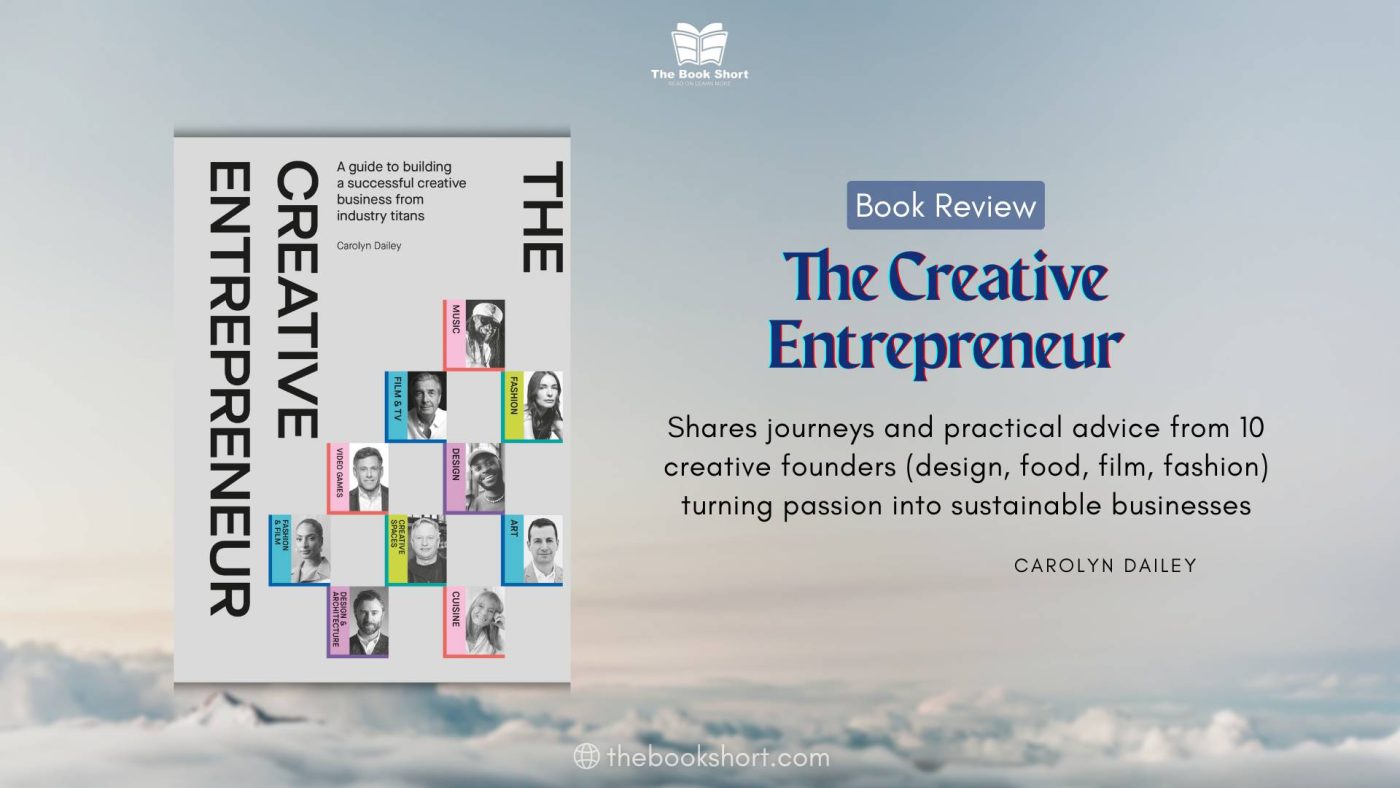
Unlock your creative potential. Our in-depth review of The Creative Entrepreneur reveals the essential insights for transforming your passion into a thriving, sustainable business.
Are you ready to fuse your creative vision with sharp business acumen? This definitive review and analysis of The Creative Entrepreneur by Carolyn Dailey is more than just a guide—it’s a roadmap to sustainable success. I was drawn to this book for its singular, interview-based approach, which brilliantly sidesteps abstract theory in favor of tangible wisdom from founders who have already walked the path. It is this chorus of authentic, battle-tested voices that elevates the book into an indispensable companion for any creative professional daring to build something of their own.
The Creative Entrepreneur: Book Details at a Glance
- Title: The Creative Entrepreneur: A Curation of Inspiration and Wisdom from Creators and Founders
- Author: Carolyn Dailey
- Year of publication: 2021
- Genre: Business, Entrepreneurship, Self-Help, Creative Arts
- Number of pages: 256
- Target audience: Aspiring and established creative entrepreneurs, artists, designers, writers, and anyone seeking to build a business with soul.

The Creative Entrepreneur: A Guide to Building a Successful Creative Business from Industry Titans
The Creative Entrepreneur Book Summary: Key Insights & Takeaways
Carolyn Dailey’s The Creative Entrepreneur is not your typical business manual. It’s a beautifully curated collection of wisdom, a mentorship-in-a-book, drawn from Dailey’s intimate conversations with over 60 visionary founders and creators. From fashion icon Anya Hindmarch to gallerist Pearl Lam, the book weaves together diverse experiences from design, media, and technology. Structured thematically, it guides you through the crucial stages and inherent challenges of building a business that is both profitable and creatively fulfilling.
The Foundation: Forging Your Idea and Identity
The book begins where every creative venture is born: with the spark of an idea and the deep personal identity of its founder. Dailey masterfully illustrates that for creative entrepreneurs, the business is never just a business—it’s a profound extension of their values, aesthetics, and mission.
- Find Your Niche Through Passion: Many of the featured founders didn’t begin with a rigid business plan. They started by spotting a gap in the market that resonated with their personal passion. The core lesson is to cultivate a unique point of view, a perspective so distinct it becomes your greatest competitive advantage.
- The Unwavering Power of Purpose: The book argues that your “why”—the reason you do what you do—is your most vital asset. This purpose-driven ethos provides the resilience needed to weather inevitable storms and serves as a North Star for every decision, from branding to hiring. It’s about building a brand that stands for something far more meaningful than its products alone.
- Embrace Your “Expert Naivety”: Several entrepreneurs reflect on how their initial lack of formal business training was, in fact, a blessing. It empowered them to challenge industry dogma and innovate freely, unburdened by the weight of “how things are supposed to be done.” This section is a powerful call to leverage your fresh perspective as a formidable strength.
The Launch Phase: Building and Funding Your Vision
With a clear identity established, the book navigates the practical, often intimidating, realities of launching. This section demystifies the mechanics of getting a business off the ground, particularly the critical areas of funding and brand creation.
- A Spectrum of Funding Models: The Creative Entrepreneur brilliantly showcases that there’s no one-size-fits-all path to funding. While some, like Farfetch’s José Neves, pursued venture capital for rapid scale, many others, such as perfumer Lyn Harris, embraced bootstrapping, growing organically by reinvesting profits. The message is liberating: the right funding model is the one that aligns with your unique goals for growth and creative control.
- Build a Brand, Not Just a Product: A consistent thread through the interviews is the non-negotiable importance of storytelling. For creatives, the brand is the narrative that forges an emotional bond between the product and its audience. This involves:
- Visual Identity: A coherent and compelling aesthetic that is a true reflection of the brand’s soul.
- Tone of Voice: Communicating in a language that resonates authentically with your tribe.
- Community Cultivation: Building a loyal following by inviting customers to be part of your story, not just consumers of your product.
The Growth Stage: Scaling with Soul
Scaling a creative business presents a unique paradox: how do you grow without diluting the creative essence that made your business special? This section offers priceless advice on leadership, team building, and intelligent expansion.
- Hire for Culture First, Skill Second: The founders unanimously stress hiring people who not only possess the right skills but who also vibrate on the same frequency as the company’s culture and vision. Your first hires set the DNA of the organization. The advice is to look for shared passion and complementary, not identical, skill sets.
- The Founder’s Necessary Evolution: As a business expands, the founder’s role must transform from “creator” to “leader.” This means mastering the art of delegation, empowering your team, and shifting your focus from doing the creative work to directing the creative vision. Many founders speak candidly about the difficulty of this transition, underscoring the need for profound self-awareness.
- Strategic Growth vs. Growth for Growth’s Sake: A central theme is the concept of “thoughtful scaling.” The book is a powerful antidote to the relentless pressure to grow at all costs. For some, success is staying small and exquisite. For others, it’s strategic partnerships or global expansion. The interviews provide a framework for making these choices from a place of mission, not market pressure.
The Human Element: The Mindset of a Creative Founder
Beneath the practical advice lies the book’s beating heart: the psychological and emotional journey of being a founder. Dailey dedicates significant space to the resilient mindset required to build and sustain a creative business for the long haul.
- Cultivating True Resilience: Failure is reframed not as an endpoint, but as a crucial data point. Nearly every entrepreneur shares raw stories of setbacks—from disastrous product launches to financial crises. Their experiences teach that resilience, the muscle that allows you to learn, adapt, and persevere, is the single most important entrepreneurial trait.
- The Symbiotic Dance of Creativity and Commerce: Perhaps the book’s most powerful revelation is its dismantling of the old “art versus commerce” myth. It argues that business constraints, like budgets and deadlines, can be catalysts for creativity, forcing brilliant and innovative solutions. Commerce is not the enemy of art; it is the framework that gives creativity structure, reach, and impact.
An In-depth Analysis of The Creative Entrepreneur’s Core Message
Carolyn Dailey’s The Creative Entrepreneur carves a vital space in the crowded world of business literature by championing narrative over prescription. Its profound strength lies in its journalistic soul, prioritizing lived experience over academic theory to deliver a deeply human analysis of what it truly takes to build a successful creative enterprise.
Structure and Key Arguments
The book’s thematic structure is its genius. Instead of a linear, step-by-step manual, Dailey masterfully curates a mosaic of voices, weaving together quotes and anecdotes from titans of industry (Anya Hindmarch, Jeremy Deller, Sir John Hegarty) to illuminate her core themes. The “case studies” are real people with real, high-stakes stories, lending the advice an unshakeable credibility.
Key Arguments:
- Business as a Creative Medium: The book’s central thesis is a radical and empowering reframing of commerce. Dailey posits that the architecture of business—strategy, finance, marketing, leadership—is not a set of soulless constraints but a powerful creative toolkit. The most successful entrepreneurs treat their business model itself as a primary form of creative expression.
- Authenticity as the Ultimate Business Strategy: In an age of digital noise and mass production, a distinct and authentic voice is the ultimate currency. The book convincingly argues that a creative business must be an honest, undiluted reflection of its founder’s vision. This genuine core is what builds tribes, commands loyalty, and ultimately justifies a premium.
- Resilience Is the Strategy: The myth of the effortless overnight success is systematically dismantled. By laying bare the struggles, pivots, and outright failures of her celebrated subjects, Dailey demonstrates that the true hallmark of an entrepreneur is not the absence of failure, but the tenacity to endure, learn, and grow stronger from it.
Writing Style and Content Quality
Dailey’s writing is that of a master curator and journalist. She wisely recedes as a narrator, allowing the powerful voices of the entrepreneurs to command the stage. Her gift lies in the elegant orchestration of these voices into a coherent and resonant narrative. The language is refreshingly direct, accessible, and completely free of the corporate jargon that suffocates so many business books.
The quality of the content is exceptional, thanks to the sheer caliber of the interviewees. These are not novices; they are seasoned leaders who have forged globally recognized brands. This provides a rare “view from the top”—an altitude of insight that is both aspirational and deeply practical. Where other books teach the “how-to” of starting a business (e.g., registering a company), this one focuses on the “how-to-think” of leading one. It’s a masterclass in mindset, strategy, and leadership philosophy, taught by example.
Notable Quotes from the Book
The book is brimming with memorable wisdom that captures its core philosophy.
- On the essential partnership between business and creativity: “I’ve always thought the worlds of creativity and commerce should be much more collaborative. They feed off one another. If you haven’t got the commerce, the creativity can’t happen, and if you haven’t got the creativity, the commerce won’t happen.” – Sir John Hegarty, Founder, Bartle Bogle Hegarty (BBH)
- On the grit required to see a vision through: “It has been a very, very hard journey and you have to have a real reason for doing it. If you’re not passionate about what you’re doing, you will give up.” – Anya Hindmarch, Founder and Designer
- On the courage to trust your own instincts: “The best advice is not to listen to too much advice. The whole point of being an entrepreneur is to have a point of view and to execute it and to see it through.” – Frédéric Malle, Founder, Editions de Parfums Frédéric Malle
These quotes powerfully illustrate the book’s central tenets: the synergy of art and commerce, the necessity of a purpose-driven fire, and the courage to forge your own path.
Personal Review and Evaluation: Is The Creative Entrepreneur Worth It?
The Creative Entrepreneur is a profoundly inspiring and refreshingly candid read. It acts as both a practical guide and a philosophical anchor for anyone navigating the intersection of creativity and commerce. By grounding every lesson in the lived experiences of its subjects, it masterfully avoids the generic, one-size-fits-all advice that so often falls flat.
Advantages:
- Unmatched Authenticity and Credibility: The interview-based format is the book’s superpower. Learning directly from the founders of brands like Jo Malone, The White Company, and Tate Modern offers an unparalleled level of wisdom and motivation.
- A Holistic Vision: The book brilliantly addresses the entire lifecycle of a creative business—from the fragile first idea to the complexities of scaling—while never losing sight of the crucial human element of entrepreneurship, like mindset and resilience.
- Genuinely Mindset-Shifting: Its most significant impact is in recalibrating the relationship between creativity and business. It empowers artists and makers to see commerce not as a necessary evil, but as a powerful amplifier for bringing their vision to the world.
Disadvantages:
- It’s a Compass, Not a Map: Readers seeking a prescriptive, checklist-style manual on the technical steps of starting a business (“Step 1: Write a business plan”) will be disappointed. This is a collection of wisdom, not a technical handbook.
- The View from Olympus: The featured entrepreneurs are at the absolute pinnacle of their fields. While immensely inspiring, this high-altitude perspective might feel intimidating or less immediately relatable for a founder just starting out on a shoestring budget.
Readability and Target Audience:
The book is exceptionally readable. Its thematic structure and short, quote-driven sections make it perfect for dipping in and out, ideal for busy founders who can only carve out a few minutes of reading time.
This book is essential reading for:
- Aspiring Creative Entrepreneurs: Students and professionals dreaming of launching their own venture.
- Early-Stage Founders: Those already in the trenches and grappling with the challenges of growth, branding, and leadership.
- Established Creatives: Seasoned professionals looking to inject a more entrepreneurial, visionary spirit into their careers.
Practical Value and Lessons:
The practical value of this book is strategic and philosophical, not technical. The most vital lessons are about building a brand with an unshakable purpose, understanding that there are countless paths to funding and success, evolving from a creator into a leader, and, above all, cultivating the mental fortitude for the entrepreneurial rollercoaster. It fundamentally shifts your identity from “I am a creative who has to do business” to “I am an entrepreneur whose medium is creativity.”
How The Creative Entrepreneur Compares to Other Business Books
The Creative Entrepreneur occupies a unique and vital position in the business book ecosystem. Here’s a clear comparison:
- vs. Traditional Business Books (e.g., The Lean Startup by Eric Ries): Mainstream business books often prescribe a specific methodology tailored to tech startups. Dailey’s book is proudly industry-agnostic within the creative sphere and is philosophical rather than methodological. It prioritizes the “why” (purpose, brand, soul) over the “how” (agile sprints, MVPs).
- vs. Books for Creatives (e.g., The Artist’s Way by Julia Cameron or Steal Like an Artist by Austin Kleon): Books like The Artist’s Way focus inward on unblocking personal creativity. Kleon’s work offers brilliant, actionable advice for the creative process itself. The Creative Entrepreneur is the crucial next chapter: once you have found and honed your creative voice, this book shows you how to build a sustainable and impactful structure around it.
It stands apart for its journalistic, interview-first format and its focus on established, high-integrity creative brands, offering a rare and invaluable “view from the top.”


If you liked this book, you might also enjoy:
- Show Your Work! by Austin Kleon: The perfect follow-up for learning how to generously share your creative process and build a genuine audience.
- Company of One by Paul Jarvis: An essential read for creatives more interested in building a small, meaningful, and profitable business than a sprawling empire.
- Let My People Go Surfing by Yvon Chouinard: The legendary story of Patagonia’s founder provides another masterclass in building a global brand without ever compromising on core values.
Conclusion and Final Recommendations: A Must-Read for Creative Founders?
The Creative Entrepreneur is an essential, invigorating resource that masterfully demystifies the world of business for creative minds. Its singular value lies in its chorus of authentic stories, which together deliver a powerful and unforgettable sermon on purpose, resilience, and the beautiful synergy between commerce and creativity. It doesn’t hand you a map, but it gives you something far more valuable: a compass, and the collected wisdom of dozens of world-class guides.
This book is unequivocally a must-read for any creative soul with entrepreneurial fire. It’s for the designer ready to launch a label, the writer determined to build a media platform, and the artist daring to turn their practice into a legacy. It delivers the confidence, strategic insight, and, most importantly, the permission to build a business as creative and unique as you are.
Have you read this book? Share your thoughts and biggest takeaways in the comments below.