
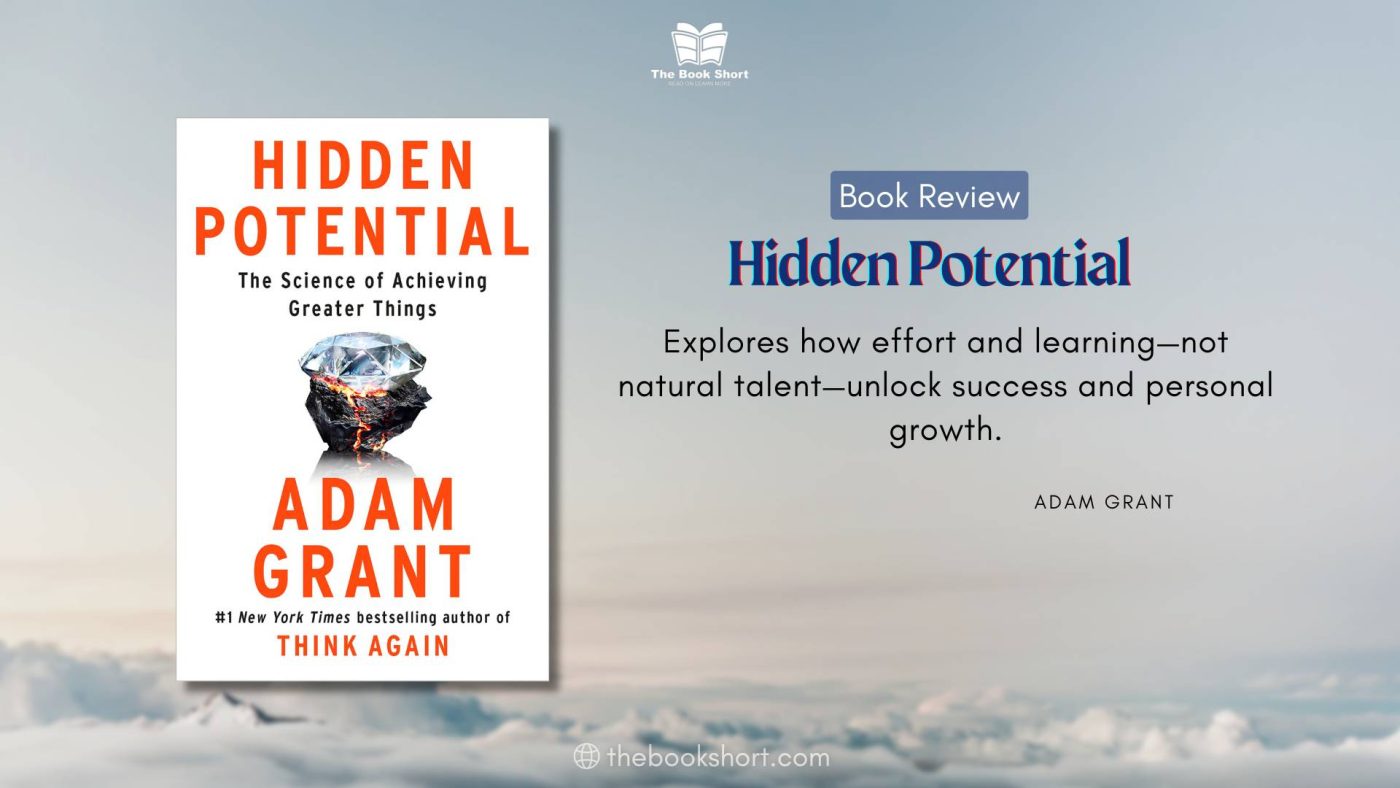
Discover your hidden potential. Learn why character, not just skill, unlocks greatness in Adam Grant’s transformative new book.
Yearning to break through limitations and achieve more? Adam Grant’s latest book, Hidden Potential, offers a profoundly empowering answer. It challenges the conventional notion that greatness is primarily a product of innate talent, arguing instead that it’s forged through continuous growth and, critically, character development. I was drawn to this book for its fresh perspective on what truly drives achievement, asserting that often-overlooked strengths are the real keys to unlocking latent capabilities. Grant provides not just theory but deeply practical insights for anyone committed to the journey of learning, adapting, and thriving, making it an essential and compelling read.
Hidden Potential Book Information
- Title: Hidden Potential: The Science of Achieving Greater Things
- Author: Adam Grant
- Year of publication: 2023
- Genre: Non-fiction, Self-help, Psychology, Business
- Number of pages: Approximately 304 pages
- Target audience: Individuals interested in personal development, continuous learning, educational strategies, effective parenting and coaching, and impactful organizational leadership – essentially, anyone invested in fostering growth in themselves or others.

Hidden Potential: The Science of Achieving Greater Things
Hidden Potential Book Summary: Unlocking the Science of Achieving Greater Things
Adam Grant’s Hidden Potential is a masterful dismantling of the myth that potential is a fixed, inherited trait. Instead, he champions the idea that true potential is a dynamic capacity for growth, cultivated through deliberate skill development and, most crucially, character building. The book is thoughtfully structured, guiding the reader through three interconnected dimensions of unlocking this hidden potential: building personal character, developing social character, and creating environments (systems) that nurture potential in others.
Grant launches his argument by directly confronting the widespread belief in innate talent as the primary determinant of success. While acknowledging that some may start with certain advantages, he powerfully demonstrates that sustained achievement is realized through persistent learning and focused effort. He re-examines the concept of “grit,” moving beyond simple perseverance to define it as a potent blend of passion and consistent, directed effort toward long-term aspirations. Yet, he delves deeper than traditional grit narratives, exploring the why behind sustained effort and the how of genuine improvement. A recurring motif is the vital importance of embracing difficulty and even discomfort as indispensable catalysts for growth.
A cornerstone of the book’s thesis is its profound focus on character as paramount, often eclipsing raw skill. Grant reframes character not in a strictly moral sense, but as a cultivated set of skills and habits that facilitate continuous learning and adaptation. He distinguishes between “skill character,” which pertains to mastery within a specific domain, and “will character,” representing the internal fortitude, drive, and resilience required to push boundaries. The book elevates qualities like conscientiousness, curiosity, and courage as foundational pillars for unlocking one’s hidden potential. Grant illustrates these points with a wealth of compelling narratives, featuring not only elite athletes who began with modest natural abilities but also world-class artists and scientists who refined their craft through painstaking deliberate practice and an unwavering commitment to improvement.
Grant dedicates significant attention to the art and science of learning how to learn effectively. He unpacks powerful cognitive strategies such as spaced repetition, interleaving, and retrieval practice, moving decisively beyond passive consumption of information towards active engagement. He also underscores the transformative value of actively seeking out constructive criticism and reframing failure not as a definitive endpoint but as invaluable feedback on the path to mastery. The concept of “deliberate practice,” widely associated with K. Anders Ericsson, is expertly woven throughout, emphasizing focused, intentional effort precisely targeted at enhancing specific skills.
The narrative then expands to explore “social character,” illuminating the indispensable role of relationships, community, and social support in fostering potential. Grant posits that realizing potential is far from a solitary endeavor; it is profoundly shaped by our interactions and the environments we inhabit. He discusses the strategic importance of identifying mentors, cultivating supportive peer relationships, and building highly effective teams. He introduces the powerful concept of “challenge networks” – carefully chosen groups of individuals who provide candid, sometimes uncomfortable, feedback and push you decisively beyond your comfort zone, contrasting them with more traditional “support networks” which primarily offer encouragement and affirmation. Learning from others, collaborating effectively with others, and contributing to collective growth are presented as vital, often overlooked, aspects of realizing both individual and shared potential.
In the book’s final section, Grant turns his insightful lens towards systems and environments, exploring how they can either ignite or suppress potential. He scrutinizes how institutions like schools, workplaces, and communities can be intentionally designed to cultivate growth in individuals. This involves fostering cultures that genuinely value curiosity, encourage calculated risk-taking, provide structured opportunities for deliberate practice, and consistently offer constructive, actionable feedback. He critically examines systems that prioritize sorting and selecting individuals based on existing talent over those that champion the development and growth opportunities for everyone. He offers potent insights for leaders, educators, and parents on how to identify and nurture hidden potential in others by shifting focus from outcomes to processes, celebrating genuine effort and tangible progress, and providing essential scaffolding to support the learning journey.
Throughout Hidden Potential, Grant masterfully weaves together a rich tapestry of diverse stories, cutting-edge research findings, and profoundly practical advice. He draws examples from the rigorous training regimens of Olympic athletes, the intricate learning curves of world-renowned musicians, the innovative educational philosophies of groundbreaking schools, and the dynamic management practices of highly successful organizations. He possesses a rare gift for making complex psychological concepts remarkably accessible and immediately actionable, equipping readers with concrete strategies they can apply directly in their own lives or within the systems they influence.
In sum, Hidden Potential is a powerful, paradigm-shifting argument for redefining our fundamental understanding of achievement. It compellingly redirects the spotlight from innate ability towards cultivated skills and developed character. By emphasizing the critical processes of learning, the transformative value of embracing discomfort, the essential nature of social support, and the profound impact of environmental design, Grant provides a clear, actionable roadmap for anyone seeking to unlock their own hidden potential and, just as importantly, empower others to do the same. The book serves as a compelling call to action: to consciously invest in character development, actively seek out challenging environments, build strong, reciprocal learning relationships, and champion the creation of systems that prioritize growth for all.
Hidden Potential Analysis: A Deep Dive into Character, Growth, and Achieving Greater Things
Adam Grant’s Hidden Potential stands out as a deeply researched, intellectually stimulating, and genuinely thought-provoking exploration of the true engines driving human achievement. The central thesis – that potential is actively grown rather than passively discovered – is a refreshing and empowering departure from prevalent narratives that often place undue emphasis on innate talent. Grant effectively and persuasively dismantles the “naturals” myth, replacing it with a robust, evidence-backed case for the transformative power of intentional effort, strategic learning, and, most notably, character development.
Key Arguments & Structure: Building the Foundation for Growth
The book’s structure is exceptionally logical and effective, layering arguments from the individual level, expanding to the social sphere, and culminating with an examination of systemic influence. This progressive approach allows Grant to construct a comprehensive and nuanced case for unlocking potential. He begins by defining character in a functional, actionable way – as learnable skills that enable learning and adaptation – and then powerfully demonstrates how cultivating these specific skills (conscientiousness, curiosity, courage) is fundamentally crucial for sustained growth and achieving greater things.
- Character as Learnable Skill: This is arguably the book’s most significant and empowering argument. Grant brilliantly reframes character traits not as static personality features but as dynamic habits and skills that can be intentionally developed through deliberate practice, mindful reflection, and strategic mindset shifts. This perspective is inherently empowering for the reader, suggesting that anyone, regardless of their starting point, can cultivate the core attributes essential for profound growth.
- Embracing Discomfort: Grant offers a powerful and well-supported case for actively seeking out challenges and leaning into the inherent difficulty that accompanies true learning and mastery. He provides compelling evidence that the most significant growth occurs precisely at the edge of our comfort zone, directly challenging the common human tendency to prioritize ease and predictability over struggle and stretch.
- Process over Outcome: A consistent and crucial theme woven throughout the book is the overriding importance of fixating on the learning process itself – engaging in effective practice, proactively seeking and incorporating feedback, and intelligently iterating after encountering failure – rather than becoming solely fixated on the final result or external validation. This fundamental mindset shift is presented as absolutely critical for achieving sustained improvement and resilience.
- Social Character and Systems: Grant rightly and insightfully expands the concept of potential beyond the isolated individual. The sections dedicated to “challenge networks” and intentionally creating environments conducive to growth are particularly insightful, demonstrating that potential is not realized in a vacuum but is profoundly shaped and amplified by social support, strategic relationships, and thoughtful systemic design.
Grant’s adept use of diverse and compelling examples – spanning the worlds of sports and music, business and education – powerfully reinforces his arguments and makes complex theoretical concepts remarkably relatable and inspiring. The progressive structure, seamlessly moving from individual development to the powerful influence of others and systemic factors, provides a truly holistic and comprehensive view of the intricate process by which hidden potential is unlocked.
Writing Style & Content Quality: Engaging, Insightful, and Evidence-Based
Grant’s writing style is a significant strength: accessible, consistently engaging, and imbued with clear authority. He effortlessly weaves together rigorous academic research with captivating storytelling, making complex psychological concepts readily understandable and deeply resonant. He employs anecdotes effectively to illustrate his points, featuring a compelling mix of both widely recognized figures and inspiring lesser-known individuals who powerfully exemplify the principles he discusses.
- Clarity and Conciseness: Grant writes with admirable clarity, avoiding unnecessary jargon and explaining technical terms with precision and ease. His prose is direct, purposeful, and highly readable.
- Narrative Flow: The book exhibits excellent narrative flow, with smooth, logical transitions between core concepts, supporting evidence, and illustrative examples. Each chapter builds thoughtfully upon the preceding ones.
- Evidence-Based: A defining characteristic and key strength of Grant’s work is the robust foundation of rigorous research backing his claims. He doesn’t merely offer opinions; he presents compelling studies, relevant data, and expert insights, lending significant credibility and weight to his arguments about achieving greater things.
- Practicality: Moving beyond theoretical exposition, the book consistently offers concrete, immediately actionable strategies that readers can implement in their own lives or roles, whether they are students, parents, employees, leaders, or coaches.
Compared to many other books in the self-help, psychology, or business genres that focus on success or potential, Hidden Potential distinguishes itself through its deep, nuanced dive into the process of growth and its unique, empowering emphasis on character viewed as a dynamic set of learnable skills. While many popular books touch upon concepts like grit or deliberate practice, Grant’s integrated approach – weaving these ideas together with social character and systemic influence – feels more comprehensive, integrated, and ultimately more transformative. His focus transcends mere achievement; it centers on the fundamental human capacity for continuous learning and adaptation, fueled by intentional effort, strategic engagement, and cultivated inner strength.
Notable Quotes from the Book: Echoes of Growth and Resilience
These quotes capture the compelling essence of the book’s transformative message: that potential is an active, dynamic force, character is a cultivable skillset, genuine growth necessitates embracing challenge, and relationships are indispensable allies on the journey.
- “Potential is not a measure of capacity. It’s a measure of progress.” (This core idea is powerfully articulated throughout the book, a central tenant).
- “Character is not about our inherent nature; it’s about our skills in navigating life.”
- “Discomfort is the price of admission to a meaningful life.”
- “The path to excellence is paved with challenging opportunities.”
- “Finding the right challenge network matters just as much as finding the right support network.”
Evaluation & Personal Review of Hidden Potential: A Practical Guide to Unlocking Your Best Self
Adam Grant’s Hidden Potential: The Science of Achieving Greater Things is, in my estimation, a highly valuable, perhaps even indispensable, read for anyone genuinely invested in personal growth, the science of learning, or supporting the development of others. My personal impression after reading it is overwhelmingly positive. This book is far more than just motivational; it is profoundly informative, rigorously researched, and exceptionally practical.
Advantages: Why This Book Shines
- Mindset Transformation: It effectively and persuasively challenges fixed mindsets surrounding potential and talent, offering a far more dynamic, empowering, and ultimately truthful view of how genuine growth occurs.
- Research-Backed Authority: Grant’s arguments are not only compelling but also incredibly robust, underpinned by a wealth of credible psychological research and illuminating real-world examples. This evidence base lends significant weight to his claims.
- Actionable Strategies: The book excels in providing concrete, actionable strategies that readers can implement immediately to improve their own learning, build essential character skills, and foster more effective growth environments for themselves and others.
- Broad, Universal Applicability: The lessons and insights shared are remarkably relevant across a wide spectrum of life roles and stages, making it valuable for students, educators, professionals, parents, coaches, and leaders alike.
- Engaging and Human Read: Despite its academic rigor and depth, Grant’s skill as a storyteller and communicator makes Hidden Potential a consistently engaging, accessible, and genuinely human read that feels personal and relevant.
Disadvantages (Minor Considerations):
- For readers who are already deeply familiar with the literature on deliberate practice (e.g., through Ericsson’s Peak) or growth mindset (Dweck’s Mindset), some foundational concepts might feel familiar. However, Grant’s unique contribution lies in how he synthesizes these ideas and, crucially, adds the often-underemphasized dimensions of character as a learnable skill and the profound impact of social and systemic factors.
- While the book provides clear strategies, implementing the principles of deliberate practice, embracing discomfort, and consciously building character skills requires sustained personal effort and discipline – which, while inherent to the subject, is a practical reality the reader must be prepared for.
Readability Level & Suitability: Who Will Benefit Most?
The book is highly readable and accessible. Grant’s clear prose, coupled with his effective use of vivid stories and analogies, makes complex topics understandable to a general audience without sacrificing depth. He successfully avoids overly academic or technical language. It is ideally suited for:
- High school and college students navigating the challenges of learning, skill development, and personal identity formation.
- Parents and educators dedicated to fostering intrinsic motivation, resilience, and a genuine love for learning in children and students.
- Professionals at any stage seeking to continuously improve their skills, adapt effectively to a changing world, or lead and develop teams with greater impact.
- Anyone with a keen interest in the science of learning, peak performance, human development, and how we can cultivate the capacity to achieve more meaningful things.
Practical Value: Translating Insight into Action
The practical value of Hidden Potential is genuinely immense.
- Concrete Lessons: It provides invaluable insights into how to learn more effectively (backed by cognitive science), illuminates the critical importance of actively seeking challenging situations over easy wins, and offers practical guidance on cultivating the essential character skills (like curiosity, conscientiousness, and courage) that serve as the bedrock for long-term growth and resilience.
- Direct Application: You can immediately apply the strategies Grant outlines to enhance your study habits, approach difficult projects at work with greater confidence and efficacy, tackle personal fitness or creative goals with renewed strategic focus, or even structure learning activities for your children in ways that truly foster development over performance pressure. The book’s emphasis on process helps fundamentally reframe setbacks and “failures” as essential, non-threatening learning opportunities.
- Transformative Mindset Shift: Perhaps the most significant and lasting impact is the potential for a profound shift in perspective about potential itself. Moving away from an anxious question like “Am I talented enough?” towards an empowering, actionable inquiry like “How can I strategically improve and grow?” is fundamentally freeing and equips the reader with a powerful locus of control. It encourages a sustained, joyful focus on effort, effective strategy, continuous development, and character building rather than being limited or defined by perceived innate ability.
The book provides a clear, compelling roadmap for cultivating the capacity to achieve greater things, suggesting that it’s not just about working harder, but crucially about working smarter, embracing the right kinds of challenges, and developing the inner architecture of character that sustains growth over a lifetime.
Comparing Hidden Potential with Similar Books: Finding Its Place
Hidden Potential fits comfortably within the popular science, psychology, and self-improvement landscape, engaging deeply with themes of achievement, learning, capability, and personal growth.
It shares significant thematic overlap with seminal works like Angela Duckworth’s Grit: The Power of Passion and Perseverance. Duckworth’s book also champions the importance of perseverance and passion (grit) as more predictive of long-term success than innate talent alone. Grant acknowledges Duckworth’s work but expands upon it, defining character more broadly than just grit and offering a deeper exploration into the how of building these skills, along with a crucial emphasis on the environmental and social factors that nurture them.
The book also resonates strongly with K. Anders Ericsson and Robert Pool’s Peak: Secrets from the New Science of Expertise, widely considered the definitive work on deliberate practice. Grant frequently references and integrates the principles of deliberate practice but places it as a key strategy within a much larger, holistic framework encompassing character development and systemic support. Hidden Potential is arguably more accessible to a general audience and broader in its scope and application than Peak, which focuses more intensely on the specific methods used by experts to achieve elite performance through deliberate practice.
Works centered on mindset, particularly Carol S. Dweck’s Mindset: The New Psychology of Success, are also clearly related. Grant’s book strongly reinforces the critical importance of holding a growth mindset – the belief in the malleability of abilities – but Hidden Potential goes further by providing more granular, detailed strategies for how to cultivate that growth, focusing on specific character skills and the vital social and contextual factors that facilitate it.


If readers found Hidden Potential insightful and valuable, they would likely also enjoy exploring:
- Grit by Angela Duckworth: For a focused, in-depth examination of the role of passion and perseverance in long-term goal achievement.
- Mindset by Carol S. Dweck: To further solidify understanding of how beliefs about intelligence and talent profoundly impact learning and resilience.
- Peak by K. Anders Ericsson and Robert Pool: If they desire a more technical and detailed exploration of the science behind deliberate practice and achieving expert-level performance.
- Atomic Habits by James Clear: For practical, step-by-step strategies on building the small, incremental habits that underpin consistent long-term progress and contribute significantly to character development.
Hidden Potential offers a compelling synthesis of these influential ideas, adding the vital dimensions of character as a learnable, strategic skillset and the often-underestimated influence of social and systemic factors on individual growth. It provides a fresh, integrated, and empowering perspective on what it truly takes for individuals and groups to learn, adapt, and achieve progressively greater things over the course of a lifetime.
Conclusion & Recommendations for Hidden Potential: Achieve Greater Things by Cultivating Growth
Hidden Potential by Adam Grant is, without reservation, an outstanding book that effectively redefines our understanding of achievement and human capability. Its most profound and valuable contribution lies in its powerful, evidence-based argument that potential is not a scarce, fixed gift bestowed upon a lucky few, but rather a dynamic capacity that can be actively grown and expanded through intentional effort, strategic learning, and the deliberate cultivation of character. Grant presents a compelling, optimistic, and rigorously researched case for shifting focus from innate ability to the process of improvement, embracing the necessary discomfort that accompanies genuine growth, and nurturing crucial character skills like curiosity, conscientiousness, and courage.
Is Hidden Potential worth reading? An emphatic yes. It is not only inspiring but also serves as an exceptionally pragmatic guide to unlocking personal growth and fostering it in others. It is particularly impactful for anyone who has ever felt limited by a perceived lack of talent, questioned their ability to learn new skills, or felt unsure about how to make meaningful progress on their personal or professional journey.
Who stands to benefit most from reading this book?
- Students and lifelong learners committed to mastering skills and expanding their knowledge.
- Educators and parents dedicated to nurturing resilience, intrinsic motivation, and a growth mindset in young people.
- Coaches, mentors, and trainers focused on helping individuals and teams reach their peak performance.
- Leaders and managers in organizations seeking to build cultures of continuous learning, innovation, and development.
- Anyone with a deep curiosity about the psychological science underpinning human learning, adaptation, and excellence, and who wants actionable strategies to apply it.
Hidden Potential offers not just theoretical insights, but genuinely actionable strategies that have the power to fundamentally change how you approach learning, face challenges, pursue personal development, and effectively support the growth trajectories of those around you. It is a powerful call to action to invest in cultivating your own inner resources and building environments that allow everyone the opportunity to achieve greater things.
Have you read Hidden Potential by Adam Grant? What were your key takeaways or how has it impacted your approach to growth? Share your thoughts and experiences in the comments below!