
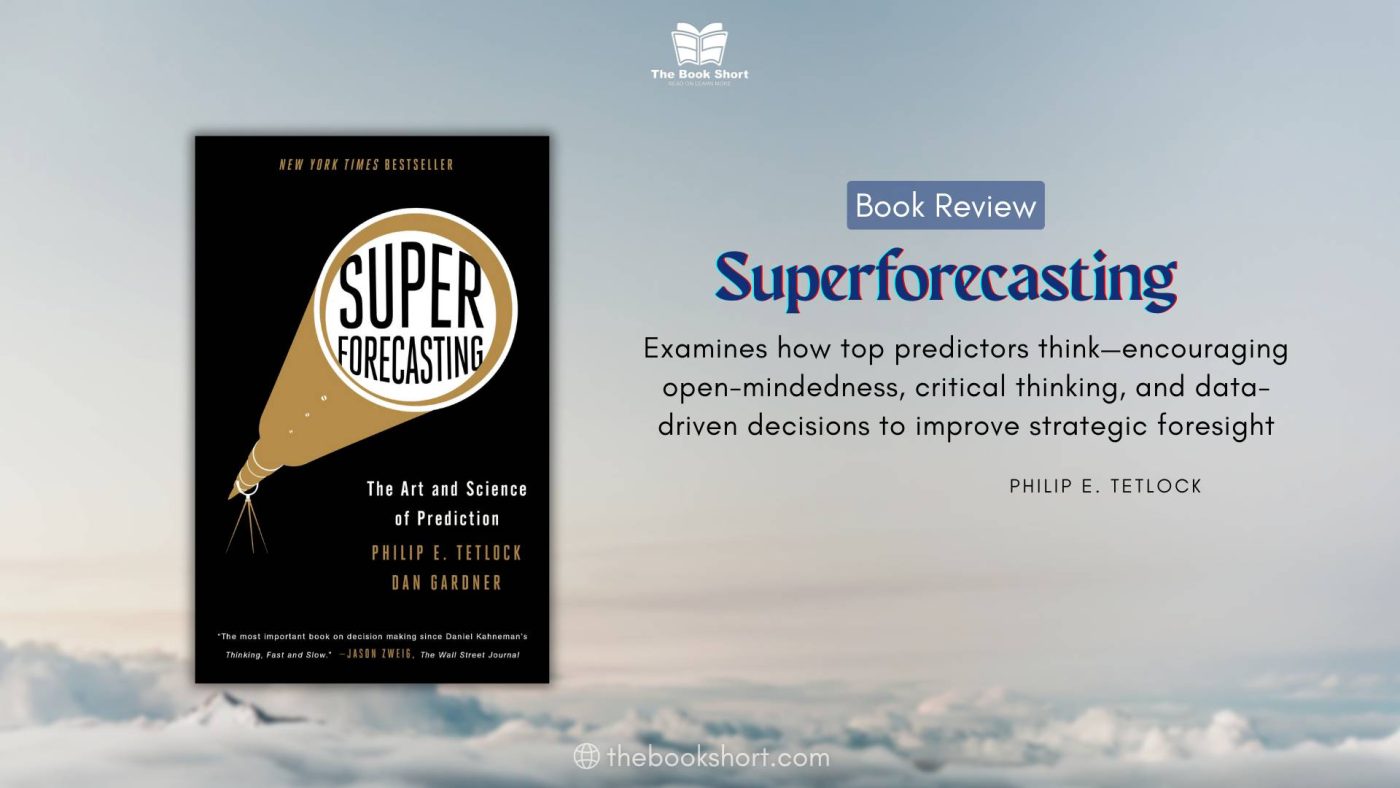
Can we truly predict the future? This book review of Superforecasting explores how ordinary people can learn to forecast with astonishing accuracy.
What if predicting the future wasn’t a mystical gift, but a skill you could master? Superforecasting: The Art and Science of Prediction by Philip E. Tetlock and Dan Gardner confronts this very question, backed by years of landmark research that demystifies the act of forecasting. This book demands attention because it moves beyond the now-familiar catalogue of our cognitive biases and offers a concrete, evidence-based framework for sharpening our minds. Its unique power lies in an optimistic and actionable message: by adopting specific habits of thought, anyone can become demonstrably better at navigating an uncertain world, making this a profound tool for clearer thinking.
Superforecasting: Key Book Details
- Title: Superforecasting: The Art and Science of Prediction
- Author: Philip E. Tetlock and Dan Gardner
- Year of publication: 2015
- Genre: Non-fiction, Psychology, Business, Decision Science
- Number of pages: 352
- Target audience: Leaders, analysts, investors, policymakers, and anyone passionate about improving their decision-making, fighting cognitive bias, and thinking more rationally.

Superforecasting: The Art and Science of Prediction
A Comprehensive Summary of Superforecasting: The Art and Science of Prediction
Superforecasting is not about gazing into crystal balls. It is a rigorous, data-driven investigation into what makes a select few individuals exceptionally good at peering into the future. The book’s explosive insights are drawn from the Good Judgment Project (GJP), a monumental forecasting tournament sponsored by the U.S. government’s Intelligence Advanced Research Projects Activity (IARPA).
The Good Judgment Project: An Unprecedented Experiment
The GJP, which ran from 2011 to 2015, forms the book’s narrative spine. It enlisted tens of thousands of ordinary volunteers and challenged them to predict the likelihood of specific geopolitical and economic events (e.g., “Will Greece leave the eurozone within the next year?”). The project’s audacious goal was to discover if forecasting is a talent, a skill, or just luck—and if it could be improved.
The results were nothing short of revolutionary. A tiny fraction of volunteers—just 2%—emerged as “superforecasters.” These were not professors or pundits, but regular people from all walks of life. Yet, they consistently crushed the competition, outperforming university experts, the collective judgment of the intelligence community, and even professional intelligence analysts with access to classified information. Their forecasts were, on average, 30% more accurate than those of intelligence officers. The book is a deep dive into who these people were and, more importantly, how they thought.
The Fox vs. The Hedgehog: Two Cognitive Styles
To explain the chasm between good and bad forecasters, Tetlock masterfully resurrects a parable from the Greek poet Archilochus, famously revitalized by philosopher Isaiah Berlin: “The fox knows many things, but the hedgehog knows one big thing.”
- Hedgehogs: These thinkers are driven by a single, powerful ideology or theory (think Marxism, or staunch free-market libertarianism). They are confident, decisive, and brilliant at weaving a clean, compelling narrative. Their weakness? They are dogmatic, often blind to contradictory evidence, and consequently, terrible forecasters. They cram new facts into their pre-existing worldview rather than allowing their worldview to be reshaped by reality.
- Foxes: These thinkers are intellectually scrappy and humble. They draw from a diverse array of sources, embrace nuance, and are comfortable living with complexity and contradiction. Unbound by any single “big idea,” they are in a perpetual state of beta, constantly updating their beliefs as new evidence emerges. The superforecasters, Tetlock discovered, were overwhelmingly foxes.
The Anatomy of a Superforecaster
The book brilliantly dissects the mental habits and behaviors that define a superforecaster. It’s not about what they know, but how they approach knowing. These are the key traits of their success:
- Actively Open-Minded: They don’t merely tolerate dissent; they hunt for it. They possess a “cognitive grit,” deriving pleasure from the hard work of wrestling with views that challenge their own.
- Intellectually Humble: They grasp the profound complexity of the world and the inherent limits of their own knowledge. They aren’t afraid to be wrong and are quick to own their mistakes.
- Numerate and Probabilistic: They are fluent in the language of numbers and think in degrees of belief, not in black-and-white certainties. They avoid vague predictions like “X might happen” in favor of precise statements like, “I believe there’s a 65% chance of X happening.” This granularity makes their forecasts testable and easy to adjust.
- Frequent Belief Updaters (Applied Bayesianism): Superforecasters treat their beliefs as hypotheses to be tested, not treasures to be guarded. As new information arrives—even tiny scraps—they make small, continuous adjustments to their probability estimates, a practice that mirrors the logic of Bayesian updating.
- Growth Mindset: They see forecasting not as an innate talent but as a skill that can be honed through deliberate practice and rigorous feedback. Every error is a lesson, not a failure.
- Meticulous Questioners: They break down huge, fuzzy questions (“Will there be a war over Taiwan?”) into smaller, concrete, and researchable sub-problems (“What are the latest satellite images of military buildups? What is the tone of recent diplomatic cables?”). This technique of deconstruction is often called “Fermi-izing,” after the physicist Enrico Fermi.
- Balancing Inside and Outside Views: They skillfully synthesize two distinct perspectives to form a judgment:
- The Outside View: This is the anchor point. It starts with a base rate: historically, how often has this type of event occurred?
- The Inside View: This is the adjustment. What are the unique, specific details of this situation that might push the outcome away from the historical average?
- Synergistic Teamwork: The GJP found that placing superforecasters in teams made them even more accurate. They excelled at sharing information, respectfully challenging one another’s reasoning, and synthesizing their diverse perspectives into a single, superior probabilistic forecast.
Superforecasting powerfully concludes that these are not genetic gifts. They are components of a mindset and a method that can be learned, offering a practical roadmap for anyone who wants to see the future more clearly.
Superforecasting Book Analysis: Deconstructing the Message
Superforecasting is a landmark in the literature of rational thinking. It serves as a powerful, empirically-grounded rebuttal to the widespread cynicism surrounding prediction, offering instead a message of attainable improvement.
Key Arguments, Structure, and Themes
The book’s central thesis is that good forecasting is not an arcane art but a skill that can be cultivated through discipline and practice. Tetlock and Gardner systematically demolish the idea that credentials, confidence, or fame are reliable proxies for predictive accuracy. Instead, they champion a methodical, process-driven approach. The book’s overarching theme is the triumph of cognitive humility and rigorous inquiry over ideological certainty and status.
The structure is masterfully engineered to build this case:
- The Problem: It opens by establishing the generally poor state of expert prediction, referencing Tetlock’s earlier groundbreaking work in Expert Political Judgment.
- The Experiment: It then casts the Good Judgment Project as the central narrative, a compelling scientific quest for truth.
- The Discovery: The heart of the book dissects the “protagonists” of this quest—the superforecasters—and their winning cognitive traits.
- The Toolkit: Finally, it synthesizes these traits into actionable principles, empowering the reader to translate insight into practice.
This narrative structure transforms a potentially dry academic study into an electrifying story of discovery, rendering its profound lessons accessible and unforgettable.
Writing Style & Content Quality
The partnership between Philip Tetlock, the rigorous academic, and Dan Gardner, the gifted journalist, is the book’s secret ingredient. Gardner’s touch is evident in the crisp, story-driven prose. The text is alive with anecdotes, from cautionary tales of intelligence failures to compelling profiles of individual superforecasters like Doug Lorch and Bill Flack. This narrative approach makes the dense, data-rich research feel both human and compelling.
Unlike many pop-psychology books that extrapolate grand theories from a handful of studies, Superforecasting is anchored in one of the most extensive and rigorous social science experiments ever conducted. The quality of the content is unimpeachable; every major claim is supported by a mountain of data from the GJP. It distinguishes itself from a book like The Black Swan, which powerfully highlights the role of unpredictable, high-impact events, by focusing on the vast territory of consequential events that are forecastable with improved skill. It also serves as the perfect complement to Thinking, Fast and Slow, moving beyond the diagnosis of cognitive biases to offer a tested cure.
Notable Quotes from Superforecasting
- On Humility and Open-Mindedness: “For superforecasters, beliefs are hypotheses to be tested, not treasures to be guarded.” This single sentence perfectly captures the radical mindset shift at the heart of the book.
- On the Nature of Forecasting: “Forecasting is not a magic trick. It is a skill that requires discipline, hard work, and a willingness to learn from one’s mistakes.” This quote demystifies prediction, reframing it as an attainable discipline rather than an esoteric gift.
- On Precision: “The spirit that animates the Good Judgment Project is profoundly numerate. Vague verbiage, untethered from numeric probabilities, is not allowed.” This underscores the critical importance of moving from fuzzy words (“it’s likely”) to falsifiable numbers (“I’m 70% confident”).
Superforecasting Review: An Expert’s Personal Take
Superforecasting isn’t just an interesting book; it’s a manual for upgrading your mental hardware. Its seamless blend of groundbreaking research and riveting storytelling makes it a modern classic with immense practical utility.
Personal Impressions: Advantages and Disadvantages
Advantages:
The book’s greatest virtue is its evidence-based optimism. It doesn’t leave you stranded in a sea of your own cognitive biases; it hands you a proven, actionable toolkit to build a raft. The “Ten Commandments for Aspiring Superforecasters” at the end is a brilliant, concise guide to putting the ideas to work. The focus on process over innate talent is deeply empowering, with applications that extend far beyond geopolitical prediction. It provides a new vocabulary—of probabilities, base rates, and belief updating—for thinking more clearly about any uncertain future.
Disadvantages:
If one were to critique the book, it would be that the core traits of a superforecaster are revisited extensively. While this repetition serves to reinforce the key lessons, some readers may find certain chapters feel slightly redundant. Furthermore, the examples are heavily concentrated in the realms of geopolitics and economics. While this reflects the nature of the GJP, readers whose interests lie far afield might have to work a little harder to translate the examples—though the underlying principles remain undeniably universal.
Readability and Target Audience
The book is exceptionally readable. Thanks to Dan Gardner’s journalistic flair, complex statistical and psychological concepts are illuminated through compelling narratives and lucid prose. You do not need a Ph.D. in political science to grasp its powerful message.
This book is essential reading for:
- Business leaders and investors who must make high-stakes decisions under deep uncertainty.
- Policy analysts and intelligence professionals whose job is to anticipate and prepare for the future.
- Students of psychology, economics, and political science seeking to understand the frontiers of decision science.
- Frankly, anyone who wishes to become less ideological, sharpen their critical thinking, and make better-informed choices in their personal and professional life.
Practical Value
The practical value of Superforecasting is immense. It can fundamentally rewire how you consume information and contemplate the future. After reading it, you begin to instinctively ask better questions: What’s the base rate here? What are my hidden assumptions? What piece of evidence would make me change my mind?
These lessons can be applied directly to:
- Business Strategy: Forecasting market shifts, competitive actions, or project success rates with greater discipline.
- Personal Finance: Making more rational investment choices by thinking in probabilities rather than deceptive certainties.
- Career and Life Decisions: Evaluating different paths by breaking down overwhelming uncertainties into smaller, more manageable questions.
Ultimately, Superforecasting doesn’t just teach you how to predict; it teaches you a more disciplined, humble, and effective way to think.
How Superforecasting Compares to Other Books
Superforecasting sits at the nexus of psychology, decision science, and big data. Its unique contribution shines when compared with other giants in the field.
- If you liked Thinking, Fast and Slow by Daniel Kahneman, you will find Superforecasting to be its essential, practical sequel. Kahneman masterfully diagnoses the cognitive biases that plague our judgment. Superforecasting accepts this diagnosis and provides the tested, real-world prescription for how to counteract those biases and achieve better outcomes.
- If you liked The Black Swan by Nassim Nicholas Taleb, you will find Superforecasting to be a crucial and clarifying counterpoint. Taleb persuasively argues that history is shaped by rare, unpredictable, high-impact events. Tetlock operates in a different but equally important space, demonstrating that while true Black Swans are by definition unforecastable, a vast number of consequential events are forecastable to a meaningful and valuable degree. The two books together provide a more complete map of uncertainty.
- If you liked Thinking in Bets by Annie Duke, you will recognize a kindred spirit in Superforecasting. Both books champion probabilistic thinking and the vital discipline of separating decision quality from outcome quality. Duke draws her powerful lessons from the poker table, while Tetlock draws his from a massive geopolitical forecasting tournament, but their core message about embracing uncertainty and learning from feedback is deeply aligned.


Conclusion: Why You Should Read This Superforecasting Book Review and the Book Itself
Superforecasting by Philip E. Tetlock and Dan Gardner is a profoundly important and empowering book. Its singular value lies in its rigorous, evidence-based proof that good forecasting is not a dark art but a cognitive skill that can be cultivated. It offers a clear, actionable roadmap for thinking with greater humility, curiosity, and precision.
Is it worth reading? Absolutely, and without reservation. This book is essential for anyone making high-stakes decisions, from the C-suite to the trading floor to the voting booth. More broadly, it is a must-read for any citizen of the 21st century who wants to become a clearer, more rational, and more effective thinker. It is a toolkit for navigating the fog of uncertainty that surrounds us all.
Have you read this book? Share your thoughts and forecasts in the comments below.