
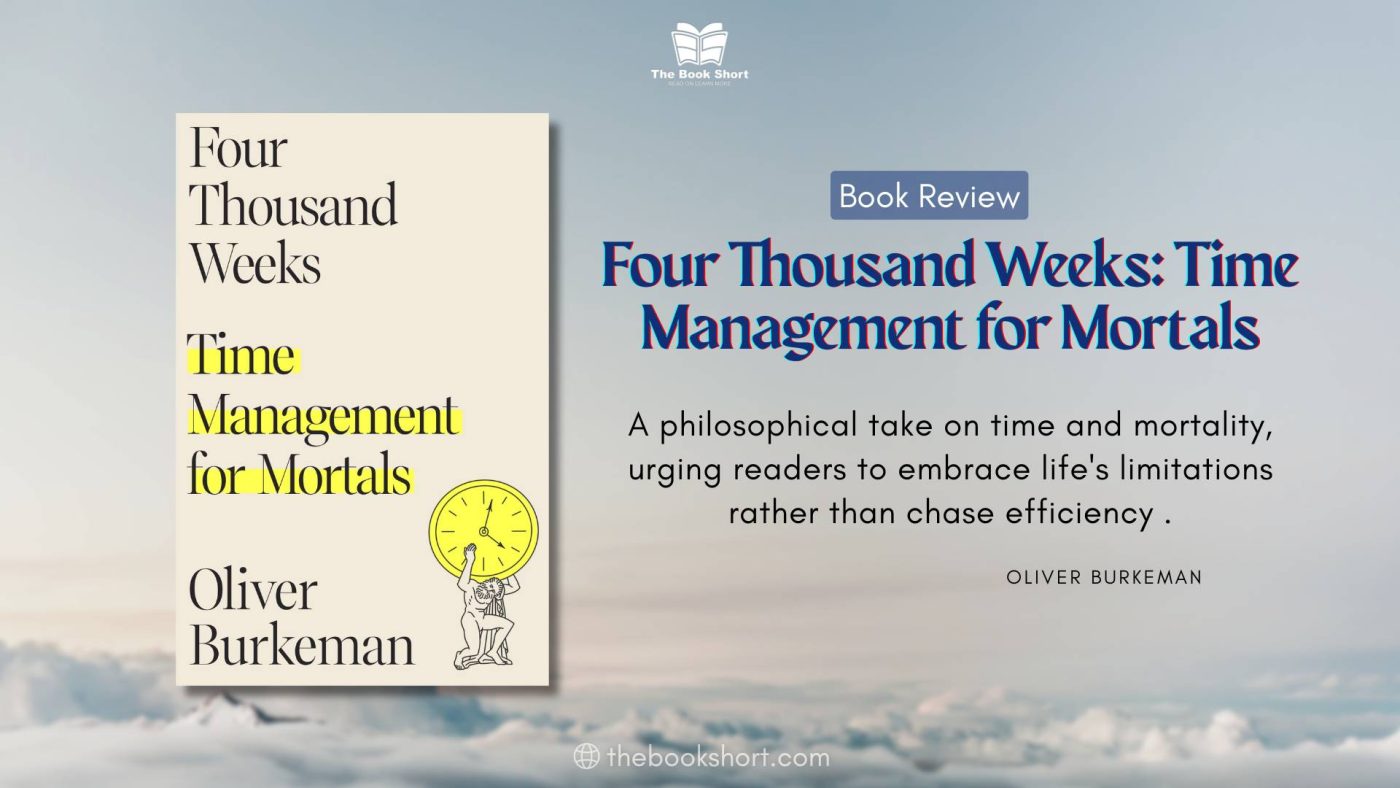
Our modern world often feels like a relentless conveyor belt, constantly pushing the idea that with the right apps, hacks, and systems, we can somehow transcend our limits, squeezing ever more productivity from each day. Yet, despite our frantic efforts and overflowing digital calendars, the gnawing feeling of being overwhelmed, perpetually behind schedule, and fundamentally “busy” persists. It’s this profound, frustrating disconnect that Oliver Burkeman confronts with bracing honesty in Four Thousand Weeks: Time Management for Mortals. I dove into this book not seeking another set of techniques, but because its core premise promised a radical, refreshing departure from the conventional wisdom. Instead of offering pathways to infinite control, Burkeman invites us to embrace a simple, uncomfortable truth: our time here is startlingly, irrevocably finite. By accepting this finitude – that an average human lifespan is roughly four thousand weeks – he argues we can unlock a more meaningful, engaged, and surprisingly less anxious way of living. This isn’t just a book about time; it’s a profound reflection on what it means to be a limited human being in an infinite world, making it essential reading for anyone trapped in the relentless pursuit of ‘getting everything done’.
Basic Information About Four Thousand Weeks: Time Management for Mortals
- Title: Four Thousand Weeks: Time Management for Mortals
- Author: Oliver Burkeman
- Year of Publication: 2021
- Genre: Non-fiction, Philosophy, Self-help, Productivity Critique
- Number of Pages: Approximately 272 pages (varies by edition)
- Target Audience: Individuals struggling with time pressure, productivity anxiety, busyness; readers interested in the philosophy of time, finitude, and finding meaning in a limited life.

Four Thousand Weeks: Time Management for Mortals
Main Content Summary of Four Thousand Weeks by Oliver Burkeman
Oliver Burkeman’s Four Thousand Weeks stands as a powerful counter-argument to the dominant culture of productivity optimization. It deliberately bypasses the typical fare of tips, tricks, and complex organizational systems. Instead, the book offers a deeply philosophical meditation on human finitude, using the stark figure of four thousand weeks (roughly 80 years) not as a morbid limitation, but as a crucial lens through which to view our relationship with time and life itself. The central, transformative argument is that our chronic struggle with time isn’t a practical problem of inefficient methods, but a fundamental, existential problem rooted in our resistance to accepting our own limitations and our misguided attempt to exert infinite control over a finite reality.
The book’s insights unfold through several interconnected themes, challenging deeply ingrained assumptions about time management and productivity culture.
The Stark Reality of Finitude
The cornerstone of Burkeman’s argument is the simple, yet often avoided, truth of our limited lifespan. Presenting life as roughly “four thousand weeks” serves to internalize this number and confront its implications. Burkeman posits that much of our modern time anxiety stems from a deep-seated, often subconscious, refusal to accept this finitude. We live as if we should be able to handle an infinite stream of possibilities – clear every email, read every book, pursue every opportunity – striving for a mythical future state where everything is finally “under control.” The book argues this is not only impossible but the source of endless stress.
A Sharp Critique of Conventional Productivity
Burkeman rigorously dissects the conventional productivity industry. He argues that its focus on efficiency and control, while seemingly helpful, often exacerbates the very problem it claims to solve. By providing techniques to do more, faster, it merely expands our perception of what we could or should be doing. This leads to an ever-growing to-do list and heightened anxiety about the tasks left undone. The endless quest to “get everything done” is portrayed as a futile endeavor because “everything” encompasses an infinite horizon of possibilities, while our capacity and time remain stubbornly finite.
Embracing the Liberating Power of Constraints
A pivotal shift advocated by the book is moving away from fighting against constraints to actively embracing them. Recognizing and accepting that you simply cannot do everything is not a sign of failure, but the essential first step toward making genuinely meaningful choices about what you will prioritize. Constraints – our limited time, energy, resources, and the inherent trade-offs of choosing one path over others – are framed not as obstacles to overcome but as the foundational structure within which a focused, purposeful life must be built. Accepting limitations grants clarity and permits presence.
The Tyranny of the Future
Burkeman examines our pervasive tendency to instrumentalize the present moment, treating it merely as a stepping stone or a means to achieve some idealized future state. We rush through current tasks, eyes fixed on a future where we imagine finally being “caught up,” “stress-free,” or “in control.” This fixation on a perfectly managed future means we rarely fully inhabit or appreciate the present. The book underscores that the future is not a destination of rest but merely more present moments that will also demand choices and attention. The elusive sense of completion and relief we chase by “getting things done” never truly arrives because new demands will inevitably emerge.
Reclaiming Attention in a Distracted Age
In an era of infinite digital stimuli and constant demands, our attention has become a besieged and finite resource. Burkeman emphasizes that managing time is, at its heart, managing our attention. Distraction isn’t just an annoyance; it often serves as a convenient avoidance of the discomfort that arises when we confront our limited capacity and the inherent difficulty of choosing what truly merits our focus. The book explores practical implications for cultivating focused attention, not for the sake of heightened output, but to foster deeper engagement and presence with the few things we deliberately choose to prioritize.
The Necessity of Consciously Dropping Balls
A powerful, practical consequence of embracing finitude is the unavoidable reality that some tasks will go undone. In the conventional mindset, this is framed as failure. Burkeman courageously re-frames it as an inevitable consequence of being mortal with limited time. The key, he argues, is to be deliberate about which balls you choose to drop, rather than letting important things fall randomly due to overwhelm and lack of focus. This requires conscious, sometimes difficult, decisions about priorities and accepting that other, potentially desirable, things will simply not happen.
The Societal Pressure to Be Busy
The book also touches upon the broader social and economic forces that fuel our collective obsession with productivity and busyness. Our culture often equates being busy with importance, success, and even moral worth. This external pressure adds a significant layer to our internal struggle with time, making it even harder to deliberately slow down, prioritize rest, or engage in activities that aren’t deemed “productive” by societal standards.
The Unexpected Value of Doing Nothing
Paradoxically, a book ostensibly about time management devotes space to the importance of not always being productive. Burkeman explores the profound discomfort many people feel with idleness, unstructured time, or even boredom. This discomfort often drives us back into frenetic activity. The book suggests that periods of genuine rest, unstructured thought, and even boredom are not wasted but are crucial for reflection, creativity, and simply experiencing being, free from the pressure to constantly do or achieve.
Cultivating a Meaningful, Finite Life
Ultimately, Four Thousand Weeks pivots from dissecting the problems of time management to offering a pathway toward living a more focused, meaningful life because of our limited time, not in spite of it. The goal isn’t to cram more activities into the limited time we have, but to choose what genuinely matters and engage deeply with the limited moments granted to us. By confronting and accepting the impossibility of getting everything done, the book provides a sense of profound liberation, freeing us to choose what is truly worth doing and be fully present while doing it.
In-Depth Analysis of Four Thousand Weeks Book
Oliver Burkeman’s Four Thousand Weeks isn’t just a book; it’s an intervention in the dominant narrative of productivity. It sharply distinguishes itself from the vast landscape of time management literature by eschewing quick fixes for a deep, often uncomfortable, philosophical inquiry into the human condition and our relationship with time.
Structure, Key Arguments & Themes
The book is masterfully structured, guiding the reader through an intellectual and emotional journey. It begins by laying bare the stark reality of our finite lifespan and then meticulously unpacks the psychological, historical, and societal forces that cause us to resist this fundamental truth.
- Part 1: The Problem: This section introduces the central premise of the four-thousand-week lifespan and launches a compelling critique of the conventional time management paradigm as a futile attempt to achieve infinite control over a finite reality. It grounds this critique in historical perspectives on time and illuminates the roots of our modern anxieties.
- Part 2: The Methods: Moving beyond the diagnosis, this part delves into specific manifestations of our resistance to finitude, exploring the psychological burden of the endless to-do list, the corrosive impact of distraction, the cultural pressure to be perpetually busy, and the difficulty of embracing patience. Crucially, it doesn’t offer typical solutions but rather presents counter-intuitive approaches born from the philosophy of acceptance and limitation.
- Part 3: The Alternative: Having dismantled the old framework, this section offers a vision for a different relationship with time. It champions embracing finitude not as a limitation but as a source of liberation, advocating for deliberate choices, meaningful constraints, accepting uncertainty, and the radical act of being present in the now.
The interlocking key arguments form a cohesive and powerful whole:
- Finitude is Unavoidable: The most basic truth is that your time is limited, and no amount of efficiency can change this.
- The Futility of the Productivity Grind: Chasing infinite completion within finite time is a losing game that breeds anxiety.
- Acceptance as Liberation: Embracing what you cannot do is the essential prerequisite for clarity and focus on what you can do meaningfully.
- Time is Attention: In an overwhelming world, where you choose to focus your limited attention is the most critical “time management” decision.
- Meaning Resides in Limitation: A finite life, with its forced trade-offs, uncertainties, and the necessity of conscious choice, is the only place where genuine meaning can be forged.
This structural progression is highly effective. It first challenges the reader’s foundational assumptions about time and control, creating space for a new perspective before introducing the alternative framework. It’s not prescriptive in the typical self-help sense; it’s an invitation to fundamentally rethink our relationship with the most fundamental resource – or rather, the fundamental reality – of our existence.
Writing Style & Content Quality
Burkeman’s prose is a significant strength of the book. It is exceptionally clear, insightful, and remarkably engaging, especially given the philosophical depth of the subject matter. He masterfully weaves together abstract philosophical concepts, fascinating historical context, relevant psychological research, and relatable personal anecdotes. The tone strikes a perfect balance: it’s empathetic towards the reader’s struggles with time, yet firm and uncompromising in laying bare the uncomfortable truths.
- Clarity and Accessibility: Complex philosophical ideas are rendered accessible without sacrificing nuance or depth. Jargon is avoided, and concepts are explained through vivid examples.
- Engaging and Relatable Tone: Burkeman often employs self-deprecating humor and shares his own past struggles with productivity culture, creating an immediate rapport with the reader. This prevents the book from feeling like a lecture and makes the challenging ideas easier to digest.
- Intellectual Depth and Research: The book is clearly the product of extensive research, drawing upon a diverse intellectual lineage from ancient Stoics and Epicureans to modern thinkers like Heidegger and contemporary sociologists. This depth provides a robust foundation for his arguments.
- Narrative Flow: Despite its non-linear exploration of themes, the book maintains a strong narrative momentum. Each chapter builds upon the last, drawing the reader deeper into the implications of finitude.
The content quality is outstanding because it refuses superficiality. It doesn’t just skim the surface of productivity problems; it dives into the underlying human resistance to limitation and mortality. It’s not just offering practical tips; it’s proposing a profound reorientation of our perspective on time and life itself.
Notable Quotes from the Book
- “The average human lifespan is absurdly, terrifyingly, insultingly short.” (Setting the stage with the central, unavoidable fact.)
- “The day will never arrive when you finally have everything under control.” (A direct challenge to the unattainable goal driving much time anxiety.)
- *”A certain amount of things *will* go undone. The question is merely which things.”* (Introducing the crucial concept of deliberate choice and dropping balls.)
- “The greatest – perhaps the only – struggle of the mortal is against the anxiety of finitude.” (Pinpointing the root psychological resistance behind our time troubles.)
- “The truly profound challenge of the finite life isn’t to manage time at all, but to make the choices about how to live it.” (Distilling the book’s ultimate message and re-framing the core problem.)
- “Productivity is a trap. Becoming more efficient just makes you more aware of how much you could potentially be doing, and thus even more stressed about not doing all of it.” (Exposing the counter-intuitive and self-defeating nature of chasing infinite efficiency.)
- “Learning to live with this chaos, and to relate to it creatively, is the real task of time management.” (Shifting the focus from control to engagement with reality.)
These quotes are powerful examples of how Burkeman distills complex ideas into memorable, impactful statements that challenge conventional thinking and encapsulate the book’s unique, liberating perspective.
Evaluation & Expert Personal Review of Four Thousand Weeks
As a reader and reviewer deeply familiar with both classic productivity literature and philosophical inquiry, Oliver Burkeman’s Four Thousand Weeks landed with the force of a necessary truth. My personal experience with the book was one of profound, even unsettling, recognition followed by a sense of immense liberation. It’s a book that doesn’t just offer advice; it provides a much-needed philosophical and psychological reckoning with the reality of being human.
One of its greatest strengths is its unflinching honesty. Burkeman doesn’t peddle optimism about overcoming limitations; he confronts the fundamental constraint of our finite existence head-on. This honesty is surprisingly comforting. It was profoundly liberating to read that the pervasive feeling of being overwhelmed or “not enough” isn’t necessarily a personal failure but an almost inevitable consequence of trying to cram an infinite stream of possibilities into a profoundly limited capacity. The book reframes the struggle from one against personal deficiency to one against a non-negotiable existential reality.
If there’s a potential “disadvantage,” it’s that the book requires a genuine willingness to engage with uncomfortable truths and potentially dismantle long-held beliefs about control and achievement. It’s not a book for those seeking shallow hacks or easy answers. It demands a significant shift in mindset, which can feel challenging because it means relinquishing the comforting, albeit false, illusion of someday having “everything under control.” For readers expecting a typical “how-to,” this book might feel initially frustrating precisely because its value lies in changing why you approach time, not just how.
The readability is exceptionally high. Burkeman’s writing is fluid, witty, and deeply humane. He translates complex philosophical and psychological concepts into language that is not only understandable but genuinely engaging. The use of relatable anecdotes and historical context prevents the book from feeling academic, making it accessible to a wide audience despite its intellectual depth.
This book is suitable for virtually anyone caught in the modern whirlwind of busyness and productivity pressure. It is particularly valuable for individuals who have tried conventional time management systems and still feel overwhelmed, anxious, or unfulfilled. It’s a book for knowledge workers, creatives, parents – really, anyone navigating the demands of contemporary life who suspects that the endless quest for efficiency might be missing the point. It’s tailor-made for people ready to question the dominant narrative that equates worth with productivity.
The practical value of Four Thousand Weeks resides not in discrete techniques but in the fundamental transformation of perspective it fosters.
- Core Lesson: The most significant lesson is the profound, liberating power of accepting finitude. This acceptance is not passive resignation but an active prerequisite for making deliberate, meaningful choices about how to spend the incredibly limited time we have. It shifts the focus from trying to fit everything in to choosing what few things truly matter.
- Application: While not a book of “hacks,” its philosophy leads to practical shifts: consciously setting “hard limits” on work or commitments, deliberately choosing not to do certain things, practicing patience with difficult or slow processes, cultivating focused attention on single tasks (single-tasking is the new multitasking), and designing your life around acknowledging limitations rather than fighting them. It encourages a deliberate confrontation with the reality that you will never catch up and empowers you to decide what’s truly worth being behind on.
- Mindset Shift: This is the book’s true genius. It reframes time management from an external battle against an overwhelming influx of tasks to an internal acceptance of reality. It moves the focus from the quantity of tasks completed to the quality of presence and engagement with chosen activities. It replaces the anxiety of chasing an impossible future with the potential for deeper meaning found in the finite present.
In my view, Four Thousand Weeks transcends the typical boundaries of the time management genre. It’s less a manual for managing time and more a philosophical guide for living a meaningful life with time, acknowledging its inherent limitations. It serves as a powerful, necessary antidote to the relentless pressure to optimize, offering wisdom, perspective, and ultimately, a path toward a more peaceful and purposeful existence.
Comparison with Similar Books
While Four Thousand Weeks shares shelf space with books on productivity and self-improvement, its unique philosophical foundation distinguishes it significantly from the majority of the genre.
Most conventional time management books, such as David Allen’s Getting Things Done, Cal Newport’s Deep Work (though Newport is more nuanced than many), or timeless classics like Stephen Covey’s The 7 Habits of Highly Effective People (especially the urgent/important matrix), operate within the paradigm of maximizing output, streamlining workflows, and achieving greater control over one’s schedule and tasks. Their goal is typically to help you process more, prioritize effectively, and align your actions with your long-term goals within the existing framework of demanding modern life.
Four Thousand Weeks, in contrast, challenges the very premise that control and efficiency are the ultimate or even achievable goals when it comes to time. It suggests that the continuous need for more sophisticated systems arises precisely because we refuse to accept our inherent limitations. While Burkeman’s philosophy doesn’t negate the utility of certain techniques (like prioritizing or batching), it radically reframes why we might use them – not to clear an infinitely regenerating to-do list, but to make peace with its existence and make deliberate choices about which few things will receive our limited time and attention.
Books that share a critical or philosophical stance towards modern productivity culture and the attention economy, and therefore bear some resemblance, include:
- Greg McKeown’s Essentialism: The Disciplined Pursuit of Less: This book shares a strong thematic overlap with Burkeman’s focus on doing less but doing it better. Essentialism provides a structured approach to identifying and eliminating the non-essential, aligning well with Burkeman’s idea of embracing constraints and making deliberate choices. However, Four Thousand Weeks goes deeper into the existential reasons why essentialism is necessary – namely, our finitude.
- Jenny Odell’s How to Do Nothing: Resisting the Attention Economy: Odell’s work is a broader cultural critique of the relentless demands for our attention and productivity in contemporary capitalist society. She advocates for resistance through disengagement, cultivating local awareness, and valuing non-productive time and spaces. Her arguments strongly resonate with Burkeman’s themes of dealing with distraction, the pressure to be busy, and the value of idleness, offering a more socially and ecologically minded perspective.
- Cal Newport’s Deep Work: Rules for Focused Success in a Distracted World: Newport’s focus is on cultivating the ability to concentrate intensely on cognitively demanding tasks in a world built for distraction. This directly aligns with Burkeman’s emphasis on managing attention as the core of time management. However, Newport’s primary goal is often framed in terms of achieving high-value output and professional success, whereas Burkeman’s perspective is fundamentally about living meaningfully within limitations, regardless of output metrics.
Readers who found Four Thousand Weeks impactful due to its philosophical depth and its willingness to challenge conventional wisdom might also appreciate:
- Essentialism by Greg McKeown (for a complementary, more structured approach to prioritizing based on ‘less but better’).
- How to Do Nothing by Jenny Odell (for a broader, more culturally critical look at resisting productivity demands and valuing non-activity).
- Works of Stoic philosophy, particularly those by Marcus Aurelius (Meditations) or Epictetus (Enchiridion), which offer ancient wisdom on accepting external circumstances beyond our control (including time’s passage) and focusing energy on what is within our power (our judgments, choices, and actions).
In essence, Four Thousand Weeks distinguishes itself by operating on a more fundamental level. It’s less concerned with optimizing the logistics of time management and more with correcting our flawed metaphysical relationship with time itself, offering a path to peace and purpose through acceptance rather than control.
Conclusion & Recommendations for Four Thousand Weeks
Oliver Burkeman’s Four Thousand Weeks: Time Management for Mortals is not just a book about managing your calendar; it’s a profound philosophical reckoning with the fundamental reality of being human – that our time is severely, gloriously limited. Its value is outstanding precisely because it refuses to offer comforting illusions or superficial fixes. Instead, it provides a bracingly honest, deeply insightful, and ultimately liberating perspective shift that is genuinely necessary in our productivity-obsessed culture. Its strength lies in its intellectual rigor, empathetic tone, and the radical permission it grants us to stop chasing an impossible ideal of control and completion.
Is it worth reading? Without question. Four Thousand Weeks is one of the most important and impactful books published in recent years for anyone grappling with the pressures of modern life. It offers not just new ideas, but a fundamentally different framework for thinking about time, productivity, and meaning. It challenges deeply ingrained habits of thought and behaviour, offering a path toward a less anxious, more focused, and more genuinely fulfilling existence rooted in reality rather than fantasy.
Who should read it? If you’ve ever felt overwhelmed, chronically busy, like you’re constantly playing catch-up, or anxious about all the things you “should” be doing but aren’t – this book is written for you. It’s particularly resonant for individuals who have tried various time management systems and found that more efficiency didn’t equate to less stress or more fulfillment. If you suspect that the endless pursuit of “getting everything done” might be a trap, this book will confirm your suspicions and offer a wiser alternative. It’s a must-read for any mortal ready to accept their finitude and discover the unexpected freedom and focus that comes with it.
Have you embarked on the journey through your Four Thousand Weeks? Share your thoughts and reflections on Burkeman’s powerful perspective in the comments below!