
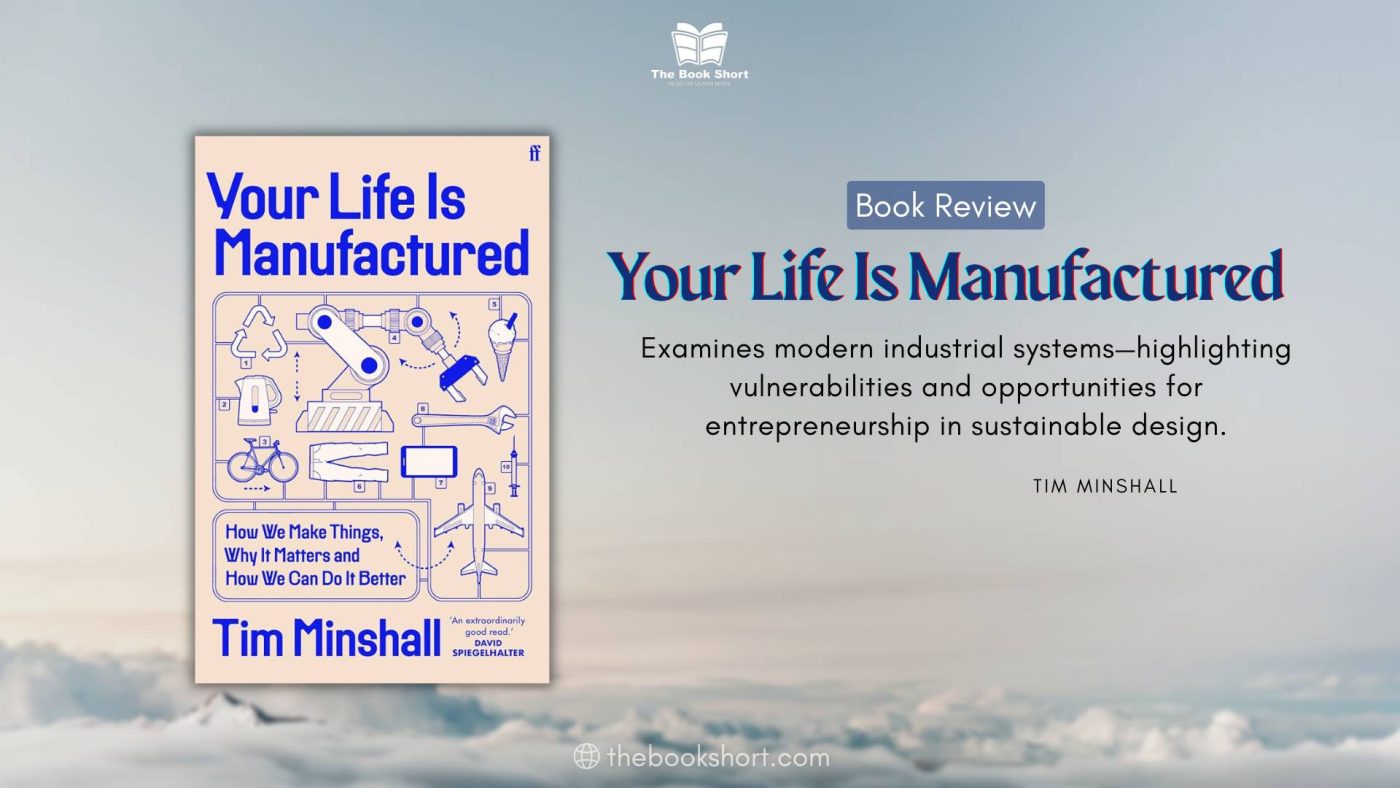
Discover the hidden world of making. This book review and analysis of Your Life Is Manufactured by Tim Minshall will fundamentally change how you see the world around you. This book stands out for its brilliant ability to bridge the chasm between complex engineering and our daily lives, revealing that manufacturing is not a relic of the industrial past, but a vibrant, creative force actively shaping our future. Its power to make the invisible visible is what makes it an essential and truly compelling read.
Your Life Is Manufactured: Key Book Details
- Title: Your Life Is Manufactured: The hidden world of engineering, and how it shapes our lives
- Author: Tim Minshall
- Year of publication: 2023
- Genre: Non-fiction, Engineering, Technology, Business
- Number of pages: 288
- Target audience: Curious minds, students, engineers, entrepreneurs, policymakers, and anyone interested in how the modern world truly works.

Your Life Is Manufactured: How We Make Things, Why It Matters and How We Can Do It Better
A Detailed Summary of Your Life Is Manufactured
In Your Life Is Manufactured, Tim Minshall, Cambridge’s Professor of Innovation, embarks on a vital mission: to demystify the art and science of making. He passionately argues that manufacturing is far more than factories and production lines; it is the fundamental human impulse to turn ideas into reality, a creative process that underpins the very fabric of modern civilization. The book takes us on a journey from the simple building blocks of production to the sprawling, interconnected systems that deliver the products and services we depend on every moment of every day.
Part 1: Deconstructing the “How” of Making
The book begins by meticulously breaking down the core elements of manufacturing. Minshall posits that to truly appreciate our world, we must first understand how it is made. He expertly moves beyond the romanticized myth of the lone inventor, revealing that meaningful innovation is almost always a collaborative, iterative, and often messy process.
- From Idea to Object: The initial chapters trace the fascinating journey of a product from a conceptual spark to a tangible item in our hands. This involves the crucial stages of design, prototyping, rigorous testing, and constant refinement. Minshall illuminates these complex steps with wonderfully accessible examples, from the revolutionary engineering of a Dyson vacuum cleaner to the humble design of a disposable coffee cup.
- The Trinity of Manufacturing: He introduces three pillars that form the foundation of all making:
- Materials: What is it made of? The book delves into the properties of metals, plastics, ceramics, and composites, explaining how the choice of material dictates a product’s function, feel, cost, and environmental footprint.
- Processes: How is it shaped? Minshall offers a captivating overview of manufacturing processes, guiding the reader from ancient techniques like casting and forging to modern marvels like 3D printing (additive manufacturing) and computer-guided precision machining.
- Scale: How many do we need? The monumental challenge of scaling production from a single prototype to millions of identical units is a central theme. This section brilliantly explains the power of economies of scale and why the dawn of mass production was a force that revolutionized society.
Part 2: The Systems That Sustain Our Lives
Moving from individual products, Minshall masterfully zooms out to reveal the vast, often invisible systems that enable manufacturing on a global scale. This part of the book is crucial for understanding the profound interconnectedness of our modern economy. He argues that the product itself is merely the tip of the iceberg; the real magic lies in the systems that create, deliver, and sustain it.
The Unseen Network: Supply Chains
Minshall dedicates significant attention to supply chains, vividly describing them as the “circulatory system” of the global economy. Using the example of a single smartphone, he traces its components back through a dizzying network of mines, refineries, factories, and assembly plants spread across multiple continents. This powerful analysis highlights:
- Complexity and Fragility: The intricate web of suppliers and logistics partners that must operate in near-perfect harmony. The COVID-19 pandemic and the Suez Canal blockage are used as stark case studies to demonstrate just how fragile these complex systems are.
- Logistics and Just-in-Time: The principles of moving goods efficiently across the planet and the double-edged sword of “just-in-time” manufacturing, a philosophy that minimizes waste but also heightens vulnerability to shocks.
Quality, Resilience, and the Human Factor
Beyond logistics, the book examines the critical systems designed to ensure products work reliably and safely. Quality control is reframed not as a final inspection, but as a deeply embedded philosophy that permeates the entire production process. Crucially, the human element remains at the center of this narrative. Minshall emphasizes that despite breathtaking automation, manufacturing still relies on the irreplaceable skills, expertise, and problem-solving abilities of millions of people—from shop-floor technicians to process engineers and supply chain strategists.
Part 3: Manufacturing Our Collective Future
In the book’s powerful final act, Minshall pivots to the future, arguing that the principles of manufacturing are essential for tackling humanity’s greatest challenges. He convincingly reframes manufacturing as a forward-looking, profoundly creative endeavor that will build the world of tomorrow.
- Sustainability and the Circular Economy: How can we design products and systems that minimize waste and heal our planet? Minshall explores the urgent shift from a linear “take-make-dispose” model to a circular one, where products are designed from the outset for longevity, repair, reuse, and recycling.
- Healthcare and Bespoke Solutions: The book showcases how manufacturing innovation is revolutionizing medicine. Breathtaking examples include the rapid scale-up of vaccine production, the 3D printing of custom prosthetics and biological implants, and the creation of life-saving diagnostic tools.
- The Future of Work: Minshall confronts the fear of automation head-on, arguing that while technology will inevitably replace certain repetitive tasks, it will also create new, more fulfilling roles that demand creativity, critical thinking, and systems management. The factory of the future will be a dynamic place of human-machine collaboration.
Ultimately, the message of Your Life Is Manufactured is a powerful call to action: to become more informed, engaged, and appreciative citizens of a world we have collectively built and are responsible for improving.
In-Depth Analysis: Themes and Style in Your Life Is Manufactured
Tim Minshall’s Your Life Is Manufactured distinguishes itself in the crowded popular science genre by offering a perspective that is at once panoramic and deeply human. He successfully transforms the often-intimidating field of engineering into a compelling narrative of human ingenuity, collaboration, and hope.
Key Arguments and Structure
At its core, the book’s central argument is that manufacturing is the invisible scaffolding of modern life, and understanding it has become a form of essential civic literacy. Minshall methodically dismantles the outdated, grim perception of manufacturing as a low-skill, dying industry. He repositions it as a dynamic, knowledge-intensive field that is absolutely critical to solving the complex problems of the 21st century.
The book’s elegant structure is one of its greatest strengths. It builds with perfect logic from the micro to the macro:
- The Object: It begins with the tangible product, grounding the reader in the familiar by breaking it down into its constituent materials and processes.
- The System: It then zooms out to expose the breathtakingly complex supply chains, logistics, and quality systems required to produce that object at a global scale.
- The Future: Finally, it projects these principles forward, applying them to grand challenges like global health, climate change, and sustainability.
This layered structure allows the reader to build a solid foundation of understanding before tackling more abstract, systemic ideas, making the book exceptionally clear and accessible. Minshall’s key insight is not just that manufacturing is important, but that a “manufacturing mindset”—one of iterative problem-solving, systems thinking, and a drive to turn ideas into reality—is an invaluable tool for everyone.
Writing Style & Content Quality
As a Cambridge professor, Minshall writes with deep authority, but his style is refreshingly free of dry, academic jargon. His prose is clear, energetic, and infused with a contagious passion for his subject. The book’s quality is elevated by his remarkable gift for translating highly technical concepts into relatable, human-centered narratives.
He achieves this through:
- Vivid Analogies: Comparing supply chains to the human circulatory system or describing quality control as a core philosophy rather than a mere department makes complex ideas instantly intuitive.
- Diverse Case Studies: The examples are brilliantly chosen, ranging from the deceptively simple (a Pringles crisp) to the monumental (the Ventilator Challenge UK during the pandemic). This variety keeps the content fresh and powerfully demonstrates the universal applicability of his points.
- A Human-Centric Focus: Minshall consistently brings the narrative back to the people who make it all happen—the designers, engineers, technicians, and managers. This prevents the book from becoming a cold, technical manual and transforms it into a profound story of collective human achievement.
What truly sets Your Life Is Manufactured apart is its holistic, systems-level approach. While a book like Mark Miodownik’s Stuff Matters offers a fascinating deep dive into materials, Minshall is concerned with the entire ecosystem: how those materials are sourced, shaped, assembled, and delivered within a global network. He connects the dots between engineering, economics, and society in a way few authors can.
Notable Concepts from the Book
- “Manufacturing is, at its heart, the activity of turning ideas into reality. It is the process that connects the imagination of the inventor to the daily lives of the user.” (Paraphrased concept) – This captures the book’s core definition of manufacturing as a creative, not just a technical, process.
- “We are all, in a sense, living inside a machine that we do not understand. My aim is to give you a glimpse of the instruction manual.” (Paraphrased concept) – This highlights the book’s mission to empower readers by revealing the hidden systems that shape their world.
- On supply chains: “Think of it not as a chain, but as a dense, pulsating web. A break in one tiny filament can send tremors across the entire structure.” (Paraphrased concept) – This powerfully illustrates the mind-boggling complexity and inherent fragility of the global systems we depend on.
Personal Review and Evaluation of Your Life Is Manufactured
Reading Your Life Is Manufactured is a genuinely eye-opening experience. It achieves something truly remarkable: it makes you look at the most mundane objects in your life—your coffee mug, your pen, your smartphone—with a newfound sense of wonder and profound appreciation. Tim Minshall succeeds completely in his quest to elevate manufacturing from a niche topic for specialists to a subject of universal importance.
Where the Book Shines:
- Engaging and Accessible: Despite the complexity of its subject, the book is an absolute pleasure to read. Minshall’s passion is infectious, and his masterful use of storytelling makes even the most technical details utterly fascinating.
- A Powerful New Perspective: The book provides a powerful mental model for understanding the modern world. The “systems thinking” it champions is applicable far beyond manufacturing, offering fresh insights into economics, politics, and societal challenges.
- Optimistic and Forward-Looking: While frankly acknowledging challenges like environmental impact and job displacement, the book’s tone is ultimately one of energizing optimism. It frames manufacturing as a key instrument for building a better, more sustainable, and healthier future.
A Minor Caveat:
- Potential for Detail Overload: For readers with zero background in engineering, some sections detailing specific processes (like injection molding or casting) might feel dense. However, Minshall always does an excellent job of tying these technical dives back to the bigger, more compelling picture.
- UK/Western-Centric Examples: While the examples are excellent, they are naturally drawn from the author’s context, with a slight focus on UK and European manufacturing stories. This is a minor point, as the principles discussed are unequivocally universal.
Readability and Audience:
This book is highly readable and masterfully written for a curious general audience, not specialists. It’s perfectly suited for:
- Students considering careers in STEM, business, or design.
- Business leaders and policymakers who need to understand the true foundations of our modern economy.
- General non-fiction readers who enjoyed world-expanding books like Sapiens, Factfulness, or Stuff Matters.
- Anyone who has ever picked up an object and wondered, “How on earth was this made?”
Practical Value:
The practical value of Your Life Is Manufactured lies in the profound and lasting shift in mindset it inspires. The key lessons it imparts are:
- Appreciation for the “Made” World: You will never look at a simple product the same way again. This newfound appreciation fosters a deeper sense of responsibility and can inspire less wasteful consumption.
- Enhanced Problem-Solving Skills: The book is a masterclass in systems thinking. It trains you to look beyond the immediate problem to understand the interconnected network of causes, effects, and potential solutions.
- Informed Citizenship: Understanding the fundamentals of supply chains, production, and innovation makes you a more informed consumer, voter, and citizen, better equipped to engage with news about trade, technology, and the economy.
In essence, the book doesn’t just give you facts; it gives you a new lens through which to view the world.
How Your Life Is Manufactured Compares to Other Books
Your Life Is Manufactured fits neatly into a growing genre of non-fiction that seeks to explain the hidden workings of the modern world, yet it carves out its own unique and vital niche.
- Compared to Stuff Matters by Mark Miodownik: Miodownik’s celebrated book takes a materials-first approach, exploring the world through the lens of steel, paper, and concrete. It is a deep dive into the “what.” Minshall’s book is the perfect companion, focusing on the “how”—the processes, systems, and people that transform those materials into functional products at a global scale. If Miodownik explains the substance, Minshall explains the system.
- Compared to The Box by Marc Levinson: The Box tells the epic story of a single, world-altering innovation: the shipping container. It is a brilliant deep-dive into how one manufacturing-adjacent idea can remake global economics. Minshall’s book is far broader, weaving together hundreds of such innovations to paint a comprehensive picture of the entire manufacturing ecosystem. Where The Box is a deep and narrow case study, Your Life Is Manufactured is a wide and interconnected survey.
- Compared to The Goal by Eliyahu M. Goldratt: The Goal is a classic business novel that teaches the principles of process improvement through a fictional narrative. It is a practical guide for managers inside a factory. Minshall’s book operates at a higher, more societal level, aiming to educate a general audience about the immense importance of manufacturing as a whole.


If you enjoyed the systems-thinking and revelatory nature of Your Life Is Manufactured, you might also enjoy:
- Factfulness by Hans Rosling: For its shared mission to correct common misconceptions and provide a data-driven framework for understanding the world more clearly.
- How to Invent Everything by Ryan North: A witty and humorous take on the foundational technologies needed to rebuild civilization, touching on many of the same core concepts as Minshall.
- Extra Life: A Short History of Living Longer by Steven Johnson: Explores the systemic scientific and industrial innovations (like vaccines and sanitation systems) that have dramatically increased human lifespan, echoing Minshall’s themes of collaborative, world-changing progress.
Conclusion: Is Your Life Is Manufactured Worth Reading?
Yes, without a doubt. Your Life Is Manufactured is an essential read for anyone curious about the modern world. Its profound value lies in its power to make the invisible visible, to connect the abstract concepts of engineering and economics to the tangible reality of our daily lives. Tim Minshall has crafted a book that is both deeply educational and genuinely inspiring.
This book should be on the shelf of every student who wants to understand how the world works, every leader who makes decisions that shape it, and every single one of us who uses the products it creates. It is a powerful reminder that we are not passive consumers in our world, but active participants in an ongoing story of making, innovation, and collective improvement. This book doesn’t just explain that story; it equips you to become a more conscious and engaged character within it.
Have you read this book? Share your thoughts in the comments below.