
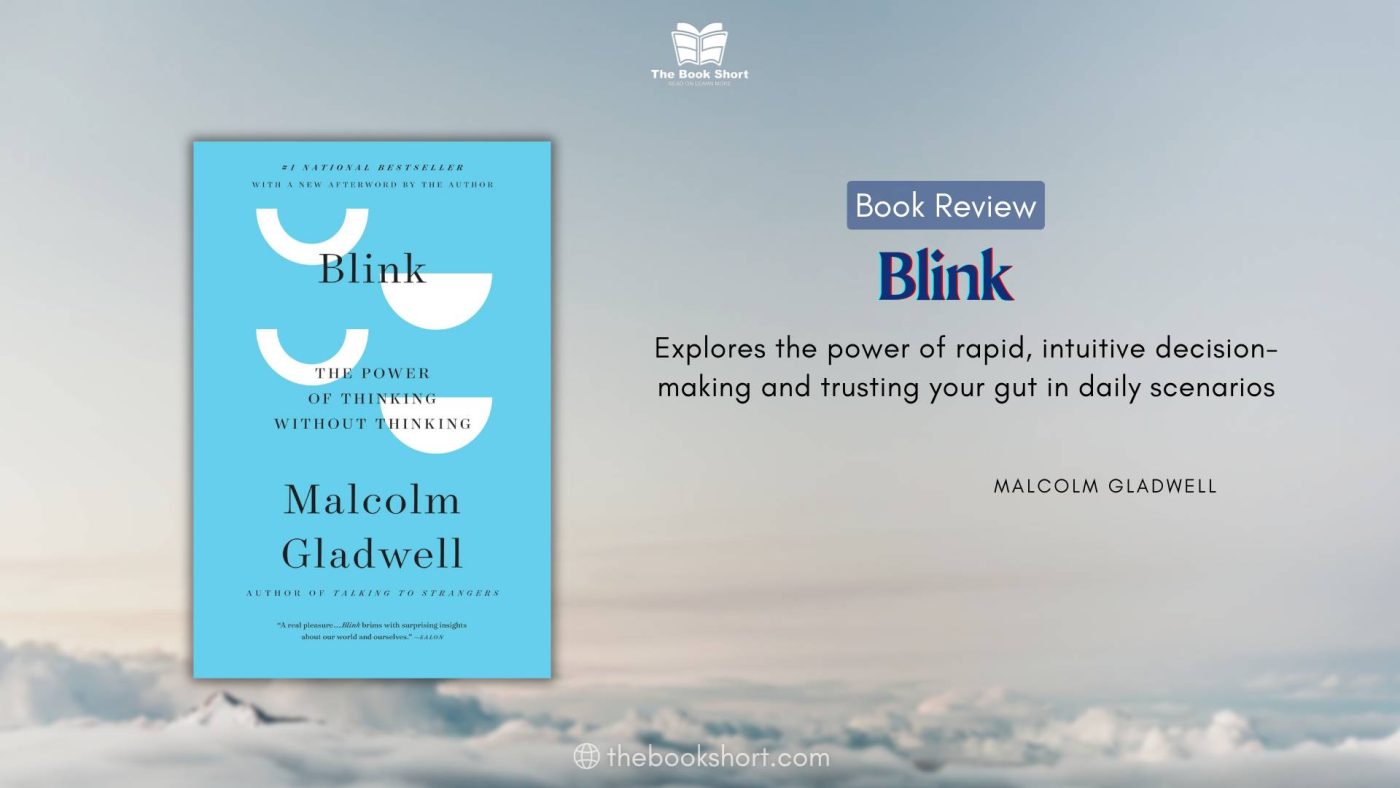
A Blink book review and analysis exploring the power of snap judgments and the two seconds that can change everything. Malcolm Gladwell’s Blink is a book that fundamentally alters how you perceive the world, turning the spotlight on the mysterious, powerful, and often perilous world of snap judgments. It masterfully bridges the gap between dense psychological research and our own daily lives, revealing why we should both trust and deeply question our intuition. This exploration of the unconscious mind is as relevant today as when it was first published, challenging us to look closer at the hidden forces that shape our choices.
Blink: A Book Summary in Brief
- Title: Blink: The Power of Thinking Without Thinking
- Author: Malcolm Gladwell
- Year of publication: 2005
- Genre: Non-fiction, Psychology, Pop Science
- Number of pages: 296
- Target audience: General readers interested in psychology, decision-making, intuition, and business.

Blink: The Power of Thinking Without Thinking
Main Content Summary of Blink: The Power of Thinking Without Thinking
Blink by Malcolm Gladwell isn’t a book you read from start to finish like a novel. Instead, it’s a captivating journey through a single, revolutionary idea: the decisions we make in the blink of an eye are often as sound as—or even superior to—those we ponder for weeks. Gladwell builds his case not with dry theory, but with a whirlwind of unforgettable stories, scientific studies, and real-world dramas.
The Theory of Thin-Slicing: Knowing in an Instant
The book opens with a fascinating puzzle: the Getty Museum’s kouros statue. After 14 months of rigorous scientific analysis declared it a genuine ancient Greek artifact, a handful of art historians knew it was a fake within seconds. A feeling of “intuitive repulsion” washed over them. They couldn’t articulate exactly why, but they knew.
This is Gladwell’s entry point to “thin-slicing”: our unconscious mind’s incredible ability to find meaningful patterns in fleeting moments and thin slices of experience. He argues that our brain is a silent supercomputer, constantly processing data beneath the surface of conscious thought. A snap judgment isn’t a mere guess; it’s a high-speed conclusion delivered by a hidden, powerful intelligence.
The Adaptive Unconscious and Its Locked Door
Gladwell gives this hidden intelligence a name: the “adaptive unconscious.” To illustrate its power, he introduces psychologist John Gottman, who can predict with over 90% accuracy whether a married couple will divorce after observing their conversation for just a few minutes. Gottman thin-slices their interactions, identifying fleeting micro-expressions of contempt that are lethal to a relationship.
Yet, this mental superpower operates behind a “locked door.” We receive the conclusion—the gut feeling, the hunch—without access to the reasoning. We can’t explain how we know, only that we know. Blink is Gladwell’s attempt to pick that lock, helping us understand where these feelings come from and when we should heed their call.
When Snap Judgments Fail: The Warren Harding Error
Gladwell doesn’t shy away from the dark side of thin-slicing. Our rapid cognition can be a pipeline for our deepest biases and lead to catastrophic errors. He calls this the “Warren Harding Error,” named after the U.S. President who was elected primarily because he looked the part. His tall, handsome, and distinguished appearance created a halo of competence, masking a famously inept presidency.
This chapter is a sobering look at how easily our intuition is corrupted by stereotypes and irrelevant details. Gladwell presents the Implicit Association Test (IAT), a tool that reveals our hidden biases about race and gender, proving that our snap judgments are often tainted by prejudices we consciously reject and may not even know we possess.
The Power of Less: Structured Intuition
One of the book’s most thrilling case studies is the Millennium Challenge, a massive U.S. military war game. The “Blue Team,” representing the U.S., was armed with overwhelming data, satellite intel, and a rigid, analytical command structure. Their opponent, the “Red Team,” led by maverick retired Marine Lt. General Paul Van Riper, relied on intuition, speed, and unpredictability. In a stunning upset, Van Riper’s lean and agile team decimated the lumbering, data-drowned Blue Team.
This story makes a powerful point: too much information can be a curse. It can trigger “analysis paralysis,” burying insight under a mountain of data. Van Riper’s victory demonstrates that in high-stakes environments, a fast and frugal approach—guided by deep expertise and structured intuition—is often far more potent.
Context and Expertise: The Musician’s Dilemma
Not all snap judgments are created equal. Expertise is the bedrock of reliable intuition. Gladwell explores this through the curious case of the musician Kenna, whose innovative music was adored by industry experts but flopped in consumer focus groups. This highlights a critical paradox: experts, whose instincts are honed by years of experience, can thin-slice quality with remarkable accuracy. The general public, however, lacking that trained context, may react very differently in the sterile environment of a survey than they would hearing the same song on the radio.
This section drives home two crucial lessons:
- True intuition isn’t a magical gift; it’s a skill cultivated through thousands of hours of dedicated practice.
- The context in which we make a snap judgment profoundly shapes its accuracy.
The Dangers of Stress: When Thin-Slicing Breaks Down
The book culminates in a heart-wrenching analysis of the tragic police shooting of Amadou Diallo, an unarmed man killed in a hail of 41 bullets. Gladwell argues that extreme stress short-circuits our ability to thin-slice effectively. The officers’ minds, flooded with adrenaline, entered a state of “temporary autism”—a condition where the brain is so overwhelmed by physiological arousal that it can no longer accurately read the world. Their fatal snap judgment wasn’t born from clear intuition, but from a catastrophic breakdown of perception fueled by fear.
Gladwell’s powerful conclusion is that we must become architects of our decision-making environments. We need to respect the extraordinary power of the first two seconds, but also recognize the conditions—like stress, fatigue, and bias—that can warp this gift into a grave liability.
In-depth Book Analysis of Blink: Gladwell’s Message
Malcolm Gladwell’s Blink is more than a collection of great stories; it is a cultural touchstone that challenges our worship of exhaustive, data-driven analysis. It champions the misunderstood power of intuition while serving as a stark warning against its unchecked influence.
Characters, Structure, and Key Arguments
The “characters” in Blink are not fictional creations but real people whose experiences become windows into the book’s core ideas: the perceptive art historians, the insightful marriage counselor, the renegade general, and the victims of intuition gone horribly wrong.
Structure: Gladwell constructs the book as a mosaic of case studies rather than a linear argument. He introduces the central theme of thin-slicing and then examines it from a dozen different angles, weaving together narratives from art history, psychology, military strategy, and criminology. This structure is essential to his thesis; by revealing the same cognitive principles at play in wildly different fields, he argues for their universality. While critics might call this cherry-picking, it creates a gripping narrative that feels more like a captivating documentary than a dry academic text.
Key Arguments:
- Intuition is Cognition: Gladwell’s primary mission is to legitimize the adaptive unconscious as a real and powerful form of thinking, not just a vague, mystical feeling.
- A Double-Edged Sword: Blink is a book of powerful contrasts. For every story of brilliant intuition (the kouros, Gottman’s lab), there is a cautionary tale of its failure (Warren Harding, Amadou Diallo). The message isn’t simply “trust your gut,” but rather, “understand your gut.”
- Expertise and Environment are Everything: Gladwell shows that effective thin-slicing is a learned skill, not an innate talent. More importantly, the environment in which we make a snap judgment can either sharpen or corrupt our intuitive powers.
Writing Style and Content Quality
Gladwell’s writing style is the secret to Blink‘s phenomenal success. He is a master of narrative non-fiction.
- Accessibility: He has an uncanny ability to distill complex academic research into clear, conversational prose, using vivid analogies that make abstract concepts stick.
- Storytelling: He frames each chapter around a compelling human drama, building suspense and emotional connection. We are on the edge of our seats, waiting to see if the experts are right about the statue or how Van Riper will outsmart a supercomputer.
- Pacing: The book moves at a brisk, exhilarating pace, leaping from one fascinating example to the next, ensuring the reader is always engaged.
The content quality is a frequent topic of debate. As a journalist and synthesizer of ideas, Gladwell’s goal is to ignite public conversation, not to publish peer-reviewed research. Critics argue he sometimes oversimplifies complex issues and curates evidence to fit his thesis. However, the immense value of Blink lies not in its academic rigor, but in its unique ability to provoke curiosity and critical thinking in a mass audience that would otherwise never encounter these powerful ideas.
Notable Quotes from the Book
- “Anyone who has ever scanned the bookshelves of a new acquaintance knows that it is possible to divine a great deal about someone’s character and interests from a brief survey of their reading material.” – A perfect, everyday example of the thin-slicing we all do.
- “The key to good decision making is not knowledge. It is not brilliance. It is understanding. It is the ability to filter out the unimportant and focus on what matters.” – This captures the central lesson of the Millennium Challenge and the surprising power of having less information.
- “We have, as human beings, a storytelling problem. We’re a bit too quick to come up with explanations for things we don’t really have an explanation for.” – A crucial acknowledgment of the “locked door” problem—our tendency to invent logical reasons for decisions that actually came from a place we can’t access.
Evaluation & Personal Review of the Book Blink
Blink is one of those rare, transformative books that permanently alters the lens through which you see the world. It’s a brilliant exploration of first impressions, gut feelings, and the hidden architecture of your own mind. This is pop psychology at its absolute finest: endlessly entertaining, deeply insightful, and intellectually alive.
Advantages:
- Immensely Engaging: Gladwell’s storytelling is simply magnetic. It’s a non-fiction book that reads like a thriller, making it a true page-turner.
- Genuinely Paradigm-Shifting: It fundamentally changes your relationship with intuition. You start to notice your own “Blink” moments, questioning whether they are rooted in expertise or tainted by bias.
- Broadly Applicable: The insights resonate far beyond the page, offering valuable lessons for business, leadership, relationships, and for understanding complex social issues like prejudice and profiling.
Disadvantages:
- Risk of Oversimplification: In his quest for clarity, Gladwell sometimes smooths over the messy complexities and counter-arguments of the science. The book can feel more like a curated series of “aha!” moments than a fully balanced treatise.
- An Inherent Contradiction: The central advice can feel paradoxical. The book tells you to both trust your instincts and be deeply suspicious of them. It doesn’t offer a simple manual for telling them apart, but perhaps that’s the point: understanding our minds is a complex, lifelong task.
Readability and Audience:
The book’s readability is off the charts. Gladwell’s prose is clean, crisp, and effortlessly engaging. It requires no prior knowledge of psychology, making it a perfect read for:
- Students of psychology, sociology, or business.
- Professionals whose jobs rely on quick judgment (e.g., HR, marketing, leadership, law enforcement).
- Anyone with a curiosity for self-improvement and the inner workings of the human mind.
Practical Value:
The true practical value of Blink is the gift of meta-awareness—the ability to think about your own thinking. It doesn’t provide a neat checklist, but instead installs a new mental framework. After reading it, you are far more likely to:
- Pause and interrogate a strong first impression: Is this expertise or prejudice talking?
- Recognize high-risk situations (like stress or fatigue) where your judgment is likely compromised.
- Appreciate that deliberate, data-heavy analysis isn’t always the best path.
- Understand that to improve your intuition, you must deliberately train your unconscious with rich experiences.
It encourages a more mindful, humble, and intelligent approach to our own cognitive lives—an invaluable skill in our complex world.
Comparison with Similar Books in this Book Analysis
Blink is a cornerstone of the genre of books that translate big, complex ideas for a mainstream audience.
If you found Blink fascinating, you must read Daniel Kahneman’s Thinking, Fast and Slow. It is widely considered the denser, more scientific deep-dive into the very same territory. Where Gladwell uses stories to illustrate the “adaptive unconscious,” Kahneman (a Nobel laureate) provides the foundational theory, meticulously breaking down our two modes of thought: the fast, intuitive “System 1” and the slow, analytical “System 2.” If Blink is the thrilling movie trailer, Thinking, Fast and Slow is the award-winning feature film.


Other similar books include:
- The Power of Habit by Charles Duhigg: Another exploration of our brain’s automatic processes, this time focusing on the science behind how habits are formed and changed.
- Nudge by Richard Thaler and Cass Sunstein: Examines how subtle changes in our environment (“choice architecture”) can guide our decisions, a theme that beautifully complements Blink’s focus on context.
Conclusion & Recommendations for the Book Blink
Blink: The Power of Thinking Without Thinking is an essential read. Its true genius lies in its masterful storytelling and its profound ability to make you see both the world and yourself with fresh eyes. Gladwell pulls back the curtain on the hidden machinery of the mind, celebrating its astonishing power while delivering a sober warning about its capacity to fail us.
Is it worth reading? Without a doubt. For its unforgettable narrative and mind-altering insights alone, Blink has earned its place as a modern classic. It’s that rare book that manages to be both intellectually robust and an absolute joy to read.
Who should read it? In short, everyone. While professionals in leadership, marketing, and creative fields will find immediate applications, the book’s investigation of human nature is universal. If you’ve ever wondered why you feel the way you do about people, art, or ideas, this book holds a piece of the answer.
Have you read this book? Share your thoughts in the comments below