
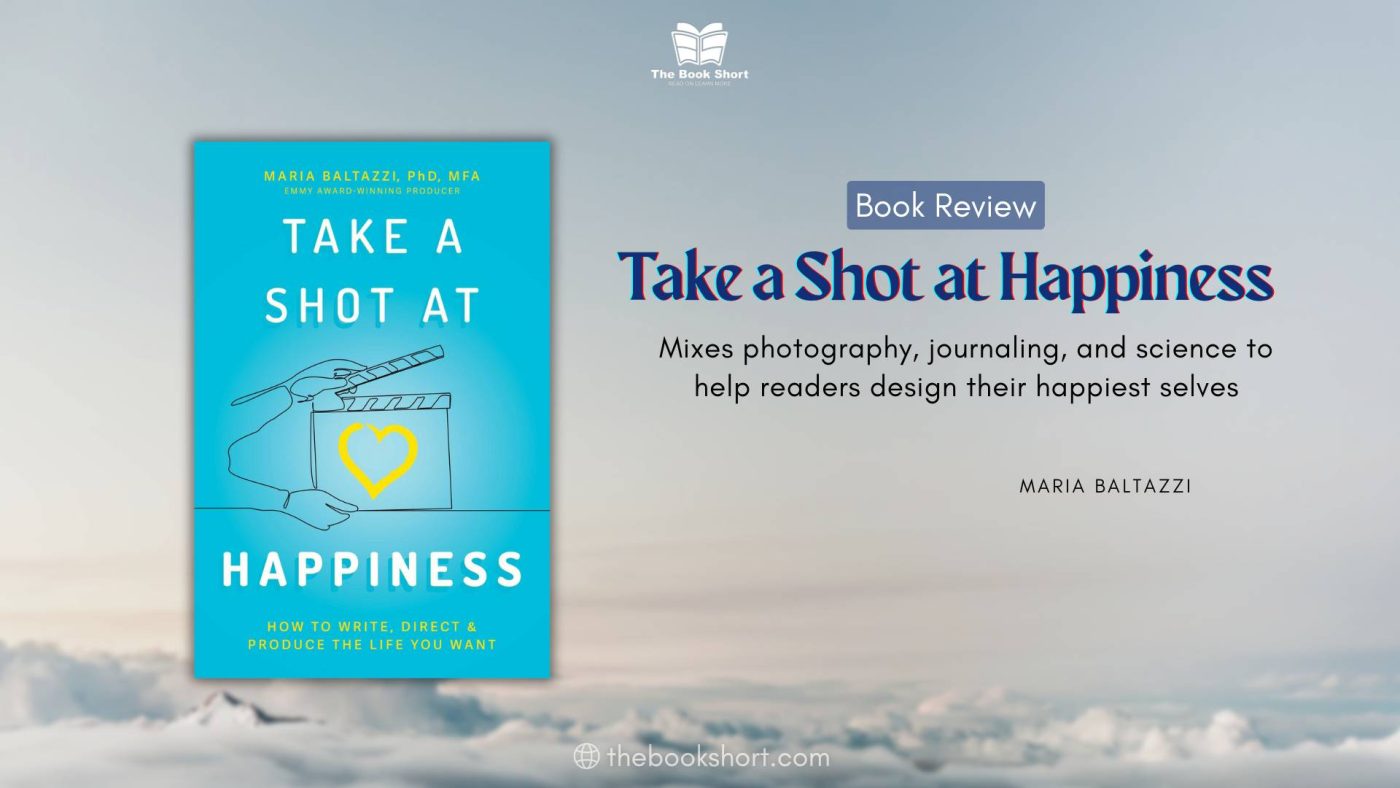
A practical guide to happiness from a Survivor producer, this book review explores a unique, four-step framework for a more fulfilling life. What if the secret to a happier life wasn’t a secret at all, but a mission plan forged in the jungles of reality television? In her book Take a Shot at Happiness, Emmy-winning producer Maria Baltazzi does just that, translating lessons learned from the high-stakes world of Survivor into a powerful, practical blueprint for well-being. I was drawn to this book for its brilliant fusion of gripping adventure memoir and evidence-based positive psychology. Its “SHOT” acronym provides a memorable and actionable path to a more joyful life, making it an essential read for anyone ready to make a real change.
Take a Shot at Happiness: Book at a Glance
- Title: Take a Shot at Happiness: How to Take a SHOT at a Happier Life
- Author: Maria Baltazzi
- Year of publication: 2022
- Genre: Self-Help, Memoir, Positive Psychology
- Number of pages: 230
- Target audience: Individuals seeking practical, actionable strategies for improving their well-being, fans of travel and adventure memoirs, and those looking for an accessible introduction to happiness principles.

Take a Shot at Happiness: How to Write, Direct & Produce the Life You Want
A Detailed Summary of the Take a Shot at Happiness Book
Take a Shot at Happiness by Maria Baltazzi is not just another self-help book; it’s a field guide to a more vibrant life, tested in the crucible of extreme environments and backed by solid science. As an Emmy-winning producer for the hit show Survivor, Baltazzi draws from her extraordinary experiences—from scouting treacherous locations to managing life-or-death logistics—to forge a simple and unforgettable framework for cultivating happiness: the SHOT acronym. The book is built around these four pillars, masterfully weaving together personal anecdotes, psychological insights, and practical exercises, or “shots,” that readers can implement from day one.
The Core Premise: Taking Your “SHOT”
Baltazzi’s core message is clear and empowering: happiness isn’t a destination you arrive at, but a skill you cultivate through daily practice. It demands intention and consistent effort, much like training for an endurance race or mastering a craft. The SHOT framework deconstructs this practice into four interconnected domains: Self, Health, Others, and Tribe. Each section of the book explores one of these pillars, delivering the “why” through compelling stories and science, and the “how” through targeted, actionable shots.
S – The Journey Inward (Self)
The first pillar, Self, is the bedrock upon which a happy life is built. Baltazzi argues that before you can meaningfully improve your health, relationships, or community ties, you must first know who you are. This chapter is a call to introspection, self-awareness, and the cultivation of a resilient inner core.
- Key Concepts:
- Defining Your Values: Baltazzi challenges us to excavate our core values—the non-negotiable principles that serve as our internal compass. Living in alignment with these values, she shows, is a direct source of fulfillment and inner peace.
- Mindfulness and Presence: Drawing from production moments where a lapse in focus could be catastrophic, she underscores the power of being fully present. She introduces simple mindfulness techniques to anchor readers in the now, quieting anxieties about the future and regrets about the past.
- Self-Compassion: The author confronts the inner critic, teaching us to treat ourselves with the same kindness we would offer a dear friend. This means acknowledging our flaws without judgment and viewing mistakes as lessons, not failures.
- Discovering Your ‘Why’: This isn’t about finding a single grand purpose, but about understanding the deeper motivations that drive your daily actions and choices.
- Actionable “Shots”:
- The Values Compass: An exercise to identify, write down, and prioritize your top five core values.
- Five-Minute Mindful Reset: A simple, guided practice to build a sustainable mindfulness habit.
- The Gratitude Log: The classic practice of noting three specific things you are grateful for each day to rewire your brain for positivity.
H – Nurturing Your Vessel (Health)
The Health pillar tackles the undeniable link between our physical and mental states. Baltazzi is unequivocal: you cannot build a happy life on a foundation of poor health. Having witnessed the extreme physical and psychological toll Survivor took on contestants, she advocates for a holistic approach to health that is both sustainable and realistic.
- Key Concepts:
- The Mind-Body Connection: Baltazzi presents the science showing how movement, nutrition, and sleep directly influence our mood, cognitive clarity, and emotional resilience.
- Movement as Medicine: The focus here isn’t on punishing fitness regimes but on weaving consistent, joyful movement into daily life. She shares how simple walks in nature during location scouts became a vital tool for de-stressing and creative problem-solving.
- Fueling Your Engine: The book offers sensible advice on nutrition without being dogmatic or promoting fad diets. The emphasis is on mindful eating and choosing foods that provide sustained energy and support a healthy brain.
- The Power of Sleep: Sleep is framed not as a luxury but as a non-negotiable biological imperative for emotional regulation, memory consolidation, and physical recovery.
- Actionable “Shots”:
- The 10-Minute Nature Walk: A commitment to a short daily walk, ideally outdoors, to clear your head and move your body.
- The Hydration Challenge: A simple goal to consistently increase water intake throughout the day for better energy and focus.
- The Digital Sunset: An exercise to power down all screens at least an hour before bed to dramatically improve sleep quality.
O – The Power of Connection (Others)
The Others pillar explores our fundamental human need for deep, meaningful, one-on-one relationships. Citing extensive research like the landmark Harvard Study of Adult Development, Baltazzi argues that the quality of our close relationships is the single greatest predictor of our long-term happiness and health.
- Key Concepts:
- Quality over Quantity: This section is a powerful reminder to nurture a few deep, authentic connections rather than collecting a long list of superficial ones.
- Empathy and Active Listening: Using vivid examples from her work as a producer, where understanding a person’s story was everything, Baltazzi teaches practical techniques for listening with intent and responding with genuine empathy.
- The Art of Giving: She illuminates how acts of generosity—big and small—not only benefit the recipient but also trigger a powerful “helper’s high” that boosts the giver’s own happiness.
- Setting Healthy Boundaries: A crucial and often overlooked element of strong relationships is learning to protect your energy, time, and well-being by saying “no” when needed.
- Actionable “Shots”:
- The Connection Call: A challenge to reach out to one person each week with an actual phone call instead of a text.
- The Five-Minute Favor: A prompt to do a small, unsolicited favor for a colleague, friend, or family member.
- Voice Your Appreciation: The simple but profound practice of verbally expressing specific gratitude to someone in your life.
T – Finding Your Place (Tribe)
The final pillar, Tribe, expands the lens from individual relationships to our broader sense of community and belonging. A tribe is any group united by shared interests, values, or goals that provides a sense of identity and mutual support. For Baltazzi, the cast and crew of Survivor often formed an intense, high-stakes tribe.
- Key Concepts:
- The Need to Belong: Baltazzi explains the evolutionary and psychological roots of our need to be part of a group, highlighting how loneliness poses a significant risk to our health.
- Identifying Your Tribes: She guides readers to recognize the various tribes they already belong to—from family and work to hobbies and local communities—and to consciously deepen their engagement.
- Contributing to the Collective: True belonging blossoms when we move from being a passive member to an active contributor, sharing our unique skills and energy with the group.
- Building Your Tribe: For those feeling isolated, she provides a clear roadmap for finding and connecting with like-minded people, both online and in the real world.
- Actionable “Shots”:
- Join the Group: A prompt to sign up for a class, club, or volunteer organization aligned with a personal interest.
- The Community Connection: The simple act of greeting neighbors or local shopkeepers to weave a stronger fabric of micro-connections.
- Host a Gathering: A nudge to organize a small get-together to strengthen the bonds within one of your existing tribes.
In-Depth Analysis of the Take a Shot at Happiness Book: Themes and Style
Maria Baltazzi’s Take a Shot at Happiness enters a crowded field but immediately distinguishes itself. Its power lies not in inventing new wisdom, but in framing timeless truths within a modern, adventurous, and brilliantly accessible structure. The book is a masterclass in blending personal narrative, hard science, and an unwavering bias for action.
Characters, Structure, and Key Arguments
The book’s structure is its secret weapon. The SHOT (Self, Health, Others, Tribe) framework is simple, sticky, and deeply intuitive. It serves as a powerful mental model that readers can use as a diagnostic tool for their own lives long after they’ve finished the book. This system transforms the vague, overwhelming goal of “being happier” into a concrete project with four clear, manageable workstreams—a strategy worthy of a world-class producer.
The central “character” is Baltazzi herself, and her voice is the book’s driving force. She is not a detached academic but a fellow traveler sharing what she’s learned from the front lines. By candidly revealing her own battles with burnout, her professional triumphs, and her personal “shots” at happiness, she builds profound credibility and rapport. Her stories—whether about handling a medical crisis in a remote jungle or finding a moment of stillness amidst production chaos—become potent metaphors for the everyday challenges we all face.
The book’s key argument is refreshingly pragmatic: happiness is a skill, not a state of being. It is the cumulative result of small, consistent actions. By demolishing the myth of a “happiness destination,” Baltazzi reframes it as a daily practice, thereby democratizing it and making it accessible to anyone willing to take their shot.
Writing Style and Content Quality
Baltazzi’s writing is conversational, energetic, and full of optimistic grit. It feels less like reading a book and more like getting life-changing advice from a worldly, wise, and incredibly capable friend. She expertly weaves together three distinct threads:
- High-Stakes Memoir: The anecdotes from her career are the book’s signature element. They aren’t just colorful stories; they are proof-of-concept, demonstrating that these principles hold up even under the most extreme pressure. This “in-the-trenches” perspective gives her advice a weight and authenticity that is rare in the genre.
- Accessible Science: Baltazzi grounds her framework in established positive psychology, referencing key studies on everything from gratitude to social connection and the mind-body link. This assures the reader that her advice is evidence-based, not just personal anecdote.
- Actionable Blueprint: The “shots” are the book’s beating heart. These micro-habits are designed to be low-friction and easy to implement, brilliantly sidestepping the overwhelm that often derails self-improvement efforts. The metaphor of taking a “shot” is playful, empowering, and unforgettable.
The content quality is exceptional because of this seamless integration. The stories illustrate the science, and the science validates the “shots.” This synergy makes the book both profoundly inspiring and intensely useful.
Notable Quotes from the Book
While every reader will find their own gems, the spirit of Baltazzi’s message shines through in ideas like these:
- On Self: “Before you can navigate the world, you have to learn to read your own internal compass. Knowing your values is that compass.”
- On Health: “On location, we treated our bodies like mission-critical equipment, because they were. Your body is the most essential piece of gear you own for the adventure of life. Maintain it accordingly.”
- On Others: “The most profound moments of human experience, whether in a suburban home or on a deserted island, are rarely about what happens, but who you share it with.”
- On Tribe: “A tribe isn’t just about finding people who are like you. It’s about finding a place where you can become more of yourself, supported and celebrated by the group.”
Personal Review and Evaluation of Take a Shot at Happiness
Take a Shot at Happiness is a breath of fresh air in the self-help space. It succeeds precisely because it doesn’t try to reinvent the wheel of happiness; instead, it gives you a much better, all-terrain vehicle for the journey. Its true value is in its ingenious packaging, authentic voice, and relentless focus on execution.
Personal Impressions: Advantages and Disadvantages
Advantages:
- The SHOT Framework: This is the book’s crowning achievement. The acronym is memorable, logical, and provides a holistic yet manageable structure for self-improvement, turning abstract concepts into four clear pillars of practice.
- Authenticity and Credibility: Maria Baltazzi’s Survivor background is not a gimmick; it’s the very soul of the book. Her stories of resilience, leadership, and human connection in extreme settings give her advice a rare gravitas. You trust her because she’s been tested.
- Relentlessly Action-Oriented: This book is designed to be used, not just read. The “shots” are small, specific, and built to create momentum, aligning perfectly with the best research on behavior change. The focus on micro-habits makes the advice feel immediately achievable.
- A Gripping Narrative: The blend of memoir, science, and how-to results in a book that’s as entertaining as it is enlightening. It inspires without being preachy and informs without being dry.
Disadvantages:
- Familiar Principles: For veterans of self-help literature, the core concepts—mindfulness, gratitude, social connection, exercise—will not be new. The book’s innovation lies in its exceptional framework and delivery, not in unearthing novel principles.
- Prioritizes Simplicity: While a virtue for most, readers seeking a deep, complex philosophical or psychological treatise might find the approach too direct. This is a practical field manual, not a dense academic text.
Readability Level and Target Audience
The book’s readability is outstanding. Baltazzi’s prose is clear, direct, and accessible to the widest possible audience. She avoids jargon, explaining scientific concepts in plain, relatable language.
This book is perfectly suited for:
- Self-Help Newcomers: An ideal starting point for anyone embarking on a personal growth journey. The SHOT framework is the perfect roadmap.
- Anyone Feeling “Stuck”: For those battling burnout, listlessness, or a general sense of blah, this book offers a concrete action plan for reclaiming your vitality.
- Pragmatic Achievers: Readers who prefer less theory and more action will love the no-nonsense approach and the focus on “shots.”
- Fans of Adventure and Memoir: The thrilling stories from Survivor and Baltazzi’s global travels make it a uniquely compelling read in its category.
Practical Value and Application
The practical value of Take a Shot at Happiness is immense. Its greatest accomplishment is translating the knowledge of what makes us happy into a clear process for achieving it. A reader doesn’t just finish this book feeling motivated; they finish with a toolkit, a plan, and the confidence to start immediately.
The ultimate lesson is that happiness is an aggregate of small, intentional choices. By consistently taking daily “shots”—a short walk (Health), a call to a friend (Others), a moment of gratitude (Self), a small contribution to a group (Tribe)—we can fundamentally elevate our baseline of well-being. It brilliantly shifts the reader from being a passive consumer of ideas to an active architect of their own life.
How Take a Shot at Happiness Compares to Other Self-Help Books
In the vast landscape of self-help, Take a Shot at Happiness carves out its own territory by acting as a bridge between several popular genres. It masterfully combines the project-based approach of Gretchen Rubin’s The Happiness Project, the micro-habit science of James Clear’s Atomic Habits, and the resilience-themed storytelling of Angela Duckworth’s Grit.
- Compared to The Happiness Project: Both books treat happiness as an intentional, structured project. However, Baltazzi’s SHOT framework is more streamlined and easier to recall than Rubin’s monthly resolutions. Moreover, Baltazzi’s high-octane Survivor backdrop provides a grittier, more adventurous canvas than Rubin’s domestic one, which will appeal to a broad audience.
- Compared to Atomic Habits: If James Clear wrote the definitive guide on the “how” of habit formation, then Maria Baltazzi has written the perfect guide on “what” to focus on. Take a Shot at Happiness provides the strategic pillars of a happy life (Self, Health, Others, Tribe), while Atomic Habits provides the tactical playbook for implementing them. They are perfect companion books.
- Compared to Grit: Angela Duckworth offers a deep dive into the psychology of passion and perseverance. Baltazzi’s work echoes the theme of resilience but places it within a more holistic framework for overall life satisfaction, not just singular goal achievement. Her “shots” are less about pushing through monumental challenges and more about weaving small, positive practices into the very fabric of daily life.


If readers enjoyed Take a Shot at Happiness, they might also enjoy:
- The Happiness Project by Gretchen Rubin, for another structured, actionable approach to improving well-being.
- Atomic Habits by James Clear, to master the science of building the small habits that Baltazzi recommends.
- Grit: The Power of Passion and Perseverance by Angela Duckworth, for a deeper exploration of the resilience theme highlighted in Baltazzi’s stories.
- 10% Happier by Dan Harris, which also blends a gripping personal memoir (from a skeptical news anchor) with an exploration of practical wellness techniques like meditation.
Final Thoughts: Is the Take a Shot at Happiness Book Worth Reading?
Take a Shot at Happiness is a phenomenal book that delivers on its promise with precision and heart. It offers a simple, powerful, and actionable guide to building a more fulfilling life. Its genius lies in the SHOT framework, a tool that demystifies happiness and transforms it from a fuzzy ideal into a tangible, four-part practice. Anchored by the author’s incredible life experience and grounded in science, the book is both profoundly inspiring and intensely practical.
Yes, this book is absolutely worth reading. In a crowded market, it cuts through the noise with a clear, credible, and effective system for change.
This book is highly recommended for:
- Anyone feeling overwhelmed and unsure where to begin their journey to well-being.
- Individuals seeking a practical toolkit rather than abstract philosophy.
- Those who value authentic storytelling and need proof that these principles work in the real world—especially when the stakes are high.
This is a field guide for the adventure of your life, and Maria Baltazzi is the experienced, trustworthy, and inspiring guide you want by your side.
Have you read this book? Share your thoughts in the comments below.