
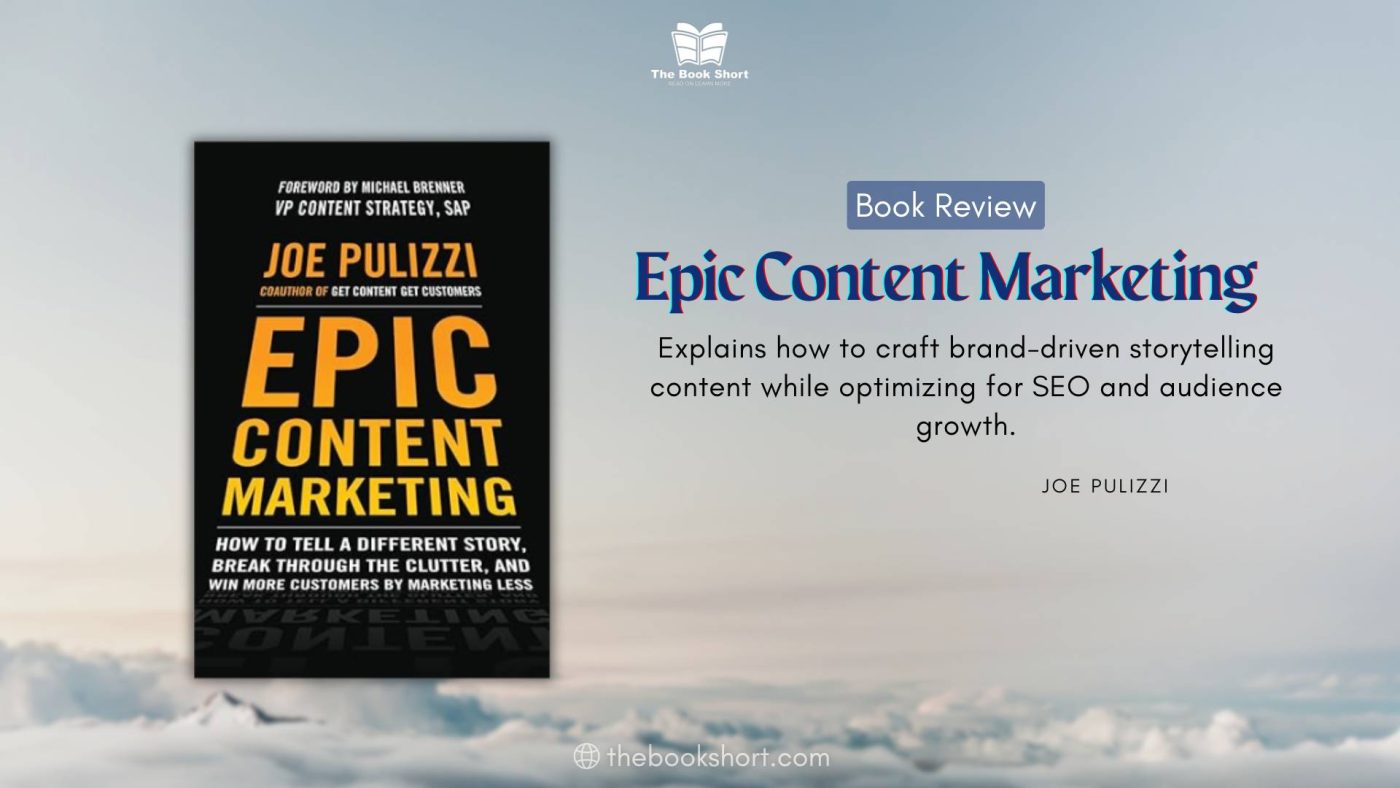
An in-depth book review and summary of Joe Pulizzi’s Epic Content Marketing. Discover key insights, analysis, and why this is a must-read for marketers.
Tired of shouting into the void? Of crafting marketing messages that get ignored? Joe Pulizzi’s foundational text, Epic Content Marketing, offers a revolutionary and far more rewarding path. This book isn’t just another marketing guide; it’s a blueprint for fundamentally shifting your approach from interruption to attraction. We’re delving into it because its core message—that you must become the media, not just buy media—is more relevant today than ever. It provides an actionable framework for creating content that customers will thank you for, making it an essential read for anyone serious about building a modern brand.
Epic Content Marketing: Book Overview & Key Details
- Title: Epic Content Marketing: How to Tell a Different Story, Break through the Clutter, and Win More Customers by Marketing Less
- Author: Joe Pulizzi
- Year of publication: 2013
- Genre: Business, Marketing, Communication
- Number of pages: 352
- Target audience: Marketers, business owners, entrepreneurs, content creators, and communication professionals.

Epic Content Marketing: How to Tell a Different Story, Break through the Clutter, and Win More Customers by Marketing Less
Epic Content Marketing Book Summary: Pulizzi’s Core Principles
Joe Pulizzi, widely hailed as the “Godfather of Content Marketing,” presents a comprehensive strategy for transforming your business into an authentic publisher. The book’s central thesis is that the era of interruptive, self-promotional advertising is over. The future belongs to brands that earn attention and loyalty by consistently delivering valuable, relevant, and compelling content. This summary breaks down Pulizzi’s powerful methodology.
Part 1: The Foundation – Finding Your Niche and Mission
Before a single word is written, Pulizzi demands a pause for deep strategic thinking. This is the bedrock of epic content, yet it’s the step most businesses skip.
- Defining Your Content Niche: You cannot be all things to all people. The first challenge is to carve out a specific area of focus where you can become the definitive expert. This means finding the sweet spot where your business’s deep knowledge intersects with your audience’s most pressing needs or passions. Pulizzi’s directive is clear: go small to go big. Own a specific conversation.
- The Content Tilt: This is arguably the book’s most transformative concept. Your “tilt” is your unique perspective—an angle on your niche that no one else is covering. It’s what makes you different and indispensable. A powerful content tilt is what allows a brand to slice through the overwhelming noise of the internet and establish a memorable voice. Without it, you’re just adding to the static.
- The Content Marketing Mission Statement: To keep every piece of content laser-focused, Pulizzi offers a simple but powerful formula for a mission statement. This guiding star clearly defines:
- Your Core Target Audience: Who, specifically, are you serving?
- What You Will Deliver: The format and type of information you will provide.
- The Audience’s Outcome: What tangible benefit or improvement will your audience gain?
This mission statement becomes a non-negotiable filter, ensuring every blog post, video, or podcast serves your strategic purpose and your audience’s needs.
Part 2: The Plan – Building Your Content Machine
With a solid strategy in place, the focus shifts to building the operational engine to execute it consistently.
- Identifying Your Personas: Pulizzi urges a move beyond sterile demographics to create vivid, empathetic “buyer personas.” This involves a deep dive into your audience’s goals, daily struggles, and information consumption habits. Truly understanding who you’re speaking to is the key to creating content that resonates on a human level.
- Managing the Content Process: A successful content program operates like a media company, not a series of disconnected marketing campaigns. This requires discipline and structure:
- The Editorial Calendar: A non-negotiable tool for planning, organizing, and scheduling your content. It’s the engine of consistency and the key to managing resources without chaos.
- Content Types: Pulizzi surveys a wide array of formats—from blogs and podcasts to videos and white papers—and guides businesses to choose the ones that best align with their audience and amplify their “content tilt.”
- The Content Marketing Team: He breaks down the essential roles for running a content operation, such as a Chief Content Officer, writers, and designers. He also makes it clear that in a small business, one person might wear many of these hats.
Part 3: The Execution – Creating and Distributing Epic Content
This section gets to the heart of producing and promoting your work. Pulizzi lays out “Six Principles for Epic Content Creation” that serve as a quality control checklist.
- Fulfill a Need: Your content must be fundamentally useful. It has to solve a problem, answer a question, or satisfy a curiosity for your audience.
- Be Consistent: Your audience should anticipate your content like their favorite weekly podcast or magazine. Consistency is the currency of trust and loyalty.
- Be Human: Ditch the corporate jargon. Write with a distinct personality and connect with your audience on an emotional, personal level.
- Have a Point of View: This is your “content tilt” in action. Don’t be afraid to take a stand and offer a unique perspective that challenges the status quo.
- Avoid “Sales Speak”: The primary objective is to educate, entertain, or inspire—not to sell. The sale is a natural byproduct of the trust and authority you’ve built over time.
- Be Best of Breed: For any given topic you tackle, aim to create the single most valuable, comprehensive, or entertaining piece of content on the internet.
Once created, content needs an audience. Pulizzi champions a “hub and spoke” distribution model. Your primary content platform (e.g., a blog or YouTube channel) is the “hub,” while social media, email, and other channels are the “spokes” that drive traffic back to your owned asset. He relentlessly emphasizes the critical importance of building a subscriber base—especially an email list—because it’s the only audience you truly own, immune to algorithm changes.
Part 4: The Payoff – Measuring Your Success
Content marketing isn’t an art project; it’s a business driver. The final section is dedicated to measurement and proving ROI. Pulizzi presents a maturity model for measurement that evolves from simple consumption metrics to tangible business impact. Key areas to measure include:
- Consumption Metrics: Page views, downloads, video watch time.
- Sharing Metrics: Social media shares, comments, inbound links.
- Lead Generation: Newsletter sign-ups, form completions.
- Sales Metrics: How content influenced the sales pipeline, customer lifetime value, and loyalty.
The ultimate goal is to connect the dots and prove that building a loyal, engaged audience leads directly to creating more valuable and loyal customers.
In-depth Book Analysis of Epic Content Marketing’s Strategy
Joe Pulizzi’s Epic Content marketing is far more than a tactical playbook; it is a manifesto for a fundamental shift in marketing philosophy. Its enduring power lies in its unwavering focus on foundational principles over fleeting digital trends.
Key Arguments & Structure
Pulizzi’s central argument is both simple and profound: companies must stop interrupting what people are interested in and become what they are interested in. To achieve this, they must adopt the mindset, processes, and discipline of a media company. This is the book’s unwavering north star.
The book’s structure masterfully guides the reader along this transformation. It’s a logical and empowering progression from the abstract to the actionable:
- The ‘Why’ (Strategy): It begins with the most critical and challenging questions: What is our unique purpose? Who do we exist to serve? What makes us different? By front-loading concepts like the content niche and the content tilt, Pulizzi forces a strategic reckoning that most marketing books ignore.
- The ‘How’ (Operations): Next, it translates that strategy into a concrete operational plan, demystifying the process with tools like editorial calendars, team roles, and persona guides. This section makes the ambitious goal of becoming a publisher feel achievable for any organization.
- The ‘What’ (Execution & Measurement): Only after the foundation and plan are set does the book turn to creation, distribution, and measurement. By placing measurement last, Pulizzi brilliantly reinforces that ROI is the outcome of a well-executed strategy, not the starting point.
This structure is a complete A-to-Z roadmap, capable of taking any marketer from a vague idea to a fully functional and measurable content engine.
Writing Style & Content Quality
Pulizzi’s voice is direct, passionate, and refreshingly clear. He avoids dense, academic jargon, opting instead for actionable advice delivered with the conviction of a seasoned practitioner. His motivational tone makes the monumental task of transforming your marketing feel not just possible, but exciting.
The book’s quality is anchored in its rich use of real-world examples. It’s packed with case studies—from giants like Coca-Cola and John Deere to nimble, niche businesses—that aren’t just window dressing. Each story serves to prove a specific principle, demonstrating that this methodology is versatile and effective across industries and scales.
Notable Quotes from the Book
Pulizzi’s philosophy is captured in dozens of memorable, tweetable lines that cut to the core of content marketing.
- “Your customers don’t care about you, your products, or your services. They care about themselves.”
This quote is a bracing and necessary reminder to pivot from company-centric boasting to audience-centric service. It’s the foundational truth that underpins the entire book.
- “If your content is for everybody, it’s for nobody.”
This is the perfect, concise argument for defining a sharp content niche. It directly challenges the corporate impulse to cast the widest possible net, which almost always results in catching nothing.
- “The goal is not to be a content brand. The goal is to be the content brand in your particular niche.”
This line elevates the conversation beyond mere production. It captures the ambition of the “content tilt” and the necessity of aiming for undisputed leadership and authority within your chosen space.
Epic Content Marketing Book Review: A Personal & Expert Take
Epic Content Marketing has rightfully earned its place as a cornerstone of the modern marketing library. It succeeds where so many others fail by delivering both the strategic “why” and the tactical “how” with unparalleled clarity. Reading it doesn’t just leave you with new ideas; it leaves you with a blueprint.
Advantages:
- Timeless Principles: By focusing on strategy—finding a niche, developing a unique tilt, and serving an audience—the book’s advice remains potent and relevant, long after specific social media platforms evolve or disappear.
- Actionable Framework: This is not abstract theory. The Content Marketing Mission Statement, editorial calendar templates, and step-by-step guidance provide a clear and direct path to implementation.
- Profoundly Motivational: Pulizzi’s passion for his subject is infectious. He builds a compelling case that this approach is not only more effective but also more ethical and fulfilling than interruptive advertising.
- Powerful Case Studies: The diverse examples serve as irrefutable proof that the model works for B2B, B2C, global corporations, and solo entrepreneurs alike.
Disadvantages:
- Dated Platform References: Published in 2013, some specific digital tools and company examples can feel a bit out of date. However, this is a minor quibble, as the principles behind these case studies are evergreen.
- Requires True Commitment: The epic model that Pulizzi champions is not a quick-win tactic. It demands patience, resources, and genuine long-term buy-in, which can be a difficult sell for organizations obsessed with immediate, short-term results.
Readability & Target Audience
The book is exceptionally readable. The language is straightforward, chapters are logically structured, and complex ideas are broken down with simple analogies and clear examples. It is perfectly tailored to its intended audience:
- Marketing Managers and Directors: It provides the strategic language and framework needed to build a modern marketing function and justify the investment to the C-suite.
- Small Business Owners and Entrepreneurs: It offers a powerful, cost-effective playbook for competing with larger incumbents by building a loyal community.
- Content Creators (Writers, Podcasters, Videographers): It elevates their craft by connecting it to business strategy, enabling them to create work that has a real impact.
Practical Value & Mindset Shift
The book’s practical value is immense. A reader could genuinely design their entire content strategy from scratch using its chapters as a guide. The templates and checklists are immediately applicable.
But the most profound impact of Epic Content Marketing is the mindset shift it triggers. It compels you to stop asking, “What can we sell today?” and start asking, “How can we help our audience today?” It reframes marketing as an act of generosity that builds trust, which ultimately drives far more sustainable business growth. This evolution from a campaign-based mindset to a publication-based one is the book’s most powerful and enduring lesson.
How Epic Content Marketing Compares to Similar Books
Epic Content Marketing serves as a comprehensive strategic guide, occupying a unique space in the marketing landscape. Here’s how it complements other essential reads:


- Everybody Writes by Ann Handley: This is the perfect companion piece. While Pulizzi gives you the high-level strategy (the ‘what’ and ‘why’), Handley provides the masterclass in execution (the ‘how’ of brilliant writing). If Epic is the architectural blueprint for the house, Everybody Writes teaches you how to lay each brick with precision and style.
- This Is Marketing by Seth Godin: Godin’s work is more philosophical, focusing on the empathy, ethics, and “why” behind marketing—its very soul. Pulizzi is more operational, providing the systems and processes to bring that soul to life. Read Godin to find your purpose, then read Pulizzi to build the engine that delivers it.
- Jab, Jab, Jab, Right Hook by Gary Vaynerchuk: Vaynerchuk’s book is hyper-tactical and platform-specific, focused on the rhythm of giving value (“jabs”) before asking for the sale (“right hook”). It’s an exceptional guide for content distribution, whereas Epic is the definitive guide for content strategy and creation. Pulizzi helps you decide what story to tell; Vaynerchuk shows you how to tell it effectively on today’s social platforms.
If you value the customer-centric approach in Epic Content Marketing, you will also love They Ask, You Answer by Marcus Sheridan, which offers a brilliantly simple but powerful framework for building a content strategy around honestly answering every question your customers have.
Conclusion: Why Epic Content Marketing is a Foundational Read
Epic Content Marketing is not just another book to add to the shelf; it is an essential text for anyone serious about business in the digital age. Its unique value lies in providing a complete, end-to-end system for marketing that builds assets, not expenses. It’s not a list of tips and tricks, but a cohesive and powerful business philosophy.
Is it worth reading? Absolutely and unequivocally. For a marketing professional, it’s a foundational text. For a business owner, it’s a playbook for sustainable growth. It provides the clarity, confidence, and structure needed to step off the treadmill of expensive, ineffective advertising and start building a true business asset: a loyal and engaged audience. This book is for anyone who is ready to stop chasing customers and start attracting them.
Have you read this book? Share your thoughts in the comments below.