
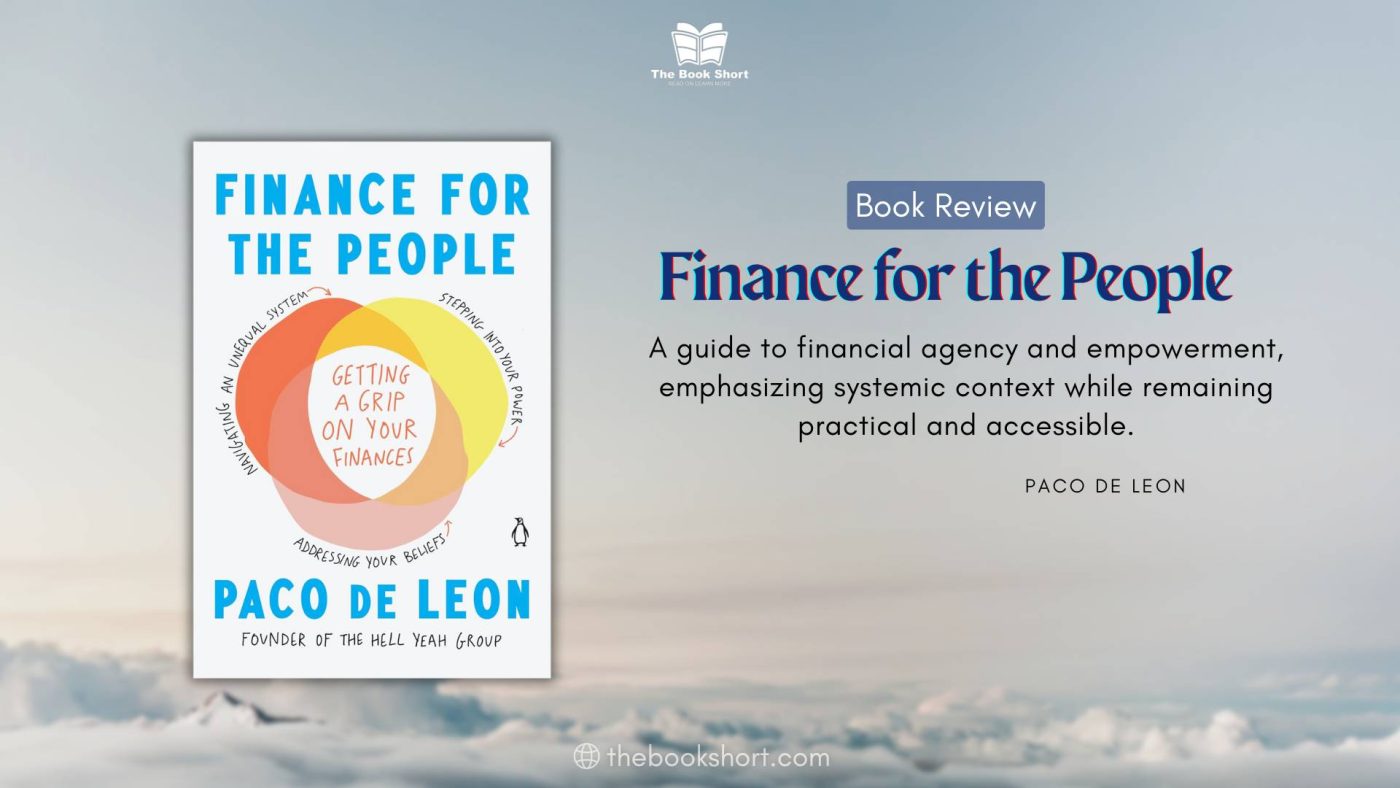
Unlock your financial power with this Finance for the People book summary and review—a truly shame-free guide to managing money with confidence and compassion.
If you’re tired of personal finance books that feel cold, judgmental, and completely detached from your real life, you’ve found the antidote. This analysis explores Finance for the People by Paco de Leon, a breath of fresh air in a genre that often induces more anxiety than it solves. We selected this book for a deep-dive review because of its revolutionary focus on the psychology of money. It masterfully blends rock-solid practical advice with creative exercises and a profound sense of empathy, acknowledging that our financial behaviors are deeply entangled with our emotions, histories, and values. It offers a path to financial wellness that feels not only achievable but genuinely kind.
Finance for the People: Book Details at a Glance
- Full Title: Finance for the People: Getting a Grip on Your Finances
- Author: Paco de Leon
- Year of Publication: 2022
- Genre: Personal Finance, Self-Help, Psychology
- Number of Pages: 304
- Target Audience: Millennials, Gen Z, creatives, freelancers, and anyone who feels anxious, intimidated, or alienated by traditional financial advice.

Finance for the People: Getting a Grip on Your Finances
A Comprehensive Summary of Finance for the People
Finance for the People frames its guidance as a “financial road trip,” a brilliant metaphor that guides you from exploring your internal money landscape to navigating the external world of finance. Paco de Leon uses her signature wit, relatable analogies, and charming illustrations to break down daunting topics into digestible, actionable steps. The book feels less like a rigid rulebook and more like a compassionate, interactive workbook designed to empower you from the inside out.
Part 1: Your Inner World & The Emotional Landscape of Money
The journey begins not with budgets and spreadsheets, but with soul-searching. De Leon’s core thesis is that you cannot truly manage your money until you understand your relationship with it. This first section is dedicated to excavating the deep-seated psychological and emotional roots of your financial life.
- Uncovering Your Money Stories: De Leon introduces the powerful concept of “money stories”—the subconscious scripts we inherit from our family, culture, and life experiences. These narratives (e.g., “money is evil,” “I’m just bad with money,” “only workaholics get rich”) quietly dictate our every financial move. The first crucial step on this road trip is to identify your personal money story and bravely question its truth.
- Facing Financial Fears Head-On: The book creates a safe harbor to confront common financial terrors: the dread of looking at your bank balance, the heavy shame of debt, the constant stress of a fluctuating income. De Leon provides tangible exercises like “fear-setting,” which helps you articulate your anxieties, map out worst-case scenarios, and build contingency plans, effectively shrinking fear down to a manageable size.
- Meeting Your Multiple “Selves”: A key insight is that we are not a single, monolithic person but a community of “selves”: our Past Self, Present Self, and Future Self. Financial harmony, de Leon argues, is about balancing the competing needs and desires of each. Your Present Self craves that expensive dinner, but your Future Self is counting on you for retirement savings. The book teaches you to become a “benevolent zookeeper” for these selves, making choices that honor the well-being of all three.
Part 2: Getting Your Financial Sh*t Together
With the emotional groundwork firmly in place, the book pivots to the practical mechanics of personal finance. De Leon demystifies core concepts with unforgettable analogies and simple, judgment-free frameworks.
Crafting a Budget That Doesn’t Feel Like a Cage
De Leon masterfully reframes budgeting from a restrictive chore into an empowering act of alignment with your values.
- The Waffles vs. Pancakes Method: Forget tedious, line-item spreadsheets. De Leon offers a more intuitive system. “Waffles” are your fixed, predictable expenses (rent, subscriptions) that fit neatly into the grid. “Pancakes” are your variable, lumpy spending (groceries, entertainment) that spreads out unpredictably. This simple mental model helps you categorize and manage spending without obsessive, soul-crushing tracking.
- Values-Based Spending: The ultimate goal is to design a spending plan that is a true reflection of your core values. You’re encouraged to define what is genuinely important to you—be it community, creativity, security, or adventure—and then align your financial decisions with that vision. This transforms budgeting from an exercise in deprivation into an act of profound intention.
Tackling Debt and Savings with Strategy and Grace
This section addresses two of the biggest financial pain points with a mix of empathy and strategic genius.
- Debt as a Problem, Not a Moral Failure: De Leon discusses debt without an ounce of shame, treating it as a logistical problem to be solved. She clarifies the difference between strategic (“good”) and problematic (“bad”) debt and lays out the two main payoff strategies: the “avalanche” method (tackling the highest-interest debt first for mathematical efficiency) and the “snowball” method (clearing the smallest debts first for powerful psychological wins). The choice is yours, based on what motivates you most.
- Saving as an Act of Self-Kindness: Saving is presented not as a sacrifice but as a gift to your Future Self. The book underscores the non-negotiable importance of an emergency fund as your financial shock absorber. It also offers practical, set-it-and-forget-it tips for automating your savings, turning it into a seamless background habit rather than a daily test of willpower.
Part 3: Investing and Building for a Richer Future
Investing is often the most intimidating frontier for beginners, and this is where Finance for the People demystifies with exceptional clarity.
- Making Investing Make Sense: De Leon translates the jargon-filled world of investing into plain English. She explains what investing truly is (owning assets that can grow in value), the key account types (401(k), IRA), and what you might invest in (stocks, bonds, index funds). She uses brilliant analogies, like comparing a diversified portfolio to a well-balanced pizza with a variety of toppings, to make the concepts stick.
- A Simple Path to Get Started: The book champions a passive investing strategy using low-cost index funds or ETFs—a proven, low-stress approach for long-term wealth creation. This message is incredibly empowering, freeing readers from the belief that they need to be stock-picking gurus to succeed.
- Dreaming of Retirement and Financial Freedom: The final leg of the journey looks toward your long-term goals. De Leon illustrates the magic of compound interest and passionately encourages readers to start investing for retirement now, no matter how small the amount. The ultimate goal is to build a future where work is optional, granting you the ultimate luxuries: freedom and choice.
In-Depth Analysis of the Book Finance for the People
Paco de Leon’s Finance for the People is far more than a how-to guide; it’s a manifesto for a more humane, inclusive, and psychologically-attuned approach to money. Its radical departure from the genre lies in its foundational belief: your financial reality is a direct reflection of your inner world.
Structure, Voice, and Key Arguments
The book’s central “character” is you, the reader, whom de Leon coaches with the warmth and wit of a trusted friend. The structure, a “financial road trip,” is a genius narrative device that transforms a potentially clinical subject into an adventure of self-discovery. This framing creates a natural, intuitive flow from the internal (your psychology), to the external (practical tools), and onward to the aspirational (your future).
Key Arguments:
- Finance is Emotional, Not Just Rational: The book’s most potent argument is that financial literacy without emotional intelligence is a job half-done. By insisting that readers first confront their “money stories” and anxieties, de Leon ensures that the practical advice is built on a foundation of self-awareness. This stands in stark contrast to traditional finance books that jump straight to spreadsheets, implicitly blaming readers for a lack of discipline.
- Shame is the Enemy of Financial Progress: De Leon actively dismantles the shame surrounding debt, financial mistakes, and income struggles. Her compassionate tone and flexible frameworks create a safe space for the radical honesty required to make real, lasting change.
- Financial Wellness is Alignment, Not Austerity: The book soundly rejects the “scrimp-and-save” martyrdom preached by some gurus. Instead, it champions a philosophy of intentionality. The goal isn’t merely to accumulate more money; it’s to wield money as a tool to sculpt a life that aligns with your deepest values, making the entire process feel purposeful and joyful.
Writing Style & Content Quality
De Leon’s writing style is the book’s superpower. It is:
- Conversational and Hilarious: She writes like the sharpest, funniest friend you have, explaining complex ideas over coffee. The text is brimming with humor, clever pop-culture references, and disarmingly candid anecdotes that make it impossible to put down.
- Visually Rich and Creative: An accomplished illustrator, de Leon fills the book with her own quirky drawings, charts, and diagrams. These aren’t just decorative; they are cognitive tools that distill complex ideas like asset allocation or budgeting frameworks into instantly graspable visuals.
- Radically Accessible: She possesses a rare talent for translating intimidating financial jargon into simple, sticky analogies (the Waffles/Pancakes budget, a portfolio as a pizza). This throws the doors of financial conversation wide open to beginners who have long felt excluded.
The content quality is superb. While the tone is breezy and conversational, the financial advice is sound, well-researched, and aligns with respected financial planning principles (e.g., advocating for low-cost passive investing, prioritizing high-interest debt). It masterfully bridges the gap between empathetic life coaching and solid, actionable strategy.
Notable Quotes from the Book
- On Money Stories: “Our work is to find the story, to see it for what it is—a story, not a fact—and to understand how it has shaped our behavior.”
- On Financial Anxiety: “The antidote to fear isn’t fearlessness. It’s knowledge.”
- On Budgeting: “A budget is not a cage; it is the key to the cage.”
- On Self-Compassion: “Talk to yourself about money the way you’d talk to a friend who is struggling. With kindness, compassion, and a gentle but firm nudge in the right direction.”
Evaluation & Expert Personal Review
Finance for the People is a game-changing addition to the personal finance canon, earning its place as an essential text for a new generation grappling with money. It succeeds by shifting the entire paradigm from one of rigid rules and shame to one of mindful empowerment and self-compassion.
Advantages:
- A Revolution of Empathy: The book’s greatest strength is its unwavering focus on the psychology of money. It validates readers’ feelings of anxiety and confusion, making it a uniquely powerful tool for anyone alienated by dogmatic financial advice.
- Supremely Engaging and Readable: Paco de Leon’s wit, personal stories, and charming illustrations transform learning about finance from a dreaded chore into a genuine pleasure.
- Actionable and Unforgettable: Despite its deep focus on mindset, the book is loaded with concrete, practical advice, from the brilliant Waffles/Pancakes budget to a clear, simple path for getting started with investing.
- Genuinely Inclusive: The book speaks directly to a diverse audience often ignored by traditional finance literature, including those with variable incomes, freelancers, artists, and members of the gig economy.
Disadvantages:
- May Be Too Foundational for Experts: For those already well-versed in advanced tax-optimization strategies or complex portfolio management, the book’s content will likely serve as a refreshing back-to-basics read rather than a source of new, advanced techniques.
- Casual Style Isn’t for Everyone: While the vast majority will find the conversational tone to be a welcome relief, a small subset of readers seeking a formal, academic treatise on finance may not connect with the style.
Readability and Suitability:
The readability is off the charts. The language is clear and direct, the chapters are logically organized, and the visual elements are both delightful and deeply instructive. This book is perfectly suited for:
- Young Adults (Millennials/Gen Z): The tone, cultural touchstones, and focus on modern financial challenges like student debt and the gig economy will resonate powerfully.
- Absolute Financial Beginners: Anyone who has ever felt overwhelmed or “bad with money” will find this book to be a gentle, encouraging, and transformative starting point.
- Creatives, Freelancers, and Entrepreneurs: De Leon, herself a creative professional, offers specific, validating insights for those navigating non-traditional careers and income streams.
- Anyone Experiencing Financial Anxiety: This book is financial therapy. It is a powerful guide for healing your relationship with money.
Practical Value:
The practical value is immense. A reader will walk away not just with a plan to tackle debt and a strategy to invest, but with a fundamentally transformed mindset. The most profound lesson is that financial health isn’t about achieving perfection; it’s about making conscious, values-driven choices with relentless self-compassion. It gives readers the permission and the tools to stop avoiding their finances out of fear and start engaging with them from a place of curiosity, confidence, and control.
Finance for the People vs. Other Finance Books
Finance for the People carves out its own vital space in a crowded field by putting emotional well-being front and center.
- Compared to Dave Ramsey’s The Total Money Makeover: Ramsey employs a rigid, bootcamp-style system that often uses shame (“gazelle intensity,” cutting up credit cards) as a primary motivator. De Leon’s approach is the philosophical opposite: flexible, compassionate, and shame-free. While Ramsey’s strict rules can work for those who crave them, de Leon is far more effective for those who need to heal their underlying relationship with money first.
- Compared to Ramit Sethi’s I Will Teach You to Be Rich: Sethi’s classic also targets millennials with a focus on automation and living a “rich life.” It’s brilliant on systems and optimization. De Leon’s book, however, dedicates significantly more time and space to the crucial upfront psychological work, making it a better starting point for anyone paralyzed by financial anxiety or a history of money-related trauma.


If you loved the modern, empathetic approach of Finance for the People, you might also enjoy:
- Broke Millennial Takes On Investing by Erin Lowry: A similarly accessible, jargon-free guide that serves as a perfect next step, diving deeper into the specifics of investing for beginners.
- The Psychology of Money by Morgan Housel: This book explores the complex and often irrational ways people think about money through a series of fascinating short stories, beautifully complementing de Leon’s focus on our personal money narratives.
Conclusion & Recommendations: A Book Review That Matters
Finance for the People is a vital, refreshing, and deeply necessary book for our times. Its extraordinary value lies in its revolutionary premise: true financial wellness begins with compassion, not spreadsheets. By seamlessly weaving profound psychological insight with practical, easy-to-follow financial strategies, Paco de Leon has crafted a guide that empowers rather than shames, and inspires rather than intimidates.
Is it worth reading? An unequivocal yes. This is a must-read for anyone who has ever felt stressed, confused, or “less-than” because of money. It is especially recommended for young adults, creatives, and financial novices searching for a guide that speaks their language and honors their emotional reality. It provides both the practical tools and the profound permission you need to finally get a grip on your finances—on your own terms.
Have you read Finance for the People? Share your thoughts and biggest takeaways in the comments below