
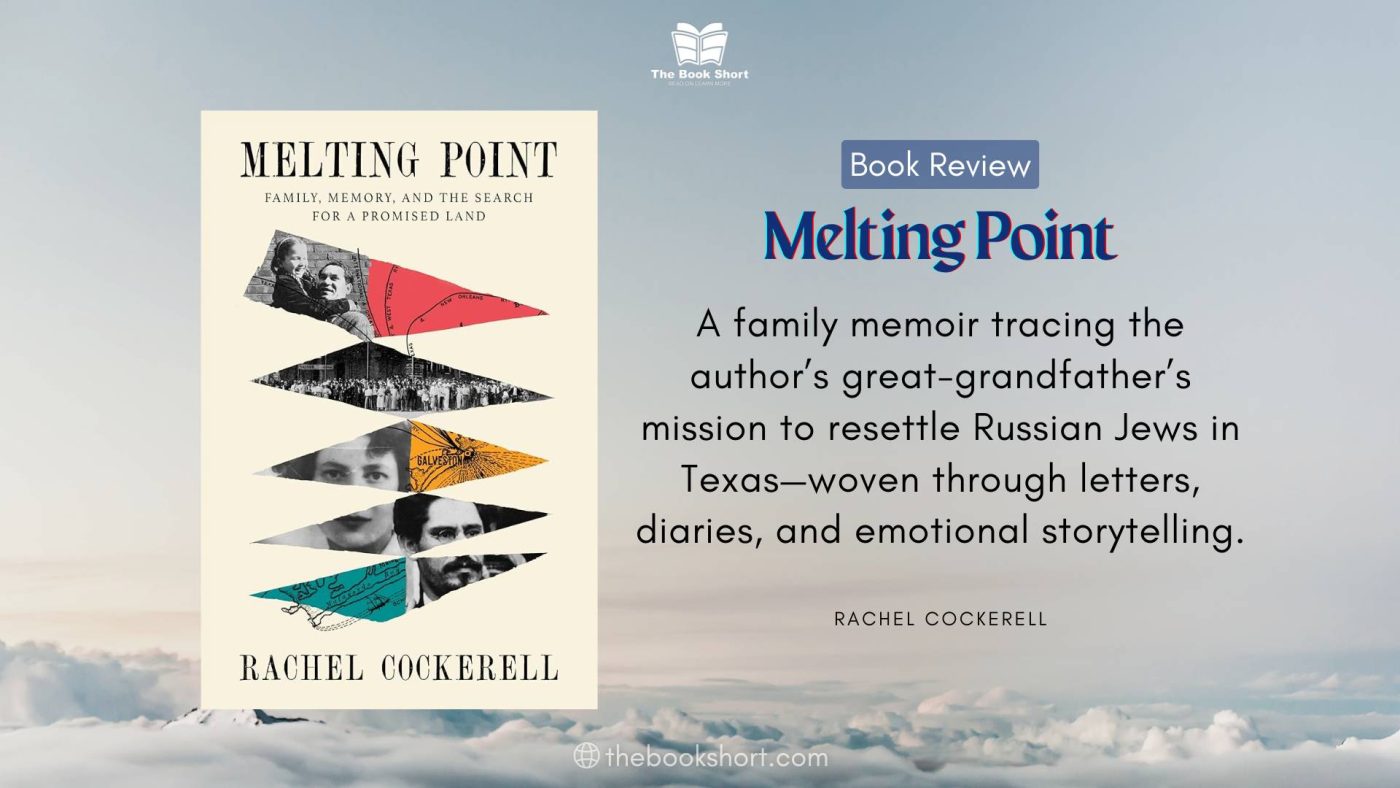
Explore Rachel Cockerell’s ‘Melting Point’: A Profound Journey Through Family, Memory, and Identity
Embark on a compelling exploration across generations, memory, and the enduring search for a place to call home in Rachel Cockerell’s powerful book, “Melting Point.” This acclaimed work masterfully blends personal memoir with meticulous historical investigation, tracing the dispersal of the author’s Austrian Jewish family from Vienna in the shadow of WWII and their fragmented paths across continents. “Melting Point” offers a unique and deeply human perspective on how historical trauma shapes individual lives and family legacies. It stands out for its lyrical prose, intimate portrayal of displacement and resilience, and its insightful look at a lesser-known facet of Holocaust history, prompting readers to reflect on their own connections to the past.
Book Details: Melting Point by Rachel Cockerell
- Title: Melting Point: Family, Memory and the Search for a Promised Land
- Author: Rachel Cockerell
- Year of publication: 2023
- Genre: Memoir / Family History / Historical Non-fiction / Jewish History
- Number of pages: Approximately 368 (Note: Page count may vary slightly by edition)
- Target audience: Readers interested in 20th-century European history, the Holocaust, Austrian Jewish history, memoirs of displacement, family sagas, and themes of identity, memory, and exile.
Exploring the Narrative: Melting Point Book Summary & Analysis
Rachel Cockerell’s Melting Point is a deeply personal quest and a meticulously researched excavation of her family’s past. Focusing on her paternal Jewish ancestors from Vienna, Austria, the narrative traces their forced dispersal across the globe in the face of rising Nazism, serving as both a rich family history and a profound meditation on memory, identity, and the elusive concept of home.
The journey begins with the author confronting the geographical scattering of her family branches, flung across continents from London to Tel Aviv, Australia, and America. This modern fragmentation sparks her deep dive into the cataclysmic historical events that led to this global diaspora. Cockerell transports us back to early 20th-century Vienna, painting a vivid portrait of her great-grandparents and grandparents’ lives within a vibrant, cultured, and seemingly well-integrated Jewish community that felt intrinsically connected to Austrian identity.
The pivotal moment, the heart of the book’s historical turning point, is the annexation of Austria by Nazi Germany in 1938 – the infamous Anschluss. This abrupt rupture shattered the world her family knew. Cockerell details the terrifying speed of escalating antisemitic measures, persecution, and violence that forced her relatives into desperate decisions for survival. She recounts their frantic, often agonizing efforts to secure visas, find sponsors abroad, and arrange safe passage out of a country that had overnight become utterly hostile.
The book follows different family members as they navigate the treacherous landscape of impending exile and the subsequent realities of being refugees:
Life in Pre-War Vienna
Cockerell tenderly reconstructs her family’s life in Vienna before the storm. She introduces key figures, most notably her charismatic great-grandmother, Annie, whose voice echoes through her preserved letters and possessions, forming a central thread in the narrative tapestry. Life is depicted as comfortable, intellectually stimulating, and socially integrated, making the ensuing rupture devastatingly stark and personal.
The Shadow of the Anschluss
Tension mounts palpably as the political climate in Austria deteriorates towards catastrophe. Cockerell captures the terrifying reality of the Anschluss – the sudden betrayal by friends and neighbours, the instant loss of rights and dignity, and the pervasive, paralyzing fear. This section powerfully illustrates the agonizing choices families faced: leave immediately or cling to hope? Who could possibly obtain the necessary papers, and where in the world offered even a sliver of safety? The shrinking options and escalating desperation are rendered with vivid emotional impact.
Forced Migration and Global Dispersal
Here, the family tree splinters dramatically. Cockerell meticulously traces the separate, often harrowing, journeys:
- Some family members managed to reach England, frequently under challenging circumstances, facing initial suspicion, hardship, and the complexities of refugee status.
- Others sought refuge in Mandatory Palestine, whether driven by burgeoning Zionist ideals or simply the desperate need for any safe haven, grappling with the harsh realities and conflicts of building a new life in a fraught land.
- Still others landed in far-flung locales like Australia or America, each destination presenting its own unique set of cultural, social, and economic challenges and opportunities for adaptation.
Cockerell’s narrative goes far beyond merely stating that they left; she delves into the how – the logistical nightmares, the forced severances from homeland, language, and culture – and the profound, lasting consequences of rebuilding shattered lives from scratch in unfamiliar environments.
The Elusive “Promised Land”
The book’s subtitle, “The Search for a Promised Land,” is not limited to a single physical destination like Israel/Palestine (though that is one significant path). It represents a deeper, more metaphorical yearning for security, belonging, and the possibility of a future free from the spectres of persecution and loss. Cockerell probes whether any of these destinations truly felt like a “promised land” to her ancestors, revealing the persistent sense of displacement and the enduring psychological scars of trauma. The book’s evocative title, “Melting Point,” suggests a moment of intense crisis where identity, place, and self are tested, fundamentally altered, and potentially fractured.
Memory, Silence, and Legacy
Cockerell reflects movingly on how the seismic trauma of displacement and the Holocaust reverberated through the generations that followed. She explores the often-present silences within her family, the stories deemed too painful or difficult to tell, and the fragmented shards of memory that were nonetheless passed down. The very act of writing the book becomes an integral part of this process – an active effort to piece together a shattered past using disparate clues from archives, oral histories from living relatives, and personal artifacts. She examines the inherent tension between the natural human desire to forget pain and the moral imperative to remember, understand, and bear witness.
The Author’s Personal Quest
Woven throughout the rich historical narrative is Cockerell’s own contemporary journey of discovery. She travels to Vienna, walks the streets her ancestors knew, follows their trails across Europe and beyond, and grapples with the complex, often unsettling relationship between the past and the present. Her personal reflections, vulnerabilities, and evolving understanding add a vital emotional layer to the historical account, making the history feel immediate, relevant, and deeply human.
In essence, Melting Point is a multi-layered tapestry that uses the specific, compelling experience of one family to illuminate the broader human story of displacement, loss, and remarkable resilience in the face of unimaginable historical upheaval. It transcends simple historical recounting to explore the deep, lasting impact of trauma on identity formation, family dynamics, and the very meaning of “home” across the vast expanse of time and generations.
Analyzing Melting Point: Themes, Style, and Impact
Rachel Cockerell’s Melting Point distinguishes itself as a compelling work that seamlessly integrates rigorous historical research with profound personal reflection. Its significant strength lies in its ability to leverage the specific, intimate story of one family’s dispersal from Vienna to explore universal themes of memory, identity, displacement, and the enduring human need for belonging.
Characters, Structure, and Key Themes
The book’s structure is intentionally built around tracing the author’s various family lines from their rooted life in pre-war Vienna through their divergent paths of exile. The key “characters” are her ancestors, brought vividly to life not as fictional constructs, but through painstaking research utilizing archival documents, poignant letters, family photographs, and the author’s deeply empathetic interpretations. Figures like her great-grandmother Annie emerge as central presences, guiding much of the narrative exploration.
While largely chronological in charting life in Vienna, the Anschluss, and the subsequent departures, the structure is fluidly interspersed with the author’s contemporary reflections, accounts of her visits to significant historical sites, and transparent insights into her research process. This non-linear element, though occasionally requiring the reader’s full attention, effectively mirrors the fragmented nature of memory and the inherent challenges in reconstructing a past that has been deliberately shattered and partially silenced.
Implicitly woven throughout the narrative are several key arguments and insights:
- The trauma of displacement and persecution is not confined to a single generation but echoes and impacts the identity and sense of belonging of descendants decades later.
- Memory is a complex, often unreliable narrator; understanding historical truth requires active investigation and critical analysis to bridge the gaps left by silence, partial recollections, or deliberate omission.
- The concept of a “promised land” is often fraught with difficulty and may never fully replace the lost homeland or entirely erase the deep-seated pain of exile and loss.
- Family history is inextricably linked with global history; understanding personal stories provides a powerful, humanizing lens through which to comprehend broader historical events and forces.
Writing Style & Content Quality
Cockerell’s writing style is arguably one of the book’s greatest strengths: elegant, evocative, and deeply empathetic. She possesses a remarkable ability to convey complex, often harrowing, historical events with clarity while simultaneously imbuing the personal stories of her ancestors with immense emotional depth and nuance. Her prose is frequently lyrical, particularly when describing the ghosts of places or reflecting on the profound weight of history on individual lives.
The content quality is exceptionally high, a testament to her extensive and dedicated research. She draws upon a wide array of sources, including precious personal family archives (letters, diaries, photographs), official documents (visas, emigration papers, government records), institutional archives (museums, historical societies in multiple countries), and interviews with surviving relatives. This multi-faceted, diligent approach lends significant credibility, richness, and granular detail to the historical narrative. The seamless blend of objective historical facts with subjective family memories creates a text that is both informative and deeply moving.
What truly makes Melting Point stand out is its specific, focused lens on the Viennese Jewish experience in the immediate aftermath of the Anschluss and its detailed, empathetic tracing of multiple, divergent paths of exile taken by members of a single extended family. Unlike some broader historical narratives, Melting Point offers an intimate, granular look at the direct consequences of one pivotal event on individual lives, vividly demonstrating the myriad ways people coped, scattered, and attempted to rebuild. The author’s courageous willingness to include her own contemporary journey of discovery, her struggles with the weight of this history, and her personal reflections adds a layer of vulnerability, honesty, and relatable humanity often absent in purely historical accounts, making the book particularly powerful and resonant for contemporary readers.
Echoes of the Past: Themes Reflected in Melting Point
While specific quotes might require revisiting the text, the book is permeated with passages that powerfully capture its core themes. Memorable passages likely echo sentiments such as:
- Reflections on the fragility of identity and belonging: The abrupt transition from feeling fully Austrian to being declared an unwanted alien – “They had been Austrian, and then suddenly they were not, not in the eyes of their neighbours, not in the eyes of the state.”
- The weight of memory and the burden or necessity of silence: The unspoken stories hanging heavy in the air between generations – “The silence felt heavy, not empty, but full of stories waiting to be uncovered, or perhaps, deliberately buried out of pain or protection.”
- The complex, unending search for ‘home’: Questioning whether home is a physical place lost, a place arrived in, or an internal, fragmented state carried within – “Was ‘home’ the place you left behind, a ghost you could never quite escape? Or was it the place you arrived in, always foreign? Or perhaps something you carried, fragmented, inside you, a mosaic of memory and longing?”
- The enduring, often invisible, impact of the past on the present: How historical forces shape not just events, but the very fabric of families and individual psyches – “History wasn’t just dates and events in a textbook; it was a living thing, running in the veins of her family, shaping the landscape of their present.”
These thematic echoes, woven through Cockerell’s evocative prose, capture the essence of the book’s profound exploration of displacement, fractured memory, and the complex journey of identity across generations marked by historical trauma.
Evaluation & Personal Review of Melting Point
Melting Point is a book that stays with you, resonating long after you’ve turned the final page. From the perspective of a reviewer, my personal impression is one of deep admiration. Rachel Cockerell has not only meticulously researched her family’s history but has also crafted a narrative that is both historically illuminating and profoundly moving on a human level.
Advantages:
- Emotional Resonance: The personal narratives of displacement, loss, and survival are incredibly poignant, making the large-scale historical events feel immediate and deeply impactful through individual lives.
- Exceptional Research: The seamless integration of extensive family archives and broader historical documents provides a rich, credible, and detailed foundation for the narrative.
- Beautiful & Engaging Prose: Cockerell’s writing is elegant, thoughtful, and often quite beautiful, rendering even complex historical details accessible and emotionally engaging.
- Valuable Unique Focus: The specific lens on the experience of Viennese Jews during the Anschluss and the subsequent detailed tracing of multiple, divergent paths of exile offers a valuable perspective that complements and enriches broader narratives of the Holocaust and displacement.
- Relatable Authorial Presence: The inclusion of Cockerell’s own honest journey of discovery, her grappling with the weight of this history, and her reflections on its meaning adds a vulnerable, relatable, and highly relevant layer, bridging the past and the present.
Disadvantages:
- Narrative Complexity: Following multiple family branches dispersing across various locations can occasionally feel dense, requiring the reader’s careful attention to keep track of individuals and timelines.
- Pacing: As is often the case with detailed, research-heavy family histories, the pace, particularly during extensive detailing of archival findings or complex emigration logistics, can sometimes feel slower compared to a more traditionally plot-driven narrative. However, this is a minor point given the book’s genre and aims.
Readability Level and Suitability:
The book is written in clear, accessible, and elegant prose, making it highly readable despite the often-heavy and complex subject matter. It demands engagement and thoughtful attention, but Cockerell guides the reader effectively through the historical and personal complexities. It is highly suitable for:
- History Enthusiasts: Particularly those interested in 20th-century European history, World War II, the Holocaust, Austrian history, and the experiences of refugees and displaced populations.
- Readers of Memoir and Family History: Anyone who enjoys deeply personal, well-researched explorations of lineage, identity, and the impact of historical events on families.
- Those Interested in Themes of Memory, Trauma, and Identity: The book is a profound and moving meditation on how the past shapes the present and the ongoing legacy of historical trauma across generations.
Practical Value and Enduring Impact:
- Lessons in Resilience and Adaptation: The stories highlight the remarkable capacity of individuals and families to survive, adapt, and attempt to rebuild lives after enduring immense loss and trauma.
- Understanding Intergenerational Trauma: It provides valuable, tangible insight into how historical trauma can echo through families across generations, subtly or overtly influencing identity, relationships, and a sense of belonging.
- The Importance of Family Stories: The book powerfully underscores the ethical and personal importance of documenting, preserving, and understanding one’s own family history, not only as a private exercise but as a vital way to connect with and humanize broader historical currents.
- Shifting Perspectives on Home and Belonging: It encourages profound reflection on the fluid and often painful concepts of home, belonging, nationality, and identity when confronted with forced migration and the arbitrary nature of borders and state power.
Overall, Melting Point is a significant and deeply moving contribution to the literature of memory, history, and identity. It is a book that successfully educates the mind while profoundly touching the heart, offering both historical understanding and resonant human insight.
Comparing Melting Point with Similar Books
Melting Point finds its place within a significant and growing body of literary non-fiction that explores the lasting impact of 20th-century European conflicts and displacements through the intimate lens of family history and memory. It shares thematic and structural common ground with several notable titles, while also forging its own distinct identity.
Similar books include:
- The Hare with Amber Eyes: A Hidden Inheritance by Edmund de Waal: Like Melting Point, de Waal’s internationally acclaimed book traces the history of a prominent European Jewish family (the Ephrussis) whose fortunes and collection were dispersed by the Holocaust. Both books ingeniously use physical objects (a collection of netsuke for de Waal; letters, documents, and artifacts for Cockerell) as catalysts and anchors for their extensive historical investigation. Both blend personal reflection with rigorous research and explore themes of lost heritage, fractured identity, and the weight of the past. However, Melting Point focuses more intensely on the immediate, lived experience of exile and the diverse paths taken by multiple family members seeking refuge across disparate geographical locations, offering a broader scope of dispersal outcomes compared to The Hare with Amber Eyes‘ focus on the journey of a collection and one family branch.
- East West Street: On the Origins of Genocide and Crimes Against Humanity by Philippe Sands: Sands also undertakes a profound investigation into his family history, tracing his grandfather’s journey from Lviv (Lemberg) and weaving it together with the intellectual history behind the development of international law concepts like ‘genocide’ and ‘crimes against humanity,’ concepts developed by lawyers from that same city. Both books are powerful memoirs interwoven with historical detective work, confronting the past through a deep personal connection. Melting Point leans more heavily into the personal, emotional, and familial consequences of displacement and exile, whereas Sands integrates the family story more explicitly with the development of legal frameworks designed to address the very atrocities his family experienced.
- Inheritance: The Story of Knole and the Sackvilles by Victoria Sackville-West (and a wider genre of exploring inherited history tied to place): While not focused on Jewish displacement or the Holocaust, this genre of exploring a family’s history tethered to a specific ancestral place or legacy shares the fundamental drive to understand the present through the deep currents of the past. Melting Point takes this core concept but applies it to a family unit defined by the violent loss of place and forced migration, making the “inheritance” one primarily of memory, trauma, fragmentation, and global dispersal rather than land, property, or title.
For readers who were captivated by Melting Point‘s compelling blend of personal memoir, meticulous historical investigation, and its sensitive exploration of Austrian Jewish identity, displacement from Central Europe, and the echoes of the Holocaust, they would likely find resonance in:
- The Hare with Amber Eyes by Edmund de Waal
- East West Street by Philippe Sands
- Vienna to Vichy: The Destruction of a Community, 1938–1942 by Ruth Langer (a more academic history focusing specifically on Austrian Jews, but providing crucial context)
- Leaving Berlin by Marieluise Janssen (a fictional work, but often praised for capturing the complex emotional landscape of exile)
Melting Point ultimately distinguishes itself through its granular focus on the specific historical moment of the Viennese Anschluss and its ripple effects, offering an intimate, multi-threaded narrative that traces the varied, challenging, and often unexpected outcomes of forced migration on individuals within a single extended family unit dispersed across disparate corners of the globe.
Conclusion & Recommendations
“Melting Point: Family, Memory and the Search for a Promised Land” is a deeply moving, significant, and beautifully written book that utilizes the intimate lens of one family’s history to illuminate the profound human consequences of war, persecution, and displacement. Rachel Cockerell’s meticulous research, empathetic understanding, and elegant prose combine to create a powerful narrative that serves both as a testament to her family’s complex resilience and as a vital contribution to our understanding of 20th-century European history and the enduring, often unseen, legacy of trauma.
The book’s outstanding value lies in its unique ability to connect large-scale, abstract historical events to the deeply personal, lived experiences of individuals and families, demonstrating with potent clarity how history is not merely a collection of dates and facts but a force that actively shapes lives across generations. It highlights the intricate and often painful interplay of memory, identity, and the elusive, aching concept of “home” for those who have been forcibly uprooted from theirs.
Is “Melting Point” worth reading? Unequivocally, yes. It is a compelling, enlightening, and emotionally resonant journey into a family’s past that speaks volumes about universal themes of loss, survival, adaptation, and the fundamental human search for belonging in a fragmented world.
Who should read it? Anyone interested in modern European history, particularly the history of Austria and the devastating impact of the Holocaust, Jewish history, family memoirs, and thoughtful explorations of memory, identity, and displacement. It is an essential read for those seeking to understand the long-term, human cost of historical trauma and the ways in which the past continues to live within us.
Have you read Rachel Cockerell’s Melting Point? Share your thoughts and reflections in the comments below!