
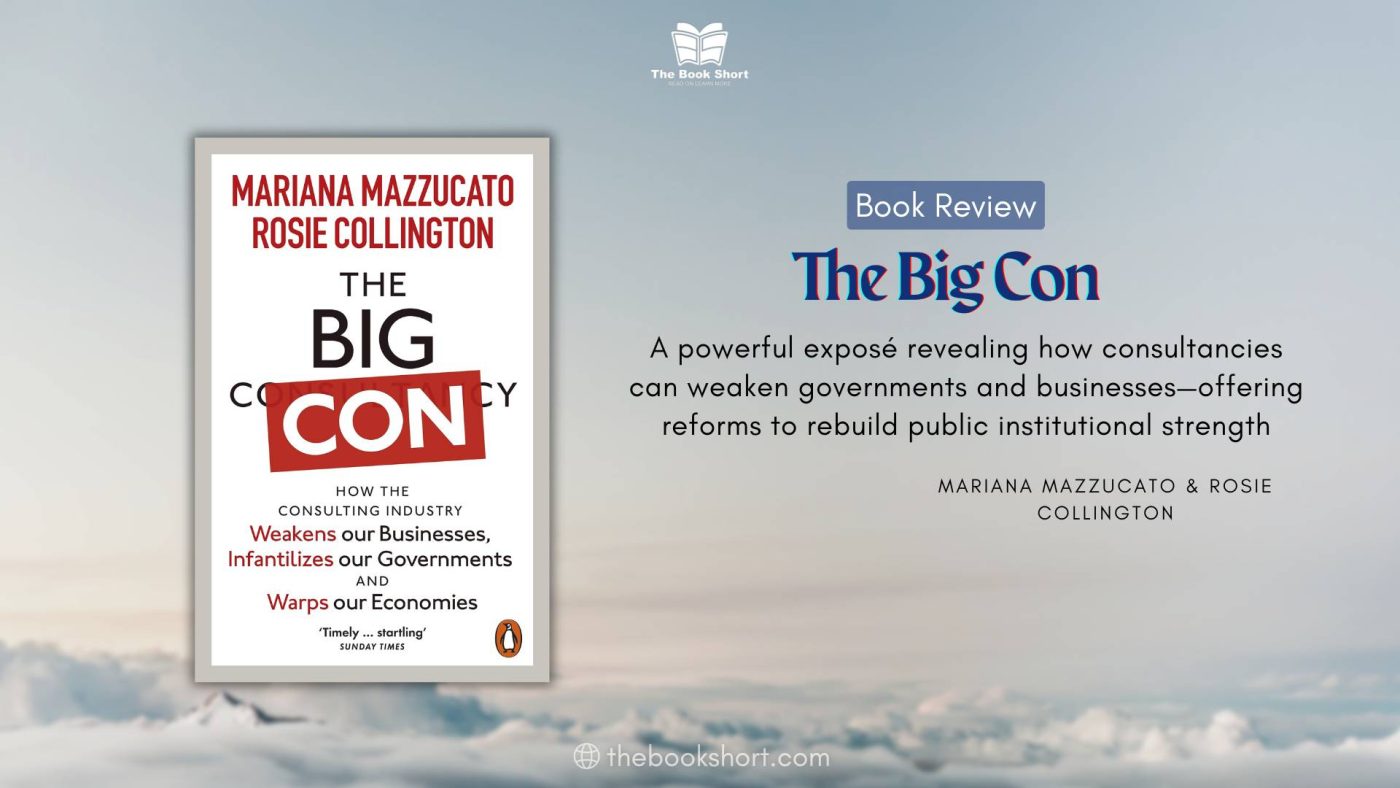
Uncover how the consulting industry weakens our economies. This book review of The Big Con provides a summary and analysis of this must-read exposé.
Is the consulting industry a vital partner for progress or a sophisticated parasite hollowing out our institutions from within? This is the provocative question at the heart of The Big Con. Mariana Mazzucato and Rosie Collington deliver a timely and searing critique of a powerful, yet notoriously opaque, industry that shapes our governments, businesses, and economies. The book’s urgent value lies in how it systematically dismantles the mythology of consulting, exposing a deeply ingrained “confidence trick” that fosters dependency, stifles innovation, and drains public and private wealth.
The Big Con: A Quick Book Overview
- Full Title: The Big Con: How the Consulting Industry Weakens Our Businesses, Infantilizes Our Governments, and Warps Our Economies
- Authors: Mariana Mazzucato & Rosie Collington
- Year of Publication: 2023
- Genre: Non-fiction, Economics, Political Science
- Number of Pages: 336
- Target Audience: Policymakers, public sector professionals, business leaders, economists, and any reader curious about the hidden forces shaping modern capitalism.
A Summary of The Big Con’s Main Content
Mariana Mazzucato and Rosie Collington’s The Big Con delivers a powerful indictment of the global consulting industry. The book argues that behemoth firms like McKinsey, Boston Consulting Group (BCG), Deloitte, PwC, EY, and KPMG have masterfully sold a narrative of their own indispensability, all while systematically weakening the very clients they profess to serve. The “con” is not necessarily about outright fraud, but a far more insidious confidence trick that locks organizations into a debilitating cycle of dependency.
The Anatomy of the Con
The authors meticulously deconstruct the playbook used by big consulting. It’s a multi-stage process designed for self-perpetuation:
- Sow Insecurity: Consultants begin by convincing potential clients—from government ministries to Fortune 500 companies—that they lack the internal expertise, capabilities, and dynamic vision to navigate modern challenges.
- Promise Panaceas: They present themselves as the exclusive keepers of world-class, cutting-edge knowledge, offering bespoke solutions backed by proprietary data and global insights.
- Engineer Dependency: Rather than building up a client’s own long-term capacity, consultants deliver opaque, jargon-laden reports and slick slide decks that are difficult to implement without their continued paid assistance. This ensures they are brought back for the next phase, and the one after that.
- Extract Value, Not Create It: They charge exorbitant fees, extracting immense financial value. Crucially, the authors argue, this is often achieved without creating equivalent economic or social value. Knowledge is not transferred; it remains a closely guarded asset of the consulting firm, ready to be sold to the next client.
This process hollows out organizations from the inside. Governments forget how to govern, and businesses lose their capacity for genuine innovation, becoming permanently reliant on expensive external advisors.
How the Con Infantilizes Governments
A significant portion of the book examines the devastating impact of consulting on the public sector. Mazzucato and Collington provide a damning collection of examples showing how governments worldwide have outsourced their most fundamental functions.
- Outsourcing Governance: Instead of empowering their own civil servants, ministries now hire consultants to draft key policies on everything from healthcare reform to national climate strategy. The authors point to the UK government’s staggering over-reliance on consultants for its COVID-19 Test and Trace system, which proved to be astronomically expensive and profoundly ineffective.
- Demoralizing Public Service: This constant outsourcing devalues the expertise of public servants, crushing morale and triggering an exodus of talent. Why build a career in public service when the most strategic and meaningful work is handed to outsiders paid multiple times more?
- Systemic Conflicts of Interest: The book illuminates the “revolving door” between government and the consulting industry. Former officials leverage their public-sector contacts for lucrative consulting gigs, while consultants are seconded into government, blurring lines and creating glaring conflicts of interest. A firm might advise a government on privatizing a public service while simultaneously advising the private companies bidding on the assets.
The result is an “infantilized” state—one that is risk-averse, stripped of its long-term vision, and incapable of tackling complex, large-scale challenges without calling in the consultants.
Weakening Businesses and Warping Economies
The con, the authors argue, is not confined to the public square. The same value-extracting logic has saturated the corporate world, with equally corrosive results.
- Stifling True Innovation: By outsourcing R&D strategy and corporate vision, companies surrender their innovative spark. Consultants often push standardized, “best-practice” models that promote homogenization across an industry, not a genuine competitive advantage.
- Fueling Short-Termism: The focus invariably shifts to metrics that look good on a PowerPoint slide—short-term cost-cutting and immediate shareholder value—at the expense of long-term investment in people, technology, and sustainable growth.
- A Form of Intellectual Property Laundering: The book makes the provocative claim that consulting firms can act as vectors for intellectual property transfer. They gain intimate knowledge of one company’s operations and then sell thinly veiled versions of those insights to its direct competitors, all under the benign label of “industry expertise.”
At a macroeconomic level, this behavior warps the entire economy. It diverts capital from productive investment into extractive consulting fees and fosters a risk-averse corporate culture that erodes dynamism across the system.
The Way Forward: Rebuilding Internal Capability
The Big Con is not merely a polemic; it concludes with a clear-eyed call for reform. The authors contend that the solution is not to ban consultants but to fundamentally reset the relationship.
- Reinvest in In-House Capacity: Governments and businesses must have the confidence to reinvest in their own people, trusting and training them to handle strategic challenges.
- Rewrite the Rules of Engagement: Procurement contracts must be designed to guarantee knowledge transfer. A core condition of any consulting project should be the upskilling of the client’s internal teams.
- Demand Radical Transparency: There must be far greater transparency around consulting contracts, especially in the public sector, to expose conflicts of interest and hold both consultants and clients accountable for tangible results.
The ultimate message is a powerful appeal to rebuild organizational confidence and competence from within, shattering the cycle of dependency that defines the big con.
An In-depth Book Analysis of The Big Con
Mazzucato and Collington’s The Big Con is far more than a business exposé; it is a systemic critique of a core malfunction in modern capitalism. The book’s force comes from its structural diagnosis, its assertive voice, and its profound departure from the orthodox narrative of corporate efficiency.
Key Arguments and Structure
The book is constructed as a masterful polemic. It first identifies its villain—the consulting industry—and its signature weapon: the “confidence trick.” This isn’t a shadowy conspiracy but a deeply embedded, highly profitable business model. The characters are archetypes: the overconfident consultant peddling silver bullets, the risk-averse bureaucrat eager to offload responsibility, and the short-sighted CEO focused on the next quarter’s results.
The authors’ core arguments are razor-sharp:
- Consulting is Value-Extracting, Not Value-Creating: This is the book’s foundational thesis. Countering the industry’s own marketing, the authors argue that consultants primarily repackage existing knowledge, extract disproportionate fees, and leave clients weaker and more dependent. This reframes the industry from a helpful service to a predatory force.
- The Destructive Myth of “Best Practice”: The book systematically demolishes the idea that a one-size-fits-all solution exists for complex problems. The “best practice” sold by consultants is often generic advice that ignores crucial context, stifles creativity, and drives industry-wide mediocrity.
- Capability as a Public Good: Perhaps the book’s most vital contribution is its argument that internal organizational capability—especially within the state—is a critical public good. When this collective know-how is eroded, society is impoverished by poor governance, wasted tax dollars, and a crippling inability to tackle grand challenges like climate change and pandemics.
The narrative flows logically from problem to consequence to solution. By first detailing the mechanics of the “con” and then illustrating its ruinous impact on both state and business, the authors build an irrefutable case before presenting their final recommendations, making the call to action feel both urgent and achievable.
Writing Style and Content Quality
The writing is a potent mix of academic rigor and journalistic punch. Mazzucato is a world-renowned economist, and the book is built on a bedrock of solid economic theory. Yet, it is written for a broad audience, using clear, forceful language that avoids academic pretension. The tone is unapologetically critical, conveying a controlled burn of intellectual fury.
The content is exceptionally well-researched, drawing on a vast array of global case studies—from the flawed privatization of Saudi Aramco and the hollowing out of the UK’s National Health Service to South Africa’s state capture scandals. This global scope drives home the point that the “con” is not an isolated problem but a systemic feature of 21st-century capitalism.
What truly distinguishes The Big Con is its relentless focus on capability. While other critiques of capitalism center on inequality or financialization, Mazzucato and Collington identify the erosion of know-how and institutional confidence as a primary engine of our current economic dysfunction. This provides a fresh and powerful lens for understanding the world.
Notable Quotes from the Book
The book is filled with memorable lines that distill its core message:
- “The ‘big con’ is not a simple story of fraud… It is a story about how the consulting industry has built a confidence trick that has infiltrated the highest levels of business and government, creating a cycle of dependency that is difficult to break.”
- “By positioning themselves as the sole proprietors of ‘expertise’, consultants have encouraged a culture of risk aversion and a loss of confidence within the very organizations they are meant to serve.”
- “Instead of building capabilities within their client organizations, consulting firms have a vested interest in keeping that knowledge proprietary. The client pays for the fish but is never taught how to fish.”
These quotes capture the book’s central theme: the parasitic relationship that has emerged between consultants and their clients, and the urgent need to reclaim the organizational confidence and competence that has been lost.
Evaluation and Personal Review of The Big Con
The Big Con is a timely, infuriating, and absolutely essential read. It presents a cohesive and meticulously documented argument that forces you to fundamentally question the value of one of the modern economy’s most powerful and secretive industries.
Advantages:
- A Powerful, Sticky Metaphor: The “confidence trick” framing is brilliant. It elegantly captures the insidious nature of the consultant-client dynamic without needing to allege widespread illegality.
- Overwhelming Evidence: The authors support their thesis with a formidable collection of international case studies, making the argument feel concrete, grounded, and globally relevant.
- A Constructive Vision: This book doesn’t just tear down; it builds up. The closing emphasis on rebuilding in-house capability is a positive, empowering, and actionable message.
Disadvantages:
- A Broad Brush: In its righteous campaign to expose the “con,” the book risks painting the entire industry with the same critical brush. It arguably downplays instances where highly specialized consultants provide genuine, indispensable expertise that an organization truly lacks.
- Occasionally Repetitive: The central argument is so powerful that it’s hammered home in nearly every chapter. While this reinforces the message, some readers might find the core thesis feels well-worn by the final pages.
Readability and Audience:
For a book on economics, it is remarkably accessible. Mazzucato and Collington are masters at translating complex systemic issues into clear, compelling prose. This book will resonate deeply with several groups:
- Public Sector Professionals: Anyone working in government will find the dynamics described painfully familiar and will feel validated by this sharp-edged critique.
- Business Leaders and Managers: It’s a vital warning against the siren song of outsourcing strategic thought and a powerful call to reinvest in your own people.
- Students of Economics, Business, and Public Policy: It offers an essential critical perspective on the real-world dysfunctions of modern capitalism.
- Concerned Citizens: Anyone wondering why governments often seem so incompetent or why large corporations feel so generic will find a persuasive and deeply unsettling explanation here.
Practical Value:
The practical value of The Big Con is immense. It’s a paradigm-shifting book. After reading it, you will never again hear a government announcement about hiring a major consulting firm in the same way. It provides the critical framework to ask the right questions: Why can’t we do this ourselves? What core capabilities are we letting atrophy? Is this contract designed to transfer knowledge or to lock us into future dependency?
The book’s ultimate lesson is a call for organizational courage and self-reliance. True innovation and resilience, it argues, are not bought off the shelf; they are cultivated from within.
Comparison with Similar Books on the Consulting Industry
The Big Con joins a growing shelf of vital critiques of corporate power. It distinguishes itself with its macroeconomic lens and its focus on organizational capability.
If the arguments in The Big Con resonated with you, you might also appreciate:
- When McKinsey Comes to Town: The Hidden Influence of the World’s Most Powerful Consulting Firm by Walt Bogdanich and Michael Forsythe: This is a stunning work of investigative journalism focused on a single, notorious firm. While The Big Con analyzes the industry’s entire business model, When McKinsey Comes to Town offers shocking, granular accounts of the firm’s controversial work with opioid manufacturers, authoritarian regimes, and cigarette companies. It reads more like a true-crime exposé of specific ethical catastrophes.
- The Firm: The Story of McKinsey and Its Secret Influence on American Business by Duff McDonald: An earlier, historical narrative of McKinsey’s rise, this book is less overtly critical than the others but provides crucial context for how the industry became so powerful. Reading it alongside The Big Con creates a fascinating “before and after” picture of the industry’s public perception.
- Dark Towers: Deutsche Bank, Donald Trump, and an Epic Trail of Destruction by David Enrich: While its subject is a bank, not a consultancy, Dark Towers shares a deep thematic connection with The Big Con. Both books are about the hollowing out of institutional ethics and the destructive power wielded by organizations that operate in the shadows, beyond meaningful public scrutiny.


The Big Con stands apart by focusing less on individual scandals and more on the flawed economic logic that makes the entire industry a systemic problem. Mazzucato and Collington, as economists, are fundamentally concerned with how the consulting industry warps incentives and systematically destroys knowledge on a societal scale.
Conclusion and Recommendations: A Summary of The Big Con’s Value
The Big Con is a landmark piece of economic and political analysis. Its greatest value lies in providing a powerful, unifying framework for a problem many have felt but struggled to name: the creeping outsourcing of thinking itself from our most important institutions. The book arms you with the vocabulary, the evidence, and the intellectual confidence to challenge the myth of consultant supremacy.
Is it worth reading? Absolutely. For its clarity, force, and relevance, it is one of the most important non-fiction books of recent years.
Who should read it? Anyone in a position of leadership, whether in the public or private sector, should consider it mandatory. It is also essential reading for every taxpayer and citizen who wants to understand the hidden mechanisms draining our public coffers and weakening our collective capacity to build a better future.
Have you read this book? Share your thoughts in the comments below.