
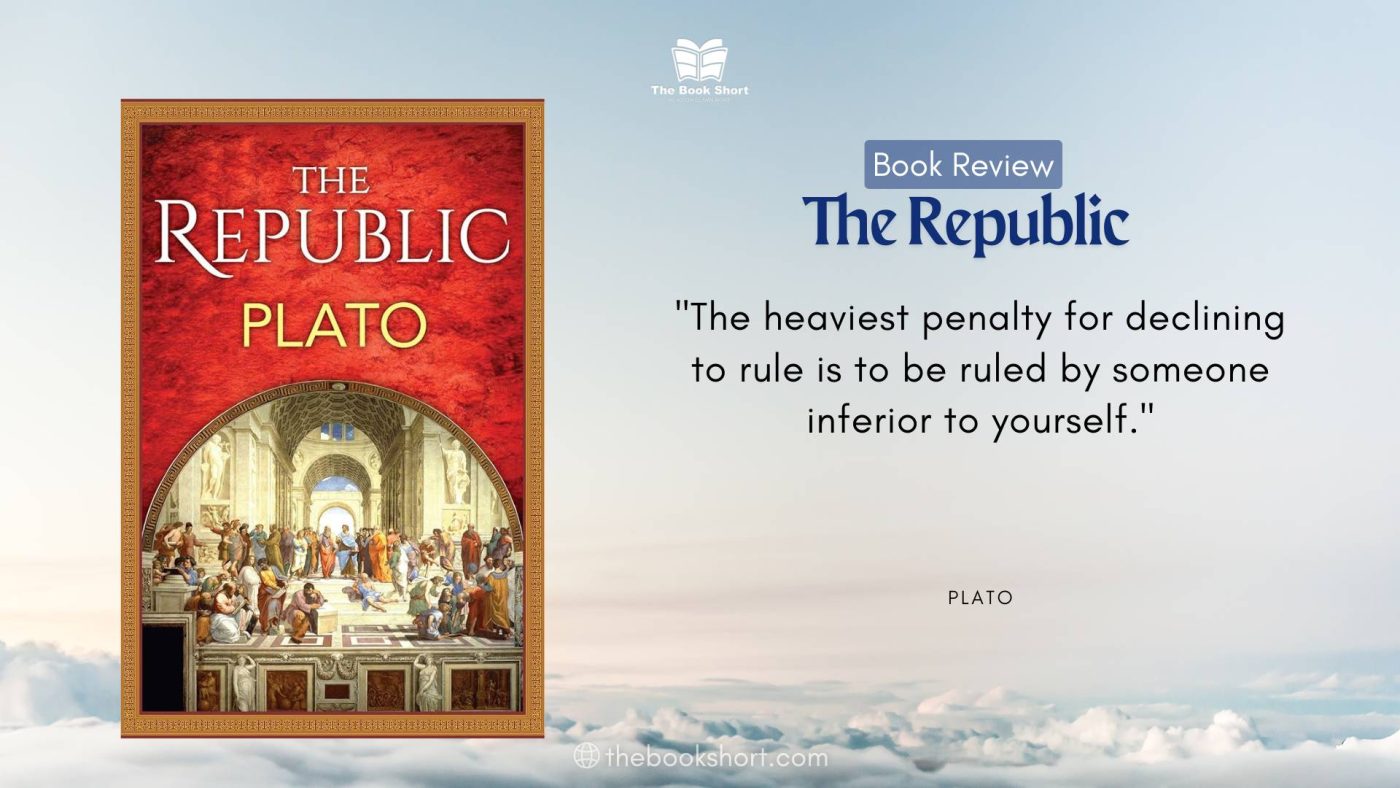
Explore justice, the ideal state, and the soul in Plato’s timeless dialogue, The Republic. A journey into ancient philosophy that still shapes thought today.
Unlocking Plato’s Masterpiece: A Deep Dive into The Republic
Plato’s The Republic is more than just a book; it’s a foundational text in Western philosophy, grappling with questions of justice, the ideal society, and the nature of reality itself. I chose this monumental work for analysis due to its enduring relevance and the depth of its inquiry, offering profound insights that challenge and shape our understanding of politics, ethics, and the human soul thousands of years after its creation. Its unique dialogue format and visionary scope make it essential reading for anyone seeking to understand the roots of philosophical thought.
Basic Information about The Republic Book by Plato
- Title: The Republic (Πολιτεία, Politeia)
- Author: Plato
- Year of publication: Approximately 380 BCE
- Genre: Philosophy, Political Philosophy, Ethics, Dialogue
- Number of pages: Varies significantly by translation and edition (typically 300-500 pages)
- Target audience: Students of philosophy, political science, ethics; anyone interested in classical philosophy, political theory, or Western intellectual history.
Main Content Summary of The Republic by Plato
Plato’s The Republic, primarily presented as a dialogue between Socrates and various Athenians and foreigners, embarks on an ambitious quest to define justice and describe the perfectly just state (the Kallipolis) and the just individual. The discussion evolves significantly from simple definitions to a comprehensive vision encompassing politics, education, metaphysics, and the human psyche.
The book is traditionally divided into ten books, each building upon the last:
Books I–II: The Challenge of Justice
- Book I: The dialogue begins with Socrates visiting the Piraeus. The initial question posed by Cephalus is about old age and wealth. The discussion quickly pivots to justice. Various definitions are proposed and refuted:
- Cephalus: Justice is paying debts and telling the truth.
- Polemarchus: Justice is giving to each what is owed; helping friends and harming enemies.
- Thrasymachus: Justice is nothing else than the interest of the stronger. He argues injustice is more profitable than justice.
- Book II: Glaucon and Adeimantus, Socrates’ brothers, challenge him to prove that justice is desirable for its own sake, not merely for its consequences (reputation, rewards). They present the myth of Gyges’ ring (which grants invisibility and thus impunity for unjust acts) to argue that people are only just out of fear of punishment. This sets the stage for Socrates’ defense of justice’s intrinsic value.
Books II–IV: Constructing the Just City (Kallipolis)
- To understand justice in the individual, Socrates proposes building a city in theory, assuming that justice will be easier to observe in a larger entity.
- Foundation of the City: The city arises from human needs and the principle of specialization (division of labor). The first city is a simple, healthy one.
- The Luxurious City: Desires expand, leading to a “feverish” or luxurious city, requiring a larger territory and thus guardians/soldiers.
- Training the Guardians: Socrates outlines a rigorous education program for the guardians, focused on music, poetry, and physical training, carefully censored to instill virtue (moderation, courage) and prevent negative influences. They must be “gentle to friends and harsh to enemies.”
- The Four Virtues: The just city is characterized by four cardinal virtues:
- Wisdom: Resides in the rulers (the guardians).
- Courage: Resides in the auxiliaries (the soldiers).
- Moderation (Temperance): Spreads throughout the city, agreement on who should rule.
- Justice: The principle of minding one’s own business and performing the task one is naturally best suited for.
- Justice in the Individual: Socrates argues that the individual soul mirrors the city, consisting of three parts:
- Reason: Corresponds to the rulers.
- Spirit (Thymos): Corresponds to the auxiliaries (emotions like anger, ambition).
- Appetite: Corresponds to the producers (desires for food, drink, sex, money).
- A just individual is one whose soul is in harmony, with reason ruling spirit and appetite.
Books V–VII: The Philosopher-King and Forms
- Communism in the Guardian Class: Socrates controversially proposes that guardians and auxiliaries should share property and even spouses/children to eliminate private interests and ensure loyalty to the state. Equality for women in the guardian class is also argued.
- The Philosopher-King: The most radical proposal: the rulers of the just city must be philosophers. Only those who understand the true nature of reality (the Forms) are fit to govern.
- Theory of Forms: Plato introduces his metaphysical theory: the visible world is merely a shadow of a higher, intelligible world of Forms (eternal, perfect essences like Justice, Beauty, Goodness). Philosophers, through dialectic, can grasp these Forms.
- Allegories: Socrates uses famous allegories to explain the philosopher’s journey and the theory of Forms:
- The Sun: The Form of the Good is to the intelligible world what the sun is to the visible world (providing light/truth and existence).
The Divided Line: Illustrates the different levels of knowledge and reality, from images to physical objects to mathematical reasoning and finally, the Forms. - The Cave: The most famous allegory. Prisoners chained in a cave only see shadows on the wall, mistaking them for reality. A freed prisoner ascends to see the sun (the Form of the Good), representing the philosopher’s ascent from ignorance to true knowledge. The philosopher’s duty is then to return to the cave to enlighten others, even if met with resistance.
- The Sun: The Form of the Good is to the intelligible world what the sun is to the visible world (providing light/truth and existence).
Books VIII–IX: Degeneration of Cities and Souls
- Socrates describes the decline from the ideal city (aristocracy ruled by philosopher-kings) through four increasingly unjust forms of government and corresponding character types:
- Timocracy: Ruled by honor and ambition (Sparta-like). Characterized by the timocratic man, driven by spirit/honor.
- Oligarchy: Ruled by wealth. Characterized by the oligarchic man, driven by necessary appetites, stingy.
- Democracy: Ruled by freedom and equality of desires, leading to anarchy. Characterized by the democratic man, ruled by unnecessary appetites, chaotic.
- Tyranny: Ruled by a single individual driven by the lowest desires, suppressing all freedom. Characterized by the tyrannical man, completely enslaved by his appetites, the most unjust and unhappy individual.
- Socrates argues that the tyrannical man is the most miserable, proving that justice is indeed more profitable than injustice, even without external rewards.
Book X: Art, Forms, and the Immortality of the Soul
- Critique of Art: Poetry and imitative art are criticized for appealing to the lower part of the soul (appetite and emotion) and being mere imitations of physical objects, which are themselves imitations of the Forms. They are thus “three times removed from truth.”
- Immortality of the Soul: Socrates argues for the immortality of the soul, suggesting that injustice cannot truly destroy it.
- Myth of Er: The book concludes with a myth describing the afterlife, where souls are judged, rewarded/punished, and choose their next lives. This myth serves as a final argument for the importance of living a just life, as the consequences extend beyond death.
The Republic is a complex and multifaceted work, exploring fundamental questions about human nature, society, knowledge, and reality through the lens of creating an ideal state and defining true justice.
In-depth Analysis of The Republic by Plato
Plato’s The Republic is a philosophical tour de force that interweaves political theory, ethics, psychology, and metaphysics into a cohesive argument for the supreme value of justice.
Characters, Structure, and Key Arguments
The dialogue format is crucial to The Republic‘s structure. Socrates, Plato’s mouthpiece, guides the conversation, refuting opponents’ arguments (like Thrasymachus’) and collaboratively building the ideal city with Glaucon and Adeimantus, who act as intelligent, challenging interlocutors. This dialectical process allows Plato to explore arguments thoroughly and present his ideas not as dogma but as conclusions reached through reasoned inquiry.
Key arguments are numerous and foundational:
- Justice as Harmony: Not merely external actions, but an internal state of the soul where reason rules.
- The State as a Macrocosm of the Soul: The structure of the city mirrors the structure of the individual soul.
- The Philosopher-King: Rulers must possess true knowledge (episteme) of the Forms, especially the Good, to govern justly. This links political authority directly to philosophical wisdom.
- Theory of Forms: A dualistic metaphysics positing a higher, unchanging realm of Forms as the ultimate reality, accessible only through intellect.
- Critique of Democracy and Tyranny: A powerful argument against populist rule and absolute power, linking political decay to the degeneration of the soul.
Writing Style & Content Quality
Plato’s writing style, mediated through Socrates, is characteristically engaging and accessible (for philosophical text). The use of dialogue prevents the work from becoming a dry treatise. Socrates employs analogies and myths (like the Cave, the Divided Line, the Myth of Er) which are incredibly powerful pedagogical tools, illustrating complex abstract ideas in memorable ways.
The content quality is exceptionally high, marked by logical rigor (though not without points of debate), depth of thought, and systematic approach. Plato doesn’t just state conclusions; he builds arguments step-by-step, addressing potential objections raised by his interlocutors. The transition from defining justice to designing a city, then discussing education, gender roles, metaphysics, and the afterlife, showcases a remarkably holistic philosophical vision.
What Stands Out or Differs
The Republic stands out dramatically from many other political or ethical works by linking the external structure of the state directly to the internal state of the individual soul. Most political theories focus on laws, rights, or power structures; Plato insists that the quality of the state depends fundamentally on the virtue of its citizens, particularly its rulers.
Furthermore, the radical proposals regarding the guardian class (communism, equality for women) and the absolute necessity of philosophical knowledge for leadership were revolutionary and remain controversial. The Theory of Forms provides a metaphysical underpinning to his ethics and politics that is unique and has shaped subsequent philosophical thought for millennia. The Cave allegory alone is one of the most influential metaphors in intellectual history. Unlike simple ethical exhortations, The Republic offers a fully integrated system where metaphysics informs politics informs ethics informs psychology.
Notable Quotes from The Republic
- “Justice is nothing else than the interest of the stronger.” (Thrasymachus)
- “Until philosophers are kings, or the kings and princes of this world have the spirit and power of philosophy… cities will never have rest from their evils, nor the human race.” (Book V)
- “The heaviest penalty for declining to rule is to be ruled by someone inferior to yourself.” (Book I)
- “We are not providing for the happiness of a exclusive class in our State, but for the happiness of the whole.” (Book IV)
- “The beginning is the most important part of the work.” (Book II)
- “The human soul is a tripartite entity.” (Book IV)
- “Behave toward everyone in such a way that if you lived in a community where everyone behaved in that way, you would be happy.” (Paraphrased wisdom often attributed to the spirit of the work, particularly regarding justice)
- “The power of learning is present in everyone’s soul.” (Book VII)
- “The eye of the soul is by other pursuits blinded and obscured, but by these purified and rekindled.” (Regarding philosophical education, Book VII)
These quotes offer glimpses into the core themes and arguments that make The Republic a compelling and enduring read.
Evaluation & Expert Personal Review of The Republic
The Republic is a challenging but immensely rewarding read. My personal impression is one of awe at the sheer scope and ambition of Plato’s project. While some proposals (like the communism for guardians or the censorship of art) feel potentially dystopian by modern standards, the underlying arguments about the importance of character, education, and the pursuit of truth in governance remain profoundly relevant.
Advantages and Disadvantages
Advantages:
- Foundational: Provides essential context for understanding subsequent Western philosophy and political thought.
- Comprehensive: Integrates ethics, politics, psychology, education, and metaphysics.
- Thought-Provoking: Challenges readers to think deeply about fundamental questions of justice, governance, and reality.
- Literary Merit: The dialogue format and vivid allegories make complex ideas accessible and engaging.
Disadvantages:
- Complexity: Can be difficult for readers unfamiliar with ancient philosophy or Plato’s context.
- Controversial Ideas: Some of Plato’s proposals (e.g., censorship, ruling elite, eugenics implications) are ethically troubling today.
- Translational Variations: Different translations can significantly impact understanding.
Readability Level and Target Audience
The Republic has a high readability level. It requires concentration, willingness to engage with abstract ideas, and patience with the Socratic method of argument. It is definitely not light reading.
It is most suitable for:
- University students studying philosophy, political science, or classics.
- Anyone with a serious interest in the history of ideas.
- Readers looking for a deep philosophical challenge rather than a quick summary of points.
It is not suitable for casual readers seeking an easy introduction to ethics or politics.
Practical Value
The practical value of reading The Republic is less about providing a blueprint for a real-world government (Plato himself seemed aware of the Kallipolis’s utopian nature) and more about cultivating critical thinking and self-reflection.
- Lessons on Justice: It forces the reader to consider what justice truly is, beyond mere legality or social convention, and its connection to individual character.
- Understanding Political Systems: The analysis of degenerating constitutions offers insights into the potential pitfalls of different forms of government that resonate today.
- Importance of Education: Plato’s emphasis on rigorous, virtue-oriented education highlights its crucial role in shaping individuals and societies.
- Change in Mindset: Engaging with the Theory of Forms and the Cave allegory can fundamentally alter one’s perspective on reality, knowledge, and the difference between appearance and truth.
- Self-Knowledge: The tripartite soul model provides a framework for understanding internal conflict and the importance of reason guiding desires.
In short, The Republic provides intellectual tools and conceptual frameworks that can enrich one’s understanding of oneself, society, and the pursuit of a good life, even if its specific political prescriptions are debated.
Comparison with Similar Books to The Republic
The Republic stands almost alone in its specific blend of elements, but it can be contextualized alongside other foundational works in political philosophy and ethics.
- Aristotle’s Politics: Often considered the direct successor and critic of The Republic. Aristotle takes a more empirical approach, examining existing constitutions rather than designing an ideal one from scratch. While The Republic is prescriptive and utopian, Politics is descriptive and pragmatic. Readers interested in the practical analysis of governance after the theoretical idealism of Plato should read Politics.
- Machiavelli’s The Prince: A stark contrast in approach. While Plato is concerned with justice and the ideal state ruled by virtue, Machiavelli focuses on acquiring and maintaining political power through efficacy, often divorcing politics from conventional morality. Reading The Prince after The Republic highlights the dramatic shift in Western political thought from the classical pursuit of the good to the modern pursuit of power.
- St. Augustine’s City of God: This work responds to classical pagan philosophy (including Plato) from a Christian perspective. Augustine contrasts the “City of God” (aligned with divine truth and justice) with the “earthly city” (driven by worldly desires). It shares The Republic‘s concern with the ideal community but places it in a theological framework.
If readers liked The Republic‘s blend of philosophical inquiry, political theory, and ethical reasoning, they might also enjoy:
- Aristotle’s Nicomachean Ethics: For a detailed exploration of virtue ethics and the good life, focusing on the individual.
- Plato’s Symposium: For another brilliant example of Plato’s dialogue style, focused on the nature of love and beauty (related to the Forms).
- Thomas More’s Utopia: For a Renaissance work that explicitly follows Plato’s lead in describing an ideal (though fictional) society.
- John Locke’s Second Treatise of Government: For a foundational text in liberal political theory, offering a contrasting view on the social contract, natural rights, and the purpose of government.
Comparing The Republic with these works illuminates its unique place in the history of ideas and how later thinkers built upon, reacted to, or departed from Plato’s vision.
Conclusion & Recommendations for Reading The Republic
Plato’s The Republic is an unparalleled classic that offers a comprehensive vision of justice, the ideal society, and the life well-lived. Its outstanding value lies in its foundational status in Western thought, its integration of diverse philosophical domains, and its enduring capacity to provoke deep reflection on fundamental human questions.
Is it worth reading? Absolutely. It is a cornerstone text for understanding philosophy, political theory, and the very trajectory of Western intellectual history.
Who should read it? Anyone serious about philosophy, political science, ethics, or the history of ideas. Students, scholars, and intellectually curious individuals willing to grapple with complex arguments will find it profoundly rewarding. It requires patience and effort, but the insights gained are invaluable.
Have you read this book? Share your thoughts on Plato’s Republic in the comments below!