
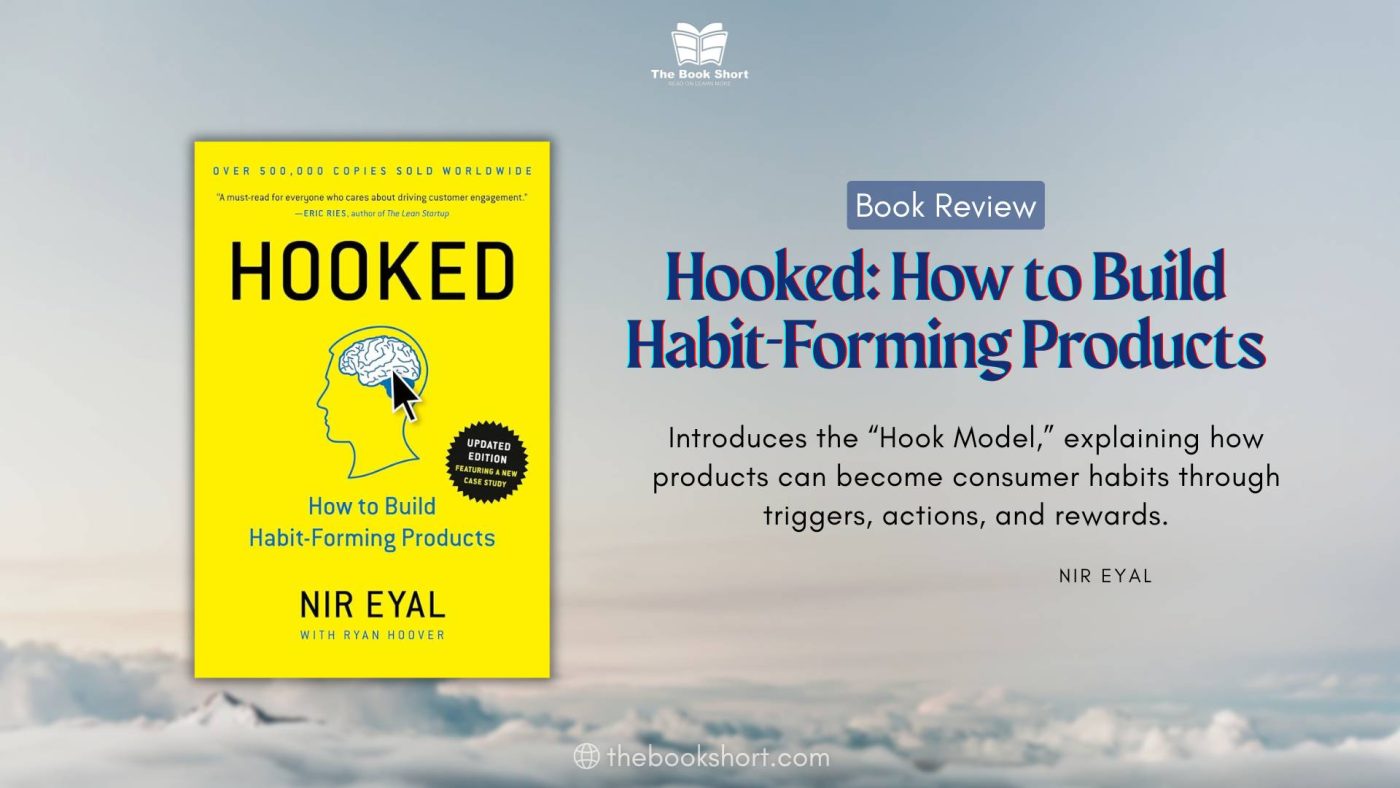
A Deep Dive into Nir Eyal’s Hooked: A Summary and Review
Why do some products weave themselves into the fabric of our lives, while others are forgotten in a week? Nir Eyal’s groundbreaking book, Hooked, doesn’t just ask this question—it answers it with a chillingly effective blueprint. I’ve chosen Hooked for this deep dive because it provides a clear, actionable framework for product builders, designers, and marketers. Its enduring power lies in how it demystifies user psychology, transforming abstract theory into a practical model for creating products that become second nature.
Hooked by Nir Eyal: Book Details at a Glance
- Title: Hooked: How to Build Habit-Forming Products
- Author: Nir Eyal with Ryan Hoover
- Year of publication: 2014
- Genre: Business, Product Management, Psychology, Marketing
- Number of pages: 256
- Target audience: Product managers, designers, marketers, startup founders, and anyone interested in the psychology behind our technology habits.

Hooked: How to Build Habit-Forming Products
Hooked Book Summary: Unpacking the Four-Step Model
In Hooked: How to Build Habit-Forming Products, Nir Eyal introduces his seminal “Hook Model.” This four-step framework is a powerful engine designed to create unprompted user engagement—in other words, a habit. The ultimate goal is to connect a user’s problem to your product’s solution with enough frequency that it becomes an unconscious routine. This self-perpetuating cycle consists of a Trigger, an Action, a Variable Reward, and an Investment.
The Foundation: Habits as a Competitive Advantage
Eyal first establishes why habits are the holy grail for any modern business. Products that successfully install themselves in a user’s routine gain an almost insurmountable competitive advantage:
- Increased Customer Lifetime Value (CLV): Habitual users engage more often and for longer, dramatically increasing the value they bring over time.
- Greater Pricing Flexibility: As a product becomes an ingrained part of a user’s life, they become far less sensitive to price changes.
- Supercharged Growth: These loyal users become a product’s most potent evangelists, driving organic, word-of-mouth growth that money can’t buy.
- A Moat Against Competition: Once a user forms a habit—like searching on Google or scrolling Instagram—it becomes incredibly difficult for a rival product to break that loop, even with a superior offering.
Step 1: Trigger
A trigger is the spark that initiates behavior. Eyal brilliantly categorizes triggers into two distinct types: external and internal. The journey from one to the other is the path to habit formation.
- External Triggers: These are the cues in our environment that tell us what to do next. They are essential for bringing new users into the fold. Eyal identifies four types:
- Paid Triggers: Advertising, SEO, and other paid channels. Effective for acquisition, but expensive and not sustainable for long-term retention.
- Earned Triggers: Coveted press mentions, viral videos, or a feature on the App Store. Powerful and free, but unpredictable and difficult to maintain.
- Relationship Triggers: A recommendation from a friend. This is often the most effective trigger, built on a foundation of trust.
- Owned Triggers: Cues the user has willingly permitted, such as an app icon on their home screen, a notification, or an email newsletter. The goal of the initial stages is to guide the user from fleeting external triggers to these more permanent, owned ones.
- Internal Triggers: This is where the magic—and the true habit—happens. Internal triggers are deeply personal, manifesting as emotions, thoughts, or pre-existing routines. A pang of loneliness triggers a visit to Facebook. A moment of boredom leads to endless scrolling on TikTok. A fear of being out of the loop (FOMO) prompts a reflexive check of email or X (formerly Twitter). The ultimate objective of a habit-forming product is to forge a powerful association with a user’s internal trigger, becoming the default solution to their feeling or pain point.
Step 2: Action
Following a trigger, the user must perform an action. Here, Eyal masterfully incorporates Dr. B.J. Fogg’s Behavior Model, which states that for any behavior to occur, three elements must converge at the same moment:
B = MAT (Behavior = Motivation + Ability + Trigger)
- Motivation: The user must have a compelling reason to act. Eyal highlights core human drives: seeking pleasure and avoiding pain; seeking hope and avoiding fear; seeking social acceptance and avoiding rejection.
- Ability: The action must be easy to perform. Ability isn’t about skill; it’s about simplicity. Product designers must ruthlessly eliminate friction. Think of the seamless infinite scroll, the single click of a “like” button, or the utter simplicity of a Google search. The easier the action, the more likely it will occur, even with low motivation.
- Trigger: As discussed, a trigger must be present to spark the behavior.
If a user fails to take the desired action, Eyal offers a powerful diagnostic: are they lacking motivation, or is the action too difficult? He argues that innovators should almost always prioritize making the action simpler (increasing ability) over trying to pump up user motivation.
Step 3: Variable Reward
This is the pulsing heart of the Hook Model. After acting, the user receives a reward. Crucially, this reward must be variable. Predictable rewards satiate us; variable rewards create a state of craving and intrigue. It is the anticipation of the reward, not the reward itself, that hijacks our brain’s pleasure centers. Eyal identifies three types of variable rewards that appeal to our deepest needs:
- Rewards of the Tribe: These are social rewards fueled by our profound need to belong. The likes, comments, and shares we receive on social media validate us, making us feel connected, accepted, and important.
- Rewards of the Hunt: Stemming from our primal need to seek and acquire, these rewards are about the search for resources. We see this in the endless scroll of a newsfeed (hunting for novel information), the thrill of a stock market fluctuation, or the addictive pull of a slot machine (hunting for a financial win).
- Rewards of the Self: These rewards satisfy our intrinsic desire for mastery, competence, and completion. The satisfaction of clearing our email inbox (achieving “Inbox Zero”), unlocking a new level in a game, or mastering a skill on Duolingo are all powerful rewards of the self.
Step 4: Investment
The final step in the cycle is the Investment. This is where the user puts something of value back into the system, which in turn primes them for the next pass through the hook. Investments store value and load the next trigger. They can take many forms:
- Data: Customizing a profile, setting preferences, or adding personal information.
- Content: Posting photos on Instagram, writing reviews on Yelp, or building a playlist on Spotify.
- Followers/Reputation: Amassing followers on X or earning a high seller rating on eBay.
- Skill: Mastering the complexities of a tool like Photoshop or a language on a learning app.
Every investment, no matter how small, increases the product’s value to the user, making it stickier and harder to leave. It also loads future triggers (e.g., a response to your post brings you back into the app), ensuring the user’s return.
An In-Depth Analysis of the Hooked Model
Nir Eyal’s Hooked is far more than a business book; it’s a field guide to applied psychology in the digital age. His analysis reveals the powerful, and at times unsettling, architecture behind modern technological engagement.
Structure and Key Arguments
The book’s genius lies in its elegant, unforgettable structure. Built around the four stages of the Hook Model, each chapter—Trigger, Action, Variable Reward, Investment—is a self-contained masterclass. This cyclical framework isn’t just for organization; it is the central argument. Eyal compellingly posits that user devotion isn’t a happy accident but the result of deliberate, psychological engineering.
His core thesis is that to win in the crowded 21st-century marketplace, you must build a habit. While others focus on features or marketing funnels, Eyal hones in on the holy grail of unprompted engagement—the user’s subconscious impulse to turn to your product without an external nudge. This, he argues, is what separates flashes in the pan from enduring platforms like Google, Instagram, and Amazon.
Brilliantly, Eyal includes a final chapter on the “Manipulation Matrix,” which serves as the book’s conscience. Here, he confronts the profound ethical questions his model raises, providing a framework for creators to evaluate their own work. He asks them to determine if they are a “Facilitator” (helping users with habits they already want to form), a “Peddler,” an “Entertainer,” or a “Dealer” (profiting from harmful addictions). This chapter elevates Hooked from a simple “how-to” guide into a work of responsible innovation, demanding that creators ask not only “How can I hook users?” but also “Should I?”
Writing Style and Content Quality
Eyal’s writing is deceptively simple and remarkably effective. He masterfully translates dense psychological concepts and academic research into clear, actionable prose, avoiding jargon in favor of directness. The book is saturated with meticulously dissected case studies—from Pinterest and Twitter to the Bible app—that vividly illustrate the Hook Model in action. This approach breathes life into abstract concepts, making them tangible and immediately applicable.
The quality of the content is exceptional because it synthesizes established psychological principles (from figures like B.J. Fogg and B.F. Skinner) into a novel and proprietary framework. What sets Hooked apart is this potent combination of diagnosis and prescription. It doesn’t just explain the “what” (users form habits); it provides the “how” (here is the four-step model to engineer them). It bridges the chasm between academic psychology and practical product development better than almost any other book on the shelf.
Notable Quotes from the Book
- “Instead of relying on expensive marketing, habit-forming companies link their services to the users’ daily routines and emotions.”
- This quote is the book’s DNA. It argues that the most powerful form of marketing is a product so useful it becomes part of a user’s identity.
- “Many innovations fail because consumers irrationally overvalue the old while companies irrationally overvalue the new.”
- A sharp insight into human psychology, this highlights the immense friction of behavioral change and why building a habit is the only reliable way to overcome it.
- “To change behavior, products must ensure the user feels in control. People must feel they are choosing to use the service, not being forced.”
- This speaks to the subtle psychology of the “Investment” phase. True commitment is built on user agency, not coercion.
- “The ultimate goal of a habit-forming product is to solve the user’s pain by creating an association so that the user identifies the company’s product or service as the source of relief.”
- This is the endgame. The product ceases to be a tool and becomes the go-to solution for an internal state, like boredom, loneliness, or uncertainty.
Evaluation and Personal Review of Hooked
Hooked by Nir Eyal is a foundational text for anyone building, designing, or marketing in the modern world. It is simultaneously enlightening and profoundly practical, offering a critical lens through which to both understand and create the technologies that shape our lives.
Personal Impressions and Advantages
The primary strength of Hooked is its stunning clarity and actionable design. The Hook Model is an elegant, memorable mental model that is easy to recall and apply in real-world scenarios. Unlike business books that leave you feeling inspired but directionless, Hooked equips you with a concrete diagnostic tool. After reading it, you can immediately deconstruct the success of existing products or brainstorm features for a new one using the Trigger, Action, Variable Reward, and Investment framework.
Another powerful advantage is its ethical core. Eyal courageously confronts the manipulative potential of his own model. The “Manipulation Matrix” is a vital tool for self-regulation, urging creators to weigh the human impact of their work. This responsible approach lends the book a depth and maturity that many business guides lack.
Disadvantages
If Hooked has a weakness, it’s that its examples, though perfectly illustrative, are products of their time. Published in 2014, the case studies are dominated by the tech giants of that era (Facebook, Twitter, Pinterest). While the psychological principles are timeless, a contemporary reader might crave analysis of newer habit-forming phenomenons like TikTok, Wordle, or modern SaaS tools. Furthermore, while the model is powerful, it can risk making success sound formulaic. The book inevitably downplays the immense role that luck, timing, market conditions, and raw execution play in a product’s triumph or failure.
Readability and Target Audience
The book is exceptionally readable. Eyal’s prose is crisp and engaging, making complex ideas accessible without ever dumbing them down. The logical structure, reinforced by helpful “Do This Now” summaries at the end of each chapter, makes it a pleasure to read and easy to reference.
This book is essential reading for:
- Product Managers and UX/UI Designers: It provides a user-centric language for designing features that drive genuine engagement.
- Startup Founders and Entrepreneurs: It offers a vital blueprint for building user retention and sustainable growth from the ground up.
- Marketers: It reveals the deep psychology behind creating campaigns and touchpoints that build lasting relationships with users.
- Anyone curious about technology’s pull: It serves as a brilliant, and slightly unsettling, user manual for your own brain in the digital age.
Practical Value
The practical value of Hooked cannot be overstated. It fundamentally rewires how you think about product design. You stop thinking in terms of isolated features and start thinking in terms of self-reinforcing loops. It provides a shared vocabulary for teams to debate and strategize about user engagement. Its lessons are directly applicable—from designing a notification system (Triggers) and simplifying a signup flow (Action) to fostering a community (Variable Rewards). It forces a critical mindset shift from merely acquiring users to thoughtfully retaining them by becoming an indispensable part of their lives.
Comparison with Similar Books on Habit Formation
Hooked carves out a unique niche at the intersection of business strategy and behavioral psychology. To fully appreciate its contribution, it’s useful to see how it stacks up against other landmark books in the field.
Hooked vs. The Power of Habit by Charles Duhigg
- The Power of Habit is a masterpiece of narrative nonfiction, exploring the science of habits through compelling stories that span individuals, corporations, and societies. Duhigg’s core framework is the “Habit Loop”: Cue, Routine, Reward.
- Comparison: Duhigg’s book is brilliantly diagnostic—it explains why habits exist and how they shape our world. Eyal’s book is powerfully prescriptive—it takes those same principles and shows product creators how to build them. The Power of Habit is for a general audience seeking to understand themselves and the world. Hooked is a specialized manual for builders. They are perfect companion reads: Duhigg gives you the foundational “why,” while Eyal provides the actionable “how” for the digital architect.
Hooked vs. Indistractable by Nir Eyal
- Indistractable is Eyal’s essential follow-up, tackling the problem from the opposite side. If Hooked is a manual for building engaging products, Indistractable is a guide for reclaiming your focus and attention from them.
- Comparison: The two books create a fascinating creator/consumer dialectic. Hooked is for the producer; Indistractable is for the user. Reading them back-to-back provides a complete, 360-degree view of Eyal’s philosophy on technology. It reveals a mature and nuanced perspective: the same mechanisms that build helpful habits can lead to destructive distraction, and we need strategies to manage both sides of the equation.


If you liked Hooked, you might also enjoy:
- Contagious: Why Things Catch On by Jonah Berger: This book delves into what makes ideas and products go viral. While Hooked is about retention through habit, Contagious is about acquisition through social transmission.
- Thinking, Fast and Slow by Daniel Kahneman: For readers who want the deep, academic dive into the cognitive biases and psychological shortcuts that Eyal’s model leverages. It’s the scientific bedrock for many of the ideas in Hooked.
- Made to Stick: Why Some Ideas Survive and Others Die by Chip Heath and Dan Heath: A fantastic guide to making your ideas more memorable and impactful, which pairs perfectly with the product-building focus of Hooked.
Conclusion and Recommendations on the Book Hooked
Hooked: How to Build Habit-Forming Products is an essential, enduring, and indispensable guide for the digital age. Its true genius lies in its brilliant synthesis of complex psychology into a simple, memorable, and actionable framework. The Hook Model has given an entire generation of creators a shared language and a powerful lens to shift their focus from fleeting acquisition to sustainable, habit-driven engagement.
Is it worth reading?
Without a doubt. For its intended audience, Hooked isn’t just “worth reading”—it’s required reading. It provides a fundamental literacy in the mechanics of modern user behavior. For the casual reader, it offers a fascinating and sobering peek behind the curtain, explaining precisely why our devices are so hard to put down.
Who should read it?
This book is a must-read for product managers, startup founders, UX/UI designers, and marketers. Yet, its insights are equally valuable for entrepreneurs in any industry, behavioral psychologists, and any citizen of the digital world seeking to understand the forces shaping their attention. It will permanently alter the way you see the products you use every single day.
Have you read this book? Share your thoughts in the comments below.