
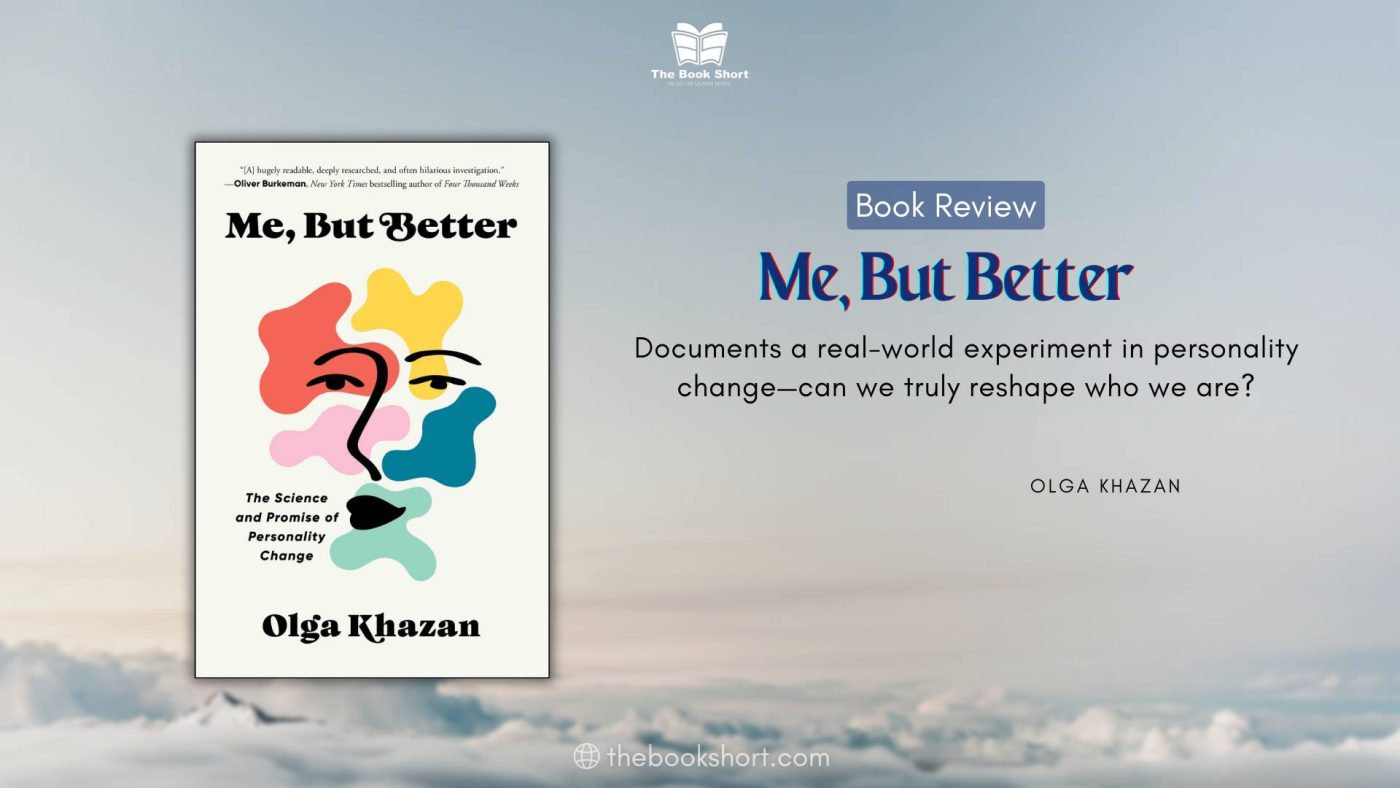
This Me, But Better book summary analyzes Olga Khazan’s witty, scientific quest to change her personality, offering a roadmap for practical self-improvement.
Ever wished you could be a little less anxious, a touch more outgoing? In Me, But Better, journalist Olga Khazan dives headfirst into this very challenge. I chose this book for analysis because it masterfully bridges the gap between vulnerable personal memoir and rigorous scientific journalism. It sidesteps the vague platitudes common in the self-help aisle by grounding every attempt at change in hard psychological research, making it a uniquely practical and deeply relatable guide for anyone curious about the mechanics of personal transformation.
Me, But Better Book Summary: Key Information
- Full Title: Me, But Better: The Unexpected Science of How to Be The Person You Want to Be
- Author: Olga Khazan
- Year of Publication: 2019
- Genre: Self-Help, Popular Psychology, Memoir
- Number of Pages: 288
- Target Audience: Anyone interested in psychology, personal development, and evidence-based strategies for meaningful change.

Me, But Better: The Science and Promise of Personality Change
Main Content Summary of Me, But Better
Me, But Better is Olga Khazan’s journalistic and deeply personal investigation into the science of personality change. Unhappy with certain aspects of her own makeup—namely, her high neuroticism and deep-seated introversion—she embarks on a quest to discover if it’s truly possible to become the person she aspires to be. The book is structured around her real-world attempts to modify these core traits, blending her own experiences with extensive research and interviews with leading psychologists.
The Central Premise: Can We Really Change?
The book is built on one compelling question: Is our personality fixed, or can it be deliberately reshaped? Khazan confronts the long-held belief that our core traits are set in stone by early adulthood. She uses the “Big Five” personality traits, a cornerstone model in modern psychology, as the framework for her investigation:
- Openness to Experience: (Imaginative and curious vs. conventional and cautious)
- Conscientiousness: (Disciplined and organized vs. spontaneous and easy-going)
- Extraversion: (Outgoing and energetic vs. solitary and reserved)
- Agreeableness: (Compassionate and cooperative vs. critical and challenging)
- Neuroticism: (Prone to anxiety and negative emotions vs. emotionally stable and resilient)
Khazan argues that while we have a genetic starting point, our traits are far more malleable than we assume. Change is possible, she discovers, but it requires targeted, consistent effort—a scientifically-backed version of “act as if” until the acting becomes reality.
Tackling Neuroticism: The Quest for Calm
At the heart of the book lies Khazan’s battle with her own neuroticism, the primary trait she is determined to change. Her journey to become more emotionally stable is a multi-pronged assault on her fears, documented with unflinching honesty and humor.
- Cognitive Behavioral Therapy (CBT): She immerses herself in the principles of CBT, learning to catch and challenge her automatic negative thoughts. Instead of spiraling into panic over a work presentation, she practices reframing it as an opportunity and rationally assessing the low probability of a true catastrophe.
- Exposure Therapy: To dismantle her social anxiety and fear of judgment, she undertakes a series of brilliantly uncomfortable public experiments. She intentionally wears her shirt inside out, asks for a random discount on a cup of coffee, and even lies down on the sidewalk for 30 seconds—all to prove to her hyper-vigilant brain that the social fallout is survivable, and usually nonexistent.
- Pharmaceuticals and Biofeedback: Khazan explores the role of beta-blockers like propranolol, which blunt the physical symptoms of anxiety (a racing heart, shaky hands) to help her navigate stressful situations with a clearer mind. She also experiments with biofeedback devices to gain conscious control over her physiological stress responses.
The crucial takeaway is that reducing neuroticism isn’t about eradicating anxiety, but about fundamentally changing your relationship with it. It’s about building a versatile toolbox to manage anxious thoughts and feelings, rather than being ruled by them.
Cultivating Extraversion: Learning to Be Outgoing
As a self-proclaimed introvert who finds social events draining, Khazan pushes herself far outside her natural comfort zone to become more outgoing.
- Improv Comedy: In what she describes as a nightmare for an introvert, she joins an improv class. The core rule of improv—”Yes, and…”—forces her to become more spontaneous, agreeable, and collaborative, providing a low-stakes training ground for social risk-taking.
- Forced Socialization: She commits to acting like an extrovert. This involves initiating conversations with strangers, attending parties she would normally dread, and mastering the art of asking others questions about themselves—a classic technique for deflecting social pressure while building genuine rapport.
Her experiment reveals that extraversion is, in large part, a set of learnable skills. While she may never be a natural-born life of the party, she proves she can successfully adopt extroverted behaviors when she chooses to.
Enhancing Conscientiousness and Agreeableness
Khazan also chronicles her efforts to become more organized and kinder, rounding out her self-improvement project.
- Conscientiousness: She delves into the science of habit formation and willpower. She road-tests techniques like “implementation intentions”—creating a specific if-then plan (e.g., “If I finish my morning coffee, then I will immediately spend 30 minutes on my most important task”). This transforms a vague intention into a concrete, actionable trigger.
- Agreeableness: To soften her critical inner voice and become more compassionate, Khazan practices loving-kindness meditation. This involves directing well-wishes toward herself, loved ones, and even people she finds difficult. She finds that while the change isn’t instantaneous, the practice helps to recalibrate her brain’s default response from judgment to empathy.
Ultimately, the book concludes that personality change is not about a radical overnight transformation but about making incremental shifts. It’s the process of consciously choosing new behaviors and practicing them until they carve new neural pathways and become second nature. Khazan’s journey is a powerful testament to the idea that with the right tools and tenacious effort, we can all become a “better” version of ourselves.
In-depth Analysis of Me, But Better by Olga Khazan
Olga Khazan’s Me, But Better carves out a vital space in the crowded self-help genre by grounding its advice in a potent trifecta of vulnerable memoir, sharp-witted journalism, and accessible science. Its analysis reveals a message that is both radically empowering and refreshingly realistic.
Structure, Arguments, and Khazan as “Character”
The book’s structure is its greatest strength. Rather than a dry academic treatise, Khazan makes herself the primary case study. Each chapter is framed around her personal quest to modify one of the Big Five personality traits, transforming abstract psychological concepts into a compelling human story. We don’t just learn about exposure therapy; we are right there with Khazan, cringing and cheering as she nervously asks a barista for a 10% discount on her coffee. This “character-driven” approach makes the science unforgettable.
The book’s central argument delivers a nuanced rebuttal to psychological determinism. Khazan posits that personality is not a fixed destiny but a “characteristic adaptation.” We have our baseline traits (the “characteristic”), but our behaviors, habits, and mindsets are the “adaptations” we can consciously sculpt. This distinction is liberating. It frees us from the fatalism of “that’s just how I am” while setting realistic expectations. The goal isn’t to magically erase your core self, but to learn to act in ways that better serve your goals—and over time, that action can become an authentic part of who you are.
Writing Style and Content Quality
Khazan’s writing is a masterful blend of journalistic precision and self-deprecating humor. A staff writer for The Atlantic, she writes with a confidence and clarity that makes complex topics feel effortless. She has a gift for translating dense scientific studies and psychological jargon into vivid, understandable language. For example, she explains the neurological roots of her anxiety not with a textbook definition, but by describing it as her brain’s “smoke detector with a faulty sensor.” This wit and relatability prevent the book from ever feeling preachy or condescending.
The quality of the content is exceptional because it is rigorously evidence-based. Unlike so many self-help books built on anecdote and affirmation, every strategy Khazan attempts is supported by interviews with leading psychologists and citations from peer-reviewed research. This journalistic integrity is what elevates Me, But Better above its peers. It isn’t just one woman’s story of self-improvement; it is a meticulous investigation into the scientifically validated methods available to us all, making it a superb piece of science communication.
Notable Quotes from the Book
These quotes capture the book’s core philosophy on effort, identity, and the science of change:
- On the nature of change: “Personality change is a bit like physical fitness: You can’t just go to the gym once and be swole forever… It requires a bit of regular maintenance.”
- On the ‘act as if’ principle: “The big secret to personality change, the scientists I spoke with told me, is that it’s not about some big, scary, character-level overhaul. It’s about setting smaller, more manageable goals for yourself. In a way, it’s about faking it.”
- On self-acceptance vs. self-improvement: “This book is not about trying to become some other, better person, as though you’re a fixer-upper. It’s more about sanding down your own rough edges—while appreciating the lovely, gnarled wood underneath.”
These quotes powerfully illustrate the book’s central message: meaningful change is an incremental, effortful process rooted in small behavioral shifts, not a grand, instantaneous reinvention.
Evaluation & Expert Personal Review
Me, But Better is a standout in the popular psychology landscape, offering a rare fusion of entertainment, education, and actionable advice. It’s both a captivating read and a genuinely useful manual for personal growth.
Personal Impressions and Strengths:
The book’s defining strength is its profound honesty. Olga Khazan is not a guru on a mountaintop; she is a fellow traveler in the trenches of self-doubt, documenting her stumbles, anxieties, and small victories with unflinching candor. This vulnerability creates an immediate bond of trust and makes her advice feel earned and authentic. Her willingness to subject herself to hilariously awkward experiments is both comedic and deeply inspiring.
Its other pillar is its scientific foundation. By weaving in accessible research from psychology and neuroscience, Khazan provides the “why” behind the “how.” Readers don’t just get a list of tips; they understand the mechanisms by which these techniques reshape our brains and behaviors. This evidence-based approach builds confidence and empowers the reader to choose strategies that are most likely to work for them.
The book has no significant disadvantages, though it’s worth noting that it’s filtered primarily through Khazan’s personal challenges with anxiety and introversion. Readers whose primary struggles lie elsewhere (e.g., a lack of agreeableness or conscientiousness) will find those sections less developed. However, the underlying principles she uncovers are universally applicable to changing any behavioral trait.
Readability Level and Target Audience:
The book is exceptionally readable, written in a sharp, journalistic style brimming with humor and wit. It is perfectly suited for a broad audience, from those with a casual interest in self-improvement to psychology enthusiasts looking for real-world applications of theoretical concepts.
This book is perfect for:
- Individuals who feel “stuck” in certain personality patterns and are searching for a realistic path toward change.
- Anyone weary of generic self-help tropes and hungry for strategies backed by solid science.
- Fans of journalistic memoirs that blend personal narrative with deep-dive investigation (in the vein of Mary Roach or A.J. Jacobs).
- Skeptics of the self-help genre; Khazan’s critical, evidence-based approach is a refreshing antidote.
Practical Value and Lessons:
The practical value of Me, But Better is immense. Its most powerful lesson is that personality is not a life sentence. Change is possible, but it is a skill that demands deliberate practice. The book offers a potent toolbox of techniques—from cognitive reframing and exposure therapy to implementation intentions and loving-kindness meditation—that readers can immediately begin applying to their own lives.
The most profound mindset shift the book offers is the move from a fixed mindset (“I am an anxious person”) to a growth mindset (“I am a person who sometimes experiences anxiety, and I have tools to manage it”). It teaches us that our identity is not defined by our innate tendencies, but by the conscious choices we make every single day.
Comparison with Similar Books
Me, But Better sits at a unique intersection of genres, and its blend of personal experiment and scientific journalism helps it stand apart from other popular titles.
- Compared to Grit by Angela Duckworth: While Grit provides a brilliant deep dive into the science of one specific trait—perseverance—Me, But Better offers a broader exploration across the Big Five personality traits. Khazan’s book is also more of a personal narrative, making it a more accessible and relatable entry point into the science of character.
- Compared to Atomic Habits by James Clear: Atomic Habits is a masterclass in the “how” of behavior change, offering a precise, actionable framework. Me, But Better is the “why” and “what.” Khazan explores which personality traits one might want to change and why it’s psychologically possible, positioning habits as one of several crucial tools for doing so. The two books are outstanding companions.
- Compared to Quiet by Susan Cain: Quiet is a powerful celebration of introversion, arguing for its inherent value. Me, But Better, while respecting the strengths of introversion, asks a different question: “What if an introvert wants or needs to learn the skills of an extrovert?” It focuses on expanding one’s behavioral repertoire rather than simply embracing a baseline, offering a more action-oriented perspective on navigating the world.


If you liked “Me, But Better,” you might also enjoy:
- Atomic Habits by James Clear
- Grit: The Power of Passion and Perseverance by Angela Duckworth
- The Happiness Hypothesis by Jonathan Haidt
- Stumbling on Happiness by Daniel Gilbert
Conclusion & Recommendations
Me, But Better: The Unexpected Science of How to Be The Person You Want to Be is a remarkable book that more than delivers on its ambitious promise. Its outstanding value lies in its ability to demystify the science of personality and present a path to change that is realistic, evidence-based, and deeply human. Olga Khazan’s witty, vulnerable, and rigorously researched journey is both a profound comfort and a powerful call to action.
Is it worth reading? Absolutely. It is one of the most intelligent, entertaining, and genuinely useful books on self-improvement to be published in the last decade.
Who should read it? This book is essential reading for anyone who has ever wished they could sand down a rough edge of their personality but didn’t know where to begin. It is for the curious, the skeptical, and anyone seeking to build a better life not through magical thinking, but through deliberate, incremental, and courageous effort.
Have you read this book? Share your thoughts in the comments below