
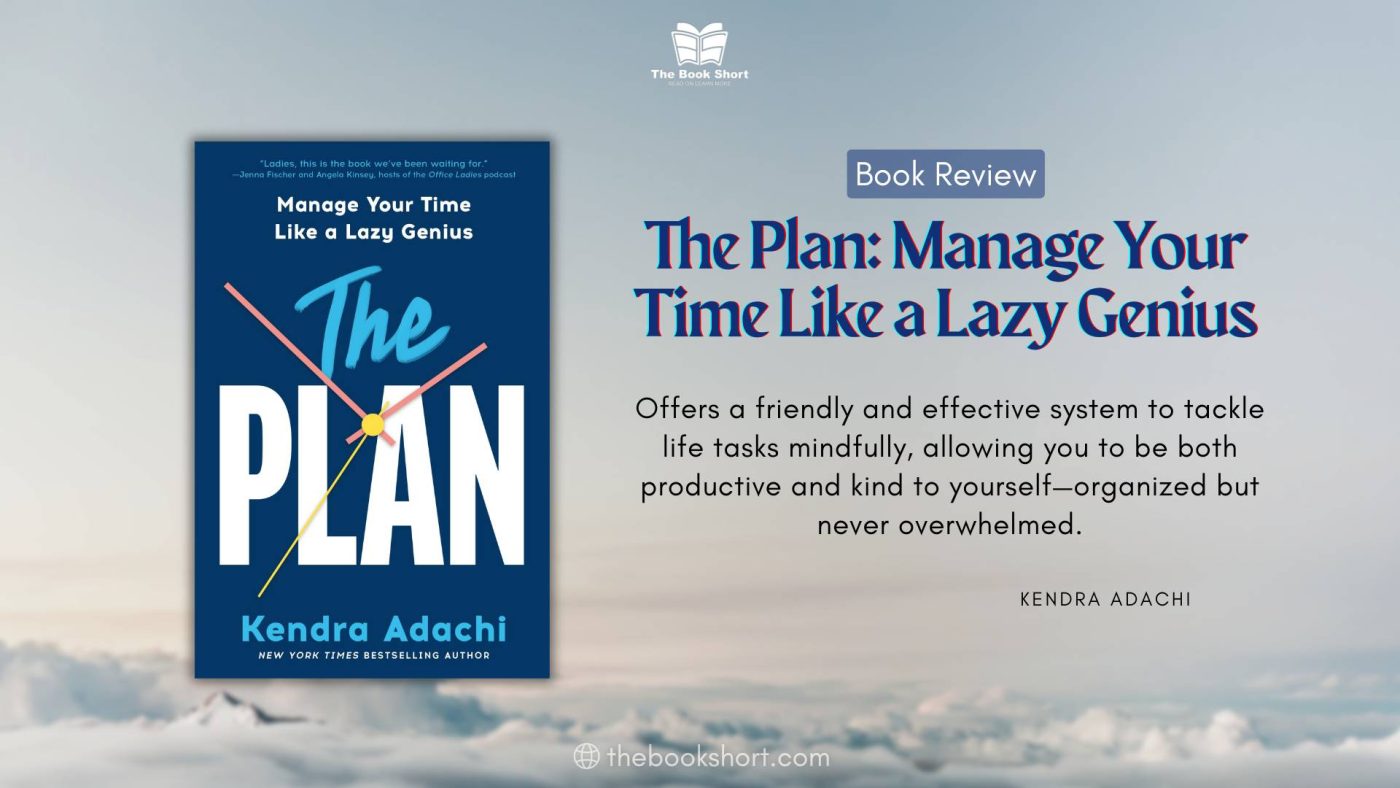
Stop the productivity shame spiral. This book review explores how Kendra Adachi’s The Plan helps you manage time by being a genius about what matters and lazy about what doesn’t.
Are you exhausted by time management systems that feel more like a straitjacket than a solution? This analysis of The Plan: Manage Your Time Like a Lazy Genius by Kendra Adachi dives into a revolutionary, grace-filled approach to organizing your life. I was drawn to this book because it passionately rejects the one-size-fits-all hustle culture, offering instead a framework that is as personal as your own fingerprint. Its profound value lies in giving you explicit permission to build a life that actually works for you. Read on to discover how.
The Plan Book Summary: Key Information
- Title: The Plan: Manage Your Time Like a Lazy Genius
- Author: Kendra Adachi
- Year of publication: 2024
- Genre: Self-Help, Productivity, Time Management
- Number of pages: 256
- Target audience: Anyone overwhelmed by productivity culture, seeking a more graceful and sustainable approach to managing their time, energy, and attention.

The PLAN: Manage Your Time Like a Lazy Genius
The Plan: A Lazy Genius Book Summary and Chapter Breakdown
The Plan: Manage Your Time Like a Lazy Genius isn’t another manual for color-coded calendars and militant to-do lists. It’s a manifesto for a kinder, saner, and ultimately more effective way to approach our time. Building on the beloved principles from her first book, The Lazy Genius Way, Kendra Adachi presents a five-step framework designed to help you create a flexible, personalized time management system that honors your unique life, personality, and ever-shifting priorities.
The core message is a radical invitation: stop trying to cram your life into a rigid, pre-made system and instead build a system that fits your life. Adachi champions the idea that a good plan doesn’t control you; it liberates you. The book is structured around five sequential yet cyclical steps, guiding you from deep introspection to practical, real-world application.
The Five Steps of The Plan
Step 1: Ponder
Before you can plan your time, you must understand what—and who—you’re planning for. The “Ponder” phase is a gentle but firm call to self-reflection and radical clarity. Adachi encourages you to quiet the noise of what you think you should be doing and get brutally honest about what truly matters to you, right now, in this season.
This step involves:
- Naming Your Season: Acknowledge the reality of your current life stage—whether you’re a new parent, a student buried in finals, a caregiver, or launching a business. Your capacity and priorities change with each season, and your plan must reflect that truth.
- Identifying Your Rhythms: Tune into your natural energy flows. Are you a morning lark or a night owl? When does creativity strike, and when are you better suited for folding laundry? Working with your body’s rhythm, not against it, is a foundational act of self-kindness.
- Understanding Your Personality: How do you respond to expectations? Knowing if you’re an Obliger, Questioner, Upholder, or Rebel (borrowing from Gretchen Rubin’s insightful Four Tendencies framework) helps you craft a plan you won’t subconsciously sabotage.
- Defining What Matters: This is the heart of the entire process. Adachi prompts you to name your core values and priorities. A plan without a “why” is just a collection of empty tasks, destined to be abandoned.
Step 2: Personalize
With a clear understanding of your “why,” it’s time to build a “how” that aligns with it. This step is about confidently rejecting generic productivity hacks and personalizing every aspect of your approach. Here, Adachi introduces her most powerful tool: The Magic Question.
The Magic Question: “What can I do now to make my life easier later?”
This single question becomes a powerful filter for every decision. It’s not about doing more; it’s about being strategic with your future self in mind. Personalization involves:
- Choosing Your Tools: Find a planner, app, or simple notebook that you genuinely enjoy using. The best tool is the one that removes friction, not adds it.
- Creating Routines: Build simple, sustainable routines around your natural rhythms. Adachi wisely distinguishes between routines (a flexible sequence of actions) and habits (an automatic behavior), emphasizing routines that support your energy rather than drain it.
- Applying The Magic Question: Use it to batch-cook meals, lay out your clothes the night before, or finally solve a recurring annoyance. It shifts your mindset from reactive urgency to proactive ease.
Step 3: Pull It All Together
This is where philosophy meets practice. Adachi masterfully guides you through the mechanics of building a weekly framework. The goal isn’t a rigid, minute-by-minute schedule but a flexible structure that reliably holds what matters most.
The central ritual here is the “Sunday Sit-Down,” a weekly meeting with yourself to:
- Review your calendar: Get a clear view of your appointments and non-negotiable commitments.
- Consult your What Matters list: Intentionally choose 1-3 priorities for the upcoming week.
- Brainstorm your to-dos: Get all the swirling tasks out of your head and onto paper.
- Create a “Daily Docket”: Loosely assign your priorities and key tasks to specific days, creating a flexible guide—not a rigid mandate—for each day.
This section also introduces vital concepts like time blocking for focused work and creating a “parking lot” for brilliant ideas that don’t belong in this week’s plan, which is crucial for preventing overwhelm.
Step 4: Practice
A plan on paper is just a theory. The “Practice” step is about implementing your plan with a spirit of gentle curiosity, not harsh judgment. You’re not testing your ability to stick to the plan; you’re testing the plan’s ability to serve you.
Adachi encourages readers to:
- “Try It On”: Treat your first week with the plan as a low-stakes experiment. Notice what feels liberating and what creates friction.
- Expect Imperfection: Life happens. A sick kid, a surprise deadline, a burst of inspiration—disruptions are inevitable. The goal is not perfect adherence but graceful recovery.
- Hold it Loosely: Remember, the plan is a tool to serve you, not a master to be obeyed. If it’s causing more stress than it relieves, it’s not you that’s failing—it’s the plan that needs to change.
Step 5: Pivot
No plan is meant to be permanent, because life isn’t. The final step, “Pivot,” normalizes and celebrates the act of adapting your plan when it’s no longer working. A pivot isn’t a failure; it’s an intelligent adjustment based on new information and lived experience.
You’ll know it’s time to pivot when:
- Your season of life changes.
- A routine consistently feels like a chore.
- Your priorities have genuinely shifted.
- Life throws you a curveball (an illness, an opportunity, a move).
Pivoting brings you full circle, inviting you to revisit the “Ponder” step, reassess what matters now, and adjust your system accordingly. This transforms the five steps from a rigid, one-time setup into a continuous, life-giving cycle.
In-Depth Book Analysis of The Plan: A Lazy Genius Approach
Kendra Adachi’s The Plan carves out a vital and deeply humane space in the crowded, often unforgiving genre of productivity literature. Its power lies not in a flashy new scheduling app but in its radical, compassionate philosophy that puts the person before the process.
Key Arguments and Structure
The central argument of The Plan is a direct rebellion against the hustle-culture ethos that equates human worth with relentless output. Adachi argues that true productivity isn’t about doing more things faster, but about intentionally making space for what matters most to you. The book’s title is its thesis: be “lazy” by strategically letting go of what doesn’t matter, and be a “genius” by focusing your precious energy on what does.
This argument is brilliantly fortified by the book’s five-step structure: Ponder, Personalize, Pull It All Together, Practice, and Pivot. This framework is the book’s architectural genius.
- It’s sequential: It provides a clear, logical path that moves the reader from the foundational “why” (Ponder) to the practical “how” (Pull It All Together) and the realistic “what now” (Practice, Pivot).
- It’s cyclical: By ending with “Pivot,” which seamlessly leads back to “Ponder,” Adachi bakes adaptability into the very DNA of the system. This stands in stark contrast to rigid methodologies like GTD, where any deviation can trigger a spiral of guilt. The structure itself is a metaphor for the book’s message of grace.
- It’s human-centered: The fact that the first two steps, Ponder and Personalize, are dedicated entirely to introspection before a single task is scheduled is a profound departure from most time management books. It insists that you know yourself before you try to manage yourself.
Writing Style & Content Quality
Adachi’s writing style is the secret ingredient that makes her message so resonant and effective. It is:
- Conversational and Relatable: Reading The Plan feels like getting coffee with a wise, hilarious, and deeply empathetic friend who gets it. She uses her own struggles with laundry mountains, meal-planning failures, and the chaos of family life to build immediate trust and make her principles feel attainable, not aspirational.
- Permission-Giving: Adachi’s tone is a constant, reassuring whisper of permission. She gives you permission to have a messy car, to change your mind, to rest without guilt, and to build a life that doesn’t need to be Instagram-perfect. For readers burned out by prescriptive, shame-based advice, this voice is a healing balm.
- Clear and Actionable: Despite its philosophical heart, the book is exceptionally practical. The “Sunday Sit-Down” is a concrete, step-by-step ritual anyone can adopt tonight. The “Magic Question” is a simple yet life-altering mental model. The quality of the content shines in its ability to bridge the gap between high-minded principles and the messy, on-the-ground reality of a Tuesday afternoon.
Notable Quotes from The Plan
Several quotes perfectly distill the book’s compassionate spirit:
“A plan is not your boss. A plan is a bouncy castle. It has a clear structure, but you are meant to move around and have fun inside it.”
This brilliant metaphor instantly reframes the purpose of a plan—not as a rigid cage, but as a supportive, flexible container designed to hold your actual life.
“Be a genius about the things that matter and lazy about the things that don’t.”
This is the entire Lazy Genius philosophy in a single, memorable mantra. It’s a powerful directive for prioritizing your finite energy and attention.
“The goal of a plan is not to get everything done. The goal of a plan is to help you get the right things done.”
This quote dismantles the tyranny of the endless to-do list and reorients the reader toward a more meaningful, less frantic definition of a day well spent.
The Plan by Kendra Adachi: Book Review and Practical Value
The Plan is far more than a book about time management; it’s a field guide to living with intention, self-compassion, and grace. It succeeds where so many others fail by delivering a system that is both profoundly philosophical and intensely practical, making it an essential read for anyone drowning in the productivity rat race.
Personal Impressions
The most significant strength of The Plan is its relentless humanity. Adachi’s framework is built on a foundation of self-compassion, anticipating the messiness and unpredictability of life. It gives you concrete tools to navigate that chaos without the accompanying guilt. The insistence on “Ponder” and “Personalize” before any scheduling occurs is transformative; it forces you to build a plan that serves your life, rather than demanding your life serve a plan. The “Sunday Sit-Down” and “The Magic Question” are immediately applicable tools that can create positive, tangible change from the very first read.
A potential drawback, if any, is that readers seeking a highly-structured, minute-by-minute scheduling system—perhaps required in certain demanding corporate or technical fields—might find Adachi’s approach too flexible. The book’s examples lean heavily toward home life, parenting, and creative work, which may require some creative translation for those in a more rigid 9-to-5 environment. However, the core principles of identifying what matters and aligning your actions are truly universal.
Readability and Target Audience
The readability is exceptional. Adachi’s warm, conversational prose makes for a quick, engaging, and enjoyable read. It’s accessible, completely free of jargon, and feels like a genuine, helpful conversation.
This book is a lifeline for:
- Parents and caregivers juggling the relentless, often conflicting, demands of others.
- Freelancers, entrepreneurs, and students tasked with creating their own structure from scratch.
- Anyone feeling burned out by hustle culture and the crushing pressure to “do it all.”
- Individuals in a season of transition (a new job, a new baby, a new city) who need to build new routines that fit their new reality.
- People who have tried and “failed” with other productivity systems and have come to believe the problem is them. (Spoiler: it’s not.)
Practical Value
The practical value of The Plan is immense, focusing on powerful mindset shifts as much as tactical changes:
- A New Definition of Success: The book liberates you to redefine a “successful” day not as one where every box was checked, but as one where you made deliberate space for what truly matters to you.
- An Actionable Framework: The five-step cycle provides a clear, repeatable process for managing your weeks with intention. The “Sunday Sit-Down” is a concrete ritual that can anchor your entire week in purpose.
- A Mental Model for Life: “The Magic Question” (“What can I do now to make my life easier later?”) is a portable, powerful tool that can be applied to everything from meal prep to project management to relationships.
- Permission to Be Human: Perhaps its greatest gift is the freedom from productivity guilt. By building a plan that expects and welcomes change, Adachi erases the shame of not “sticking to it,” fostering resilience instead of rigidity.
Books Like The Plan: Manage Your Time Like a Lazy Genius
The Plan sits at the refreshing intersection of practical productivity and mindful living. If you appreciated its grace-based philosophy, you will likely love these titles:
- The Lazy Genius Way by Kendra Adachi: This is the foundational book that introduces the thirteen Lazy Genius principles. If The Plan resonated with you, its predecessor will deepen your understanding of the entire “be a genius about what matters” philosophy.
- Essentialism: The Disciplined Pursuit of Less by Greg McKeown: This book is the perfect deep-dive for the “Ponder” step of Adachi’s plan. McKeown provides a powerful framework for identifying what is truly essential in your life and gives you the courage to eliminate everything else.
- Four Thousand Weeks: Time Management for Mortals by Oliver Burkeman: For readers who connected with the philosophical soul of The Plan, Burkeman offers a profound, and often sobering, meditation on embracing our finite time. It challenges the very notion of “getting everything done” and pushes for a more meaningful engagement with our limited, precious lives.
- Atomic Habits by James Clear: While more focused on habit formation, Clear’s work on creating small, sustainable systems is a perfect tactical companion to Adachi’s emphasis on building supportive routines. His advice is a fantastic resource for the “Personalize” and “Practice” steps.


Conclusion: Is The Plan by Kendra Adachi Worth Reading?
The Plan: Manage Your Time Like a Lazy Genius is a deeply refreshing and invaluable contribution to personal development. Its singular value lies in its compassionate, human-first approach. It doesn’t promise a fantasy world where you’ll finally get everything done; it offers something far better—a realistic promise to help you create a life with enough time and energy for the people and pursuits that give it meaning.
Yes, this book is absolutely worth reading. It is a must-read for anyone who feels chronically overwhelmed by the demands of modern life and is done with time management systems that feel designed for robots. If you crave a more graceful, flexible, and soul-affirming way to organize your days, this book is the clear, encouraging roadmap you’ve been searching for.
It’s for the parent drowning in laundry, the freelancer struggling with focus, and every person who suspects there has to be a better way to live than in a constant state of reaction. It’s a plan for being human.
Have you read this book? Share your thoughts in the comments below