
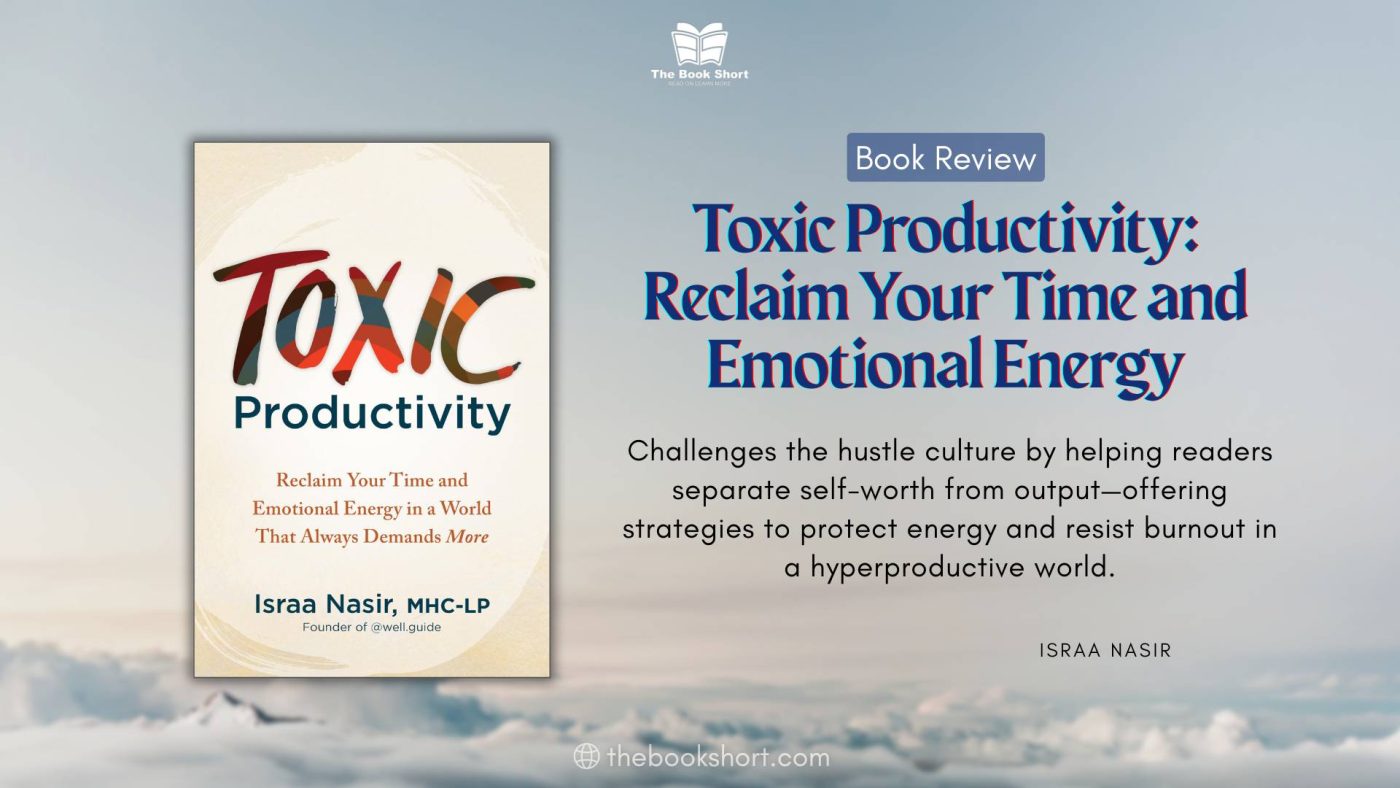
Feeling perpetually busy, yet achingly unfulfilled? This book review of Toxic Productivity by Israa Nasir is a compassionate guide to finding your way back to yourself. In a world saturated with “hustle culture” mantras, Nasir’s work is a breath of fresh air, offering a therapeutic path to reclaiming your time and emotional energy. This book was chosen for review because it dares to look past simple time-management hacks, digging deep into the psychological roots of why we feel compelled to be productive at our own expense. Its profound value lies in its seamless blend of clinical insight and actionable self-care, making it an essential manual for anyone feeling trapped on the hamster wheel of modern work.
Toxic Productivity: A Quick Book Overview
- Title: Toxic Productivity: Reclaim Your Time and Emotional Energy
- Author: Israa Nasir, M.S., LPC, NCC (Licensed Psychotherapist)
- Year of publication: 2023
- Genre: Self-Help, Psychology, Personal Development
- Number of pages: 256 pages
- Target audience: Professionals, students, creatives, high-achievers, and anyone feeling crushed by the pressure to be constantly “on.” It’s particularly resonant for millennials and Gen Z navigating the pressures of hustle culture and those healing from burnout.

Toxic Productivity: Reclaim Your Time and Emotional Energy in a World That Always Demands More
Toxic Productivity Book Summary: Core Concepts & Strategies
Israa Nasir’s Toxic Productivity is less a self-help book and more a therapeutic lifeline. It diagnoses the modern affliction of burnout culture with profound empathy, then provides a clear, compassionate roadmap to recovery. The book is structured to first guide you through understanding the problem’s deep-seated roots, then equips you with practical strategies to dismantle it in your own life.
Part 1: Understanding the “Why” Behind Our Burnout
The book’s initial section lays the groundwork by dissecting the concept of toxic productivity and its origins. Nasir argues that it’s far more than just working long hours; it’s a deeply ingrained belief system that dangerously links our self-worth directly to our output.
- What is Toxic Productivity? Nasir defines it as an obsessive, anxious need to be productive at all times, which triggers guilt and unease during any moment of rest. Key symptoms include:
- The nagging feeling that you’re “lazy” or useless when not actively working.
- Instinctively prioritizing work over your health, relationships, and personal joy.
- An inability to relax without feeling like you need a “purpose” or goal.
- Viewing rest not as a necessity, but as a reward that must be earned.
- The Societal and Psychological Roots: Nasir masterfully untangles the external and internal forces that fuel this state.
- External Pressures: She critiques late-stage capitalism, the instability of the gig economy, and the curated perfection of social media for creating a hyper-competitive environment where “the hustle” is glorified. The endless comparison on platforms like LinkedIn and Instagram fosters a pervasive fear of falling behind.
- Internal Pressures: Drawing from her clinical expertise, Nasir connects toxic productivity to our deepest psychological patterns, including perfectionism, imposter syndrome, and even unresolved trauma. She reveals how, for many, staying perpetually busy becomes a coping mechanism—a sophisticated way to avoid confronting difficult emotions, anxieties, or a fragile sense of self-worth.
Part 2: The Cycle of Guilt and the Cost of “Hustle”
This section explores the destructive cycle that toxic productivity perpetuates and its devastating toll on our mental, emotional, and physical health.
- The Guilt-Productivity Loop: Nasir masterfully breaks down the vicious cycle: We push ourselves to the brink of exhaustion, finally feeling we’ve “earned” the right to rest. But the moment we stop, an overwhelming wave of guilt washes over us, whispering that we’re being lazy and falling behind. This guilt becomes the fuel that drives us back to work, often before we’re truly recovered, thus locking us into a spiral that leads directly to burnout.
- The True Cost: The author unflinchingly outlines the severe consequences of this way of life:
- The crushing weight of burnout: A state of profound emotional, physical, and mental exhaustion caused by prolonged, unmanaged stress.
- The shadow of anxiety and depression: The relentless pressure and feelings of inadequacy become a breeding ground for serious mental health challenges.
- The erosion of identity: When our entire self-concept is wrapped up in what we do, we lose touch with who we are outside of our professional roles. Hobbies, passions, and relationships wither from neglect.
- The rebellion of the body: Chronic stress manifests physically through headaches, digestive turmoil, a compromised immune system, and persistent sleep problems.
Part 3: Reclaiming Your Time, Energy, and Self
The final and most empowering section of the book is a toolkit for liberation. Nasir emphasizes that the goal is not to become lazy or unambitious, but to cultivate a healthier, more sustainable, and more human relationship with work and ourselves.
- Redefining Productivity and Success: The first step is a radical and necessary mindset shift. Nasir guides readers to consciously uncouple their worth from their output and to forge a personal definition of a “successful life” that prioritizes joy, connection, well-being, and authentic rest.
- The Power of Boundaries: This is the cornerstone of her recovery plan. She provides practical, easy-to-use scripts and strategies for setting and holding firm boundaries:
- At Work: Learning to say “no” to non-essential tasks, logging off on time without guilt, and refusing to let work emails colonize your personal hours.
- Socially: Protecting your emotional energy from draining people and obligations.
- Personally: Scheduling non-negotiable time for true rest and hobbies, and honoring that commitment as you would a critical work meeting.
- Embracing Intentional Rest: Nasir brilliantly distinguishes between passive rest (like doomscrolling on the couch) and truly active, restorative rest. She champions scheduling diverse forms of rejuvenation—creative, social, spiritual, and physical—to holistically recharge. Rest is reframed not as a luxury or a prize, but as a fundamental human right and a biological imperative.
- Practicing Self-Compassion: As an antidote to the harsh inner critic that drives toxic productivity, Nasir introduces powerful techniques rooted in self-compassion. This means learning to treat yourself with the same kindness and understanding you’d offer a dear friend, especially in moments of perceived failure or unproductivity. This practice is the key to finally breaking the guilt cycle for good.
Throughout the book, Nasir embeds reflective journal prompts, anonymized client stories, and practical exercises, making the journey from understanding to implementation feel supported, gentle, and profoundly achievable.
In-depth Book Analysis of Toxic Productivity by Israa Nasir
Israa Nasir’s Toxic Productivity enters a crowded conversation about burnout, yet it carves out its own essential space through its therapeutic depth, compassionate voice, and unflinching look at the systems that fuel our collective exhaustion.
Structure and Key Arguments
The book’s genius lies in its structure, which mirrors a therapeutic arc: it starts with diagnosis (defining the problem), moves to psychoeducation (understanding the roots), and culminates in a treatment plan (actionable strategies). This logical and empathetic progression makes a complex and emotionally charged topic feel manageable, preventing the reader from feeling blamed or overwhelmed.
Nasir’s central argument is powerful and twofold. First, that toxic productivity is not a personal moral failing but a systemic issue, born from a culture that glorifies exhaustion and monetizes our every moment. Second, that the antidote isn’t a better planner or a new productivity app, but a radical act of self-reclamation through boundaries, intentional rest, and fierce self-compassion. She posits that true productivity is sustainable, and sustainability is impossible without honoring our fundamental human need for rest and meaning beyond our to-do lists. Unlike books that just offer tips to “work smarter,” Nasir compels us to ask the far more important question: “Why do I feel this compulsive need to work so hard in the first place?”
Writing Style and Content Quality
Nasir’s writing is a rare alchemy of professional authority and genuine warmth. As a licensed psychotherapist, she grounds her advice in established psychological principles and clinical evidence, giving the book unshakeable credibility. Yet, she masterfully avoids dense, academic jargon, choosing instead a clear, accessible, and deeply human voice that speaks directly to the reader’s lived experience.
The content quality is exceptional. By weaving in anonymized case studies from her clinical practice, she transforms abstract concepts like the “guilt-productivity loop” into tangible, relatable stories. This narrative approach fosters a sense of profound connection; you feel not lectured, but deeply seen and understood. The inclusion of journal prompts and reflective exercises elevates the book from a passive read into an interactive workbook, inviting you to actively engage in your own healing and self-discovery.
What truly sets this book apart is its compassionate core. Nasir’s tone is consistently gentle and validating. She recognizes the deep shame and guilt that often accompany burnout and meets the reader in that vulnerable space, offering reassurance that choosing rest is not a sign of weakness, but an act of profound strength and resistance in a world that demands our constant motion.
Personal Evaluation and Expert Review
Toxic Productivity: Reclaim Your Time and Emotional Energy is more than a book; it’s a timely and deeply necessary intervention in our burnout-addled culture. It provides not just solace and validation but a clear, actionable path toward a more humane way of living.
Personal Impressions:
From a professional standpoint, the book’s greatest asset is its therapeutic foundation. Israa Nasir is not a productivity guru or a life coach—she is a mental health clinician, and her expertise shines through on every page. Her advice is nuanced, psychologically sound, and prioritizes long-term well-being over the empty promise of short-term “hacks.” The relentless focus on self-compassion is especially transformative, as it directly targets the internal shame that so often prevents people from taking the rest they desperately need.
The book’s structure—from diagnosis to treatment—is brilliantly effective. It validates the reader’s struggle before asking them to change, a crucial step in any successful behavioral shift. The practical exercises and boundary-setting scripts are invaluable, turning abstract ideas into concrete, confidence-building actions.
If there’s a minor critique, it’s that some of the foundational concepts might feel familiar to those already immersed in anti-hustle discourse. However, Nasir’s unique and vital contribution is her ability to connect these broad societal trends to individual psychological wiring, offering a resonant “why” that many other books in the genre miss.
Readability and Target Audience:
The book is exceptionally readable. Nasir’s prose is clear, empathetic, and free of clinical jargon, making it accessible to a wide audience. The shorter chapters, punctuated by case studies and bulleted lists, make the information easy to digest—even for a mind clouded by the brain fog of burnout.
This book is perfectly suited for:
- Millennials and Gen Z: Generations disproportionately affected by the gig economy and the relentless pressure of social media performatism.
- High-Achievers and Perfectionists: Those who have deeply entangled their identity and self-worth with their accomplishments.
- Anyone Experiencing Burnout: If you feel exhausted, cynical, and detached, this book will feel like a conversation with a wise and caring friend.
- Managers and Leaders: It offers indispensable insights into fostering healthier, more sustainable, and more human team cultures.
Practical Value:
The practical value of this book is immense. A reader who truly engages with the material will walk away with a life-altering transformation, including:
- A Renewed Mindset: The ability to finally unhook their self-worth from their productivity and define success on their own terms.
- A Practical Toolkit: Concrete, proven strategies for setting boundaries, scheduling restorative rest, and silencing the inner critic.
- Profound Self-Awareness: A deeper understanding of their personal triggers for toxic productivity, whether they stem from societal pressure, family history, or internal anxieties.
Ultimately, Toxic Productivity is a manual for reclaiming your own life. It offers the permission slip so many of us have been waiting for—permission to slow down, to rest without guilt, and to build a more intentional, joyful, and sustainable existence.
Comparison with Similar Self-Help Books
While Toxic Productivity is a powerful standalone read, its unique contribution becomes even clearer when compared to other key books in the wellness and anti-hustle space.
- Compared to Burnout: The Secret to Unlocking the Stress Cycle by Emily and Amelia Nagoski: The Nagoski sisters focus brilliantly on the biology of stress, explaining what happens in our bodies and how to “complete the stress cycle.” Nasir’s book is the perfect psychological companion. While Burnout explains the physiological “what,” Toxic Productivity provides the therapeutic “why”—the deep-seated societal and psychological pressures that create the unrelenting stress in the first place.
- Compared to Rest Is Resistance: A Manifesto by Tricia Hersey: Tricia Hersey, founder of The Nap Ministry, frames rest as a radical political act of social justice and resistance against oppressive systems. Hersey’s work is the powerful, declarative “manifesto.” Nasir’s book, while acknowledging these crucial systemic issues, serves as the practical, therapeutic “manual” for individual healing and implementation within that larger context.
- Compared to Essentialism: The Disciplined Pursuit of Less by Greg McKeown: Essentialism is about strategically focusing your energy to achieve high-impact results—it helps you optimize your work. Toxic Productivity questions the very foundation of that goal, asking, “Why do you feel the need to achieve high-impact results at the cost of your well-being?” While Essentialism helps you perfect your lane, Toxic Productivity helps you build a rich, fulfilling life far beyond it.


If you liked Toxic Productivity, you might also enjoy:
- Burnout: The Secret to Unlocking the Stress Cycle by Emily and Amelia Nagoski, for a scientific deep-dive into the physiology of stress.
- Laziness Does Not Exist by Dr. Devon Price, for a sociological and psychological deconstruction of the myths that drive our guilt around rest.
- How to Do Nothing: Resisting the Attention Economy by Jenny Odell, for a philosophical and artistic meditation on reclaiming your attention as an act of resistance.
Conclusion and Final Recommendations
In a world drowning in hustle culture, Israa Nasir’s Toxic Productivity: Reclaim Your Time and Emotional Energy is the lifeline we desperately need. Its singular value lies in its compassionate, therapeutic approach, which moves beyond superficial hacks to heal the deep-seated wounds that tie our self-worth to our output. By masterfully blending clinical insight with gentle, actionable advice, Nasir provides not just a diagnosis for our collective burnout, but an effective, life-affirming treatment plan.
Is it worth reading?
Absolutely. For anyone feeling trapped in a relentless cycle of busyness, guilt, and exhaustion, this book isn’t just “worth reading”—it is essential reading. It is a guide back to a more balanced, sustainable, and joyful way of being.
Who should read it?
This book is a must-read for overworked professionals, overwhelmed students, burnt-out creatives, and anyone who has ever looked in the mirror and felt that their best was still not good enough. It is a powerful tool for unlearning the toxic narratives of our culture and reclaiming your fundamental right to rest.
Have you read this book or are you struggling with toxic productivity? Share your thoughts and experiences in the comments below.