
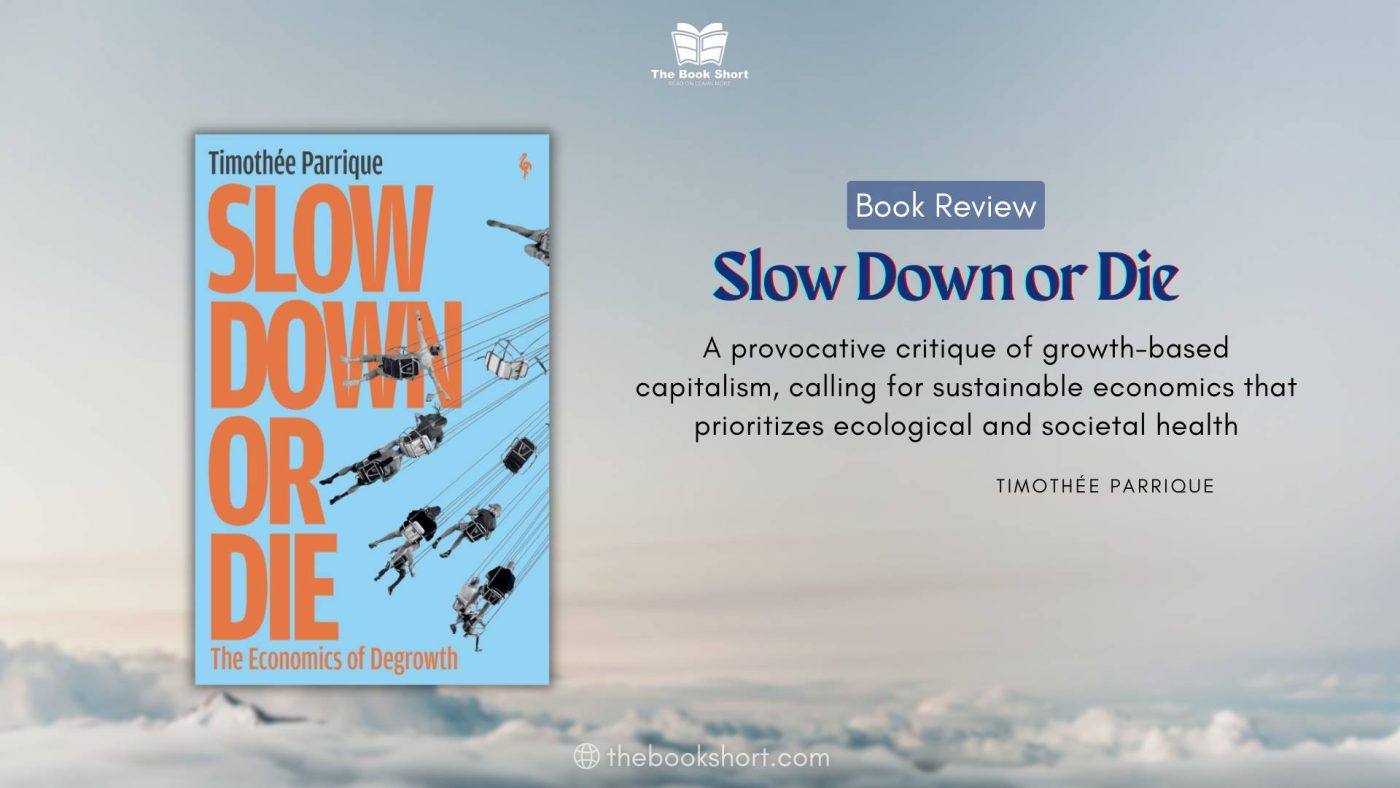
Ready to challenge the gospel of growth? This book dismantles the world’s dominant economic myths with razor-sharp wit and searing urgency, offering a radical yet profoundly hopeful vision for our collective future. I chose Slow Down or Die for this review because it achieves something remarkable: it transforms the complex, often intimidating concept of degrowth into an accessible, compelling, and utterly essential conversation. Its unique fusion of academic rigor and punchy, charismatic prose forces us to confront uncomfortable truths while inspiring a powerful sense of agency and hope.
Book Information at a Glance: A Quick Slow Down or Die Book Summary
- Title: Slow Down or Die: The Myth of Green Growth and the Birth of a New Economy (Original French title: Ralentir ou périr. L’économie de la décroissance)
- Author: Timothée Parrique
- Year of publication: 2022 (French), 2024 (English translation)
- Genre: Non-fiction, Economics, Environmentalism, Political Science
- Number of pages: Approx. 400 pages (varies by edition)
- Target audience: Students, activists, policymakers, and any reader seeking coherent alternatives to a growth-obsessed economy and grappling with the climate crisis.

Slow Down or Die: The Economics of Degrowth
A Comprehensive Summary of Slow Down or Die’s Main Content
Timothée Parrique’s Slow Down or Die is a methodical and merciless dismantling of the ideology of economic growth, followed by a passionate and constructive case for its only viable alternative: degrowth. The book is brilliantly structured to first tear down the old, failing paradigm before building a coherent and inspiring vision of a post-growth world.
Part 1: Deconstructing the Idol of Growth
Parrique opens by framing economic growth not as a neutral engine of progress, but as a quasi-religious dogma that holds modern society in a death grip. He argues that the mantra of “growth-for-growth’s-sake” has become an unassailable truth, pursued by politicians across the spectrum, even as the evidence of its catastrophic ecological and social consequences mounts.
The Dangerous Illusion of Green Growth
The centerpiece of Parrique’s demolition project is his takedown of “green growth”—the seductive promise that we can expand our economies indefinitely while reducing our environmental footprint through technology and efficiency. He meticulously exposes this idea as a comforting but lethal fantasy.
- The Decoupling Mirage: Parrique presents overwhelming evidence that “absolute decoupling”—where GDP grows while total environmental pressures fall—has never been achieved on a global scale and remains a statistical ghost. While some wealthy nations achieve relative decoupling (e.g., lower emissions per dollar of GDP), their total consumption, resource use, and ecological impact continue to climb.
- The Jevons Paradox: He vividly explains how efficiency gains often backfire, leading to more overall consumption. A fuel-efficient car doesn’t just save gas; it makes driving cheaper, encouraging more trips and longer commutes, ultimately erasing the environmental gains.
- Problem-Shifting: So-called “green” technologies often just move the environmental damage elsewhere. Electric vehicles, for example, eliminate tailpipe emissions but demand colossal mining operations for lithium, cobalt, and copper, spawning new sacrifice zones and social crises across the globe.
- The Religion of Tech-Solutionism: Parrique contends that betting our planet’s future on hypothetical technologies that don’t yet exist is a form of collective delusion. We cannot base our survival strategy on a miracle cure that may never arrive.
Part 2: Defining Degrowth and Dispelling the Myths
Having established that our current trajectory is a dead end, Parrique introduces degrowth. He is painstakingly precise in defining what degrowth is and, critically, what it is not. This section is dedicated to clearing away the fog of misconceptions that typically plagues this conversation.
What Degrowth is NOT:
- It is not a recession: A recession is a chaotic, unjust, and unplanned contraction of the economy within a system designed for growth. It is a catastrophic failure mode that creates unemployment and misery.
- It is not austerity: Austerity is the political choice to slash public services and social safety nets, forcing hardship on the most vulnerable to feed the engine of economic competition.
- It is not a Luddite retreat: Degrowth does not mean abandoning all technology or living in caves. It means being selective and democratic about which technologies we develop and deploy, focusing on those that genuinely enhance human and ecological well-being.
What Degrowth IS:
Parrique defines degrowth as a planned, democratic, and equitable downscaling of production and consumption to bring society back into balance with the living world. It is a deliberate pivot toward a new economic paradigm guided by different values.
- Planned & Democratic: The transition cannot be left to market chaos or imposed by authoritarian decree. It must be navigated through robust public debate and democratic decision-making.
- Equitable: The “slowing down” must start with the hyper-consuming Global North and the wealthiest individuals who are overwhelmingly responsible for ecological overshoot. Degrowth is fundamentally a project of justice, aimed at reducing inequality both within and between nations.
- Focused on Well-being: The ultimate goal is not simply to shrink, but to recalibrate. It means intentionally growing what matters most—well-being, community connection, public health, leisure time, and ecological health—while shrinking what is destructive, wasteful, and superfluous.
Part 3: The Degrowth Project: A Vision for a Post-Growth Society
In the book’s final act, Parrique moves from critique to construction. He lays out the policies, values, and social structures that could serve as the foundation for a degrowth society. He presents this not as a rigid, one-size-fits-all blueprint, but as a “constellation” of interconnected and mutually reinforcing ideas.
Key Policy Proposals:
- Universal Basic Services: Decommodifying the essentials of a good life by guaranteeing everyone access to high-quality healthcare, education, housing, and public transit.
- Job Guarantee & Radical Work-Time Reduction: A public job guarantee would offer meaningful employment in socially vital sectors (like ecological restoration, elder care, and community arts), while a dramatic reduction in the standard work week (to 30 hours or less) would distribute available work, combat unemployment, boost well-being, and curb consumerism.
- Progressive Taxation: Implementing steep taxes on wealth, inheritance, and carbon emissions to finance the transition, dramatically reduce inequality, and rein in luxury consumption.
- Resource and Impact Caps: Setting firm, democratically agreed-upon limits on material extraction and waste to ensure human activity operates within planetary boundaries.
- Nurturing the Commons: Expanding shared, non-market ways of meeting needs—from tool libraries and community gardens to open-source software and digital archives—to reduce the relentless pressure for individual ownership and consumption.
Parrique concludes with a powerful reframing: degrowth is not a politics of sacrifice, but a politics of liberation. It offers an escape from the frantic treadmill of consumerism, the gnawing precarity of the modern job market, and the background hum of climate anxiety. It is a vision of a slower, richer, and more meaningful life on a thriving planet.
In-depth Analysis: Themes and Arguments in Slow Down or Die
Timothée Parrique’s Slow Down or Die is far more than an environmental treatise; it’s a sharp, witty, and intellectually formidable manifesto that elevates degrowth from a fringe academic curiosity to an urgent and credible political project. Its power lies in its defiant tone, its logical structure, and its relentless focus on tearing down the myths that protect the status quo.
Key Arguments and Structure
Parrique’s core argument is devastatingly simple: infinite physical growth on a finite planet is a logical absurdity and a biophysical impossibility. He brilliantly structures the book as a one-two punch. First, he acts as a demolition expert, taking a sledgehammer to the load-bearing walls of the “green growth” narrative. Using clear data and inescapable logic, he exposes the fallacies of decoupling, proving it’s a fantasy that allows policymakers to avoid confronting the fundamental conflict between GDP accumulation and ecological survival. This deconstruction is vital; it closes the convenient escape hatch of techno-optimism.
Second, he begins to rebuild. Parrique knows that critique is not enough; you must offer a compelling alternative. His vision of degrowth is not one of grim austerity but of a vibrant, equitable, and democratic reorientation of our collective purpose. By framing it as a “project” built on tangible policies like universal basic services and work-time reduction, he shifts the conversation from a moralistic “should we?” to a pragmatic “how do we?”. This constructive turn is what makes the book a true catalyst for change, moving beyond despair toward a tangible, if radical, horizon.
Writing Style & Content Quality
Perhaps the most astonishing quality of Slow Down or Die is its style. Parrique masterfully sidesteps the dry, jargon-choked prose that renders most economic writing inert. Instead, his voice is:
- Accessible and Punchy: He wields sharp metaphors (the economy is a car hurtling toward a cliff while its occupants debate the ethics of the leather seats), cutting humor, and a direct, almost conversational tone. This makes abstract concepts like the Jevons Paradox not only understandable but memorable for a general audience.
- Academically Rigorous: For all its stylistic flair, the book rests on a bedrock of solid economic and ecological research. As a trained economist, Parrique meticulously substantiates his claims with data and citations, giving his polemic undeniable intellectual weight. This is not a rant; it’s a meticulously constructed, evidence-based indictment.
- Passionate and Urgent: The text vibrates with an urgency that is both alarming and infectious. Parrique is no detached academic observer; he is an impassioned advocate who believes humanity’s future hangs in the balance. This moral conviction animates the entire book and serves as a powerful call to arms.
This masterful blend sets the book apart. While Jason Hickel’s Less is More provides a deeper historical and anthropological context, and Kate Raworth’s Doughnut Economics offers an elegant new metric for success, Parrique’s book excels as the definitive, myth-busting introduction to the political economy of degrowth. It is a book designed to persuade, provoke, and mobilize.
Notable Quotes from the Book
Parrique’s prose is filled with memorable lines that distill his arguments:
“Green growth is an alligator in a tuxedo: no matter how elegantly it is dressed, it remains a dangerous predator.”
This quote perfectly captures his dismissive and critical stance on the promises of green capitalism, using humor to make a sharp point.
“Degrowth is not about wanting less, but about wanting what is truly enough to live well.”
This re-frames the narrative of sacrifice, positioning degrowth as a pursuit of qualitative richness over quantitative excess.
“We are addicted to growth, and the first step to recovery is admitting we have a problem.”
This metaphor of addiction powerfully illustrates society’s irrational and self-destructive pursuit of GDP growth, framing the necessary change as a process of collective healing and recovery.
An Expert Personal Review and Evaluation of Slow Down or Die
Slow Down or Die is a jolt of intellectual electricity. It’s the kind of book that grabs you by the collar, shakes you out of your complacency, and fundamentally reconfigures how you see the world. Having navigated countless texts on climate and economics, I found Timothée Parrique’s approach exceptionally refreshing, potent, and, above all, necessary for this moment.
Advantages:
The book’s supreme strength is its electrifying clarity. Parrique possesses a rare gift for translating dense economic theory and ecological data into prose that is not only digestible but genuinely entertaining and persuasive. His relentless myth-busting is methodical and devastating. He anticipates every common objection to degrowth—”What about innovation?”, “Won’t it cause mass unemployment?”, “Is this just communism in disguise?”—and dismantles each one with logic, evidence, and a refreshing lack of patience for bad-faith arguments. This makes the book an indispensable tool for anyone seeking to understand and articulate post-growth ideas.
Moreover, its optimistic and constructive vision is a powerful antidote to climate despair. So much environmental literature leaves one feeling paralyzed by the scale of the crisis. While Parrique never downplays the severity of our predicament, his focus on a desirable degrowth future—one with more leisure, stronger communities, robust public services, and greater equality—is profoundly energizing. It transforms degrowth from a bitter pill into a compelling future worth fighting for.
Disadvantages (or, More Accurately, Challenges for the Reader):
The book’s greatest strength—its uncompromising radicalism—is also its highest barrier. Parrique’s proposals represent a frontal assault on the foundations of modern capitalism and consumer society. For readers deeply invested in or benefiting from the current system, his arguments may feel alien, threatening, or naively utopian. The book demands a profound paradigm shift, forcing you to question everything you’ve been taught about progress, success, and the good life. This is not a light read in terms of its intellectual and emotional weight; its power to provoke cognitive dissonance is a measure of its importance.
Readability and Target Audience:
For a book on economics, the readability is off the charts. Parrique has written a work perfectly suited for a university student, a seasoned activist, a curious professional, or a concerned parent. You don’t need an economics degree to grasp it; in fact, Parrique might argue that such a degree makes it harder to unlearn the dogma he so skillfully debunks.
This book is essential for:
- Anyone feeling betrayed by the empty promises of “green capitalism.”
- Climate activists looking for a robust economic critique to sharpen their arguments.
- Students of economics, sociology, and environmental studies seeking genuine alternatives.
- Policymakers and business leaders brave enough to look beyond the next quarter.
- Anyone who feels in their bones that there must be a better, saner way to live together.
Practical Value:
The practical value of Slow Down or Die is immense, first as a tool for personal re-education and then as a political catalyst. It equips you with the intellectual ammunition to confidently challenge the failures of our growth-dependent system. It fundamentally rewires your brain, replacing the metric of “more” with the much wiser metric of “enough.” After reading it, you begin to see the absurdity of the GDP-fetish everywhere—in news headlines, political speeches, and corporate advertising. It catalyzes a deep re-evaluation of what we value, pushing us toward sufficiency, community, and ecological sanity.
Slow Down or Die in Context: A Comparison with Similar Books
Slow Down or Die lands in a growing library of works challenging economic orthodoxy. Placing it in conversation with its peers reveals its unique contribution.
If you enjoyed Timothée Parrique’s direct and polemical style, you will likely appreciate:
- Less is More: How Degrowth Will Save the World by Jason Hickel: Hickel’s book is the anglophone world’s leading degrowth text and a perfect companion to Parrique’s. Where Parrique offers a punchy, myth-busting economic polemic, Hickel provides a sweeping historical and anthropological narrative. He traces the ideology of endless growth back to the enclosures and colonization, giving a deep philosophical grounding to our society’s broken relationship with the living world. Reading Hickel after Parrique adds profound historical context to the economic critique.
If you were drawn to the constructive, vision-building aspect of degrowth, consider:
- Doughnut Economics: Seven Ways to Think Like a 21st-Century Economist by Kate Raworth: While not explicitly a “degrowth” book, Raworth’s work is an indispensable ally. She provides a powerful new visual framework for a thriving economy: the “Doughnut.” The goal is to meet the needs of all people (the social foundation forming the Doughnut’s inner ring) without overshooting the limits of our planet (the ecological ceiling forming the outer ring). Her framework offers a clear destination for a post-growth economy, making it a perfect conceptual partner to Parrique’s policy-driven roadmap.
- The Future is Degrowth: A Guide to a World beyond Capitalism by Matthias Schmelzer, Andrea Vetter, and Aaron Vansintjan: This book offers a more academic and comprehensive survey of the degrowth movement. It explores the diverse intellectual currents within degrowth, its history, and its connections to other social movements. It serves as an excellent next step for readers wanting to graduate from Parrique’s fiery introduction to a more encyclopedic understanding of the field.


In essence, Slow Down or Die functions as a brilliant and incendiary gateway. It is arguably the most persuasive and accessible entry point into the degrowth conversation today, armed with the intellectual firepower and rhetorical flair needed to shatter mainstream complacency.
Conclusion & Recommendations: Is Slow Down or Die Worth Reading?
Slow Down or Die is not merely worth reading; it is vital and urgent reading for our historical moment. Timothée Parrique has crafted a work of rare force that is at once an incisive economic critique, a hopeful political manifesto, and a user’s guide to dismantling the most dangerous ideology of our time. Its profound value lies in its ability to make the radical seem entirely rational and the necessary seem finally achievable. It ruthlessly strips away the comforting fiction of “green growth,” forcing a clear-eyed confrontation with reality, yet does so with enough wit and vision to leave the reader energized rather than defeated.
Is it worth reading? Without a doubt. Whether you are a hardened skeptic or a hopeful convert, this book will challenge, enlighten, and arm you with the clarity and courage to engage in the most important debate of the 21st century.
Who should read it? Everyone. But most especially, it should be pressed into the hands of those in positions of power, those who feel a growing dread about the future, and the young people who will inherit the consequences of our current inaction. It is for anyone who is ready to stop bailing water and start steering the ship toward a safe and worthy harbor.
Have you read this book? Share your thoughts in the comments below.