
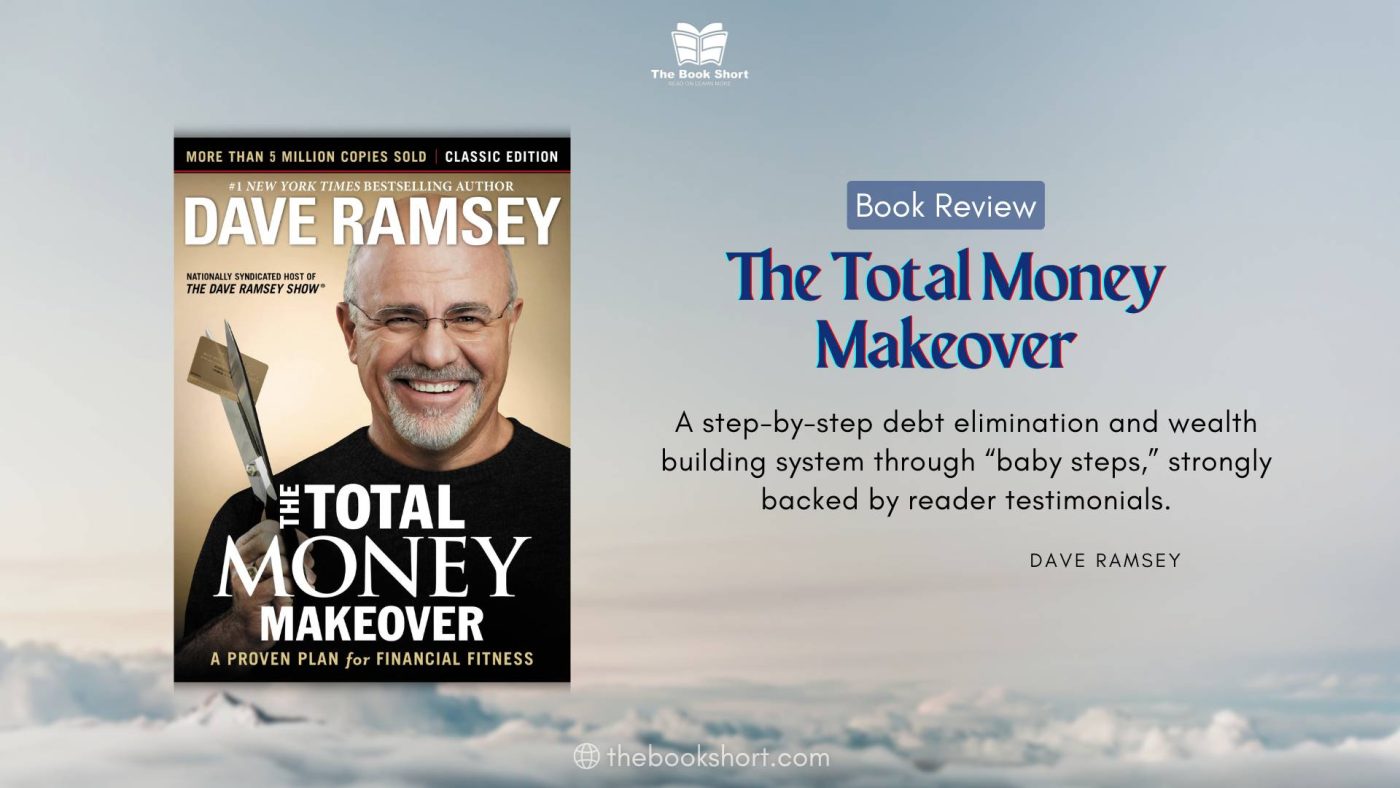
A no-nonsense plan to fix your finances. This book review and summary of The Total Money Makeover details Dave Ramsey’s 7 Baby Steps to financial freedom.
Are you drowning in debt and paralyzed by financial anxiety? Dave Ramsey’s The Total Money Makeover isn’t just a book; it’s a battle cry for anyone tired of the stress that comes with living paycheck-to-paycheck. We chose to review this modern classic because its power isn’t found in complex spreadsheets or risky investment schemes. Instead, it offers a brutally simple, behavior-driven plan that has guided millions toward financial peace. It’s a system designed to provide hope, deliver tangible wins, and inspire you to reclaim control of your future, one step at a time.
The Total Money Makeover: Book Details
- Full Title: The Total Money Makeover: A Proven Plan for Financial Fitness
- Author: Dave Ramsey
- Year of Publication: 2003 (Classic Edition), with subsequent updated editions.
- Genre: Personal Finance, Self-Help
- Number of Pages: Approximately 240 pages (varies by edition)
- Target Audience: Anyone drowning in debt, living paycheck-to-paycheck, or seeking a straightforward, disciplined framework to achieve financial stability and build lasting wealth.

The Total Money Makeover Updated and Expanded: A Proven Plan for Financial Peace
The Total Money Makeover Book Summary
Forget financial wizardry or secret formulas. The Total Money Makeover is a manual for changing your behavior with money. Dave Ramsey’s central argument is that personal finance is 80% behavior and only 20% head knowledge. The book is built around demolishing common money myths before methodically laying out his famous “7 Baby Steps.” The philosophy is deceptively simple: get out of debt with scorched-earth intensity, stay out of debt, and build wealth with patience and discipline.
Deconstructing Money Myths
Before unveiling his plan, Ramsey wages war on the cultural narratives that he argues keep people financially unwell. He relentlessly attacks the modern acceptance of debt, reframing it not as a tool but as a destructive product marketed to consumers.
- Debt Myths: Ramsey systematically dismantles the beliefs that a high credit score is a sign of wealth, that car payments are an unavoidable part of life, or that leveraging debt for investments is a smart move for the average person. He boils it down to a single, powerful maxim: “The borrower is slave to the lender.”
- Wealth Myths: He also confronts the misconception that wealth is an exclusive club for high-income earners or those who take big risks. Instead, he champions the slow, steady, and “un-sexy” path of disciplined saving and investing over decades.
The 7 Baby Steps to Financial Freedom
The undeniable heart of The Total Money Makeover is the 7 Baby Steps. Ramsey is adamant that they must be followed in their exact sequence to build the momentum necessary to rewire your financial habits.
Baby Step 1: Save $1,000 for a Starter Emergency Fund
This first step is a sprint, not a marathon. The goal is to sock away $1,000 in cash as quickly as humanly possible. This isn’t a true emergency fund; it’s a small buffer designed to stop life’s minor annoyances—a flat tire, a leaky faucet—from derailing your entire plan and sending you back into debt. It’s the small wall you build around your progress before you declare all-out war on your debts.
Baby Step 2: Pay Off All Debt (Except the House) Using the Debt Snowball
This is the most grueling, intense, and, for many, life-altering step. The method is the “Debt Snowball.” You list all your non-mortgage debts (credit cards, student loans, car loans) from the smallest balance to the largest, ignoring interest rates. You make minimum payments on everything except the smallest debt. You then attack that smallest debt with every spare dollar you can scrape together—by taking on extra work, selling everything that isn’t nailed down, and slashing your budget to the bone.
Once that smallest debt is gone, you take its payment (plus all the extra money you were throwing at it) and “roll” it onto the next-smallest debt. With each debt you eliminate, the payment “snowball” grows larger and more powerful, accelerating your progress. This is where Ramsey’s “behavior over math” philosophy shines. He champions this method over the “debt avalanche” (paying the highest interest rate first) because the quick psychological wins from knocking out small debts build the motivation needed to stay in the fight for the long haul.
Baby Step 3: Save 3 to 6 Months of Expenses in a Fully Funded Emergency Fund
With your consumer debts vanquished, you now channel the same energy and cash flow into building a robust financial shield. This fully funded emergency fund should cover three to six months of essential living expenses. It belongs in a liquid and easily accessible account, like a high-yield savings account, not invested in the market. This fund is your ultimate insurance policy against major life upheavals—a job loss, a medical crisis—ensuring you never have to rely on debt again.
Baby Step 4: Invest 15% of Your Household Income for Retirement
Once you are debt-free (except for the house) and have a full emergency fund, you’ve earned the right to build serious wealth. Ramsey’s directive is clear: invest 15% of your gross household income into tax-advantaged retirement accounts. He prescribes a specific order of operations:
- First, invest in your workplace 401(k) or 403(b) up to the full employer match.
- Next, max out a Roth IRA.
- Finally, if you still haven’t reached the 15% target, return to your 401(k) and contribute more until you do.
Baby Step 5: Save for Your Children’s College Fund
This step is tackled concurrently with Baby Step 4. Only after your own retirement savings are on track at 15% should you start putting money aside for your children’s education. Ramsey recommends tax-advantaged vehicles like 529 plans or Education Savings Accounts (ESAs).
Baby Step 6: Pay Off Your Home Early
With retirement and college savings humming along, it’s time to slay the final dragon: the mortgage. Every extra dollar you can find should be directed toward your mortgage principal. Becoming completely debt-free is the goal. Ramsey frames a paid-for home as the ultimate cornerstone of financial peace, freeing up your largest monthly expense and dramatically accelerating your ability to build wealth.
Baby Step 7: Build Wealth and Give Generously
This is the summit of the mountain. With no debts to your name, you have achieved true financial freedom. Your income is now entirely your own. You can invest aggressively, live generously, and leave a lasting legacy. Ramsey powerfully argues that the ultimate purpose of achieving financial fitness is not just to accumulate wealth, but to be in a position to give extravagantly and change the world around you.
In-depth Analysis of The Total Money Makeover
The enduring power of The Total Money Makeover lies not in groundbreaking financial theory, but in its mastery of human psychology and behavioral change. Its structure is intentionally crafted not just to inform, but to ignite a fire in the reader.
Structure, Arguments, and Key Themes
The “main character” of the book is you, the reader, whom Ramsey casts on a hero’s journey from “financially sick” to “financially fit.” The book’s structure is a rigid, linear path—the 7 Baby Steps—which is its greatest asset. It eradicates the paralysis of being overwhelmed by giving you one, and only one, objective to focus on at a time.
Key Arguments:
- Personal Finance is 80% Behavior: This is Ramsey’s core thesis. He argues that most financial problems are not knowledge problems; they are habit problems. This is why his debt snowball method (behaviorally potent) wins out over the debt avalanche (mathematically optimal).
- Debt is the Enemy, Not a Tool: Unlike many financial experts who see “good debt” and “bad debt,” Ramsey paints all debt with the same brush. It is a financial and moral anchor. By using visceral language (“the borrower is slave to the lender”), he creates an emotional aversion to it, simplifying financial decisions for his followers.
- “Gazelle Intensity” is Non-Negotiable: The plan demands radical, short-term sacrifice for long-term freedom. Ramsey calls this “gazelle intensity”—the focused panic a gazelle feels when a cheetah is in pursuit. This urgent, all-in approach is a key motivational lever he pulls throughout the book.
Writing Style & Content Quality
Ramsey’s voice is the engine of the book’s success. It is:
- Blunt and Accessible: He cuts through financial jargon with plain-spoken, conversational language. Reading it feels like getting tough-love advice from a wise, no-nonsense mentor.
- Rich with Anecdotes: The book is peppered with powerful testimonials from real people who have followed the plan. These “Debt-Free Screams” act as compelling social proof, making the reader believe, “If they can do this, so can I.”
- Intentionally Repetitive: Ramsey drills his core principles—”live like no one else, so later you can live like no one else,” “cash is king,” “debt is dumb”—into the reader’s mind. For some, it might feel redundant; for the target audience, this repetition is a powerful tool for cementing new beliefs.
- Faith-Infused: The book is undergirded by biblical principles, which deeply connects with his core Christian audience. While this can be a minor hurdle for some secular readers, the financial advice itself is universally applicable.
What truly sets it apart from other finance books is this unwavering focus on the how of behavior modification. While a book like I Will Teach You to Be Rich emphasizes automation, Ramsey is all about the manual, gritty, psychological work of digging yourself out of a deep hole first.
Notable Quotes from the Book
- “We buy things we don’t need with money we don’t have to impress people we don’t like.” – A piercing critique of consumerism.
- “Winning at money is 80 percent behavior and 20 percent head knowledge.” – The central thesis of the entire book.
- “Live like no one else so later you can live and give like no one else.” – The powerful mantra justifying short-term sacrifice for long-term freedom.
- “The borrower is slave to the lender.” – Ramsey’s simple, stark warning against all forms of debt.
- “A budget is telling your money where to go instead of wondering where it went.” – On the profound power of intentionality in personal finance.
Evaluation & Personal Review of The Total Money Makeover
Is The Total Money Makeover a good book? It’s more than that—it’s a powerful, and polarizing, financial intervention. Its incredible value lies in its ability to provoke immediate, decisive action in those who feel hopeless.
Advantages:
- Unrivaled Simplicity: The 7 Baby Steps provide a clear, unambiguous roadmap. For someone overwhelmed by financial chaos, this lack of ambiguity is a lifeline.
- Focus on Human Behavior: The book’s greatest insight is that for most people, the biggest obstacle isn’t math; it’s mindset. The Debt Snowball is the ultimate proof, prioritizing the motivational fuel of quick wins over cold, hard math—and for many, this is why it actually works.
- Intensely Motivational: Ramsey’s tone is a potent mix of preacher, drill sergeant, and encouraging coach. Combined with story after story of success, it generates a powerful sense of urgency and hope that can inspire radical, positive change.
Disadvantages:
- One-Size-Fits-All Rigidity: The plan’s strength is also its most criticized weakness. It leaves little room for nuance. For example, advising against all investing during Baby Step 2 means forgoing a 401(k) employer match, which is essentially turning down free money. His push to pay off a low-interest mortgage early is also debated by experts who argue those funds could yield higher returns in the market.
- Potentially Overly Optimistic Projections: Ramsey’s historical use of a 12% average annual return for stock market investments is considered highly optimistic by most contemporary financial planners and could lead to inadequate retirement planning if not adjusted.
Readability & Target Audience:
The book is exceptionally readable. Ramsey’s conversational style and compelling anecdotes make it feel less like a dry financial text and more like a motivational seminar you can’t put down.
This book is perfectly suited for:
- Anyone buried in consumer debt (credit cards, car loans, personal loans).
- Individuals and families living paycheck-to-paycheck with no emergency savings.
- Couples who fight constantly about money and desperately need a unified game plan.
- Anyone who feels lost and needs a simple, prescriptive guide to follow.
It is less suitable for the financially sophisticated individual who is already debt-free and is looking for advanced investment strategies, tax optimization, or nuanced financial planning.
Practical Value:
The practical value of this book is immense. It provides a concrete framework for budgeting (the zero-based budget), a proven strategy for debt elimination (the debt snowball), and a clear sequence for building wealth. But its true power lies in fundamentally rewiring your entire relationship with money, debt, and consumer culture. The discipline and intentionality it teaches are life skills that transcend finance.
Comparison with Similar Books
The Total Money Makeover carves out a unique and vital niche in the personal finance world by focusing almost exclusively on the emergency room care of debt elimination.
- vs. I Will Teach You to Be Rich by Ramit Sethi: Sethi speaks to a different audience and philosophy. He embraces automation, the responsible use of credit cards for rewards, and creating systems to build wealth with minimal daily effort. Ramsey is about intense, manual intervention to break bad habits; Sethi is about building smart, automated systems to make good habits effortless.
- vs. The Simple Path to Wealth by JL Collins: Collins’ book is essentially a brilliant, in-depth masterclass on Ramsey’s Baby Step 4. It provides the “why” and “how” behind a simple, powerful, low-cost index fund investing strategy. It serves as the perfect follow-up read for someone who has completed the first three Baby Steps.
- vs. The Millionaire Next Door by Thomas J. Stanley and William D. Danko: This book is the sociological proof behind Ramsey’s plan. It’s a research-based look at how real-world millionaires actually behave—living frugally, systematically avoiding debt, and investing consistently. It validates Ramsey’s principles with data.


If you were inspired by the no-nonsense, straightforward approach of The Total Money Makeover, you will likely also appreciate:
- The Millionaire Next Door by Thomas J. Stanley
- Retire Inspired by Chris Hogan (a Ramsey Solutions personality)
Conclusion & Recommendations
The outstanding, enduring value of The Total Money Makeover is its power to give a clear, actionable plan to people who feel like they’re drowning. It cuts through the paralyzing noise of financial advice and lasers in on the one thing that will make the biggest difference for most people: getting out of debt. Its prescriptive, step-by-step nature is a feature, not a bug, designed to lead you from chaos to control.
Is it worth reading? Absolutely. While specific points can be debated by financial nerds, the foundational principles—budgeting, living on less than you make, destroying debt, and saving for the future—are timeless. For anyone truly struggling with debt, this book isn’t just worth reading; it can be life-changing.
Who should read it? If you feel like you are losing the game of money—if you have credit card balances, car payments, student loans, and a persistent knot of financial anxiety in your stomach—this book was written specifically for you. It’s not just recommended; it’s essential.
Have you read The Total Money Makeover? Share your experience and thoughts in the comments below