
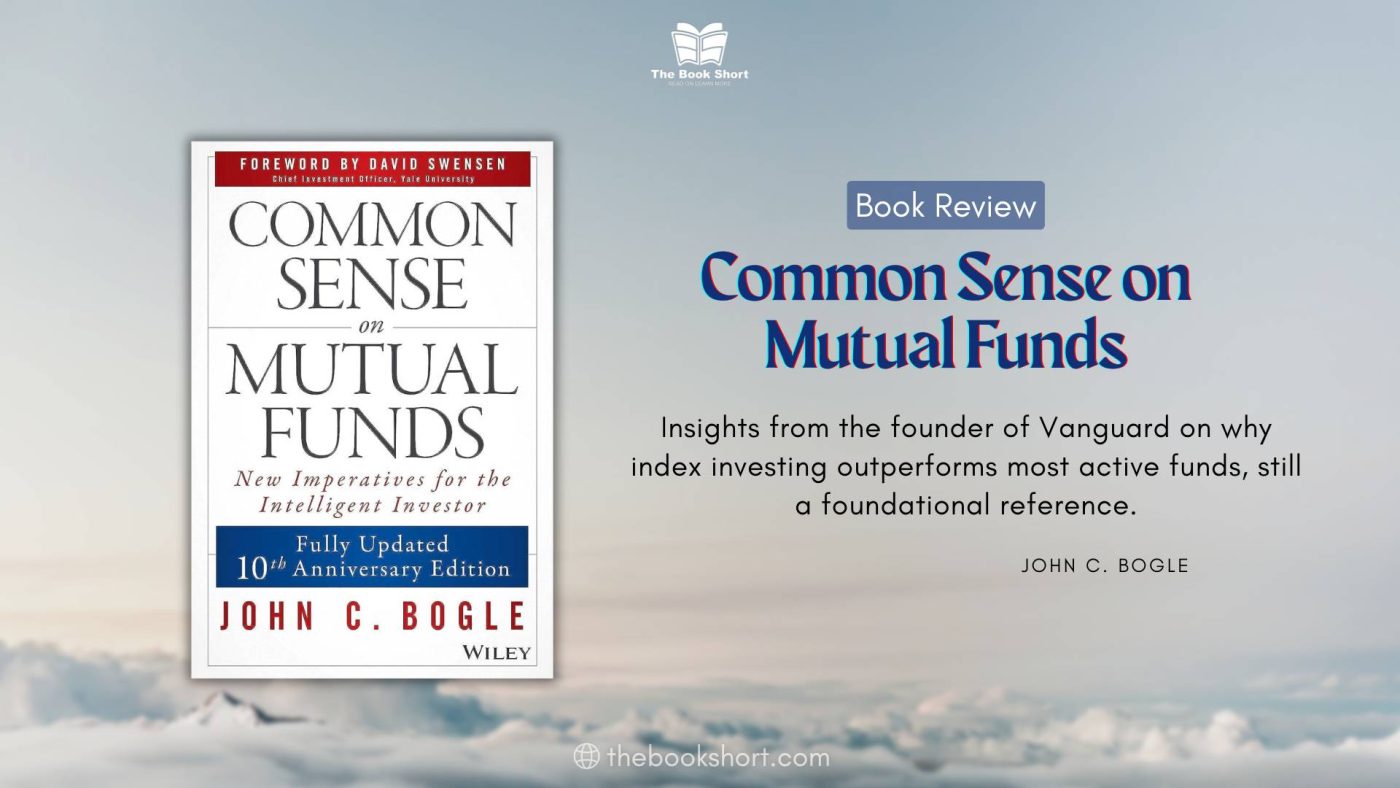
A must-read book summary of Common Sense on Mutual Funds. Discover John Bogle’s timeless, data-driven strategy for successful long-term investing.
In the world of investing literature, few books stand as tall or have sparked as profound a revolution as John C. Bogle’s Common Sense on Mutual Funds. This is not merely a guide; it’s a manifesto built on a simple, powerful, and evidence-backed philosophy that has fundamentally reshaped the landscape for the everyday investor. The book’s enduring genius lies in its irrefutable logic, a clear-sighted weapon that cuts through industry jargon and marketing noise to reveal an actionable path to building lasting wealth.
Basic Information: A Snapshot of Common Sense on Mutual Funds
- Title: Common Sense on Mutual Funds: New Imperatives for the Intelligent Investor
- Author: John C. Bogle
- Year of publication: 1999 (Updated in a 10th-anniversary edition in 2009)
- Genre: Finance, Investing, Personal Finance
- Number of pages: Approx. 600 pages (varies by edition)
- Target audience: Individual investors, financial advisors, and anyone interested in building long-term wealth through the stock market.

Common Sense on Mutual Funds: Fully Updated 10th Anniversary Edition
Main Content Summary of Common Sense on Mutual Funds
John C. Bogle’s Common Sense on Mutual Funds is a comprehensive and damning indictment of the conventional mutual fund industry. As the founder of The Vanguard Group, Bogle constructs a meticulous, data-driven case for an investment strategy rooted in simplicity, effectiveness, and, above all, low costs. The book’s central thesis is a game-changer: the single greatest enemy to long-term investment success is not market volatility, but the relentless drag of fees. With surgical precision, he dismantles the myth of active management and champions the passive index fund as the superior vehicle for the vast majority of investors.
Part I: The Problem with the Mutual Fund Industry
Bogle opens his case by diagnosing the core pathologies of the active management world. He persuasively argues that trying to beat the market through actively managed funds is a “loser’s game”—one where the collective efforts of all players mathematically guarantee underperformance for the group as a whole.
The Tyranny of Compounding Costs
The central pillar of Bogle’s argument is the devastating, inescapable impact of costs on long-term returns. He lays bare the brutal math, showing how seemingly small fees—expense ratios, trading commissions, and 12b-1 marketing fees—compound over decades to consume a shocking portion of an investor’s nest egg. An annual fee of 2% may sound trivial, but over a 40-year investment horizon, it can annihilate more than half of the portfolio’s potential value when compared to a low-cost alternative.
The Futility of Beating the Market
Bogle explains a simple, unassailable truth: for the market as a whole, the aggregate return is the market return. Once you subtract the substantial costs of active management (manager salaries, research, frantic trading), the net return for all investors must be less than the market return. It is a mathematical certainty. While a handful of managers might get lucky and beat the market in a given year, Bogle provides overwhelming historical data proving that the vast majority of actively managed funds fail to outperform their own benchmark index over any meaningful stretch of time.
Part II: The Common Sense Solution: Indexing
After deconstructing the flawed active management model, Bogle presents his beautifully elegant solution: the passive index fund. As the creator of the world’s first index fund for individual investors, his conviction and passion for the concept radiate from every page.
Buy the Haystack
Bogle’s most famous piece of advice is a brilliant analogy: “Don’t look for the needle in the haystack. Just buy the haystack!” Here, the “haystack” represents the entire stock market, and the tool for buying it is a broad-market index fund. An index fund doesn’t try to pick winners; it simply aims to replicate the performance of a market benchmark, like the S&P 500. Its profound advantages are:
- Dramatically Lower Costs: With no star manager or expensive research team, the expense ratios of index funds are a mere fraction of their active counterparts.
- Maximum Diversification: Owning a total market index fund means you own a small slice of thousands of companies, effectively eliminating the idiosyncratic risk of any single company failing.
- Superior Tax Efficiency: Index funds trade infrequently, resulting in low “turnover.” This minimizes the realization of taxable capital gains, a huge advantage for anyone investing outside of a retirement account.
- Ironclad Predictability: An index fund will never deliver spectacular outperformance, but crucially, it will never spectacularly underperform either. It reliably delivers the market’s return, minus a tiny, transparent cost.
Part III: A Practical Guide to Long-Term Investing
Bogle then shifts from theory to application, offering timeless wisdom on portfolio construction and the psychological discipline required for success.
The Importance of Asset Allocation
Bogle stresses that an investor’s most critical decision is not which individual stocks or funds to pick, but the strategic allocation of capital between major asset classes, primarily stocks and bonds. He argues this mix should be tailored to an investor’s age, risk tolerance, and financial horizon. For Bogle, a simple, balanced portfolio holding a total stock market index fund and a total bond market index fund is a nearly perfect strategy for most people.
Reversion to the Mean
He introduces the powerful statistical concept of “reversion to the mean,” a financial law of gravity suggesting that periods of exceptional performance are rarely sustainable. Hot funds of one era almost invariably cool off, becoming the laggards of the next. This serves as a powerful antidote to the destructive investor behavior of “chasing performance”—selling last year’s losers and piling into last year’s winners, a surefire way to buy high and sell low.
Stay the Course
Perhaps Bogle’s most vital message is behavioral. He implores investors to develop an iron will to ignore the market’s daily gyrations, the breathless hype of the financial media, and the primal urge to react to volatility. The “common sense” strategy is to create a sound plan, stick to it religiously, invest consistently, and let the quiet, inexorable power of compounding work its magic over decades.
In-depth Analysis of Common Sense on Mutual Funds
John Bogle’s Common Sense on Mutual Funds is more than an investment guide; it is a foundational text that established the moral, philosophical, and mathematical framework for the passive investing revolution. Its enduring power flows from its unassailable logic, fierce conviction, and the profound simplicity of its message.
Characters / Structure / Key Arguments
While the book lacks a traditional narrative, Bogle masterfully frames a central conflict between two opposing forces: the “prudent, long-term investor” on one side, and the “speculative, cost-heavy financial industry” on the other. The book itself is structured like a prosecutor’s closing argument. Bogle first establishes the crime (the “loser’s game” of active management), then presents an overwhelming mountain of evidence (decades of data, clear charts, and humble arithmetic), and finally delivers his verdict and solution: the low-cost index fund.
Bogle’s key arguments are powerful because they rest on basic math, not esoteric theory:
- Gross Return – Costs = Net Return: Bogle calls this the “relentless rule of humble arithmetic,” and it is the bedrock of the entire book. While you can’t control market returns, you can control costs—the one predictable factor that consistently erodes wealth.
- The Impossibility of Collective Outperformance: Before costs, the pool of all investors is the market and earns the market return. Therefore, after subtracting the high costs of active management, their collective net return must trail the market. This simple truth exposes the flawed premise of the active industry as a whole.
- The Wisdom of Owning the Market: Instead of embarking on the fool’s errand of identifying the few winning funds in advance, it is infinitely more rational to simply buy the entire market via an index fund and guarantee yourself a fair share of its long-term growth.
What sets this book apart is its crusading spirit. Bogle is not just a dispassionate analyst; he is a fierce advocate for the small investor, battling an industry he believes too often prioritizes its own profits over the well-being of its clients.
Writing Style & Content Quality
Bogle’s prose is direct, authoritative, and deeply persuasive. He masterfully avoids the dense jargon designed to intimidate and confuse, opting instead for clear language, powerful analogies (the “haystack”), and straightforward arithmetic that empowers the reader.
The quality of the content is unimpeachable. Every assertion is buttressed by extensive research, historical data, and compelling charts and tables. This evidence-based approach makes his case not just persuasive but nearly irrefutable. While some might find the relentless focus on costs repetitive, this repetition is a deliberate rhetorical strategy designed to hammer home the single most important lesson in investing until it is etched into the reader’s mind. The book is dense, yet its logical structure and clear divisions make it perfectly navigable. Bogle writes with the passion of a reformer and the rigor of a statistician—a combination that lends the work its unique power and credibility.
Notable Quotes from the Book
Bogle’s writing is studded with memorable aphorisms that distill his entire philosophy.
“The miracle of compounding returns is overwhelmed by the tyranny of compounding costs.”
This single sentence perfectly encapsulates the book’s central conflict: the magic of growth versus the destructive power of fees.
“Don’t look for the needle in the haystack. Just buy the haystack!”
This is perhaps his most famous line, a stroke of genius that makes the profound benefit of a total market index fund instantly understandable.
“The stock market is a giant distraction to the business of investing.”
Here, Bogle draws a critical line between patient, long-term “investing” (owning businesses for their fundamental value) and the manic, short-term “speculation” driven by market noise and price swings.
Evaluation & Expert Personal Review
Common Sense on Mutual Funds is, without a hint of hyperbole, one of the most important investing books ever written. Its impact on the financial industry and on the fortunes of millions of individual investors is immeasurable. It delivers not just a strategy, but a complete, coherent, and deeply empowering philosophy.
Advantages:
The book’s greatest strength is the raw power of its logic. Bogle’s arguments are not a matter of opinion or market timing; they are built on the immutable laws of arithmetic. This gives the reader unshakable confidence in the strategy. It is also profoundly practical, offering a clear, actionable plan that anyone can implement. By shifting the focus to what investors can control (costs, asset allocation, behavior) from what they cannot (the market’s whims), Bogle truly democratizes successful investing.
Disadvantages:
If there is a weakness, it lies in the book’s density and deliberate repetition. Bogle hammers his core themes from every conceivable angle. While this is highly effective, readers seeking a quick, breezy read may find the nearly 600 pages formidable. Furthermore, the strategy itself is, by design, “boring.” For investors conditioned by Wall Street to seek the thrill of the chase and the glory of “beating the market,” embracing this elegant simplicity can be a psychological challenge.
Readability and Suitability:
For such a substantial work, the book is remarkably readable. Bogle’s clarity makes it accessible even to a determined novice. At the same time, its depth and data-rich analysis make it essential reading for financial professionals and seasoned investors, many of whom would benefit from this powerful return to first principles. It is a must-read for anyone serious about building wealth over a lifetime.
Practical Value:
The practical value of this book is astronomical. An investor who absorbs its lessons early in life could literally add hundreds of thousands, if not millions, of dollars to their retirement portfolio compared to one who follows conventional, high-cost advice. The core tenets—minimize costs, diversify broadly, allocate assets wisely, and stay the course—are timeless. The book provides a powerful mental framework that serves as a bulwark against market panic, bad advice, and the seductive siren calls of financial marketing. It doesn’t just teach you how to invest; it fundamentally changes how you think about investing.
Comparison with Similar Books
While Common Sense on Mutual Funds is a cornerstone of any serious investing library, it shares shelf space with other essential reads.
It stands shoulder-to-shoulder with Burton Malkiel’s A Random Walk Down Wall Street. Both are titans of the evidence-based investing movement, arguing convincingly that consistently outperforming market averages is a statistical near-impossibility. Malkiel’s work offers a broader, more historical and academic tour of financial markets and theories, whereas Bogle’s is a more focused, passionate, and data-heavy polemic specifically targeting the mutual fund industry.


For readers who find Bogle’s magnum opus powerful but intimidating, its streamlined successor, John C. Bogle’s The Little Book of Common Sense Investing, is the perfect alternative. This much shorter book distills the essential arguments of its larger sibling into a more concise and accessible format, making it an ideal starting point for beginners.
For those intrigued by the behavioral challenges of Bogle’s “stay the course” mantra, Jason Zweig’s Your Money and Your Brain offers a fascinating exploration of the neuroscience behind financial decisions, brilliantly explaining why our own minds so often tempt us into making the worst possible moves with our money.
Conclusion & Recommendations: Is Common Sense on Mutual Funds Worth Reading?
Common Sense on Mutual Funds is an undisputed masterpiece of financial literature. Its supreme value lies in its ability to slice through the dense fog of complexity, jargon, and self-interest that shrouds the financial industry, illuminating the simple, powerful truth of arithmetic. Bogle provides an enduring, evidence-backed roadmap that empowers ordinary people to achieve extraordinary financial outcomes.
Is it worth reading? Absolutely. This is not a book to be merely read; it is a philosophy to be lived. For anyone committed to securing their financial future, the hours spent absorbing Bogle’s wisdom will likely yield the highest return of any investment they ever make.
Who should read it? Every single person who invests or plans to invest. From the college student opening their first Roth IRA to the seasoned investor managing a complex portfolio, Bogle’s insights are universal and indispensable. It ought to be required reading for every financial advisor on the planet.
Have you read this book? Share your thoughts and how it changed your investing approach in the comments below.