
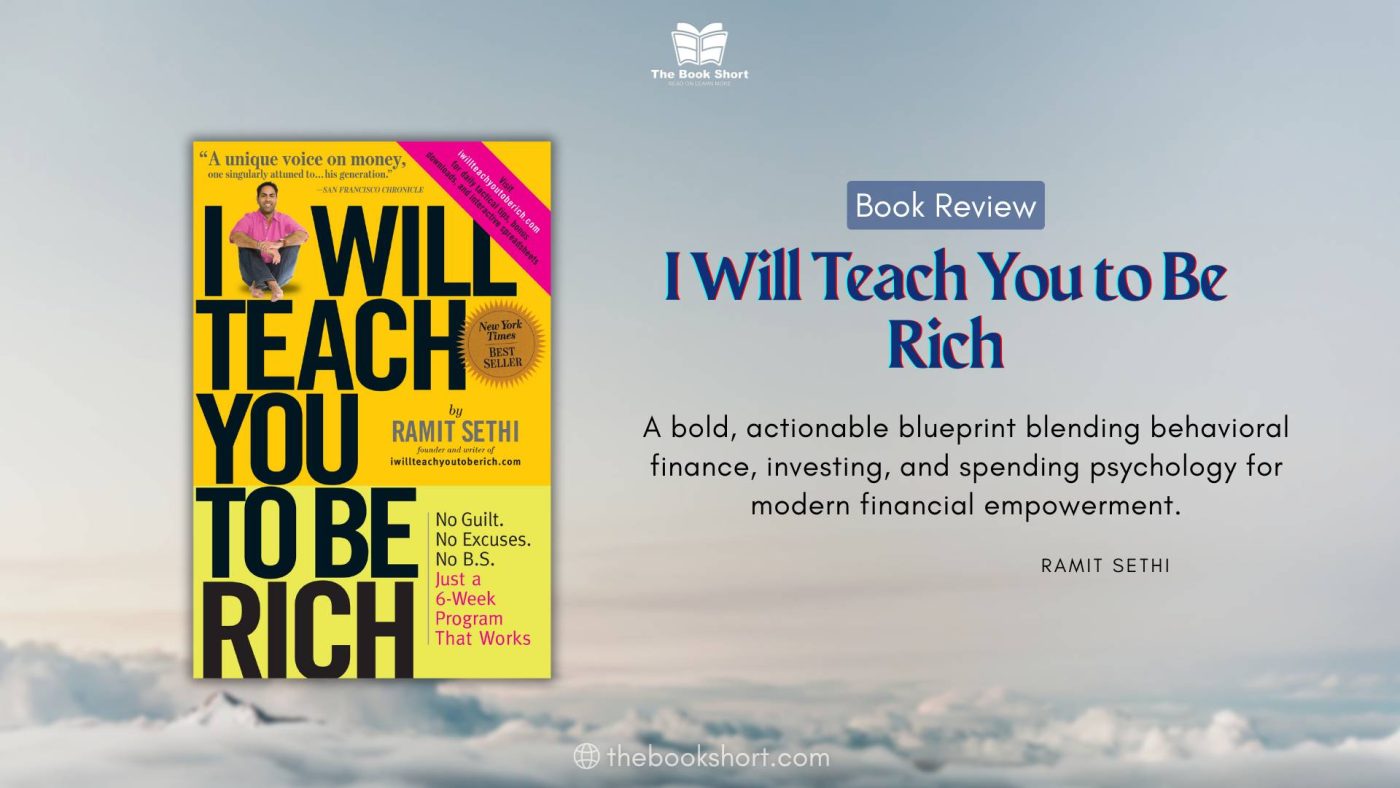
A no-nonsense book review of I Will Teach You to Be Rich, the ultimate guide to automating your finances, building wealth, and living your Rich Life.
Tired of financial advice that boils down to “stop buying lattes”? This in-depth analysis of Ramit Sethi’s I Will Teach You to Be Rich explores a radically different system for building wealth on your own terms. We’re diving into this book because of its refreshingly practical, no-guilt approach to personal finance. Its enduring power lies in a step-by-step, 6-week program that automates your money, freeing you to define and live your “Rich Life”—a concept that promises to fundamentally change how you think about your finances forever.
I Will Teach You to Be Rich: Book Facts at a Glance
- Title: I Will Teach You to Be Rich (Second Edition)
- Author: Ramit Sethi
- Year of publication: 2009 (First Edition), 2019 (Second Edition)
- Genre: Personal Finance, Self-Help
- Number of pages: 352 (Second Edition)
- Target audience: Millennials and Gen Z (ages 20-40) who want a practical, actionable system to manage their money, automate investments, and build long-term wealth without the guilt and restriction of traditional budgeting.

I Will Teach You to Be Rich: No Guilt. No Excuses. Just a 6-Week Program That Works (Second Edition)
A Comprehensive Summary of I Will Teach You to Be Rich
Ramit Sethi’s I Will Teach You to Be Rich is not another manual on get-rich-quick schemes or miserly penny-pinching. It’s a psychology-driven, pragmatic guide to designing a simple, automated financial system that builds wealth quietly in the background. The book is masterfully structured as a 6-week program, engineered to take you from a state of financial overwhelm to a streamlined system that runs on autopilot.
The Core Philosophy: Big Wins and Conscious Spending
Before unveiling his 6-week plan, Sethi lays down the foundational principles that distinguish him from the chorus of other financial gurus:
- Focus on Big Wins: Forget the financial noise of agonizing over $5 lattes. Sethi urges you to concentrate on five to ten “Big Wins” that have an outsized impact on your financial trajectory. These include automating investments, optimizing your credit, negotiating a salary increase, and slashing costs on major expenses like housing or transportation.
- The 85% Solution: Don’t let the quest for perfection become a form of procrastination. Sethi argues that getting started and being approximately right is infinitely better than doing nothing while searching for the “perfect” fund or strategy. The goal is to get 85% of the way there and move forward.
- Conscious Spending: Sethi boldly rejects traditional, restrictive budgets. In their place, he introduces the “Conscious Spending Plan.” This isn’t about what you can’t have; it’s about proactively deciding where you want your money to go. You’ll divide your income among four key areas: fixed costs, investments, savings, and guilt-free spending. The philosophy is simple yet revolutionary: spend extravagantly on the things you love, and cut costs mercilessly on the things you don’t.
The 6-Week Program: Your Step-by-Step Financial Overhaul
The heart of the book is its actionable 6-week program, designed to build your financial infrastructure from the ground up.
Week 1: Optimize Your Credit Cards
Sethi reframes credit cards not as debt traps, but as powerful tools for building wealth when used responsibly. He debunks the myth that all debt is evil, showing how strategic credit card use is the fastest path to an excellent credit score. A high score (760+) unlocks lower interest rates on life’s biggest purchases—cars and homes—potentially saving you tens of thousands of dollars.
- Action Steps:
- Pull your credit report for free to know where you stand.
- If you have high-interest debt, create a payoff plan, targeting the highest-interest-rate cards first (the “avalanche method”).
- Automate at least the minimum payment to ensure you are never late.
- Use the provided scripts to call and negotiate a lower Annual Percentage Rate (APR).
- Select a rewards card that aligns with your spending and pays you back for what you already buy.
Week 2: Beat the Banks
This week is dedicated to choosing the right accounts to stop losing money to fees and start earning meaningful interest. Sethi calls out big, traditional banks for their predatory fees and paltry interest rates.
- Action Steps:
- Open a high-yield savings account (HYSA) with a reputable online bank. These often offer interest rates 20-50 times higher than their brick-and-mortar counterparts.
- Find a checking account with no minimum balance and no monthly maintenance fees.
- Link your new accounts to create a seamless system for automated transfers.
Week 3: Get Ready to Invest
Sethi masterfully demystifies investing by focusing first on opening the right doors: your retirement accounts. This chapter is simply about setting up the accounts, not yet worrying about what to put in them.
- Action Steps:
- If your employer offers a 401(k) with a match, contribute enough to capture the full match. This is an instant 100% return on your money—it’s free.
- Open a Roth IRA, a powerful retirement account where your investments grow tax-free, and all withdrawals in retirement are also tax-free.
- He clearly explains the strategic advantage of using both accounts to build a tax-diversified nest egg.
Week 4: Create Your Conscious Spending Plan
Here, you finally design your personalized alternative to budgeting. You’ll analyze where your money is actually going and then create a forward-looking plan to direct it with intention.
- The Four Buckets:
- Fixed Costs (50-60% of take-home pay): Rent/mortgage, utilities, debt, groceries.
- Investments (10% of take-home pay): Automated contributions to your 401(k) and Roth IRA.
- Savings Goals (5-10% of take-home pay): For short-to-medium-term goals like a down payment, wedding, or dream vacation.
- Guilt-Free Spending (20-35% of take-home pay): The money you can spend on anything you want—dining out, hobbies, travel—with zero guilt.
Week 5: Save While You Sleep (Automation)
This chapter is the linchpin of the entire I Will Teach You to Be Rich system. Sethi provides a detailed, visual blueprint for automating your finances so your Conscious Spending Plan executes itself flawlessly each month.
- The Automated Money Flow:
- Your paycheck is direct-deposited into your checking account.
- On a set schedule, automatic transfers move money from your checking account to:
- Your 401(k) (deducted pre-tax by your employer).
- Your Roth IRA investment account.
- Your high-yield savings account(s).
- Your credit card balances (paid in full).
- Whatever remains in your checking account is your designated guilt-free spending money.
Week 6: The Myth of Financial Expertise
With your financial architecture built and automated, it’s finally time to select your investments. Sethi’s philosophy is liberating: you don’t need to be an expert, watch the market, or pick individual stocks.
- Key Investment Principles:
- Invest in low-cost index funds or target-date funds. These instruments provide instant diversification across the entire market, minimizing risk and historically delivering solid returns.
- Asset Allocation: He explains how to create a simple, age-appropriate portfolio, typically a mix of stock funds (for growth) and bond funds (for stability).
- Don’t time the market. The key to building wealth is consistency. Invest a set amount every single month (dollar-cost averaging) and remain invested for decades, ignoring the market’s dramatic mood swings.
In-depth Book Analysis of I Will Teach You to Be Rich
Ramit Sethi’s I Will Teach You to Be Rich has remained a perennial bestseller because it fundamentally reframes the cultural conversation around personal finance. It shifts the narrative from a place of scarcity and restriction to one of empowerment, intelligent automation, and intentional living.
Structure, Key Arguments, and Unique Approach
The book’s structure is its greatest genius. By organizing a daunting subject into a 6-week program, Sethi transforms financial management into a series of clear, sequential, and achievable steps. This “do this, then do that” methodology dismantles the analysis paralysis that keeps so many people stuck. Each chapter culminates in explicit action items, making it less of a book to be read and more of a workbook to be completed.
Key Arguments:
- Automation is Financial Freedom: The central thesis is that the most effective financial system is one you rarely have to think about. By automating savings, investments, and bill payments, you remove willpower and discipline—both finite resources—from the equation. This “save while you sleep” system is the book’s most powerful and revolutionary concept.
- Conscious Spending is Superior to Budgeting: Sethi’s dismissal of traditional budgeting is a radical departure from conventional wisdom. He understands the psychology of deprivation: telling people they can’t have something only intensifies their desire for it. His “Conscious Spending Plan” is an offensive strategy, not a defensive one. It empowers you to say an enthusiastic “yes” to what you value most, a far more motivating and sustainable path.
- Good Investing Should Be “Boring”: While the media sensationalizes stock picking and market timing, Sethi champions the opposite. He persuasively argues that for the vast majority of people, successful long-term investing should be simple, automated, and frankly, boring. His unwavering recommendation of low-cost, diversified index funds and a “set it and forget it” mindset demystifies a topic that needlessly intimidates millions.
Writing Style & Content Quality
Sethi’s writing style is a core element of the book’s magnetic appeal, especially to its target demographic of young adults.
- Conversational and Unfiltered: The tone is informal, witty, and unapologetically direct. He speaks to the reader like a sharp, no-nonsense friend or older sibling, using modern language and directly confronting common excuses. While his brashness can be polarizing, it’s a refreshing antidote to the dry, condescending tone of many financial texts.
- Action-Oriented Language: The book is packed with tangible tools, including word-for-word “scripts” for negotiating with banks and credit card companies. These scripts are brilliant because they bridge the chasm between knowing what to do and having the confidence to actually do it.
- Psychologically Grounded: Sethi masterfully weaves principles of behavioral psychology into every chapter. He addresses the invisible scripts and mental roadblocks that sabotage our finances—fear, guilt, anxiety, and inertia. He profoundly understands that managing money is far more about behavior than it is about spreadsheets.
The content quality is exceptional—it’s practical, well-researched, and updated for the modern economy in its second edition. It stands apart by providing not just the “what” and “why,” but the explicit “how.”
Notable Quotes from the Book
Several quotes perfectly capture the book’s ethos:
- “Spend extravagantly on the things you love, and cut costs mercilessly on the things you don’t.” This is the heart of Conscious Spending, a call for value-based decisions instead of joyless frugality.
- “The 85 Percent Solution: Getting started is more important than becoming an expert.” A powerful mantra against the analysis paralysis that keeps people from ever investing or optimizing their finances.
- “There is a limit to how much you can cut, but there is no limit to how much you can earn.” This highlights Sethi’s focus on playing offense (earning more, negotiating) over a purely defensive strategy (cutting small costs).
Personal Review and Evaluation of I Will Teach You to Be Rich
For the right person, I Will Teach You to Be Rich is one of the most powerful and life-changing personal finance books ever written. Its lasting impact comes not from platitudes, but from a concrete system that works in the messy reality of modern life, not just in a spreadsheet.
Advantages:
- Supremely Actionable: The 6-week program provides a clear, sequential roadmap. It is one of the very few finance books where you can finish a chapter and immediately complete a tangible task that measurably improves your financial health.
- Psychologically Astute: The book’s greatest triumph is its deep understanding of human behavior. The focus on automation and conscious spending works with our natural tendencies, not against them, removing the need for constant, draining self-control.
- Deeply Empowering: Sethi’s concept of a “Rich Life” is profoundly personal. It’s about defining wealth on your own terms—whether that means traveling for three months a year, launching a business, or simply buying the best cheese without checking the price. The book gives you the tools to build a financial engine that serves your life goals, not the other way around.
- A Complete Foundation: It masterfully covers the essential pillars of personal finance for anyone starting out: credit, banking, saving, and investing. It is the perfect “first” finance book.
Disadvantages:
- The Tone Can Be Polarizing: Sethi’s brash, confident, and sometimes cocky tone is a feature, not a bug, but it isn’t for everyone. Some readers may find his style abrasive or condescending.
- US-Centric Advice: The specific accounts (401k, Roth IRA) and institutions are American. International readers will need to research their country’s equivalents, though the core principles of automation, conscious spending, and low-cost investing are universally applicable.
- Not for Advanced Audiences: If you’ve already mastered the basics, have a fully automated system, and are seeking advanced strategies in tax optimization, real estate, or estate planning, this book will be too fundamental for your needs.
Readability and Target Audience
The book is exceptionally readable. Sethi has a gift for breaking down complex topics like asset allocation into simple, jargon-free, and even entertaining explanations.
This book is perfectly suited for:
- Young Professionals (20s and 30s) earning a steady income but lacking a coherent system to manage it.
- Absolute Beginners who feel paralyzed by the world of personal finance and need a clear place to start.
- Anyone burned out by restrictive budgeting and searching for a more positive, sustainable, and enjoyable way to build wealth.
How I Will Teach You to Be Rich Compares to Other Finance Books
In the crowded personal finance space, Sethi’s book occupies a unique and vital position.
- vs. Dave Ramsey’s The Total Money Makeover: This is the classic comparison of financial philosophies. Ramsey preaches a strict, debt-averse gospel (no credit cards, use the “debt snowball” method). Sethi champions responsible credit card use to build credit and earn rewards, and advocates for the mathematically optimal “debt avalanche” method. Ramsey’s system is powered by intense, gazelle-like focus, while Sethi’s is designed to run silently and automatically in the background for decades.
- vs. JL Collins’ The Simple Path to Wealth: The two authors are philosophical allies, both championing simple, low-cost index fund investing. However, Collins’ book is a deep, singular dive into the philosophy and mechanics of investing for financial independence. Sethi’s book is a more holistic, all-in-one system covering the entire financial foundation (banking, credit, budgeting), with investing as the powerful culmination of the 6-week program.


If readers loved I Will Teach You to Be Rich, they might also enjoy:
- The Simple Path to Wealth by JL Collins, for a more profound and detailed exploration of the “why” and “how” of index fund investing.
- Your Money or Your Life by Vicki Robin and Joe Dominguez, for a philosophical journey into your relationship with money and the concept of financial independence.
- The Psychology of Money by Morgan Housel, for brilliant stories and timeless insights into the behavioral quirks that drive financial success and failure.
Conclusion: Is I Will Teach You to Be Rich Worth Reading?
Yes. Unreservedly. For its intended audience, I Will Teach You to Be Rich is arguably the single most effective book for building a comprehensive, automated, and psychologically sound financial foundation.
The book’s extraordinary value is rooted in its practicality. It doesn’t just offer you theories; it gives you a plan, scripts to read from, and a weekly checklist. Its focus on automation is a revelation, turning best practices into effortless, background habits. Sethi succeeds in transforming personal finance from a subject of anxiety, guilt, and deprivation into one of control, intention, and, ultimately, freedom.
If you are in your 20s or 30s and feel adrift with your money, consider this book required reading. It will give you a system that can serve you for the rest of your life.
Have you read this book? Share your thoughts on Ramit’s system in the comments below