
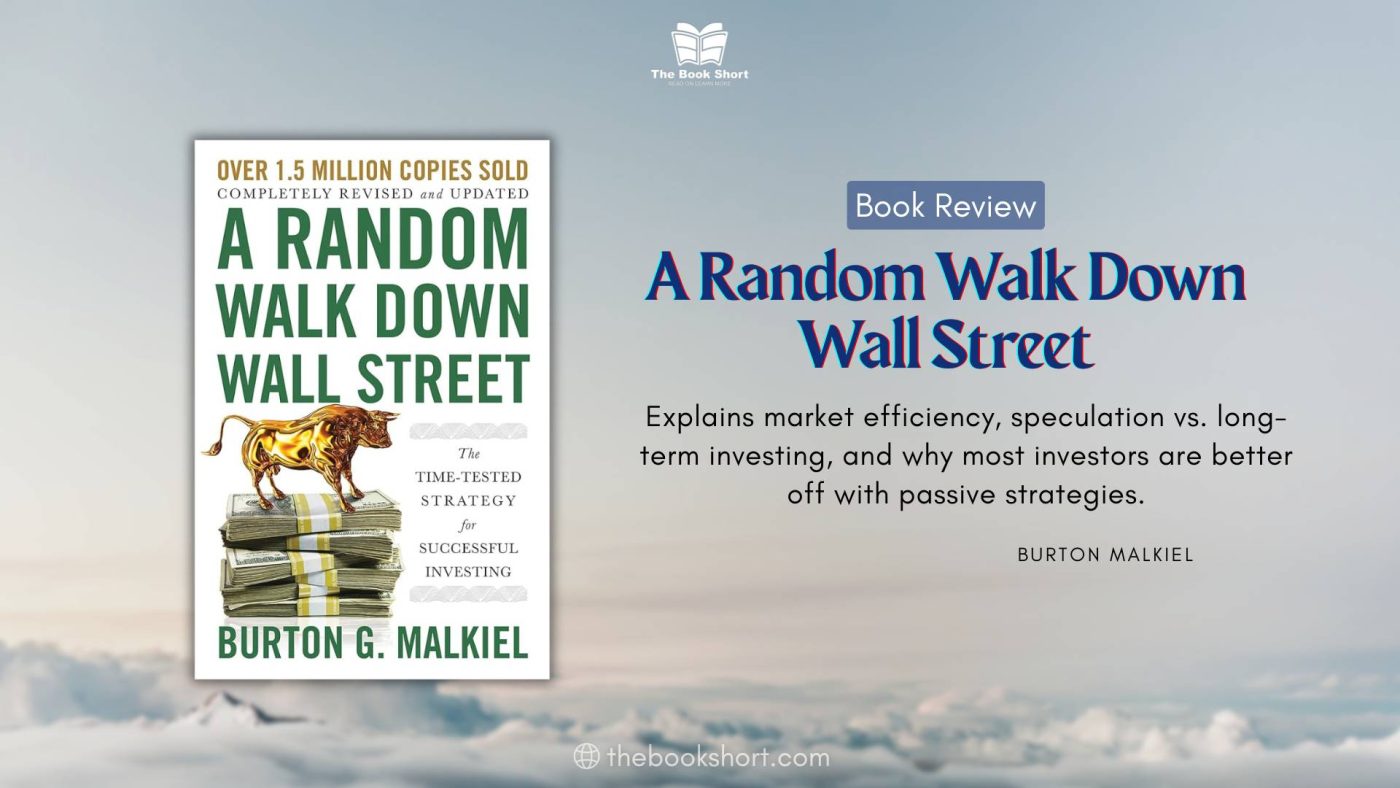
A Random Walk Down Wall Street book summary: A timeless guide to investing, proving that a simple, diversified approach often beats the experts.
Can a blindfolded monkey throwing darts at a newspaper’s stock listings really outperform a professional fund manager? This brilliant, provocative question lies at the heart of Burton Malkiel’s enduring classic, A Random Walk Down Wall Street. First published in 1973 and meticulously updated for every new generation of investors, this book has become a foundational text in personal finance. Its power lies not just in its enduring relevance, but in its unique ability to translate dense financial theory into a clear, actionable, and profoundly empowering philosophy. In a world saturated with market gurus and “hot tips,” Malkiel’s work is a masterclass in cutting through the noise.
A Random Walk Down Wall Street: Key Book Facts
- Title: A Random Walk Down Wall Street: The Time-Tested Strategy for Successful Investing
- Author: Burton Malkiel
- Year of publication: 1973 (regularly updated, with the 13th edition released in 2023)
- Genre: Personal Finance, Investing, Economics
- Number of pages: Approximately 432 pages (varies by edition)
- Target audience: Beginner to intermediate investors, students of finance, and anyone seeking a sane, long-term investment strategy.

A Random Walk Down Wall Street: The Time-Tested Strategy for Successful Investing
A Random Walk Down Wall Street Book Summary: Core Concepts
This comprehensive book summary of A Random Walk Down Wall Street unpacks Burton Malkiel’s central argument: that consistently outsmarting the stock market is a fool’s errand, making a passive investment strategy the most reliable path to building long-term wealth. The book’s genius lies in its logical four-part structure, which guides the reader from theory to practical application.
Part 1: Stocks and Their Value
Malkiel sets the stage by exploring the two fundamental—and conflicting—schools of thought on how stocks are valued.
- The Firm-Foundation Theory (Fundamental Analysis): This theory asserts that every stock has an “intrinsic value” based on tangible factors like earnings, dividends, and growth prospects. The goal of the investor, typified by legends like Warren Buffett, is to meticulously analyze a company’s health, buy its stock for less than its intrinsic value, and sell when the market price reflects or exceeds it.
- The Castle-in-the-Air Theory (Technical Analysis): This competing theory dismisses intrinsic value, arguing that a stock is worth whatever someone else will pay for it. It focuses entirely on market psychology and crowd behavior. Proponents—known as technicians or chartists—believe that human emotions create predictable patterns and trends in stock charts. Their strategy is to identify these patterns, buying before the crowd rushes in and selling at the peak of euphoric optimism, just before the “castle in the air” comes crashing down.
Malkiel patiently and systematically dismantles the claims of technical analysis, presenting compelling evidence that its so-called patterns are often indistinguishable from random chance. While he gives more credence to the logic of fundamental analysis, he ultimately demonstrates that even its most skilled practitioners struggle to consistently beat the market averages over time.
Part 2: How the Pros Play the Great Game
Here, Malkiel introduces the academic bedrock of his thesis: Modern Portfolio Theory (MPT) and the Efficient Market Hypothesis (EMH).
- Modern Portfolio Theory (MPT): Pioneered by Nobel laureate Harry Markowitz, MPT is the science of diversification. It mathematically proves that by combining different asset classes (like stocks, bonds, and real estate) that don’t move in perfect sync, an investor can significantly reduce portfolio risk without sacrificing expected returns. Malkiel champions diversification not as a mere suggestion, but as the single most important tool for every investor.
- The Efficient Market Hypothesis (EMH): This is the intellectual core of the “random walk.” The EMH proposes that stock prices instantly and fully reflect all available information. As a result, future price movements are essentially random and unpredictable because any new information is immediately baked into the price. Malkiel lucidly explains the hypothesis’s three forms:
- Weak Form: Past price movements cannot predict future prices, rendering technical analysis useless.
- Semi-Strong Form: Prices react instantly to all publicly available information, making it nearly impossible for fundamental analysis to yield an edge.
- Strong Form: Prices reflect all information, both public and private. Malkiel concedes this is an ideal, but argues the market is efficient enough to make outperformance exceedingly difficult for the average person.
The unavoidable conclusion from the EMH is that attempting to beat the market through stock picking or timing is, for most people, a futile and costly exercise.
Part 3: The New Investment Technology
In this section, which is updated with each edition, Malkiel grapples with modern challenges and nuances. He devotes significant attention to Behavioral Finance, a field that merges psychology with economics. He readily acknowledges that investors are not perfectly rational beings. Cognitive biases like overconfidence, loss aversion, and herd mentality can and do create market bubbles and panics. While these irrational episodes seem to contradict the EMH, Malkiel argues that they are notoriously difficult to predict and exploit consistently. In fact, they often strengthen the case for a disciplined, unemotional, long-term strategy.
He also provides a clear-eyed assessment of newer financial products like smart-beta funds, derivatives, and options, explaining their potential roles and significant risks for the individual investor.
Part 4: A Practical Guide for Random Walkers and Other Investors
This final section is where theory becomes a concrete, actionable blueprint. Malkiel translates his decades of research into a step-by-step guide for building wealth. He emphasizes:
- Saving and Financial Planning: Grounding your strategy in your personal goals, timeline, and tolerance for risk.
- Asset Allocation: Constructing a diversified portfolio across stocks, bonds, cash, and real estate that is appropriate for your age. He provides specific, easy-to-follow “life-cycle” allocation models.
- Implementing the Strategy: This is the culmination of the random walk theory. Malkiel makes a powerful case for using low-cost index funds and exchange-traded funds (ETFs). These revolutionary tools allow an investor to purchase the entire market (or large segments of it) for a minuscule fee, thereby guaranteeing they will earn the market’s average return with minimal cost and effort.
He concludes with a set of simple, golden rules: be patient, diversify broadly, rebalance periodically, and steadfastly resist the siren song of market fads and high-fee active managers.
In-depth Book Analysis of A Random Walk Down Wall Street
Burton Malkiel’s masterwork is far more than an investment guide; it is a meticulously constructed argument, built on a foundation of academic rigor, historical data, and a clear-eyed understanding of human nature. This book analysis of A Random Walk Down Wall Street explores the pillars of its argument, its distinctive style, and its enduring legacy.
Key Arguments and Structure
Malkiel’s central premise, the Random Walk Hypothesis, posits that short-term stock price movements are fundamentally unpredictable. His genius lies in how he structures the book to lead the reader, step by logical step, to this powerful conclusion. He first introduces the two dominant methods of active investing—technical and fundamental analysis—and then systematically exposes their limitations using historical examples and academic studies. The cautionary tales of the 1960s “tronics” bubble or the dot-com implosion of the late 1990s serve as vivid illustrations of the dangers of the “castle-in-the-air” mentality.
His argument finds its peak in his accessible explanation of the Efficient Market Hypothesis (EMH). The book’s greatest triumph is demystifying this academic concept. Malkiel acts as the ultimate translator, transforming complex statistical evidence into a compelling narrative about why trying to outsmart the collective wisdom of the market is a losing game. His conclusion is as revolutionary today as it was in 1973: for the vast majority of people, the most rational and effective strategy is a passive one—owning the entire market through a low-cost index fund.
Writing Style and Content Quality
The secret to this book’s incredible longevity is Malkiel’s voice. He masterfully avoids the dry, impenetrable prose that sinks so many finance books. His writing is sharp, witty, and peppered with memorable analogies, starting with the title itself. He writes not as a distant academic, but as a wise, pragmatic, and encouraging professor who is personally invested in his students’ success.
The quality of the content is impeccable. Malkiel rigorously supports every claim with charts, historical data, and references to seminal academic research, yet the narrative never gets bogged down. Crucially, the book is updated every few years. Later editions tackle the rise of ETFs, the insights of behavioral finance, the mania of cryptocurrencies, and other modern financial realities. This commitment to staying current ensures A Random Walk is both a history lesson and a modern-day playbook, distinguishing it from other classics that can feel like relics.
Notable Quotes from the Book
- On the “Random Walk”: “A random walk is one in which future steps or directions cannot be predicted on the basis of past actions. When the term is applied to the stock market, it means that short-run changes in stock prices are unpredictable.”
- This is the elegant definition that encapsulates the book’s central metaphor and foundational thesis.
- On Market Gurus: “God Almighty does not know the proper price-earnings multiple for a common stock.”
- This wonderfully wry and humbling line perfectly captures Malkiel’s deep-seated skepticism toward expert predictions and the false precision of so much financial analysis.
- On Passive Investing: “The surest way to achieve a better-than-average return is to buy a low-cost index fund that holds a broad portfolio of stocks.”
- This isn’t just advice; it’s the logical conclusion of the entire book. It’s a simple, powerful, and deeply empowering directive that forms the core of his practical guidance.
Personal Review & Evaluation of A Random Walk Down Wall Street
Having revisited multiple editions over the years, I believe A Random Walk Down Wall Street is one of the most indispensable and intellectually honest investing books ever written. It uniquely succeeds as both a comprehensive financial education and a practical, real-world manual.
Advantages:
- Encyclopedic Scope: The book covers an astonishing amount of ground, from the history of the Tulip-Bulb craze to Modern Portfolio Theory and age-based asset allocation. It’s a true one-stop-shop for understanding the investing universe.
- Evidence-Based Foundation: Malkiel doesn’t trade in anecdotes or opinions. His arguments for passive investing are built on a mountain of market data and peer-reviewed research, making his conclusions incredibly robust and persuasive.
- Profound Accessibility: Despite the intellectual depth, Malkiel’s lucid prose and brilliant analogies demystify Wall Street, making complex ideas clear and digestible for the novice.
Disadvantages:
- Intellectual Density: For a true beginner, certain sections—particularly the deep dive into financial theories like MPT—are dense. They demand your full attention and may require a second read to fully absorb.
- Deliberate Pacing: The first half of the book is dedicated to meticulously building the theoretical case for passive investing. Readers hungry for an immediate “how-to” list may find this initial build-up slow, but it is essential for understanding the powerful “why” behind the strategy.
Readability and Target Audience
The book is highly readable for anyone genuinely motivated to learn about investing. While it’s not a light beach read, it is a far cry from an impenetrable academic textbook.
This book is perfectly suited for:
- Beginner Investors: It provides the foundational wisdom needed to start investing intelligently and, just as importantly, to avoid the costly mistakes most new investors make.
- Intermediate Investors: It can serve as a powerful course correction, illuminating why chasing hot stocks or paying high fees for actively managed funds is a statistically losing strategy.
- Students of Finance and Economics: It is, and should be, required reading in many university courses for its brilliant synthesis of theory and practice.
Practical Value and Lessons
The practical value of A Random Walk Down Wall Street cannot be overstated. Its primary lesson is one of profound liberation: you do not need to be a Wall Street wizard or financial genius to build substantial wealth. By embracing a simple, disciplined strategy centered on diversification and low-cost index funds, you can harness the power of the market and achieve your financial goals.
The book fundamentally reframes your relationship with the market. It teaches you to tune out the daily noise, ignore the self-proclaimed gurus, and focus on the few things you can control: how much you save, how you allocate your assets, and how you minimize investment costs. The life-cycle portfolio guides in the final part of the book provide a clear, actionable roadmap that anyone can implement. Reading this book is a direct and high-return investment in your own financial literacy.
A Random Walk vs. Other Investing Books
A Random Walk Down Wall Street occupies a unique and central position in the pantheon of great investing books.
It is often compared to Benjamin Graham’s The Intelligent Investor. While both are undisputed classics, they offer fundamentally different philosophies. The Intelligent Investor is the bible of value investing, a masterclass in the deep, analytical work of finding individual undervalued securities. It’s a guide for the dedicated, active investor. A Random Walk, in contrast, makes a compelling case that this very active approach is unnecessary and often counterproductive for most people, championing a passive strategy instead. Malkiel’s book is broader, more comprehensive, and ultimately more accessible.
A more contemporary comparison is JL Collins’ The Simple Path to Wealth. Collins’ book brilliantly distills many of Malkiel’s core ideas into a direct, folksy, and powerfully simple message. The Simple Path excels in its motivational clarity. However, A Random Walk provides the deep academic and historical architecture that explains why the simple path is so devastatingly effective.


If you enjoyed the evidence-based, passive investing philosophy of A Random Walk Down Wall Street, you might also enjoy:
- The Little Book of Common Sense Investing by John C. Bogle: The definitive, passionate argument for index fund investing, written by the man who invented them.
- The Simple Path to Wealth by JL Collins: For a more concise, motivational, and blog-style take on the same powerful principles.
Conclusion: Is A Random Walk Down Wall Street Worth Reading?
Yes, absolutely. A Random Walk Down Wall Street is not just worth reading; it is essential reading for anyone serious about building long-term wealth. Its extraordinary value lies in its timeless, evidence-backed wisdom. In a single volume, it delivers a complete financial education that will arm you with the intellectual framework to confidently navigate your entire investing life.
This book is the ultimate antidote to the greed, hype, and needless complexity that the financial industry thrives on. It is a powerful, liberating truth: the most successful investing strategy is also the simplest, cheapest, and most disciplined.
Who should read it? Every aspiring investor, every student of economics, and anyone who has ever felt intimidated or overwhelmed by the world of finance. If you read only one book on investing, this should be it.
Have you read this book? Share your thoughts in the comments below.