
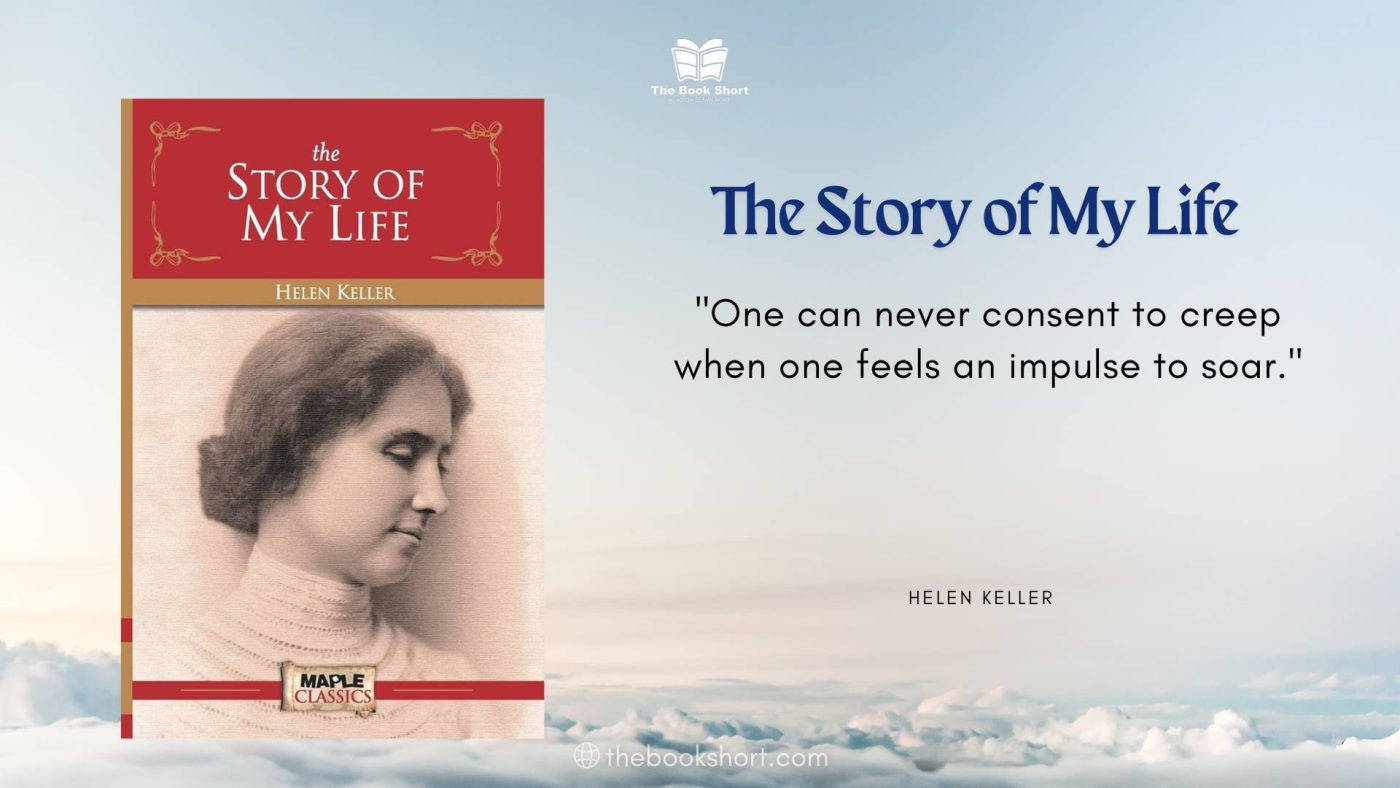
Discover the inspiring journey of Helen Keller. Learn how she defied the limits of sight and sound to achieve an extraordinary life.
Introduction
Imagine a world without sight or sound. This was Helen Keller’s reality, yet her story transcends these limitations. The Story of My Life is her powerful autobiography, a testament to human resilience and the transformative power of education and connection. I chose this book for analysis because it offers a unique perspective on the world and demonstrates the incredible capacity of the human spirit to overcome seemingly insurmountable obstacles, making it a truly valuable and inspiring read.
The Story of My Life Book: Basic Information
- Title: The Story of My Life
- Author: Helen Keller
- Year of Publication: 1903
- Genre: Autobiography, Memoir
- Number of Pages: Varies by edition (approx. 300-400 pages)
- Target Audience: General readers, students, those interested in disability studies, education, and inspirational stories.
The Story of My Life Book: Main Content Summary
The Story of My Life recounts Helen Keller’s journey from infancy to her early twenties, focusing on her experiences living without sight and hearing and her subsequent education and development. The book is primarily composed of Keller’s own narrative, but it also includes letters she wrote and supplementary notes from her teacher, Anne Sullivan, and editor, providing a more complete picture of her world and progress.
The narrative can be broadly divided into several key periods:
Early Life and the “Darkness”
Keller vividly describes her early years after an illness at 19 months old left her deaf and blind. She conveys the frustration and isolation of her condition, detailing her inability to communicate and understand the world around her. This period is characterized by her wild, undisciplined behavior born out of desperation and lack of connection. She portrays herself as a child trapped in a silent, dark world, relying solely on touch and smell, and prone to tantrums.
The Arrival of Anne Sullivan
The turning point in Keller’s life is the arrival of her teacher, Anne Sullivan, in 1887 when Helen was nearly seven years old. Keller recounts their initial struggles as she resisted Sullivan’s attempts to reach her. The pivotal moment comes at the water pump, where Sullivan spells out “w-a-t-e-r” into Helen’s hand while water flows over it. This breakthrough connects the tactile sensation with the word, unlocking the door to language and abstract thought for Helen.
The Dawn of Language and Education
Following the “water” revelation, Helen’s world explodes with meaning. She eagerly learns the names of objects and concepts through finger spelling. The book details her rapid progress under Sullivan’s dedicated tutelage. She describes learning to read Braille and raised print, and her growing understanding of the world, nature, and ideas. This section highlights the intensity of her learning and her voracious appetite for knowledge.
Expanding Horizons and New Experiences
As Helen’s communication skills grow, so do her opportunities. She learns to speak under the guidance of Sarah Fuller and describes the challenging and often frustrating process. She travels, meets prominent figures like Alexander Graham Bell and Mark Twain, and experiences the world in new ways, always translating everything through touch, smell, and the descriptions provided by others. Her accounts of visiting places, experiencing nature, and interacting with people showcase her keen observational skills despite her limitations.
Academic Pursuits and College Life
A significant portion of the book covers Keller’s formal education, including her preparation for and time at Radcliffe College (the women’s college associated with Harvard). She describes the academic challenges, the difficulty of using textbooks not in Braille, and the support she received from Sullivan, who often sat with her in class, spelling out lectures and reading materials into her hand. She shares her passion for literature, history, and philosophy, demonstrating her intellectual capabilities and determination to receive a standard college education despite her unique circumstances.
Reflection and Philosophy
Throughout the narrative, and particularly in the later chapters, Keller reflects on her experiences, her relationship with language, and her philosophical views on life, suffering, and the human spirit. She expresses profound gratitude for her education and the people who helped her, particularly Anne Sullivan, whom she refers to as her “miracle worker.” She conveys a deep sense of optimism and joy, finding beauty and meaning in the world despite her disabilities.
The letters included in the book provide supplementary insights into Keller’s thoughts, feelings, and daily life during different periods, often from a more immediate perspective. The notes from Sullivan offer context and details about the teaching methods and challenges faced, providing a third perspective on their shared journey.
In essence, The Story of My Life is a powerful account of how language liberated a mind from isolation, the crucial role of dedicated mentorship, and the extraordinary potential of human resilience and intellect.
The Story of My Life: In-Depth Analysis
The Story of My Life is more than just a personal history; it’s a profound exploration of human potential, the nature of consciousness, and the power of connection. Keller masterfully conveys her experiences, offering readers a unique window into a world perceived primarily through touch, smell, and abstract thought facilitated by language.
Characters, Structure, and Key Arguments
The central ‘characters’ are Helen Keller herself and her teacher, Anne Sullivan. The narrative is deeply focused on their dynamic, with Sullivan depicted as a relentless, patient, and brilliant educator whose impact on Helen’s life is immeasurable. The structure is primarily chronological autobiography, but it is uniquely augmented by Keller’s letters from different periods and explanatory notes from Sullivan and the editor. This multi-perspectival structure adds depth and corroboration, allowing the reader to see events not just through Helen’s reflective lens, but also through her immediate thoughts in letters and the practical details provided by Sullivan.
Key arguments or themes woven throughout the book include:
- The transformative power of language: Keller repeatedly emphasizes that learning words unlocked her mind and connected her to the world and other people. Language is portrayed as the key to consciousness and liberation from isolation.
- Overcoming adversity: Her life is a powerful example of resilience. The book argues that disability does not define a person’s potential, and that with determination and support, immense challenges can be overcome.
- The importance of dedicated education and mentorship: The narrative highlights the crucial role of a persistent and empathetic teacher like Anne Sullivan in unlocking a student’s potential, particularly one facing unique obstacles.
- The nature of perception and reality: Keller’s descriptions challenge conventional notions of how we perceive the world, demonstrating that a rich inner life and understanding can exist independently of sight and sound. She often describes her experiences metaphorically, drawing parallels between her internal state and external phenomena she learns about.
Writing Style & Content Quality
Keller’s writing style is remarkably rich, descriptive, and often poetic, particularly considering her lack of conventional sensory input. She employs vivid metaphors and similes, often drawing on her other senses or the concepts she learned through language. For instance, she describes the feel of things with great precision and uses abstract language to convey complex emotions and ideas. The quality of the content is exceptional; it is deeply introspective, intellectually stimulating, and emotionally resonant.
What stands out compared to many other autobiographies is the unique perspective. Very few people have documented the experience of acquiring language and consciousness from a state of profound sensory deprivation. Keller’s ability to articulate her internal journey, her frustrations, her breakthroughs, and her subsequent intellectual development is unparalleled. While other memoirs might focus on external events or emotional struggles, Keller’s delves into the fundamental process of a mind awakening through the acquisition of meaning. The inclusion of letters adds an immediacy that contrasts with the reflective tone of the main narrative, and Sullivan’s notes provide crucial context about the teaching methods and Helen’s behavior from an external viewpoint, creating a layered narrative.
Notable Quotes from the Book
- “The most important day I remember in all my life is the one on which my teacher, Anne Mansfield Sullivan, came to me. I am filled with wonder when I consider the immeasurable contrasts between the two lives which it connects.” (Illustrates the significance of Sullivan’s arrival)
- “Have you ever been at sea in a dense fog, when it seemed as if a tangible white darkness shut you in, and the great ship, tense and anxious, groped her way toward the shore with plummet and sounding-line, and you waited with beating heart for something to happen? I was like that ship before my education began, only I had no compass or sounding-line, and knew not how near the harbour was. ‘Light! give me light!’ was the wordless cry of my soul, and the light of love shone on me in that very hour.” (A powerful metaphor for her state before language)
- “Suddenly I felt a misty consciousness as of something forgotten–a thrill of returning thought; and somehow the mystery of language was revealed to me. I knew then that ‘w-a-t-e-r’ meant the wonderful cool something that was flowing over my hand. That living word awakened my soul, gave it light, hope, set it free!” (Describes the water pump breakthrough)
- “My teacher is so near to me that I scarcely think of myself apart from her. How much of my delight in all beautiful things is innate, and how much is due to her influence, I can not tell.” (Highlights the depth of her bond with Sullivan)
- “I am not an optimist, but a great believer in hope. And if I live long enough, I may acquire cataracts from constantly looking at the bright side of things.” (Shows her sense of humor and positive outlook)
These quotes capture her initial state, the moment of awakening, the pivotal relationship with Sullivan, and her overall philosophy.
The Story of My Life: Evaluation & Expert Personal Review
Reading The Story of My Life is a profoundly moving and inspiring experience. My personal impression is overwhelmingly positive. The book is a powerful testament to the potential of the human spirit and the critical role of education and communication in unlocking that potential. The advantages of the book lie in its unique perspective, its vivid and often beautiful prose, and the sheer inspirational power of Helen Keller’s story. It fosters immense empathy for someone living with significant sensory limitations and instills a deep appreciation for the gift of language and connection.
Are there disadvantages? For some modern readers, the writing style might feel a bit formal or dated in places, typical of early 20th-century prose. Occasionally, the detailed descriptions of her academic struggles might feel lengthy, but they are crucial to understanding her journey. However, these are minor points compared to the overwhelming value of the book.
The readability level is moderate. While the language is sophisticated at times, the narrative is compelling enough to engage most readers. It is particularly suitable for high school students and adults. It could be challenging for very young readers due to the vocabulary and abstract concepts discussed.
The practical value of this book is immense. It teaches powerful lessons in resilience, patience, and the importance of effective communication. It offers perspective, making everyday frustrations seem less significant when viewed against the backdrop of Keller’s struggles and triumphs. Reading about her journey can change one’s mindset, encouraging perseverance in the face of challenges and fostering a deeper appreciation for the abilities we often take for granted. It’s a powerful reminder that limitations are often perceived rather than inherent and that human potential is vast. It offers a blueprint for seeing possibilities where others only see barriers, making it an incredibly valuable book for personal growth and perspective.
The Story of My Life: Comparison with Similar Books
While The Story of My Life is unique due to Keller’s specific disabilities, it sits within the broader context of memoirs about overcoming significant life challenges and autobiographies detailing journeys of education and self-discovery.
Books like Jean-Dominique Bauby’s The Diving Bell and the Butterfly (written by blinking after becoming almost entirely paralyzed by locked-in syndrome) offer a similarly unique perspective from within a severely limited physical state, though Keller’s story is one of overcoming limitations from a young age rather than coping with sudden onset.
Other relevant comparisons might include memoirs focused on specific disabilities or chronic illnesses, highlighting the strength and adaptability of the human spirit. However, Keller’s focus on the acquisition of language as the key liberation sets her story apart.
If readers enjoyed The Story of My Life and were inspired by the themes of resilience, education, and overcoming adversity, they might also enjoy:
- Gifted Hands: The Ben Carson Story by Ben Carson (a story of overcoming disadvantage and learning difficulties to achieve greatness)
- When Breath Becomes Air by Paul Kalanithi (a memoir about facing mortality with grace and philosophical reflection)
- Educated by Tara Westover (a story of escaping a fundamentalist background through education)
- The Diving Bell and the Butterfly by Jean-Dominique Bauby (as mentioned above, for its unique perspective from within physical limitation)
These books share a focus on personal growth, resilience, and the power of learning or adapting in the face of extraordinary circumstances, resonating with the core themes of Keller’s autobiography.
The Story of My Life Book: Conclusion & Recommendations
The Story of My Life is a truly outstanding book whose value lies in its deeply personal yet universally resonant account of overcoming profound adversity. It is a powerful testament to the human spirit’s capacity for resilience, the transformative power of education and language, and the critical importance of human connection and dedicated mentorship.
Is it worth reading? Absolutely. It’s a classic for a reason, offering insights into the human mind and spirit that are rarely found elsewhere.
Who should read it? Anyone interested in inspirational stories, the history of education, disability studies, psychology, or simply a beautifully written account of a remarkable life. It’s particularly valuable for young people learning about perseverance and empathy, and for adults seeking perspective and motivation.
Have you read this book? Share your thoughts in the comments below!