
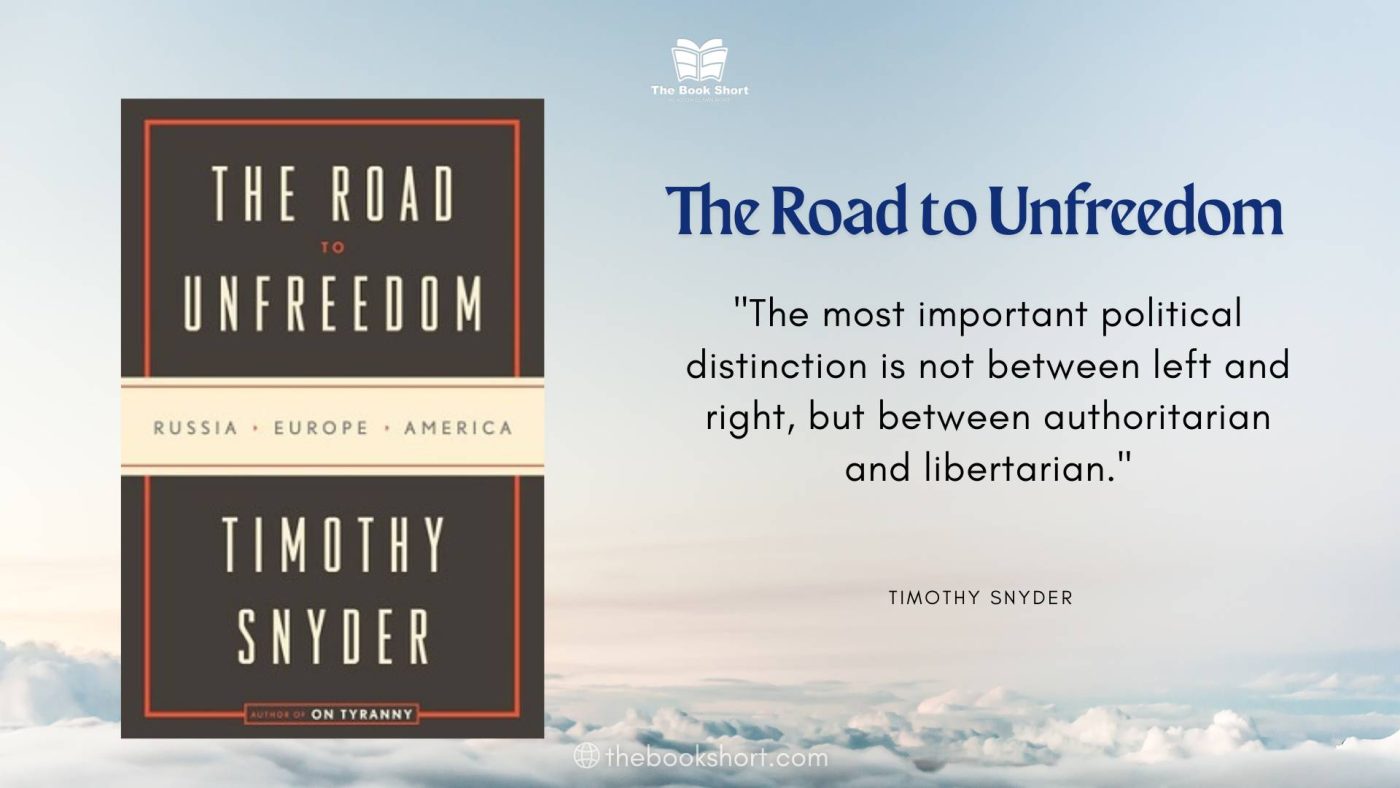
Unpack the descent into authoritarianism. This analysis of Timothy Snyder’s The Road to Unfreedom reveals how past myths paved the path to present crises. Delving into The Road to Unfreedom by Timothy Snyder offers crucial insights into our current global predicament. I chose this book for its powerful synthesis of history and contemporary politics, explaining how ideas shape dangerous realities. Its unique value lies in connecting distant pasts to immediate challenges, compelling readers to understand the origins of present unfreedom.
Basic Information: The Road to Unfreedom Book
- Title: The Road to Unfreedom: Russia, Europe, America
- Author: Timothy Snyder
- Year of publication: 2018
- Genre: Non-fiction, History, Political Science
- Number of pages: Approx. 384 pages (hardcover edition)
- Target audience: Readers interested in modern European and American history, political theory, contemporary international relations, and the rise of authoritarianism.
Main Content Summary: The Road to Unfreedom Summary
Timothy Snyder’s The Road to Unfreedom explores the historical processes that led to the current state of political crisis in Russia, Europe, and the United States, arguing that a shift from a politics of inevitability (belief in progress towards democracy and capitalism) to a politics of eternity (mythologizing a glorious, victimized past to justify present actions) is key to understanding the rise of authoritarianism.
The book is broadly structured into chronological and thematic sections, tracing the trajectory from the seemingly triumphant post-Cold War era to the challenges of the late 2010s.
- The Politics of Eternity: Snyder contrasts two forms of time in politics: “the politics of inevitability,” which sees history as a linear progression towards a desired future (like liberal democracy), and “the politics of eternity,” which focuses on mythic cycles of victimhood and greatness, using the past to justify present actions and suppress critical thought. He argues that post-Cold War Russia, under Vladimir Putin, embraced the politics of eternity, constructing narratives of historical grievance and national destiny. This approach rejects factual history in favor of usable myths.
- Russia’s Embrace of Eternity: The book details how Putin consolidated power by dismantling democratic institutions and promoting a narrative built on historical victimhood (from the collapse of the Soviet Union to perceived Western aggression) and a mystical Russian identity. Snyder highlights the role of figures like Ivan Ilyin, a Russian philosopher whose ideas about national destiny, spiritual fascism, and the importance of a strong, unified state resonated with Putin and became foundational to the new Russian ideology. This ideology justified interventions in neighboring countries (Georgia, Ukraine) and the suppression of internal dissent as necessary steps to restore Russia’s rightful place and protect it from external enemies.
- Exporting Eternity: Snyder argues that Russia actively sought to export this politics of eternity beyond its borders. This involved using propaganda (e.g., RT, Sputnik), cyber warfare, and support for far-right and populist movements in Europe and the United States. The goal was to sow discord, undermine democratic institutions, and weaken the transatlantic alliance. The narrative presented was one of corrupt liberal elites, a besieged traditional culture, and the need for strong, nationalistic leadership – themes that found resonance in various Western countries.
- The Vulnerabilities of Europe and America: The book examines how internal weaknesses in Europe and the United States made them susceptible to Russia’s influence and the politics of eternity.
- Europe: The challenges of post-Cold War integration, the strains of austerity, immigration, and the rise of populist nationalism created fertile ground for divisive narratives. Snyder looks at specific cases, particularly Ukraine, which became a battleground between Russia’s eternal narrative and Ukraine’s desire for a future-oriented, European path. He discusses the Maidan Revolution and the subsequent Russian annexation of Crimea and war in the Donbas as a direct consequence of Russia’s politics of eternity clashing with Ukraine’s politics of inevitability.
- United States: Snyder analyzes the internal divisions, the rise of partisan media, the hollowing out of democratic norms, and the increasing embrace of grievance-based politics in the US, particularly leading up to and during the 2016 presidential election. He argues that the rhetoric used by Donald Trump, with its focus on a mythical American past, blame on external forces and internal enemies, and rejection of established facts, aligned with the politics of eternity promoted by Russia. Snyder highlights the evidence of Russian interference in the election as a direct consequence of Russia exporting its political model.
- Consequences and the Path Forward: The book concludes by assessing the dangerous consequences of the shift towards the politics of eternity – the erosion of truth, the normalization of conspiracy theories, the breakdown of international order, and the threat to democracy itself. Snyder emphasizes the need to return to a politics grounded in facts, history, and a shared understanding of the future. He implicitly calls for citizens to defend democratic institutions, critical thinking, and transnational cooperation against the forces pushing towards unfreedom.
In essence, The Road to Unfreedom is a historical and political argument that contemporary crises are not random events but the result of specific ideological choices, particularly the deliberate cultivation and export of a dangerous, backward-looking political philosophy centered on myth rather than reality.
In-depth Analysis: The Road to Unfreedom Analysis
Timothy Snyder’s The Road to Unfreedom stands out for its ambitious scope, linking historical philosophy, geopolitical strategy, and contemporary domestic politics across continents. Snyder’s central thesis – the shift from a politics of inevitability to a politics of eternity – provides a powerful lens through which to understand seemingly disparate events like the annexation of Crimea, Brexit, and the election of Donald Trump.
Key Arguments and Structure
Snyder structures the book around his core concepts of inevitability and eternity. He dedicates significant space to explaining the historical and philosophical roots of Russia’s politics of eternity, drawing heavily on the ideas of Ivan Ilyin. This provides a deep, if sometimes challenging, intellectual foundation for his argument. He then meticulously traces how this ideology was implemented internally in Russia and subsequently projected outwards, analyzing its impact on Ukraine, Europe, and the United States.
The structure is largely thematic and chronological, moving from the philosophical underpinnings in Russia to their manifestation in foreign policy and their impact on Western democracies. The narrative can be dense, requiring careful attention, but the argument builds cumulatively, reinforcing the interconnectedness of events often discussed in isolation. Snyder excels at connecting the dots between obscure philosophical texts, Kremlin strategy, and populist rhetoric in Western capitals.
Writing Style & Content Quality
Snyder’s writing is characterized by its intellectual rigor, extensive historical knowledge, and a passionate, often urgent, tone. He employs a precise and academic style, which can sometimes make for demanding reading. However, this is balanced by vivid descriptions and powerful metaphors, particularly when describing the corrosive effects of the politics of eternity on truth and society.
The content quality is high, reflecting Snyder’s expertise as a historian of Central and Eastern Europe. He draws on a wide range of sources, from historical documents and philosophical texts to contemporary news reports and political speeches. His analysis is deeply informed by his understanding of the region and its complex history, providing context that is often missing in more superficial accounts of current events.
What Stands Out
What significantly differentiates The Road to Unfreedom is its deep dive into the intellectual history behind contemporary authoritarianism, particularly the detailed exploration of Ivan Ilyin’s influence on Putin’s Russia. While many books discuss Russian foreign policy or Western populism, Snyder provides a unique framework for understanding the ideological engine driving these phenomena. His explicit connection of Russian philosophy to the rise of nationalism and the erosion of democracy in the West offers a compelling, if unsettling, master narrative. The book forces the reader to consider the power of ideas, even seemingly esoteric ones, in shaping global events.
Notable Quotes
While the book is dense with argument rather than pithy phrases, the core concepts are memorable:
- On the politics of eternity: “The politics of eternity pledges to protect society from imagined threats by making people feel like victims.”
- On Russia’s strategy: “The Russian strategy was to make European and American societies more like Russia: fractious, nationalist, oligarchic, and fearful of the future.”
- On the threat: “The politics of eternity must destroy the possibility of individual historical consciousness, substituting a loop of mythic time.”
Evaluation & Expert Personal Review: The Road to Unfreedom Review
Reading The Road to Unfreedom is a challenging but ultimately rewarding experience. My personal impression is that it is a profoundly important book for understanding the geopolitical landscape of the late 2010s and early 2020s. Its central thesis – the shift from a future-oriented politics of inevitability to a backward-looking politics of eternity – feels prescient and highly relevant.
Advantages: The book’s major strength lies in its intellectual depth and the novel framework it provides. Snyder connects historical, philosophical, and political threads in a way that few others have, offering a comprehensive explanation for complex global trends. The detailed account of Ivan Ilyin’s influence is particularly valuable for anyone seeking to understand the ideological underpinnings of the current Russian regime. The book forces readers to think critically about the narratives shaping their political understanding.
Disadvantages: The book is not an easy read. Snyder’s academic style and dense arguments require focused attention. Readers unfamiliar with Russian history, philosophy, or post-Soviet politics may find certain sections demanding. At times, the connections he draws feel incredibly detailed and require significant effort to follow fully. The focus on specific philosophical figures, while crucial to his argument, can slow the pace for general readers.
Readability Level: High. This book is best suited for readers with a solid interest in history, politics, and international relations, comfortable with complex arguments and historical detail. It is not an introductory text.
Who the book is suitable for: This book is essential reading for students and scholars of history, political science, and international relations. It is also highly recommended for engaged citizens who want a deeper understanding of the forces shaping contemporary democracy and authoritarianism. Anyone trying to make sense of the rise of populism, the challenges facing liberal democracies, and Russia’s role on the world stage would benefit greatly.
Practical Value: The book offers immense practical value by providing a conceptual framework to analyze current events. It helps readers recognize the patterns of the “politics of eternity” – the use of myth, grievance, and fabricated threats – in political discourse around the world. It underscores the fragility of democratic norms and institutions and highlights the importance of historical consciousness and factual truth in resisting authoritarian narratives. It changes one’s mindset by illustrating how deeply ideas, even seemingly obscure ones, can influence political outcomes on a global scale.
Comparison with Similar Books: The Road to Unfreedom Context
The Road to Unfreedom occupies a unique space. While many books address the rise of authoritarianism or the challenges to democracy, Snyder’s work stands out for its detailed examination of the ideological shift driving these trends, specifically linking it to Russian philosophical thought and its export.
Similar books might include:
- How Democracies Die by Steven Levitsky and Daniel Ziblatt: This book focuses on the specific mechanisms by which democratic institutions are undermined from within, particularly in the US and Latin America. While it shares a concern for democratic decline, it is less focused on the historical and philosophical underpinnings discussed by Snyder.
- On Tyranny by Timothy Snyder: Snyder’s own previous work offers a more concise and accessible guide to recognizing and resisting tyranny based on lessons from the 20th century. The Road to Unfreedom provides the extensive historical and intellectual background to the dangers outlined in On Tyranny.
- Postwar: A History of Europe Since 1945 by Tony Judt: While broader in scope, Judt’s magnum opus provides the historical context of post-war Europe against which Snyder’s arguments about the challenges to the post-Cold War order can be fully appreciated.
If readers appreciated Snyder’s intellectual depth and historical approach in The Road to Unfreedom, they would likely enjoy his earlier works like Bloodlands or On Tyranny, as well as broader histories of modern Europe and Russia, or analyses of contemporary geopolitics grounded in historical understanding.
Conclusion & Recommendations: The Road to Unfreedom Worth Reading?
The Road to Unfreedom offers outstanding value by providing a vital, complex, and deeply researched analysis of the forces threatening liberal democracy today. It makes a compelling case that current crises stem from a deliberate embrace and export of a dangerous political philosophy rooted in myth and grievance.
Is it worth reading? Absolutely, for the right reader. It’s a challenging book that demands intellectual engagement, but the insights it provides into the ideological underpinnings of modern authoritarianism are invaluable.
Who should read it? Anyone serious about understanding the historical context of current geopolitical tensions, the rise of populism, and the challenges facing democracy in Russia, Europe, and the United States. It’s highly recommended for students, academics, policymakers, and politically engaged citizens seeking more than just surface-level analysis.
Have you read this book? Share your thoughts in the comments below!