
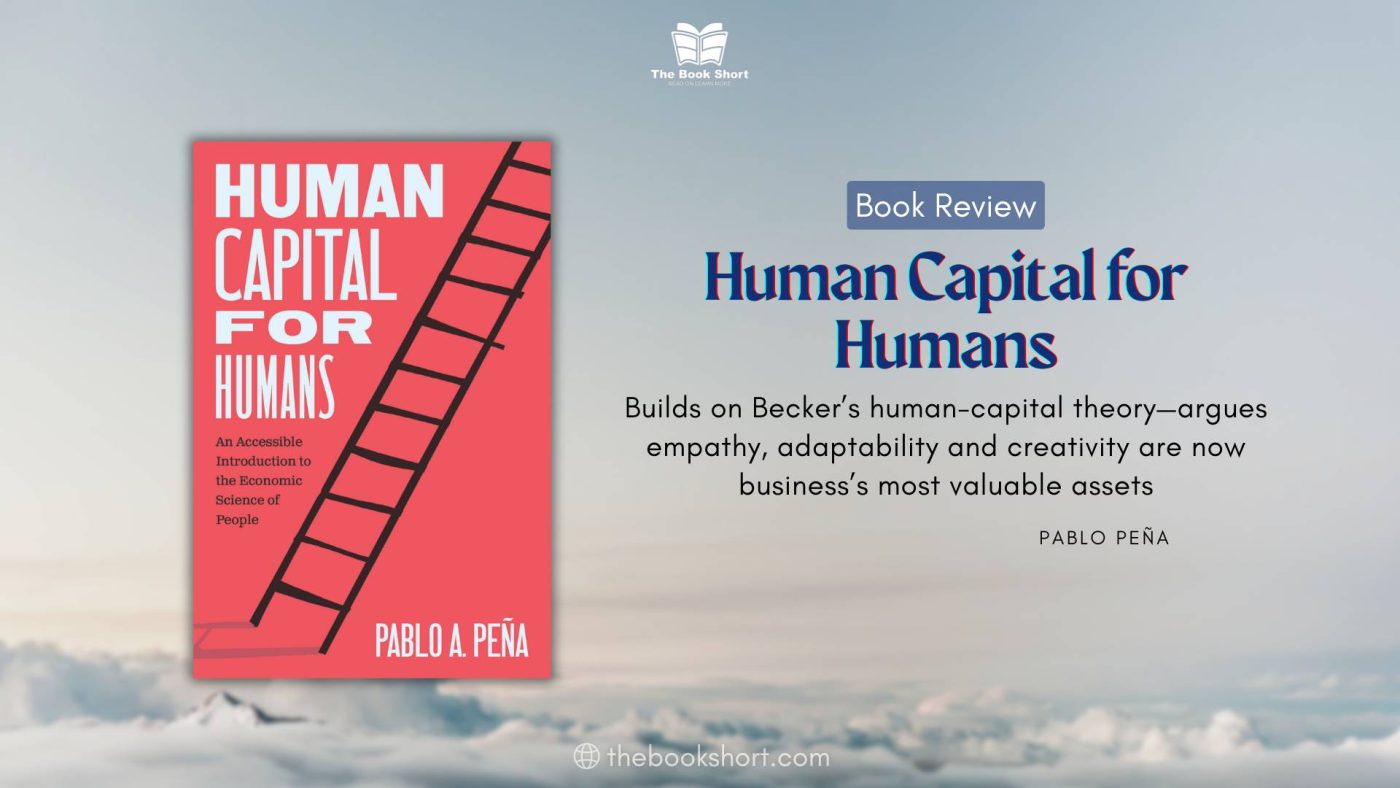
This book review of Human Capital for Humans redefines our value beyond productivity, focusing on a more holistic, human-centric approach to growth.
Are you tired of feeling like a cog in a machine, your value measured only by your output? In this summary and review of Human Capital for Humans, we explore Pablo Peña’s revolutionary call to action: to rediscover our worth beyond mere economics. This book landed on my desk and demanded attention precisely because it dismantles the cold, corporate jargon that reduces people to “resources.” It’s a profound and refreshing guide to personal and professional development that promises to reshape your understanding of work, purpose, and your own potential.
Human Capital for Humans: Key Book Details
- Title: Human Capital for Humans: A Guide to Unlocking Our True Potential
- Author: Pablo Peña
- Year of publication: 2023
- Genre: Business, Personal Development, Social Commentary
- Number of pages: 288
- Target audience: Leaders, HR professionals, managers, and any individual seeking a more meaningful approach to work and self-improvement.

Human Capital for Humans: An Accessible Introduction to the Economic Science of People
Human Capital for Humans Book Summary: A Deep Dive
Pablo Peña’s Human Capital for Humans is a powerful manifesto intent on reclaiming the concept of “human capital” from its cold, economic origins. The book argues that for decades, we have adopted a dangerously narrow view, treating skills and experience as assets to be squeezed for maximum productivity. Peña contends this approach is not only dehumanizing but ultimately self-defeating, breeding burnout, disengagement, and a staggering loss of creative potential. The book is masterfully structured into three parts: a compelling critique of the old model, the unveiling of a new, holistic framework, and a practical guide to bringing it to life.
Part 1: Deconstructing the “Human as a Resource” Model
The first section opens with a fascinating historical deep dive into the term “human capital.” Peña traces its origins to 20th-century economics, where it began as a useful metaphor. The problem, he argues, is that the metaphor was taken literally. This borrowed language of finance—”assets,” “resources,” and “return on investment”—has poisoned our work culture, leading to environments where:
- Efficiency trumps humanity: The relentless drive for optimization creates policies and workflows that prioritize output at the expense of well-being.
- Skills become transactional: Learning is reduced to acquiring only what serves an immediate corporate need, stifling curiosity and true personal growth.
- Burnout is a feature, not a bug: The unending pressure to maximize one’s “capital” cultivates an atmosphere of chronic stress, ironically depleting the very energy it seeks to harness.
Peña drives these points home with vivid case studies, illustrating how companies fixated on extracting value suffer from higher turnover, plummeting morale, and an inability to innovate.
Part 2: The Four Pillars of Human-Centric Capital
The heart of the book is Peña’s transformative framework, which rebuilds human capital around four beautifully interconnected pillars. He argues that true, sustainable value—for both the individual and the organization—is created only when we nurture the whole person.
Pillar 1: Cognitive Capital
This is far more than just raw knowledge. Cognitive Capital encompasses our curiosity, creativity, critical thinking, and capacity to learn and adapt. Peña passionately argues that it’s not what you know, but how you think. Cultivating this pillar requires creating environments of psychological safety, where people are encouraged to ask daring questions, experiment, and even fail, knowing that learning is the true goal.
Pillar 2: Emotional Capital
This pillar represents our emotional intelligence: self-awareness, resilience, and empathy. For too long, emotions were treated as a liability in the workplace, something to be suppressed. Peña reframes them as a critical asset. High Emotional Capital fosters stronger collaboration, authentic leadership, and the ability to navigate complex human dynamics. It is the very currency of trust.
Pillar 3: Social Capital
This is the value we create and receive through our relationships, networks, and sense of community. Peña makes a crucial distinction between transactional networking and genuine Social Capital, which is built on a foundation of mutual trust, reciprocity, and a shared purpose. Within an organization, it manifests as a vibrant, collaborative culture where information and support flow freely, making people feel they truly belong.
Pillar 4: Vitality Capital
This is the pillar most tragically ignored by traditional models. Vitality Capital is the sum of our physical health, mental energy, and sense of meaning. Peña argues forcefully that without vitality, all other forms of capital wither on the vine. A burned-out, depleted individual cannot be creative, empathetic, or collaborative. He makes a compelling case for work cultures that champion rest, well-being, and work-life harmony not as “perks,” but as strategic imperatives for peak performance.
Part 3: Cultivating Human Capital in Practice
The final section brilliantly bridges theory and practice, offering a concrete playbook for implementing the four-pillar model. Peña provides clear, actionable steps for three distinct audiences:
- For Individuals: Learn to conduct a personal audit of your four pillars, set holistic development goals that nourish your whole self, and practice self-advocacy to build healthier boundaries.
- For Leaders and Managers: Discover how to shift from being a “manager of resources” to a “cultivator of potential.” This involves redesigning performance metrics to reward collaboration (Social Capital), modeling vulnerability (Emotional Capital), and championing rest (Vitality Capital).
- For Organizations: Get a roadmap for rethinking HR from the ground up, investing in training that develops all four pillars, and building a culture where employees are valued as people, not just producers.
This summary of Human Capital for Humans only scratches the surface of its call to action: to spark a revolution in our workplaces and in ourselves—to build a world that stops asking, “What can I get from you?” and starts asking, “How can we all flourish together?”
Book Analysis of Human Capital for Humans: Themes & Style
Pablo Peña’s Human Capital for Humans is more than a business book—it’s a profound cultural critique and a visionary guide to a better future of work. The book stands as a powerful refutation of the lingering industrial-era mindset that treats human beings as interchangeable parts in a machine. Peña’s central thesis is both radical and commonsensical: treating people with dignity and focusing on their holistic well-being is not charity, but the most direct and sustainable path to innovation, productivity, and shared success.
Key Arguments & Structure
Peña’s masterful structure is key to the book’s impact. It follows a classic and deeply satisfying problem-solution-action arc:
- Deconstruction: It starts by expertly diagnosing the illness, providing a sharp historical and critical analysis of “human capital” that establishes the urgency of the problem.
- Reconstruction: It then moves from critique to creation, offering the Four Pillars as a hopeful and inspiring alternative. This new language—Cognitive, Emotional, Social, Vitality—is intuitive, comprehensive, and immediately useful.
- Implementation: Finally, it translates philosophy into practice. This is the book’s pragmatic genius, providing actionable steps that prevent the ideas from remaining abstract and ensure they have a clear path to making a real-world difference.
Writing Style & Content Quality
Peña’s writing is a superb blend of intellectual rigor and heartfelt, accessible prose. He weaves together insights from psychology, sociology, and economics without ever bogging the reader down. The book’s quality shines through its:
- Compelling Storytelling: Peña uses resonant anecdotes and case studies that transform abstract concepts into tangible human experiences, making his points stick with you long after you’ve closed the book.
- Evidence-Based Humanity: While the message is deeply humanistic, the arguments are fortified with data. Peña cites studies on the staggering costs of burnout and the clear ROI of investing in employee well-being and psychological safety.
- A Gift for Memorable Insights: Peña has a knack for coining phrases that crystallize his core ideas, making them easy to understand, remember, and share.
What truly sets Human Capital for Humans apart is its seamless integration of the “why” (the ethical imperative) with the “how” (the practical, evidence-based strategies). It insists that human flourishing and high performance are not two separate goals, but two sides of the same coin.
Notable Quotes from the Book
- “For too long, we have tried to fit humans into the shape of our organizations. It is time we designed organizations that fit the shape of our humanity.”
- “Burnout is not a personal failing; it is an organizational and cultural one. It is the logical conclusion of a system that views people as a resource to be consumed rather than a potential to be cultivated.”
- “The most valuable capital is not what’s on your resume, but what’s in your spirit. It’s the resilience to get back up, the empathy to lift others, and the curiosity to never stop growing.”
- “We measure profit, productivity, and efficiency. When will we start measuring what truly matters: dignity, belonging, and well-being?”
My Take: Why Human Capital for Humans is an Essential Read
Human Capital for Humans is a timely and transformative book that feels less like a business guide and more like a necessary intervention in our modern work culture. It arrives just as the Great Resignation, quiet quitting, and widespread burnout have laid bare the failures of the old model. Pablo Peña provides not just a diagnosis of the problem, but a hopeful, tangible, and profoundly practical path forward.
The book’s primary strength is its brilliantly simple yet deep four-pillar framework. Cognitive, Emotional, Social, and Vitality Capital give us a new, healthier language for what it means to grow. It’s a powerful tool for individuals to reclaim their own development and for leaders to build teams that are both high-performing and deeply human. Peña excels at connecting humanistic ideals to business outcomes, making a pragmatic and compelling case for even the most data-driven skeptic.
Where the book might face headwinds is in its perceived idealism. For those in deeply entrenched, traditional industries, implementing these changes could feel like an uphill battle. The book rightly places immense responsibility on leaders to be empathetic and visionary, and Peña’s vision might seem more aspirational than achievable in organizations resistant to change. A deeper chapter on navigating systemic resistance could have been a powerful addition.
Despite this, the book is exceptionally readable. Peña’s clear, engaging, and empathetic voice makes complex ideas feel accessible and inspiring. It’s a must-read for:
- Leaders and Managers: It’s an essential blueprint for becoming the kind of leader people are excited to work with, not for.
- HR and People Operations Professionals: It offers a visionary framework for redesigning every system—from onboarding to offboarding—around a human-centric ethos.
- Any Professional Feeling Drained: If you’re feeling burned out or questioning your career, this book will offer validation, solace, and a practical guide for redefining success on your own terms.
Ultimately, the practical value of this book is immense. It provides a new lens for viewing our lives and a clear roadmap for building organizations that attract and retain incredible talent, foster genuine resilience, and drive sustainable innovation. The mindset shift it champions—from extraction to cultivation—is its most powerful and lasting gift.
Similar Books to Human Capital for Humans
If the themes in Human Capital for Humans resonate with you, this book review suggests you might also enjoy other titles that challenge traditional notions of work and advocate for more human-centric leadership.
- Drive: The Surprising Truth About What Motivates Us by Daniel H. Pink: A classic that deconstructs “carrot-and-stick” motivation. Pink’s core motivators—autonomy, mastery, and purpose—are the fuel for Peña’s Cognitive and Vitality Capital pillars.
- Start with Why: How Great Leaders Inspire Everyone to Take Action by Simon Sinek: Sinek’s powerful argument that purpose is the root of all inspiration and engagement connects directly to Peña’s emphasis on meaning within Vitality Capital.
- Dare to Lead: Brave Work. Tough Conversations. Whole Hearts. by Brené Brown: Brown provides the tactical field guide for building the very psychological safety and trust that Peña identifies as the bedrock of Emotional and Social Capital. It’s the perfect companion piece.
- Work Rules!: Insights from Inside Google That Will Transform How You Live and Lead by Laszlo Bock: As Google’s former head of People Operations, Bock offers a data-driven look at building a human-centric culture at scale. It provides fascinating, real-world examples that complement Peña’s framework.


Final Thoughts: Is Human Capital for Humans Worth Reading?
Yes, absolutely. Human Capital for Humans is not just worth reading; it feels like an essential antidote to the burnout epidemic. Its outstanding value lies in its ability to articulate what so many of us feel intuitively: that our worth transcends our productivity, and that a workplace should be a source of growth, not depletion. Pablo Peña gives us a compelling argument, an elegant framework, and a practical guide for building a future where both businesses and people can finally thrive.
This book is a must-read for any leader, manager, or individual who believes we can do better. It is a powerful and hopeful reminder that our greatest, most renewable asset is, and always will be, our shared humanity.
Have you read this book? Share your thoughts in the comments below