
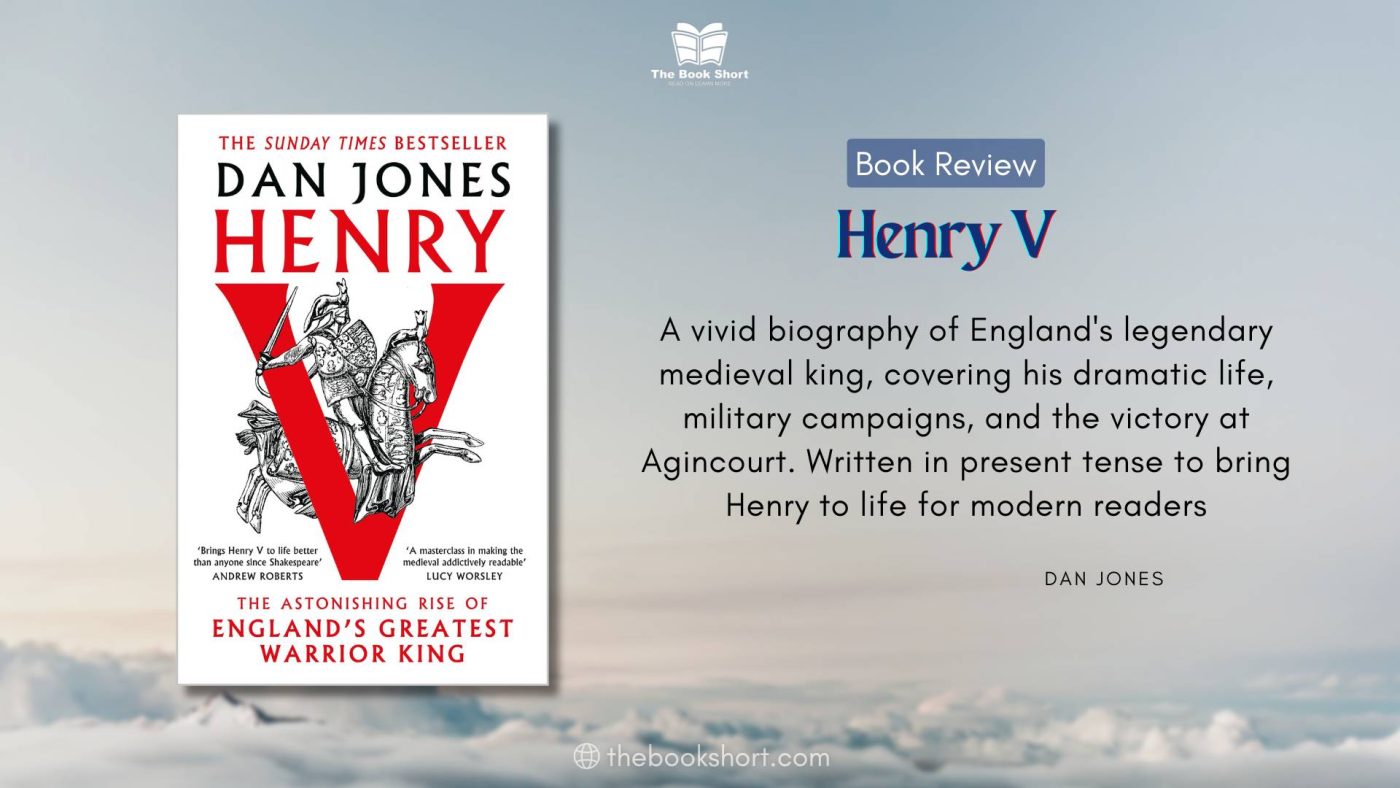
Step into the dramatic world of Henry V through Dan Jones’s compelling narrative. More than just a chronicle of battles, this book offers a vibrant, human portrait of England’s legendary warrior king, delving into the complexities of the man behind the crown. I chose this particular biography for its well-earned reputation: Dan Jones excels at merging rigorous historical scholarship with an electrifying storytelling style, making even the most intricate historical periods feel immediate and accessible. His unique ability to blend scholarly detail with dynamic prose promises a rich, insightful journey into the life of a pivotal historical figure and the defining year of his reign, making Henry V: The Warrior King of 1415 a truly worthwhile subject for this review.
Basic Information About Henry V by Dan Jones
- Title: Henry V: The Warrior King of 1415
- Author: Dan Jones
- Year of publication: 2015
- Genre: History, Biography, Popular History
- Number of pages: Varies by edition (typically around 288-350 pages)
- Target audience: Readers with a general interest in history, medieval history enthusiasts, students of English history, fans of accessible narrative history, and readers seeking a compelling account of the Battle of Agincourt.

Henry V: The Astonishing Triumph of England's Greatest Warrior King
Main Content Summary: Unpacking Dan Jones’s Henry V
Dan Jones’s Henry V: The Warrior King of 1415 isn’t a sweeping, cradle-to-grave biography. Instead, it’s a sharply focused, deeply engaging exploration of the king’s life leading up to and crucially, throughout the pivotal year 1415, culminating in the iconic Battle of Agincourt. Jones mounts a compelling case that this year, this campaign, and this battle were not just significant events, but the crucible that forged Henry V’s enduring legacy as the archetypal warrior king and cemented his place in history and popular imagination. Jones masterfully weaves together political history, military strategy, and the rich tapestry of early 15th-century England and France, painting a vivid picture of the ambitious, complex man who dared to claim dominion over both kingdoms.
The book generally follows a chronological path, though it strategically places the dramatic events of 1415 center stage, providing essential background context as needed to understand the build-up and aftermath.
Early Life and Accession: The Making of a King
Jones sets the scene by plunging the reader into the tumultuous political landscape of England in the wake of Richard II’s deposition by Henry V’s father, Henry IV. This was a time fraught with rebellion, instability, and persistent challenges to the legitimacy of the newly established Lancastrian dynasty. Prince Hal, as Henry V was known in his youth, grew up amidst this volatility, gaining crucial early military experience suppressing Welsh uprisings.
Jones tackles the persistent legend of Prince Hal’s wild and dissolute youth, famously immortalized by Shakespeare. He carefully examines the historical evidence, suggesting that while young Henry was undoubtedly headstrong and actively involved in court politics, the extent of his supposed misbehavior might have been exaggerated or later amplified to emphasize his dramatic transformation upon inheriting the crown.
His accession to the throne in 1413 marked an immediate, decisive shift. Henry V wasted no time in asserting his authority, swiftly and effectively dealing with remaining internal threats before turning his gaze outward. His bold decision to revive England’s long-dormant claim to the French throne set the stage for the monumental events to come.
The Road to War: Preparations for the French Invasion
The book meticulously details Henry V’s strategic and logistical preparations for his audacious war against France. Jones walks the reader through the intricate diplomatic dance – the increasingly ambitious demands Henry presented to the incapacitated French King Charles VI and his deeply divided court. While historians continue to debate the sincerity of Henry’s demands (whether he genuinely sought a negotiated peace or simply a plausible pretext for war), Jones vividly portrays the immense, meticulous planning that went into raising the necessary funds, amassing supplies, and assembling a formidable army and fleet.
This section powerfully underscores Henry’s capabilities extending far beyond the battlefield; he was an exceptionally effective administrator and planner, capable of mobilizing the resources of his entire kingdom for an undertaking of unprecedented scale. Jones lays bare the inherent challenges of medieval logistics – the complex process of recruiting, equipping, and provisioning soldiers, managing ships, and funding the entire enterprise – and demonstrates how Henry overcame these obstacles through sheer determination, visionary planning, and relentless organization.
The Invasion of France: The Grueling Siege of Harfleur
The narrative sweeps forward to the summer of 1415 and the departure of the English fleet across the Channel. The initial, crucial objective was the capture of Harfleur, a strategically vital port town controlling the mouth of the Seine. Jones provides a detailed, visceral account of the subsequent siege, which proved to be a far more difficult and costly affair for the English than initially anticipated.
The siege dragged on for weeks, a relentless test of the English army’s endurance. Disease, particularly dysentery, proved a far deadlier adversary than the French defenders, ravaging the ranks. Jones unflinchingly depicts the brutal realities of medieval siege warfare – the constant bombardment, the dangerous mining operations, the desperate attempts to breach the walls, and the suffering endured by combatants and civilians alike. The eventual capture of Harfleur was undeniably a victory, but it came at a heavy, sobering price in terms of lost men and depleted resources.
The March to Agincourt: A Calculated Risk
With Harfleur secured, Henry faced a critical juncture. His army was weakened by the siege and disease, and the campaigning season was rapidly drawing to a close. Rather than the seemingly logical return to England, Henry chose a breathtakingly bold and perilous course: a dangerous march across northern France towards the relative safety of English-held Calais. This decision, while appearing reckless on the surface, is presented by Jones as a calculated gamble – a move designed to provoke the much larger French army into a pitched battle on ground of his choosing, to demonstrate unwavering English resolve, and perhaps to secure plunder or valuable hostages along the arduous route.
Jones describes the arduous, exposed march through hostile territory. The English army found itself constantly harassed by French forces, and supplies dwindled precariously. The tension escalates palpabley as the massive French army, significantly outnumbering Henry’s weary, depleted force, gathers to block their path. This section expertly builds towards the inevitable, dramatic confrontation that would define Henry’s name.
The Battle of Agincourt (1415): Against All Odds
The pulsating heart of the book is Jones’s magnificent, gripping account of the Battle of Agincourt on October 25, 1415. He dedicates considerable space to establishing the scene – the rain-soaked, churned-up muddy fields near the village of Agincourt, the sheer, overwhelming scale of the French host arrayed against the smaller, exhausted English force, and the strategic deployment of both armies on the morning of the battle.
Jones meticulously explains the key elements of the brilliant English strategy: the shrewd utilization of the terrain, specifically the narrow field between dense woods that nullified the French advantage in cavalry and numbers; the devastating effectiveness of the English longbowmen; and Henry’s bold, personal decision to advance his own army to force the French to attack across the treacherous, muddy ground.
He vividly recounts the chaotic, brutal reality of the battle itself – the terrifying impact of the longbow volleys on the advancing French knights, the desperate, bloody melee in the center of the field, and the infamous, controversial order given by Henry V to kill the French prisoners during a moment of intense panic when a perceived French flanking maneuver or counterattack threatened the English rear. Jones doesn’t shy away from analyzing the complex motivations behind this ruthless command, placing it within the harsh, unforgiving context of medieval warfare and the dire straits Henry’s army faced.
The narrative immerses the reader in the unfolding events, portraying the raw courage and profound fear experienced by soldiers on both sides, and culminates in the decisive, astonishing English victory against seemingly insurmountable odds. Jones powerfully emphasizes that Agincourt was far more than just a military triumph; it was a propaganda coup of unparalleled proportions, instantly cementing Henry’s reputation as a divinely favored hero and sending waves of morale-boosting exultation throughout England.
Aftermath and Legacy: The Fruits of Victory
While the book’s central focus is firmly fixed on 1415, Jones briefly but effectively touches upon the immediate aftermath and the long-term consequences of Agincourt. He explains how the victory fundamentally altered the political landscape, paving the way for Henry’s subsequent, highly successful campaigns in France. Agincourt was the critical turning point that led to his eventual recognition as regent and heir to the French throne by the Treaty of Troyes in 1420, and his strategic marriage to Catherine of Valois, daughter of the French king.
Jones concludes by reflecting on the complex, multifaceted legacy of Henry V. Agincourt transformed him into a national icon, a potent symbol of English military prowess, righteous kingship, and divine favor. However, Jones also thoughtfully acknowledges the darker aspects of his reign – the inherent brutality of his French campaigns, the ethically challenging decision regarding the prisoners, and the ultimate historical irony that his vast conquests in France were largely lost in the decades following his premature death in 1422.
In sum, Dan Jones delivers a dynamic, accessible, and deeply human account of a crucial, defining period in Henry V’s life, highlighting the strategic brilliance, unwavering determination, and acute political acumen that characterized this ‘Warrior King’ and led to one of England’s most celebrated and debated military victories.
In-Depth Analysis of Henry V by Dan Jones
Dan Jones’s Henry V: The Warrior King of 1415 stands out in the landscape of popular history by successfully marrying a solid academic foundation with an exhilarating, narrative-driven style. The analysis is heavily weighted towards the year 1415, arguing convincingly that the campaign and the stunning victory at Agincourt were not merely significant events, but rather the crucible moments that irrevocably shaped Henry’s public image and dictated the course of subsequent history. Jones does more than just recount the facts; he actively interprets Henry’s motivations, analyzes his decisions, and places his actions firmly within the specific, often brutal, historical context in which he operated.
Characters, Structure, & Key Arguments Explored
- Characters: While the spotlight is undeniably on Henry V, Jones breathes life into the supporting cast as well – the tragic figure of the ailing French King Charles VI, the often-fractious and overconfident French nobility whose disunity proved fatal at Agincourt, and glimpses of key English commanders and the soldiers who endured the campaign. Jones makes a concerted effort to present Henry V not as a simplistic, one-dimensional hero, but as a layered, complex leader driven by a powerful mix of ambition, deep religious faith, and stark political necessity. His portrayal reveals a Henry capable of strategic genius and inspiring leadership, but also of a chillingly ruthless pragmatism, most starkly illustrated by his difficult decision regarding the French prisoners.
- Structure: The structure is primarily chronological, building inexorably towards the dramatic climax of the 1415 campaign. Jones expertly employs flashbacks and contextual explanations to provide essential background on the turbulent political situation in both kingdoms and Henry’s earlier experiences, ensuring the reader is well-grounded without interrupting the compelling forward momentum of the main narrative. The build-up to Agincourt – the siege, the march, the tense standoff – is particularly well-paced, generating a powerful sense of tension and historical inevitability. The detailed, immersive account of the battle itself forms the undeniable peak of the book, followed by a concise look at its immediate aftermath and profound long-term significance. This deliberate focus allows for a deep, penetrating look at a specific, transformative period of Henry’s life, rather than a more superficial survey of his entire reign.
- Key Arguments:
- 1415 as the Defining Crucible: Jones forcefully argues that the events of this single year, and the Agincourt campaign above all, are absolutely central to comprehending Henry V’s historical identity and his enduring popular image as England’s greatest warrior king.
- Henry’s Strategic Brilliance and Daring Risk-Taking: He convincingly portrays Henry as a profoundly skilled military commander, willing to embrace calculated risks, such as the audacious march across enemy territory to Calais, in order to achieve his ambitious objectives.
- Demystifying the Agincourt Victory: Jones meticulously dissects the factors behind the seemingly miraculous English victory, emphasizing the critical confluence of English tactical acumen, the devastating power of the longbow, the advantage provided by the muddy terrain, and the debilitating disunity and fatal errors committed by the French leadership.
- The Unvarnished Reality of Medieval Warfare: A crucial aspect of the book is its refusal to romanticize war. Jones unflinchingly depicts the grim harshness of sieges, the silent, deadly toll of disease, and the controversial, brutal necessities that sometimes dictated actions on the battlefield, such as the difficult decision to execute prisoners.
Writing Style & Quality: Bringing History to Life
Dan Jones possesses a wonderfully readable and deeply engaging writing style. He employs vivid, evocative descriptions, powerful verbs, and maintains a fluid narrative flow that utterly captivates the reader. His prose strikes a fine balance: it is accessible and clear without ever becoming simplistic, successfully translating complex historical events, intricate political maneuvers, and the brutal realities of medieval warfare into an understandable, often thrilling, story. He skillfully integrates primary source material – referencing chroniclers and official documents – but weaves this evidence seamlessly into his narrative, avoiding the dry, academic density that can sometimes alienate general readers.
The content quality is exceptionally high for a work of popular history. Jones demonstrates a clear command of established scholarship while presenting his own insightful interpretation, particularly concerning the paramount significance he assigns to the year 1415. He expertly balances political, military, and social history, providing the essential context necessary to fully grasp the events he describes. While highly accessible, the book never shies away from confronting the difficult, controversial, or less palatable aspects of Henry’s reign and actions.
What truly sets this book apart is Jones’s remarkable ability to make historical events feel immediate, dramatic, and intensely human. He is particularly skilled at depicting battle and siege scenes, placing the reader squarely amidst the mud, the chaos, and the fear of the action. This narrative flair, combined with his clear explanations of the historical stakes and consequences, distinguishes his work from drier academic texts and even some other popular histories that might lack this level of descriptive power and emotional resonance. He doesn’t just recount medieval history; he makes it feel profoundly alive and relevant.
Echoes from the Past: Notable Passages and Their Tone
While specific quotes require returning directly to the text, the essence and style of notable passages in Dan Jones’s Henry V are characterized by:
- Visceral Descriptions of Battle: Evocative language painting scenes of mud, steel, and the terrifying sound of arrows. Imagine phrases like, “The French host gathered, a terrifying forest of lances and banners, a wave of steel preparing to break upon the smaller English line, their horses churning the already sodden ground into a desperate morass…”
- Penetrating Insights into Henry’s Psyche: Lines that reveal the layers of his character, blending piety with pragmatism. For example, “Henry was a man consumed by purpose, his faith absolute, yet his plans meticulously earthly. He believed God had ordained his path, but he left nothing to divine intervention that could be secured by careful logistics and iron will.”
- Sharp Summaries of High Stakes: Sentences that crystalize the enormous historical weight of the moment. Perhaps something like, “The crossing to France in 1415 was not merely an invasion; it was a roll of the historical dice, a gamble staking the fate of a dynasty and the future relationship between two great kingdoms.”
- Humanizing the Cost of War: Descriptions that convey the suffering beyond the glory. Passages might describe the grim reality of disease: “The tents at Harfleur became hospitals and charnel houses; the unseen enemy of flux proving deadlier than any French weapon, silently claiming men who had survived the crossing and the walls.”
These examples capture the blend of historical detail, engaging narrative, and human insight that makes Jones’s writing so compelling.
Evaluation & Expert Review: A Personal Take on Henry V by Dan Jones
As a reader with a strong passion for medieval history and historical narrative, I found Dan Jones’s Henry V: The Warrior King of 1415 to be an outstanding achievement in popular history. It is both highly informative and thoroughly, enjoyably readable from start to finish.
Personal Impressions: The Highs and Lows
Advantages (Why This Book Excels):
- Masterful Storytelling: Jones is simply one of the best historical storytellers writing today. He imbues the complex political maneuvering, the logistical nightmares, and the brutal military campaigns of the early 15th century with a vibrancy and pace that makes history feel like a living, breathing drama. The book often reads with the propulsion of a great historical novel, keeping the reader utterly absorbed.
- Exceptional Accessibility: He possesses a rare talent for making a potentially dense and confusing historical period completely accessible to a broad audience. He seamlessly explains the intricate context, the diverse motivations of key players, and the far-reaching significance of events without ever assuming prior, detailed knowledge. Historical jargon is kept to a minimum and, when necessary, clearly explained.
- Compelling Focus: By deliberately centering the book around the transformative year 1415, Jones is able to provide a deep, concentrated dive into the pivotal Agincourt campaign and its immediate antecedents. This focus allows for a level of detail and narrative depth that might be diluted in a full-life biography, making the most dramatic period of Henry V’s story particularly compelling.
- Brilliant Analysis of Agincourt: The descriptions and analysis of the Battle of Agincourt itself are a major highlight. Jones clearly and vividly explains the tactics, the terrain, the deployment, and the crucial factors that contributed to the unexpected English victory, effectively demystifying the ‘miracle’ while powerfully conveying the courage and desperation of those involved.
- Nuanced Portrayal: While fully acknowledging Henry V’s iconic status in English history, Jones resists the urge to present a simplistic hero. He includes the less palatable aspects of Henry’s character and the controversial decisions he made, offering a more complex, human figure rooted in the harsh realities of his time.
Disadvantages (Minor Points to Consider):
- Intentional Limited Scope: For readers hoping for a comprehensive, cradle-to-grave biography covering every aspect of Henry V’s life and entire reign, this book’s deliberate focus on 1415 might leave them wanting more coverage of the post-Agincourt years. However, the title clearly signals this focus, so it’s more of a characteristic than a flaw, aligning perfectly with its stated aim.
- Popular vs. Academic Depth: While clearly well-researched and grounded in historical sources, the book does not engage with academic historiographical debates or present the level of minute detail found in purely scholarly biographies. This is entirely appropriate for its target audience and genre, but it’s a distinction worth noting for those seeking a highly academic treatise.
Readability and Ideal Audience
The readability of Henry V: The Warrior King of 1415 is exceptionally high. Dan Jones writes with a general audience firmly in mind, utilizing clear, engaging sentence structures and a wonderfully flowing style. Anyone with even a basic interest in history, medieval or otherwise, will find the book easy to follow and absorbing. It is ideally suited for:
- General readers seeking an exciting, human entry point into the late medieval period.
- Students looking for an accessible, engaging overview of Henry V and the Battle of Agincourt that goes beyond textbook summaries.
- Readers who simply enjoy well-written historical narratives and biographies of compelling figures.
- Fans of military history eager for a clear, dynamic account of one of history’s most famous battles.
- Anyone who knows of Henry V through Shakespeare and wishes to understand the historical context and reality behind the play.
It would be an excellent choice for a book club interested in historical subjects or for someone looking to delve into the life and legacy of this famous king and battle without being intimidated by overly academic or dry prose.
Practical Value: Lessons from the Past
Beyond its primary function as a historical narrative, the book offers several practical takeaways:
- Insights into Leadership: Henry V’s meticulous preparation for war, his complex management of logistics, his critical decisions during the campaign (including the risky march), and his personal leadership at Agincourt provide fascinating case studies in effective (and sometimes morally challenging) leadership under immense pressure.
- Understanding Strategy and Risk: The detailed analysis of the Agincourt campaign highlights timeless strategic principles: the importance of understanding and leveraging terrain, exploiting one’s strengths (like the English longbowmen), and recognizing and capitalizing on enemy weaknesses or errors.
- Contextualizing Historical Figures: The book powerfully encourages looking beyond simplistic heroic or villainous portrayals to understand historical figures as complex individuals operating within the specific, often brutal and alien, constraints and moral codes of their own time. It shows that even celebrated figures made difficult, morally ambiguous choices driven by necessity.
- Appreciating Research and Narrative Craft: It serves as a superb example of how diligent historical research, combined with exceptional storytelling skill, can transform seemingly distant events into a vibrant, compelling, and deeply human narrative.
Ultimately, the book reminds us that history is not just a list of dates and names, but a tapestry woven from the decisions, actions, courage, and flaws of real people facing unimaginable challenges.
Comparison with Other Accounts of Henry V
Dan Jones’s Henry V: The Warrior King of 1415 occupies a strong position within the genre of popular historical biographies, particularly those that shine a spotlight on dramatic military campaigns. When placed alongside more traditional academic biographies, such as those penned by esteemed scholars like Christopher Allmand or the detailed work on the period by Ian Mortimer (though Mortimer’s focus is often broader), Jones’s book distinguishes itself through its significantly more narrative-driven and accessible style. Academic works, while invaluable for specialists, typically delve deeper into primary source analysis, historiographical debates, and often provide a more exhaustive, granular account across the entire reign, which can be less engaging for the general reader.
Compared to other popular history books covering Henry V or focusing on Agincourt, Jones stands out for his signature dynamic writing style and his deliberate, sharp focus on the pivotal year 1415. This strategic choice allows him to provide an exceptionally deep and compelling dive into the Agincourt campaign and its immediate lead-up, arguably the most famous and dramatic phase of Henry’s life for many readers. Other popular histories might attempt to cover the entire reign, potentially sacrificing depth on key events, or focus solely on the battle itself without the rich biographical and contextual build-up that Jones provides.
For readers who found the accessible, narrative style, compelling focus on key events, and dynamic prose of Dan Jones’s Henry V particularly enjoyable, they would likely also appreciate:
- Other works by Dan Jones: Titles like The Plantagenets, The Templars, or Powers and Thrones explore similar historical periods and showcase his distinctive, engaging approach to history.
- Bernard Cornwell’s Azincourt: A superb historical fiction novel that tells the story of the campaign and battle from the perspective of a longbowman. It offers a visceral, ground-level, and highly human experience of the events described in Jones’s book.
- John Keegan’s The Face of Battle: While it analyzes three battles from different eras, Keegan’s detailed examination of Agincourt from a military historian’s perspective, focusing on the soldier’s experience of combat, provides a fascinating complement to Jones’s narrative.
- Julian Stockwin’s Until the Dawn (part of his Henry V series): Another option in historical fiction that follows the king’s life, offering a different narrative lens on the period.


These comparisons underscore that Jones successfully bridges the gap between rigorous historical inquiry and broad popular appeal, making complex historical events vibrant and relatable for a wide audience.
Conclusion & Recommendation: Is Dan Jones’s Henry V Worth Reading?
Dan Jones’s Henry V: The Warrior King of 1415 is, without question, a compelling, highly readable, and historically insightful account of a pivotal moment in English history and the life of one of its most iconic kings. Its greatest strength lies in its exceptional ability to transform complex historical realities – the intricate political maneuvering, the immense logistical challenges of sustaining a medieval army abroad, and the brutal, chaotic reality of battle – into a gripping, propulsive narrative that is simultaneously deeply informative and genuinely entertaining. By choosing to focus intensely on the year 1415 and the Agincourt campaign, Jones delivers a sharp, detailed, and deeply human portrait of Henry V at the absolute height of his ambition, strategic prowess, and controversial decision-making.
So, is it worth reading? An emphatic yes. For anyone with an interest in medieval history, military history, the history of the English monarchy, or simply a love for fascinating true stories about leadership, conflict, and human endurance, this book comes with a strong, enthusiastic recommendation.
Who would find this book particularly rewarding?
- Students and general readers seeking an engaging, accessible introduction to Henry V and the historical reality behind the legend.
- Anyone who has been captivated by Shakespeare’s Henry V and wants to understand the historical basis and context of the play.
- Readers who appreciate well-written, narrative-driven popular history that makes the past feel immediate.
- Military history enthusiasts looking for a clear, dynamic account of a famous battle and the campaign leading up to it.
- Anyone curious about the life and legacy of this famous king and looking for a book that avoids academic jargon while offering real historical insight.
It’s a relatively swift read given its page count, yet it’s packed with vivid historical detail, sharp analysis, and compelling storytelling. It successfully strips away some of the layers of myth surrounding Henry V and Agincourt while preserving the dramatic scale and historical significance of the king’s ambition and astonishing achievement.
Have you journeyed through 1415 with Dan Jones? Share your thoughts and impressions of Henry V: The Warrior King of 1415 in the comments below!