
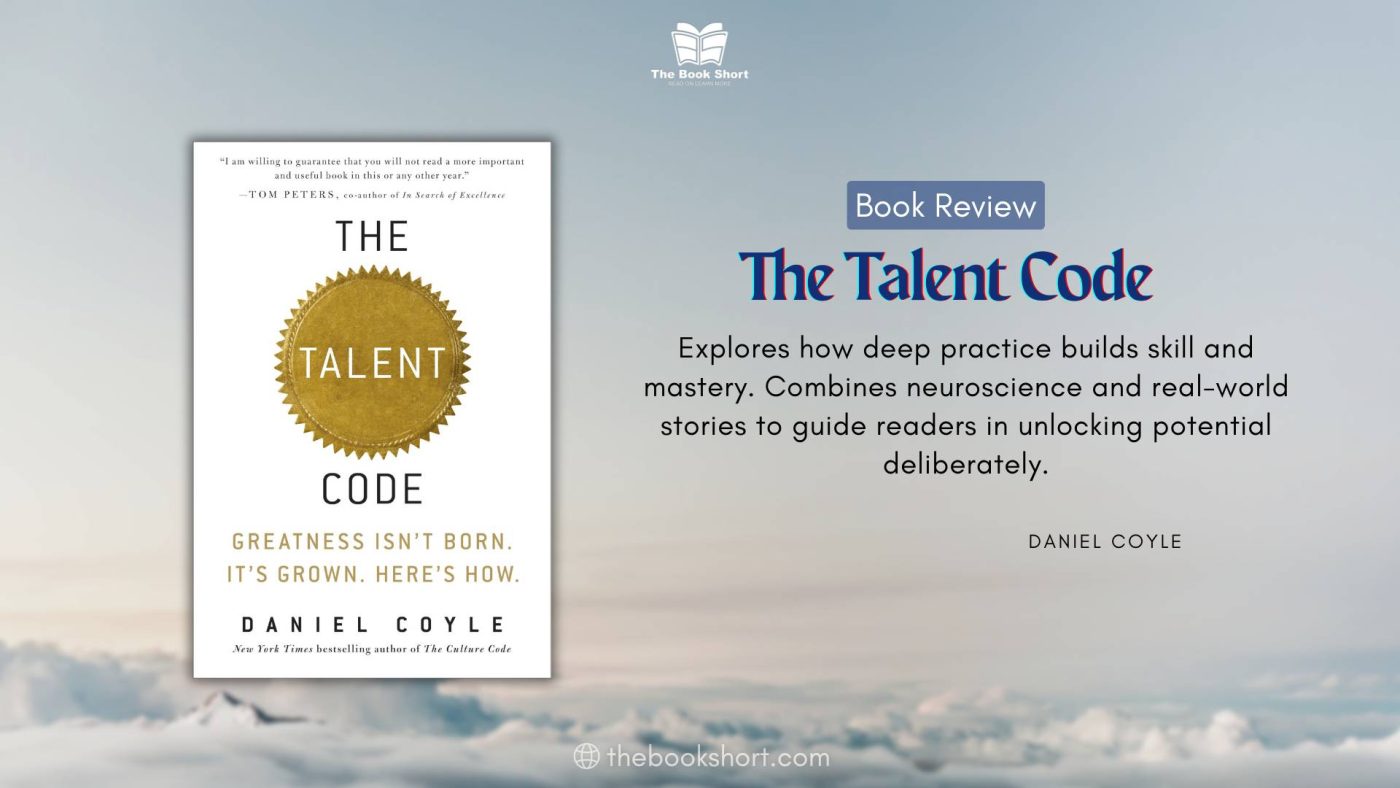
This book review of The Talent Code reveals how greatness isn’t born, but grown. Discover the three-step formula for unlocking your true potential.
Have you ever looked at a world-class athlete, a virtuoso musician, or a brilliant artist and wondered if they were simply born different? In The Talent Code, Daniel Coyle dismantles the persistent myth of innate genius, offering a powerful and scientific blueprint for excellence in any field. I was drawn to this book for its revolutionary, yet profoundly practical, approach to skill development. It doesn’t just inspire; it provides a tangible roadmap to unlocking the greatness that lies dormant within all of us.
The Talent Code: Book at a Glance
- Title: The Talent Code: Greatness Isn’t Born. It’s Grown. Here’s How.
- Author: Daniel Coyle
- Year of publication: 2009
- Genre: Non-fiction, Psychology, Personal Development, Neuroscience
- Number of pages: 256
- Target audience: Students, athletes, parents, coaches, artists, business leaders—anyone passionate about skill acquisition and realizing their full potential.

The Talent Code: Greatness Isn't Born. It's Grown. Here's How.
The Talent Code Book Summary: Unlocking the Secrets of Skill
In The Talent Code, acclaimed journalist Daniel Coyle embarks on a global quest to uncover the secrets of the world’s most astonishing “talent hotbeds”—tiny, often humble places that produce an unbelievable density of world-class performers. From a spartan tennis club in Russia that has generated more top-20 female players than the entire United States, to a bare-bones music academy in the Adirondacks, Coyle asks a deceptively simple question: What is going on here?
His investigation unearths a groundbreaking truth: extraordinary talent is not a genetic lottery ticket. It is the result of a specific, repeatable pattern of practice and motivation that anyone can learn and apply. Coyle masterfully distills this pattern into a simple, three-part framework: Deep Practice, Ignition, and Master Coaching. This book summary will explore each of these pillars of skill.
Part 1: Deep Practice – The Foundation of Skill
The true cornerstone of the talent code is Deep Practice. This isn’t about mindlessly logging hours; it’s about the quality and intensity of that time. Coyle reveals that meaningful practice is a process of targeted, focused struggle. It happens when you operate on the very edge of your abilities, making mistakes, and meticulously correcting them. This very act of struggling triggers a profound neurological response.
- The Miraculous Role of Myelin: Coyle introduces the biological secret to skill: a neural insulator called myelin. Think of it as broadband for your brain. Myelin is a fatty tissue that wraps around your neural circuits. Every time you fire a specific circuit—by practicing a golf swing, a guitar chord, or a math problem—a new layer of myelin wraps around that pathway. More myelin means a faster, smoother, and more automatic signal. Skill, therefore, is the physical manifestation of well-myelinated circuits.
- The Rules of Deep Practice: To cultivate this crucial myelin, your practice must embrace a specific kind of effort. Coyle outlines its essential characteristics:
- Chunk It Down: World-class performers don’t try to swallow a skill whole. They break it down into its smallest possible components, or “chunks.” They master each tiny piece before linking them into a fluid, seamless whole.
- Repeat with Purpose: This isn’t rote repetition. It’s about repeating an action with laser-like focus, constantly diagnosing errors and making microscopic adjustments. It is mindful, purposeful, and intense.
- Embrace the Struggle: Deep practice feels hard. It involves reaching, stumbling, and self-correcting. This struggle isn’t a sign you’re failing; it’s the very signal that triggers myelin growth. You have to “feel” the mistake to learn from it.
Part 2: Ignition – The Fuel for Motivation
While Deep Practice builds the neurological superhighways of skill, Ignition provides the rocket fuel. It is the spark of passion, identity, and commitment that drives us through the grueling, often frustrating, hours of deep practice. Without a powerful ignition, the motivation required to build thousands of layers of myelin simply fizzles out.
Coyle persuasively argues that ignition is not some mysterious internal whim but is triggered by potent environmental signals he calls “primal cues.” These cues deliver a simple, powerful message that resonates deep in our subconscious: “That is who I want to be.”
- The Power of Primal Cues: Ignition often occurs when we see someone we identify with achieve something remarkable. It could be a local hero, an older sibling, or a peer who suddenly breaks through, making success feel tangible and achievable. This creates a surge of possibility, a vivid, future-oriented vision of ourselves. The rise of the Williams sisters in tennis, for instance, didn’t just inspire; it ignited a fire for the sport in a new generation of players who saw themselves in their success.
- Sustaining the Fire: Ignition is not a one-time event. It’s a fire that needs to be constantly stoked. Coyle highlights the critical role of language and environment. Simple, powerful messages like “You’ve got this” or being immersed in a group that celebrates effort and progress are essential for keeping the motivational flames burning, especially through the inevitable plateaus and setbacks.
Part 3: Master Coaching – The Guiding Hand
The final, essential ingredient in the talent code is Master Coaching. If Deep Practice is the engine and Ignition is the fuel, the Master Coach is the expert navigator who knows every turn in the road. Coyle discovered that the coaches in these talent hotbeds were rarely charismatic cheerleaders. Instead, they were quiet, perceptive, and obsessively precise guides.
These “talent whisperers” possess a profound knowledge of their subject and an intuitive grasp of their students’ needs. They don’t dispense generic praise; they deliver the exact, targeted information required to make deep practice ruthlessly efficient.
- The Four Virtues of a Master Coach:
- The Matrix: They hold a vast, encyclopedic knowledge of their craft, allowing them to instantly diagnose a flaw and provide the perfect “chunk” for a student to focus on.
- Perceptiveness: They are masters of empathy, skilled at reading their students, understanding their unique personalities, and tailoring their communication for maximum impact.
- The GPS Reflex: They deliver short, sharp, surgically precise bursts of feedback that guide the student directly to the next correct move. They eschew long lectures for concise, actionable commands.
- Theatrical Honesty: They cultivate relationships built on absolute trust and authenticity. They care deeply for their students but are also unflinchingly honest, creating an environment of high expectations and genuine human connection.
Ultimately, The Talent Code summary reveals that greatness is not an accident of birth. It is a formula: combine intense, targeted practice with powerful, sustained motivation, all amplified by expert guidance.
In-depth Analysis of The Talent Code
Daniel Coyle’s The Talent Code elevates itself far beyond the typical self-help manual by grounding its inspirational message in solid journalism and accessible neuroscience. The book’s genius lies not just in its “what” (the three ingredients) but in its compelling “how” and “why.”
Structure and Key Arguments
Coyle’s structure is one of the book’s signature strengths. He employs a gripping, journalistic narrative, taking us along on his travels to the talent hotbeds. This storytelling framework prevents the book from ever feeling like a dry, academic treatise. By weaving scientific explanations of myelin and neurology into vivid accounts of Brazilian futsal players, the Brontë sisters, and virtuoso musicians, he makes complex concepts tangible, memorable, and human.
The book’s central argument is a powerful reframing of the “nature vs. nurture” debate. Coyle posits that talent is almost entirely nurtured, but through a very specific kind of cultivation. The core thesis is that skill is a biological process—a physical substance (myelin) that you can actively grow. This is the book’s revolutionary contribution. While others have praised practice, Coyle gives us the cellular mechanism. This shifts the conversation from the vague virtue of “hard work” to a concrete physiological process that we can intentionally trigger. His equation—Deep Practice + Ignition + Master Coaching = Skill—is as simple as it is profound.
Writing Style & Content Quality
Coyle’s prose is a pleasure to read—it’s clear, engaging, and remarkably efficient. As an award-winning journalist, he excels at synthesis, translating dense ideas from neuroscience and cognitive psychology into principles that are immediately understandable. His use of potent metaphors, like myelin wrapping a wire to increase its signal speed, makes the science intuitive and sticky.
What truly distinguishes The Talent Code from others in its genre is its evidence-based storytelling. It doesn’t rely on disconnected anecdotes. Instead, it builds a powerful, unified theory. While Malcolm Gladwell’s Outliers famously introduced the “10,000-Hour Rule,” Coyle’s work provides the critical missing piece: it’s not the sheer quantity of hours but the targeted quality of struggle within those hours that forges expertise. This sharp focus on the how of effective practice is infinitely more practical and empowering for the reader.
Notable Quotes from The Talent Code
The book is rich with memorable lines that distill its core philosophy:
- On the necessity of struggle: “Struggle is not an option: it’s a biological requirement.”
- On what deep practice feels like: “This is a place where you are reaching, failing, and reaching again.”
- On the biology of skill: “Skill is a cellular insulation that wraps neural circuits and that grows in response to certain signals.”
- On the spark of motivation: “Ignition is the set of signals and subconscious forces that create our identity; the moments that lead us to say, ‘that is who I want to be’.”
- On the art of coaching: “Good coaching is about delivering the right information at the right time.”
These quotes capture the book’s central themes: that purposeful struggle is the engine of growth, that skill is a physical reality in our brains, and that motivation and guidance are essential accelerators.
My Personal Review and Evaluation of The Talent Code
The Talent Code is one of the most impactful and paradigm-shifting books I’ve ever read on skill acquisition. Its potent blend of scientific discovery, journalistic storytelling, and actionable advice makes it both intellectually stimulating and deeply inspiring.
From my perspective, the book’s greatest strength is its sheer practicality. It demystifies the path to mastery. Before reading it, “practice” was an amorphous blob of time. Afterward, it became a specific, surgical activity: find the edge of my ability, embrace the resulting struggle, and focus intensely on correcting errors. This mindset shift is nothing short of transformative. The only minor critique is a slight repetition of the core message, but this feels intentional, serving to hammer home the central tenets until they become second nature.
The readability is exceptional. Coyle masterfully avoids jargon, writing for a broad audience. His narrative style makes it feel less like a textbook and more like a captivating journey of discovery. It is especially vital for:
- Parents and Coaches: It offers a clear, science-backed blueprint for nurturing talent.
- Educators: The principles of deep practice and ignition are directly transferable to classroom design and teaching methods.
- Anyone Learning Anything: Whether you’re tackling a musical instrument, a new language, or a complex business skill, this book provides the operating manual for accelerated learning.
The practical value is immense. The book gives you a mental toolkit for how to learn. For me, the most significant lesson was the complete reframing of mistakes. Instead of viewing errors as signs of failure, you begin to welcome them as the raw material for growth—the very signals that tell your brain where to build more myelin. This fosters a resilient “growth mindset” where challenges are not obstacles to be feared, but opportunities to be sought. Applying these principles will not only lead to tangible improvement in any pursuit but will fundamentally change your relationship with the learning process itself.
How The Talent Code Compares to Similar Books
The Talent Code stands shoulder-to-shoulder with other modern classics on performance and potential, yet it carves out its own unique and indispensable territory.
- Compared to Grit by Angela Duckworth: Grit is the definitive work on the psychology of “passion and perseverance for long-term goals.” The two books are perfect complements. Coyle explains the “how” of brilliant practice (myelin, deep practice), while Duckworth explores the “why” of relentless persistence (grit). Reading both gives you a complete picture of what it takes to achieve greatness.
- Compared to Mindset by Carol Dweck: Mindset lays the foundational psychology, distinguishing the “growth mindset” (believing abilities can be developed) from the “fixed mindset” (believing they’re innate). The Talent Code is the practical application of that philosophy; it’s the user manual for what to do once you’ve embraced a growth mindset.
- Compared to Outliers by Malcolm Gladwell: Outliers masterfully explores the external factors—culture, opportunity, timing, and the “10,000-Hour Rule”—that contribute to high achievement. Coyle’s work zooms in to the micro-level, explaining what’s happening inside the brain during those 10,000 hours. The Talent Code provides a more granular and actionable explanation for how practice actually creates expertise.


If you were captivated by the insights in The Talent Code, you will also appreciate:
- Grit: The Power of Passion and Perseverance by Angela Duckworth
- Mindset: The New Psychology of Success by Carol S. Dweck
- Peak: Secrets from the New Science of Expertise by Anders Ericsson and Robert Pool
- Atomic Habits by James Clear
Conclusion and Final Recommendations: A Worthwhile Read?
The Talent Code stands out for one profound reason: it provides a scientific, actionable, and hopeful blueprint for building skill. Its lasting value lies in replacing the paralyzing myth of innate talent with the empowering reality that greatness is something you can grow.
Is it worth reading? Unreservedly, yes. This book is a must-read for anyone who has ever wanted to improve at anything. It is a direct investment in your own potential.
You should read this book if you are a student, athlete, musician, artist, parent, teacher, coach, or business professional dedicated to mastering your craft. It offers a universal formula for excellence that will change how you think, practice, and learn for the rest of your life.
Have you read The Talent Code? Share your thoughts and biggest takeaways in the comments below