
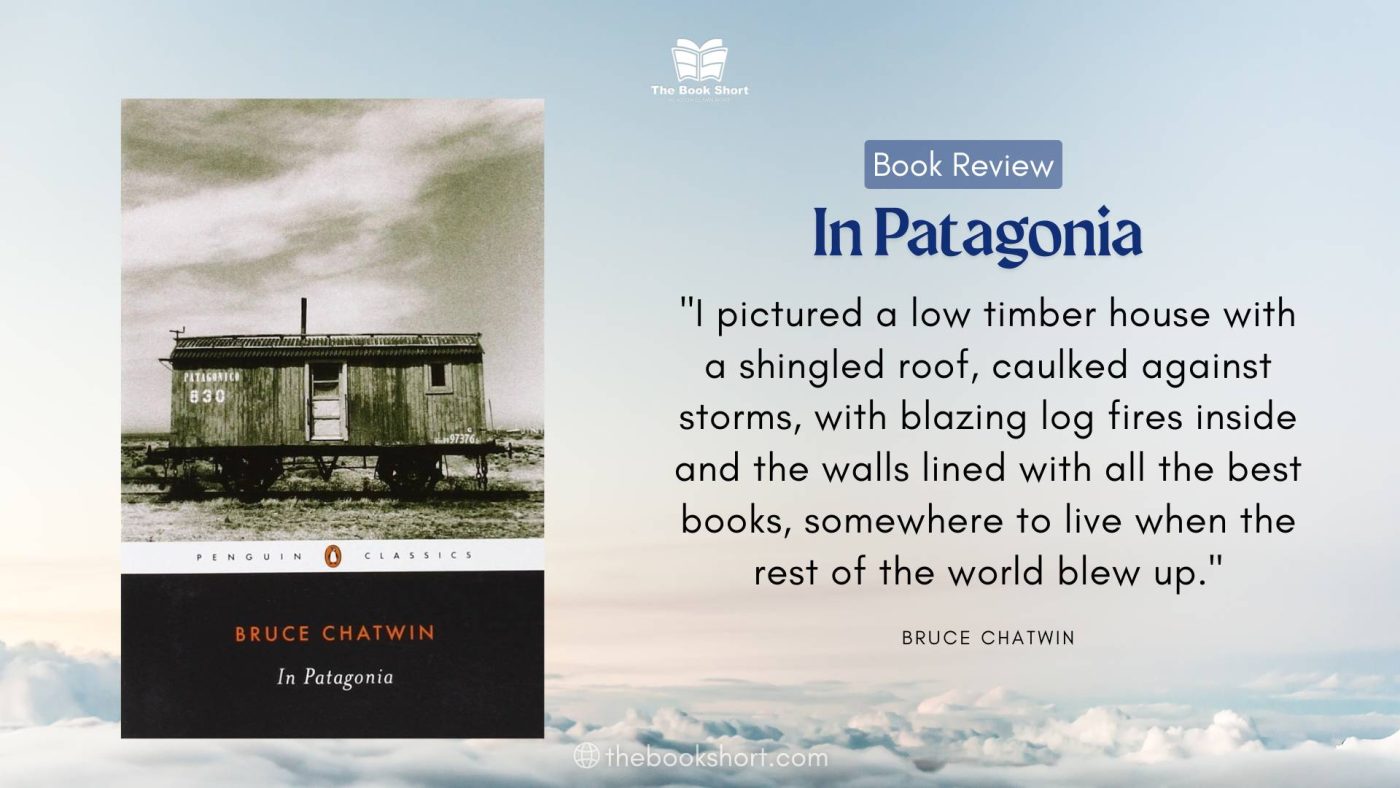
Explore Patagonia’s mysteries with Chatwin’s classic journey. Dive into a land of nomads, exiles, and tall tales that defies easy definition.
Embark on a literary journey to the ends of the Earth. Bruce Chatwin’s In Patagonia isn’t just a travelogue; it’s a tapestry of history, myth, and human eccentricity. Explore why this classic defies categorization. I chose this book for analysis because its fragmented structure, blend of fact and fiction, and captivating prose offer a unique lens through which to view both travel writing and the nature of storytelling itself. Its enduring appeal lies in its mystery and the evocative power of its language.
Basic Information about In Patagonia
- Title: In Patagonia
- Author: Bruce Chatwin
- Year of publication: 1977
- Genre: Travel Literature / Non-fiction (with elements of fiction)
- Number of pages: Varies by edition, typically around 200-250
- Target audience: Readers interested in travel, history, geography, literature, cultural studies, and unconventional narratives.
Summary of In Patagonia’s Journey
Bruce Chatwin’s In Patagonia book summary is less a linear travelogue and more a collection of interconnected vignettes, historical anecdotes, and character sketches drawn from his journey through the remote South American region of Patagonia. The narrative is structured not by chronology or geography in a straightforward sense, but by thematic links and Chatwin’s own associative process, creating a rich, albeit fragmented, tapestry of the land and its inhabitants.
The impetus for Chatwin’s journey dates back to his childhood fascination with a piece of fossilized skin belonging to a giant sloth, reportedly kept in his grandmother’s cabinet and supposedly brought back by his cousin, Charles Milward, who had lived in Patagonia. This relic serves as a tangible link to the distant land and sparks a lifelong desire to see it for himself.
Chatwin begins his travels in Argentina, eventually making his way south towards the tip of the continent. Rather than providing detailed descriptions of landscapes or tourist attractions, the book focuses almost entirely on the people Chatwin encounters and the stories they tell him, interwoven with historical tangents and biographical details about past figures connected to the region.
Encounters and Stories
Chatwin meets a diverse cast of characters, each offering a piece of the Patagonian puzzle. These include:
- Descendants of Welsh settlers who established colonies in the Chubut Valley in the 19th century, seeking religious freedom and a new life. Chatwin explores their struggle to maintain their language and culture in an isolated land.
- Exiles, fugitives, and individuals living on the fringes of society. Patagonia, with its vast emptiness and perceived end-of-the-world status, has historically attracted those seeking refuge, anonymity, or a fresh start.
- Local residents with unique histories, including ranchers, shopkeepers, and labourers, many of whom have complex or mysterious pasts.
Through conversations with these people, Chatwin gathers a wealth of anecdotes and historical details. He delves into:
- The stories of famous outlaws like Butch Cassidy and the Sundance Kid, who briefly hid out in Patagonia.
- The voyages of early explorers like Magellan and Darwin, who charted the coast and studied its unique flora and fauna.
- The experiences of lesser-known pioneers, adventurers, and rogues who left their mark on the land.
- The folklore and myths of both indigenous peoples and later settlers.
Structure and Style
The book is divided into 97 short, often very short, chapters. This fragmented structure mirrors the elusive nature of Patagonia and its history. Each chapter functions almost like a standalone vignette or sketch, yet they are linked by recurring themes: movement, rootlessness, exile, the search for origins, the tension between civilization and wilderness, and the nature of truth and storytelling itself.
Chatwin rarely provides explicit geographical context or his own emotional reactions. He acts more as a collector of stories and facts, presenting them in a spare, detached, yet deeply evocative prose style. The journey is internal and historical as much as it is physical. He travels not just through space but through time, excavating layers of history, rumour, and personal mythology that cling to the Patagonian landscape.
The book is notorious for blurring the lines between fact and fiction. Chatwin was known to embellish or invent details, condensing characters, dialogues, and events for narrative effect. This deliberate ambiguity adds another layer to the In Patagonia book analysis, raising questions about the reliability of memory, history, and the travel writer’s craft.
In essence, In Patagonia is a mosaic portrait of a remote region, pieced together from the lives and legends of its inhabitants and the echoes of its past. It is a book about place defined by its people and stories, a meditation on the human condition of wandering and belonging, set against the vast, stark backdrop of the South American south.
An In-Depth Analysis of In Patagonia
An In Patagonia book analysis quickly reveals that this is not conventional travel writing. Bruce Chatwin subverts the genre, using his journey as a framework to explore deeper, more abstract themes.
Characters / Structure / Key Arguments
The “characters” are primarily the people Chatwin encounters or reads about – a gallery of eccentrics, survivors, and dreamers. They are fleetingly glimpsed but vividly rendered, each a repository of personal history and Patagonian lore. There isn’t a main protagonist in the traditional sense; Chatwin himself remains a detached observer, a collector of narratives.
The structure is the book’s most distinctive feature. The 97 short chapters create a non-linear, associative flow. This fragmented form is deliberate. It mirrors the vast, disconnected landscape and suggests that the truth of Patagonia is not a single narrative but a constellation of disparate stories, rumours, and facts. It feels like wandering through a landscape where history and myth are scattered like fossils.
Key arguments or themes aren’t explicitly stated but emerge through the cumulative effect of the anecdotes:
- Rootlessness and Exile: Patagonia is a land of exiles and wanderers. Chatwin explores the human need to belong versus the impulse to flee or explore, a theme perhaps reflecting his own nomadic tendencies.
- The Nature of History and Storytelling: The book constantly questions the veracity of the stories it presents. It highlights how history in a place like Patagonia is often a mix of documented fact, oral tradition, rumour, and deliberate invention. This challenges the reader to consider how we construct narratives about the past and places.
- The Search for Origins and Authenticity: From the fossil sloth skin to the Welsh settlers seeking a pure community, characters are often driven by a search for something foundational, whether it’s a lost past or a true identity.
- The Power of Place: Despite focusing on people, the stark, empty landscape of Patagonia looms large, shaping the lives and stories of those within it. It’s a place that seems to strip away artifice and reveal something fundamental about human nature.
Writing Style & Content Quality
Chatwin’s writing style is renowned for its clarity, conciseness, and evocative power. His prose is spare, almost minimalist, yet capable of conjuring vivid images and complex characters with just a few strokes. He has a journalist’s eye for detail combined with a poet’s ear for language. He avoids sentimentality and excessive description, letting the stark facts and strange stories speak for themselves. This controlled, precise language contributes significantly to the book’s unique atmosphere – a sense of cool observation combined with underlying fascination.
The content quality is high in terms of literary merit and intellectual stimulation. Chatwin seamlessly weaves together history, geography, anecdote, and personal reflection (though the reflection is often implied). The breadth of his research, from obscure historical texts to chance conversations, is impressive. However, the quality is contentious regarding factual accuracy, as Chatwin freely admitted to taking liberties. This deliberate blurring is part of the book’s artistic statement, but it means In Patagonia cannot be read as a straightforward historical or geographical account.
Notable quotes from the book
- “To the South the country was brown and yellow, with long bluffs and wind-blown thistles. It reminded me of Kansas, or parts of Arizona: empty, flat country needing a horizon to give it scale.” (Early descriptive passage setting the scene)
- “A man must carry his landscape around with him.” (Reflecting on identity and place)
- “History, I suspect, is no more than a string of anecdotes.” (Underscoring the book’s approach to the past)
- “The desire to travel is a symptom of a deeper longing.” (Hinting at the underlying search that drives many characters, including perhaps the author)
What stands out or differs from other books in the same genre is precisely this fusion of meticulous detail (whether real or invented) with a fragmented structure and a deliberate ambiguity about truth. Most travelogues aim for a degree of objective reporting and a clear authorial voice reflecting on their experiences. Chatwin offers neither in a conventional sense. He presents a collage, forcing the reader to participate in assembling meaning from the disparate pieces. This experimental approach elevated travel writing into a more literary and philosophical realm.
Evaluation & Expert Personal Review
Reading In Patagonia is a unique experience, often challenging yet deeply rewarding. My personal impression is that its greatest strength lies in its captivating prose and its ability to evoke a powerful sense of place through its people and stories, rather than through geographical description. The sparse, elegant writing pulls you into a world that feels both alien and strangely familiar, populated by fascinating, often eccentric, individuals.
One major advantage is the sheer density of intriguing information and anecdote packed into its relatively short length. Every chapter offers a new historical tidbit, a quirky character, or a strange fact, making it feel much richer than many longer books. Chatwin’s style is addictive once you settle into its rhythm. The book is also a profound meditation on themes like identity, history, and wandering, offering much to ponder beyond the travel narrative.
The main disadvantage for some readers will be the fragmented structure and the deliberate ambiguity regarding fact versus fiction. It’s not a book to read if you want a straightforward guide or a clear, chronological account of a journey. The constant shifts in time, place, and subject matter can be disorienting, and the lack of a clear narrative arc might frustrate readers accustomed to more conventional storytelling. The ethical questions surrounding Chatwin’s factual liberties also warrant consideration, though they don’t necessarily detract from the book’s artistic merit.
The readability level is moderate. While the prose itself is clear and accessible, the non-linear structure and the sheer volume of names, places, and historical references require attentive reading. It’s not a passive read; it demands engagement from the reader to piece together the connections.
Who the book is suitable for: In Patagonia is best suited for readers who enjoy literary non-fiction, appreciate distinctive writing styles, and are interested in history, culture, and the human condition. It will appeal to those who like books that blur genres and challenge conventional narrative forms. It’s ideal for someone looking for something off the beaten path in travel literature, perhaps students of literature or history, or simply curious minds open to unconventional storytelling.
The practical value of In Patagonia isn’t in providing travel tips or a guide to the region. Instead, its value lies in its capacity to change your mindset about history, place, and storytelling. It teaches you to look for the extraordinary in the ordinary, to question accepted narratives, and to appreciate the richness found in the margins of maps and societies. It instills a sense of curiosity and a fascination with the hidden histories and lives that shape a place, encouraging a more nuanced and imaginative way of seeing the world.
Comparison with Similar Books In Patagonia
In Patagonia book review often places it within a lineage of literary travel writing that prioritizes atmosphere, character, and historical depth over practical information. While distinct, it shares kinship with works that explore the interplay between place, history, and human experience.
Compared to traditional travelogues focused on description and personal reflection (like those by Jan Morris), Chatwin is far more detached and historical. Compared to historical accounts of travel or exploration (like those detailing Darwin’s voyages), Chatwin is more focused on anecdotal history and contemporary lives.
If readers liked the unique blend of history, character, and distinctive prose in In Patagonia, they might also enjoy:
- The Songlines by Bruce Chatwin: Another of Chatwin’s works, exploring indigenous Australian beliefs about creation, movement, and territory, using a similar blend of travel, history, and philosophy.
- Travels with Charley: In Search of America by John Steinbeck: While more conventional in structure, Steinbeck’s journey across America in a camper truck also focuses heavily on conversations with diverse Americans and reflections on the state of the nation, though in a more overtly personal style.
- The Golden Bough by James George Frazer: While an academic work on myth and religion, its encyclopedic collection of disparate cultural practices and beliefs presented in a mosaic structure can feel surprisingly akin to Chatwin’s method of building a picture from countless small pieces. (A less direct comparison, but relevant to the structural approach).
- The Great Railway Bazaar by Paul Theroux: A classic literary travelogue, though more focused on the author’s direct experiences and observations, it shares a keen eye for character and the absurdities of travel, though less steeped in deep historical tangents than Chatwin.
In Patagonia‘s unique structure and method mean it doesn’t have many direct parallels, but these books share some thematic or stylistic DNA that readers who appreciate Chatwin’s work might find appealing.
Conclusion & Recommendations
In Patagonia book analysis reveals its outstanding value lies in its groundbreaking approach to travel writing. It is not merely a description of a place but a profound exploration of history, memory, rootlessness, and the very nature of storytelling. Chatwin’s sparse, evocative prose creates a vivid, unforgettable portrait of a remote land defined by its eccentric inhabitants and tangled pasts.
Is it worth reading? Absolutely, for the right reader. It’s a classic of 20th-century literature that defies easy categorization and offers layers of meaning upon re-reading.
Who should read it? Anyone interested in the intersection of history, geography, literature, and philosophy. Readers who enjoy unconventional narratives, appreciate concise and beautiful writing, and are fascinated by stories from the fringes of the world will find it deeply rewarding. It’s not a book for those seeking a conventional travel guide or a simple, straightforward read, but for those open to being challenged and captivated by a unique literary voice and structure.
Have you read this book? Share your thoughts in the comments below!