
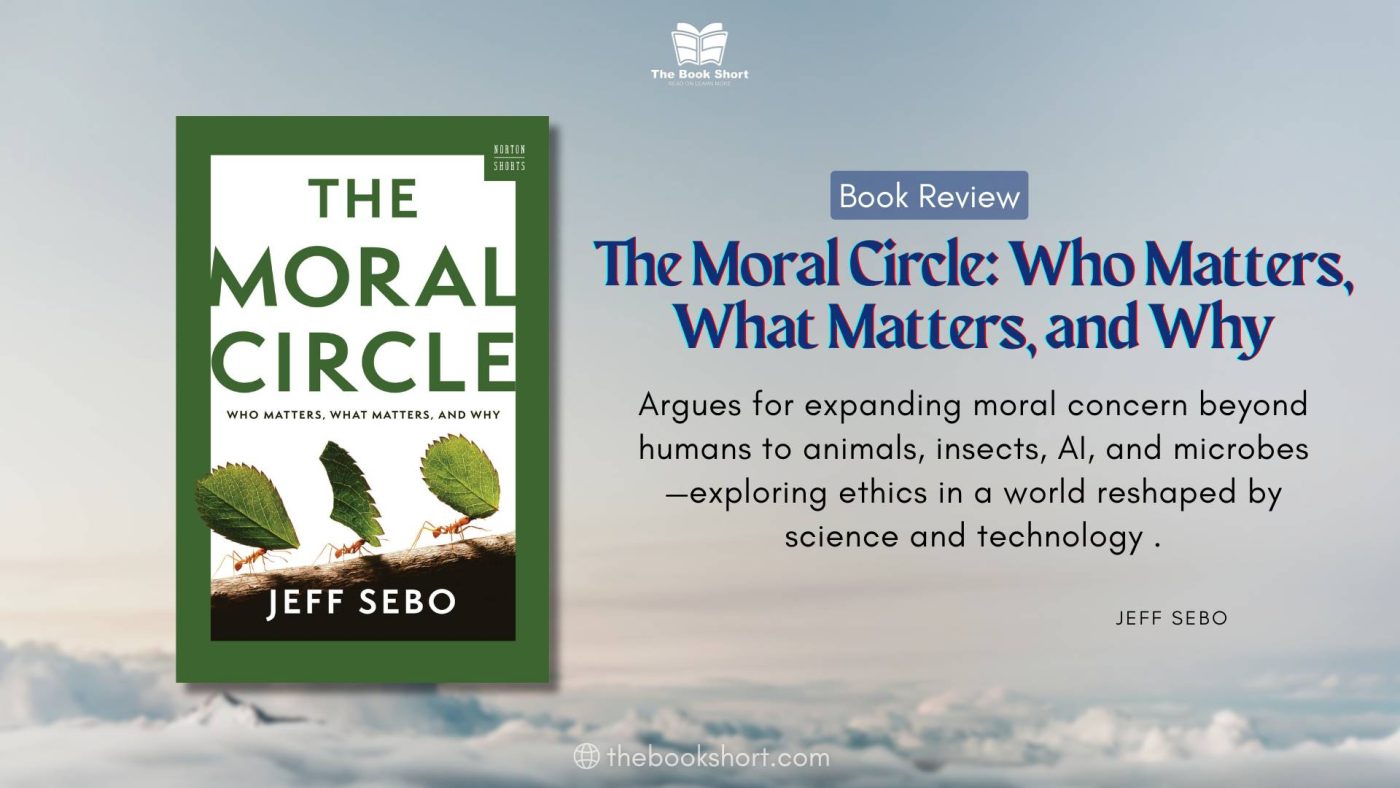
Exploring who and what deserves moral consideration isn’t just an academic exercise; it’s a question that shapes societies and defines our responsibilities. Jeff Sebo’s The Moral Circle: Who Matters, What Matters, and Why steps forward as a clear, systematic guide through this complex ethical terrain, gently but firmly prompting readers to re-examine the boundaries of their compassion and sense of justice.
Basic Information About The Moral Circle: Who Matters, What Matters, and Why
- Title: The Moral Circle: Who Matters, What Matters, and Why
- Author: Jeff Sebo
- Year of publication: 2021
- Genre: Philosophy, Ethics, Non-fiction
- Number of pages: Approximately 200 pages (varies slightly by edition)
- Target audience: Students and scholars of ethics, individuals deeply interested in animal welfare ethics, environmental ethics, and applied philosophy, as well as general readers seeking a clear introduction to moral philosophy.

The Moral Circle: Who Matters, What Matters, and Why (A Norton Short)
Main Content Summary: Understanding The Moral Circle Book
Jeff Sebo’s The Moral Circle serves as an accessible yet philosophically robust introduction to the crucial concept of moral considerability – the vital question of which individuals, groups, or entities inherently warrant direct moral concern and ethical standing. Structuring the book around the title’s foundational questions – Who Matters, What Matters, and Why – Sebo expertly guides readers on a reflective journey, encouraging them to understand and perhaps thoughtfully expand their own “moral circle,” the conceptual boundary enclosing those beings or entities they believe possess moral status and deserve protection or promotion.
The book artfully dissects the intricate landscape of moral philosophy concerning status into digestible segments. It begins by defining the moral circle itself and underscoring the profound stakes involved in determining its limits. Sebo compellingly argues that clarifying these fundamental moral commitments is not merely theoretical but essential for grappling effectively with pressing contemporary ethical challenges, spanning issues from animal rights and environmental stewardship to human rights and the emerging complexities of artificial intelligence.
Part 1: Who Matters? Exploring Criteria for Moral Inclusion
Sebo dedicates significant attention to meticulously examining the diverse criteria philosophers and societies have historically used, or could use, to determine precisely who falls within the bounds of moral concern. He presents and thoughtfully critiques several potential candidates for moral status, exploring their philosophical strengths, inherent weaknesses, and practical implications as bases for moral considerability.
- Species Membership: This criterion centers on the idea that only members of the human species inherently possess moral status. Sebo delves into the concept of speciesism, critically discussing why relying solely on species membership is frequently challenged as an arbitrary or discriminatory foundation for moral worth.
- Cognition and Consciousness: A widely debated criterion focusing on mental capacities. Sebo explores various levels of cognitive ability, such as sentience (the capacity to experience pleasure and pain), consciousness (a broader awareness of oneself and the environment), rationality, self-awareness, and the use of complex language. He carefully lays out arguments for why sentience, in particular, is often posited as a powerful, if not sufficient, basis for moral considerability, given its direct link to well-being and suffering.
- Relationships: This perspective proposes that moral status doesn’t reside solely in intrinsic properties but can arise from relational bonds, such as being part of a community, possessing social connections, or being dependent on others. Sebo examines how this shifts the ethical focus from the individual’s internal state to their external connections.
- Potentiality: The argument that possessing the potential for certain capacities (e.g., a fetus’s potential to develop into a rational, self-aware adult) can confer moral status. Sebo navigates this complex concept, frequently central to deeply divisive debates regarding the moral standing of fetuses or individuals with profound cognitive impairments.
- Being Alive: A more expansive criterion suggesting that all living things, regardless of their biological complexity or sentience, hold some intrinsic moral status simply by virtue of being alive. Sebo introduces readers to biocentric ethics and explores the far-reaching implications of valuing life itself as a basis for moral concern.
Crucially, Sebo refrains from definitively endorsing any single criterion in this section. Instead, his objective is to empower readers to critically evaluate each proposed basis for moral inclusion, carefully considering the arguments supporting and challenging it, and reflecting on the vastly different ethical landscapes that emerge depending on where the moral circle is drawn. He highlights how distinct criteria lead to dramatically different conclusions about the moral standing of non-human animals, plants, entire ecosystems, future generations, and even potential artificial entities.
Part 2: What Matters? Values, Well-being, and Moral Theories
Moving beyond the question of who matters, Sebo pivots to the equally critical question of what matters morally for those individuals or entities deemed to be within the moral circle. This section explores the diverse ethical frameworks, values, and concepts that inform our moral obligations and considerations towards those with moral status.
- Well-being: A cornerstone for many ethical theories, well-being broadly refers to the state of an individual’s life going well or poorly. Sebo discusses various conceptions of well-being (e.g., hedonistic pleasure/pain, the satisfaction of preferences, objective lists of goods necessary for a good life) and explains why protecting or promoting well-being is a universally recognized moral concern for those within the moral circle.
- Rights: The powerful concept that individuals possess fundamental entitlements or valid claims against others, such as the right to life, liberty, or freedom from suffering. Sebo clarifies how attributing rights is often contingent upon whether an individual or entity is considered to have sufficient moral status to be a rights-holder.
- Virtue: Focusing on character, disposition, and moral excellence, virtue ethics emphasizes cultivating good traits like compassion, fairness, honesty, and respect, and acting in accordance with them. Sebo touches on how developing such virtues profoundly shapes our interactions and attitudes towards others both inside and outside our current moral circle.
- Relationships and Community: Echoing the discussion in Part 1 on who matters through relationships, Sebo revisits the idea that valuing relationships, the health of communities, and social bonds constitute crucial aspects of what matters morally, adding another layer of ethical concern.
Sebo skillfully connects these diverse values and ethical concepts back to the criteria for who matters, illustrating how different combinations of inclusion criteria and value systems can generate a wide spectrum of ethical perspectives and lead to significantly varied practical conclusions. He avoids advocating for a single, dominant ethical theory, instead presenting a nuanced, pluralistic view of the landscape of moral considerations.
Part 3: Why Matters? Moral Arguments and Expanding the Circle
The final part of the book shifts focus to the dynamic and argumentative aspects of the moral circle. Sebo delves into the practical process of moral reasoning, exploring how we construct and evaluate moral arguments, and the fascinating ways in which moral circles have historically expanded and might continue to grow.
- Moral Arguments and Reasoning: Sebo provides a clear primer on how to build and critically assess moral arguments, stressing the vital importance of clear definitions, logical consistency, and the careful consideration of relevant evidence and facts. He identifies common logical fallacies and biases in moral reasoning and offers guidance on how to avoid them for clearer ethical thinking.
- Expanding the Circle: Drawing lessons from significant moments of moral progress throughout history (e.g., the abolition of slavery, movements for women’s suffrage, the Civil Rights movement), Sebo examines the patterns and drivers behind the historical expansion of moral circles to include previously excluded groups. He discusses both psychological factors (like increased empathy and exposure) and philosophical imperatives (like demands for logical consistency and fairness) that propel this expansion.
- Addressing Challenges: Sebo realistically acknowledges the inherent difficulties, complexities, and potential conflicts that arise when attempting to expand the moral circle in practice. These include genuine conflicts of interest (e.g., balancing immediate human needs against animal welfare concerns or environmental protection), practical limitations on resources and action, and deep disagreements on the foundational criteria and values discussed earlier. He encourages thoughtful deliberation, pragmatic problem-solving, and seeking common ground where possible.
Throughout The Moral Circle, Sebo employs relatable examples, thought-provoking analogies, and hypothetical scenarios (like interactions with intelligent aliens or advanced AI) to illuminate complex philosophical concepts and make them tangible. He maintains a commendably neutral stance on many controversial ethical issues, aiming instead to equip readers with the intellectual tools necessary to think rigorously and critically about these questions for themselves. The book serves fundamentally as a guide for personal ethical reflection, encouraging readers to scrutinize their own assumptions about who and what deserves moral consideration and the reasons behind those beliefs. By providing such a clear, systematic framework and exploring a diverse array of perspectives, Sebo effectively empowers readers to engage more deeply and confidently with the ethical challenges of the modern world, potentially inspiring them to thoughtfully redraw the boundaries of their own moral universe.
In-depth Analysis of The Moral Circle by Jeff Sebo
Jeff Sebo’s The Moral Circle distinguishes itself remarkably within the landscape of applied ethics through its exceptional clarity, meticulously systematic structure, and profoundly balanced approach to questions of moral standing. The book functions less as a polemic advocating for a particular moral viewpoint and more as an illuminating and comprehensive toolkit for understanding the fundamental philosophical debates underpinning moral considerability and ethical obligations.
Key Strengths in Structure, Approach, and Argument
Sebo’s core project isn’t to prescribe where everyone should draw their moral circle, but rather to vividly illustrate the process of deciding, the criteria involved, and to build a compelling case for the critical importance of engaging in this fundamental deliberation. He argues persuasively that thinking rigorously, clearly, and consistently about who and what matters, and the reasons why, is absolutely foundational to addressing the vast spectrum of ethical challenges we face today.
The book’s architectural structure is arguably its most brilliant feature. By organizing the entire discussion around the three deceptively simple yet profound core questions – Who Matters, What Matters, and Why – Sebo creates a highly intuitive and logical progression that mirrors the very journey one might undertake when confronting a complex moral issue.
- Who Matters? lays the essential groundwork by presenting the potential candidates for moral consideration and meticulously dissecting the various criteria used for inclusion or exclusion. This section is vital for establishing the potential scope of our moral concern.
- What Matters? fluidly transitions to exploring the kinds of moral value, importance, and specific obligations we might attribute to those individuals or entities once they are included within the moral circle. This moves the reader from simply identifying subjects to understanding the nature of our duties towards them.
- Why Matters? addresses the crucial meta-ethical questions concerning the justification for our moral beliefs and explores the psychological and philosophical dynamics through which moral circles expand, contract, or otherwise change over time. This is the section focused on moral reasoning, argumentation, and the fascinating phenomenon of moral progress.
This tripartite structure makes the book exceptionally accessible, even to readers with no prior background in philosophy. Readers are not overwhelmed by dense theoretical debates but are instead gently guided, step-by-step, through the most foundational questions. Sebo demonstrates a rare talent for presenting distinct and often conflicting philosophical positions (e.g., various conceptions of sentience, different ethical theories) without descending into obscure jargon or getting lost in the intricate historical context of specific philosophers. He possesses a remarkable ability to distill complex, abstract ideas into their core components, rendering them understandable and relatable to a wide audience.
A powerful, albeit often implicit, argument Sebo makes throughout the book is that inconsistencies and potential biases frequently lie hidden in people’s moral intuitions precisely because they haven’t explicitly examined or articulated the criteria they are using for moral inclusion. By clearly laying out the various criteria and prompting readers to consider their implications, he subtly yet effectively encourages readers to identify and potentially resolve these inconsistencies within their own personal moral frameworks.
Writing Style & Content Quality Assessment
Sebo’s writing style is a standout feature: remarkably clear, refreshingly concise, and largely free of the dense jargon that often makes philosophical texts intimidating. He employs straightforward language, draws upon relatable real-world examples, and utilizes hypothetical scenarios effectively to illustrate abstract and potentially counter-intuitive concepts. This makes The Moral Circle exceptionally readable and an ideal entry point for newcomers to ethical philosophy.
- Clarity: Sebo’s prose is direct and precise. Arguments are carefully built step-by-step, and complex ideas are skillfully broken down into simpler, understandable terms without oversimplification.
- Balance and Neutrality: Sebo is a master of presenting multiple perspectives fairly and objectively. He allows different arguments regarding speciesism, the role of sentience, relational ethics, etc., to speak for themselves, enabling the reader to weigh the evidence and reasoning presented. While his own inclinations might become apparent, his primary goal is clearly to equip the reader for independent thought, not to recruit them to a specific cause.
- Engaging Examples: The book is thoughtfully populated with diverse and compelling examples involving familiar animals (pets, farm animals), wild creatures, imaginative hypothetical scenarios (e.g., sentient AI, contact with extraterrestrial life), and compelling comparisons to historical shifts in moral consciousness. These ground the abstract philosophical discussions in concrete, thought-provoking contexts.
- Logical Flow: The progression of chapters follows a natural, cumulative logic, building understanding incrementally from the foundational question of who to the dynamics of why moral views change.
The content quality is consistently high. It accurately represents key ethical concepts and major debates surrounding moral status and value. While it doesn’t claim to provide exhaustive detail on every permutation of every philosophical argument, it offers a sufficiently robust and accurate overview that fully serves its stated purpose: to help readers clarify and refine their own thinking about moral boundaries.
What Makes The Moral Circle Stand Out?
Compared to many traditional academic texts on ethics, animal ethics, or environmental philosophy, The Moral Circle feels distinct and fresh for several compelling reasons:
- The Centrality of the “Circle” Metaphor: While the idea of expanding our moral concern is not entirely novel (famously discussed by thinkers like Peter Singer), Sebo structures his entire book explicitly around the concept of the “moral circle” – dissecting its boundaries, potential inhabitants, governing values, and the process of its change. This makes the core theme exceptionally focused, tangible, and easy for readers to grasp and apply to their own thinking.
- Unparalleled Accessibility for a Broad Audience: Unlike many philosophical works that presume significant prior knowledge or are written in dense, academic prose, Sebo’s book makes the profound questions of moral considerability genuinely accessible to anyone willing to engage in thoughtful reflection.
- Systematic Analysis of Criteria: The detailed breakdown and comparative analysis of the various potential criteria for moral status presented in the “Who Matters?” section is particularly strong and provides readers with a clear, adaptable framework for evaluating different arguments encountered in applied ethics debates.
- Emphasis on Process and Reasoning: The inclusion and depth of the “Why Matters?” section, which focuses on the how-to of moral deliberation, argumentation, and the dynamics of moral progress, is a crucial and often underdeveloped aspect in introductory ethical texts that tend to focus more heavily on describing different ethical theories.
Reflecting on Notable Themes (Likely Quotes)
While I don’t have access to the specific text to pull exact quotes, based on the book’s structure, themes, and Sebo’s known clarity, powerful and memorable quotes likely revolve around:
- The fundamental nature of the question: “Perhaps the most important question we can ask ourselves is, ‘Who matters?'”
- The stakes involved: “Where we draw the moral circle has profound implications for how we live and how we treat others.”
- The core criterion of sentience: “If a being is capable of suffering, is that not reason enough for their well-being to matter?”
- Highlighting potential inconsistencies: “We often feel intuitively that some beings matter more than others, but are the reasons we give logically consistent?”
- The potential for growth and change: “Moral progress often involves recognizing that beings we once excluded deserve full inclusion within our circle of concern.”
These anticipated quotes reflect Sebo’s direct, question-oriented approach and his commitment to prompting deep personal reflection in the reader.
In summary, Jeff Sebo’s The Moral Circle is a highly effective, engaging, and profoundly useful guide to one of philosophy’s most enduring and pressing questions. Its immense strength lies in its clear conceptual structure, accessible language, balanced presentation of diverse viewpoints, and its ultimate focus on equipping readers with the intellectual tools necessary to think for themselves about the boundaries and contents of their moral world. It is, at its heart, a book designed to empower individuals to engage in more thoughtful, consistent, and expansive ethical reflection.
Evaluation & Expert Personal Review of The Moral Circle
Jeff Sebo’s The Moral Circle is, in my assessment, a genuinely outstanding example of accessible, applied philosophy. My personal impression after engaging with its core ideas is overwhelmingly positive, particularly regarding its exceptional clarity, its elegant and systematic approach, and its admirable balance in navigating a topic that can quickly become intellectually overwhelming or emotionally fraught. The book successfully manages to feel less like a dry academic treatise or a forceful persuasive argument, and more like an illuminating, trustworthy map guiding the reader through the essential ethical landscape surrounding moral considerability.
Distinct Advantages:
- Exceptional Clarity and Accessibility: This is arguably the book’s single greatest strength. Sebo possesses a rare and valuable gift for distilling complex philosophical concepts, intricate arguments, and abstract ideas into language that is simple, direct, and entirely unambiguous without sacrificing nuance.
- Logically Elegant Structure: The “Who, What, Why” framework isn’t just a clever organizing principle; it provides a highly effective and intuitive pathway through the material that mirrors the very process of ethical inquiry. It allows readers to build understanding incrementally.
- Admirable Balance and Objectivity: Sebo is remarkably even-handed and fair in presenting different criteria for moral status and various ethical perspectives. He genuinely allows the reader to weigh the arguments and consider their implications, minimizing overt authorial bias and fostering independent thought.
- Direct Practical Relevance: The fundamental questions addressed in The Moral Circle are directly and urgently relevant to many of the most significant contemporary ethical debates – from animal welfare and environmental conservation to the ethics of artificial intelligence and human rights. The book provides a robust framework for thinking through these real-world issues more effectively.
- Empowering Reader Agency: Crucially, the book does not dictate answers. Instead, it provides readers with the essential tools, frameworks, and questions necessary to clarify, challenge, and construct their own informed moral beliefs and perspectives. It encourages active, personal ethical deliberation.
Considered Disadvantages:
- Depth vs. Breadth Trade-off: In its admirable pursuit of accessibility and breadth across various criteria and values, the book necessarily provides overviews rather than deep dives into specific philosophical arguments or historical contexts. Readers seeking detailed critiques of Kant, intensive analysis of specific utilitarian calculations, or comprehensive historical surveys of philosophical thought on a single criterion might find it introductory in that sense.
- Neutrality Can Challenge Some Readers: For readers approaching the book with a strong pre-existing position or those seeking definitive answers or a clear moral stance from the author, Sebo’s deliberate neutrality and focus on exploration in the initial sections might feel less satisfying than a more argumentative approach. However, this very neutrality is precisely what makes it such a valuable tool for self-discovery and critical evaluation.
Readability Level and Ideal Suitability:
The readability of The Moral Circle is exceptionally high, particularly for a book tackling such profound ethical questions. It requires no prior philosophical training, only an open mind and a willingness to think critically about fundamental concepts. It is eminently suitable for:
- Complete Beginners in Philosophy: An outstanding and unintimidating first book for anyone curious about moral philosophy, especially applied ethics and the concept of moral status.
- Students: Excellent supplementary reading for introductory ethics courses, courses focusing on animal ethics, environmental ethics, or contemporary applied ethics. It provides a strong conceptual foundation.
- General Readers: Anyone interested in thinking more deeply and clearly about their relationships with animals, the environment, or the broader scope of ethical responsibility in a complex world will find it accessible and deeply thought-provoking.
- Advocates and Activists: Individuals involved in advocacy work for animals, the environment, or human rights can use the book’s framework to articulate their own arguments more clearly, understand the philosophical underpinnings of their cause, and better understand and engage with opposing viewpoints.
Its greatest strength is its ability to invite anyone into the conversation, regardless of their background.
Profound Practical Value and Potential Impact:
The practical value and potential impact of reading The Moral Circle are considerable:
- Sharpens and Clarifies Thinking: The book forces readers to move beyond vague intuitions and articulate the specific criteria they implicitly use to determine who and what matters morally in their own lives, often revealing previously unexamined assumptions or inconsistencies.
- Enhances Moral Reasoning Skills: By clearly explaining the components of moral arguments and common pitfalls, it provides readers with concrete tools to engage in more rigorous, logical, and thoughtful ethical deliberation in any context.
- Broadens Perspective and Empathy: Simply by systematically presenting and exploring criteria for moral standing beyond the familiar (like species or rationality), such as sentience, relationships, or simply being alive, the book encourages readers to genuinely consider the moral claims of beings and entities they might not have previously considered, fostering a potentially wider circle of empathy and concern.
- Facilitates Constructive Dialogue: Understanding the different fundamental criteria and values that lead people to hold differing ethical views on contentious issues (like animal testing, dietary choices, conservation policy, or the ethics of AI) is essential for engaging in more productive and less adversarial discussions.
- Serves as a Foundation for Action: For many readers, achieving greater clarity on who and what matters morally serves as a necessary and powerful foundation for deciding how to live, what actions to take, and which causes to support. This clarity can be a catalyst for significant personal changes in behavior, consumption habits, political engagement, and overall ethical focus.
Ultimately, The Moral Circle doesn’t offer simple prescriptive answers, but it provides the indispensable conceptual map and the essential intellectual tools needed to navigate complex ethical questions more effectively, more consciously, and with greater integrity. It encourages a profound shift from reactive, potentially inconsistent moral responses to a more reasoned, consistent, and deeply considered ethical framework.
Comparison with Similar Books on Ethics
The Moral Circle sits within the broader landscape of philosophical literature addressing animal ethics, environmental ethics, and applied philosophy, but its unique contribution lies in its singular, focused examination of the process, criteria, and dynamics of moral considerability itself, rather than primarily serving as an advocacy piece for a specific group (like animals) or a defense of a single ethical theory (like utilitarianism or deontology).
- Compared to Peter Singer’s Animal Liberation: Singer’s landmark book is a powerful, foundational text that compellingly argues for expanding the moral circle specifically to include non-human animals, primarily based on the criterion of sentience and utilizing a broadly utilitarian ethical framework. Sebo’s book discusses Singer’s arguments respectfully but presents them as one significant perspective among several others, including criteria like consciousness beyond mere sentience, the importance of relationships, and the concept of rights, exploring various value systems (well-being, rights) in addition to utilitarian considerations. Sebo’s scope regarding who and what might matter is explicitly broader, and his focus is more on the how of ethical deliberation (the meta-ethical question of how we decide) rather than direct advocacy for a specific group or cause.
- Compared to Standard Environmental Ethics Texts: Many core environmental ethics texts tend to focus on the moral status of non-individual entities like ecosystems, species, or the environment as a whole (often termed holistic or biocentric approaches). While Sebo touches upon these perspectives when discussing criteria like ‘being alive’ or the value of ecological relationships and systems, his primary focus remains rooted in evaluating the potential moral status of individuals or types of entities based on their properties (like sentience, cognition, etc.), aligning more closely with the methodology often seen in animal ethics than in some forms of deep ecology.
- Compared to General Introductory Ethics Textbooks: While covering some overlapping foundational concepts (e.g., moral status, different types of value, overviews of theories), The Moral Circle is far more thematic, focused, and accessible than a typical comprehensive textbook. Its entire structure revolves around the central, unifying concept of the “moral circle,” making it a more engaging and less daunting read for a general audience or as a supplementary text focused specifically on the question of moral status.


If readers found The Moral Circle compelling and useful, they might also appreciate exploring:
- Animal Liberation by Peter Singer: For a classic, highly influential, and powerful argument specifically focused on extending moral consideration to animals based on their capacity to suffer.
- Practical Ethics by Peter Singer: A broader application of clear, analytical ethical reasoning to a range of contemporary moral issues, including animal welfare, environmental concerns, and global poverty, showcasing the ‘why’ of moral reasoning in practice.
- Eating Animals by Jonathan Safran Foer: A more narrative, personal, and emotionally resonant exploration of the ethical questions surrounding dietary choices, particularly factory farming, prompting readers to consider the ‘what matters’ in relation to how we source food.
- Speciesism by Joan Dunayer: Offers a dedicated philosophical critique of speciesism and a defense of animal rights, providing a deeper dive into arguments against human exceptionalism, complementing Sebo’s discussion of this criterion.
- The Conscious Instinct by Jay Schulkin: Explores the scientific underpinnings of consciousness, feeling, and behavior across different species, offering relevant background science that connects to the ‘cognition and consciousness’ criterion Sebo discusses.
These suggested readings offer either deeper philosophical engagement with specific areas Sebo touches upon (like animal ethics or the science of consciousness) or examples of applying similar styles of clear, accessible ethical reasoning to other important contemporary issues.
Conclusion and Recommendations
The Moral Circle: Who Matters, What Matters, and Why by Jeff Sebo is, without reservation, an exceptionally valuable and timely book for anyone grappling with, or simply curious about, the fundamental ethical question of moral considerability. Its profound value lies in its remarkable ability to distill complex philosophical debates into an accessible, intuitive, and systematic framework, providing readers with the intellectual clarity and practical tools needed to critically examine, understand, and potentially expand their own moral boundaries in a more thoughtful and consistent manner.
It is absolutely worth reading. It doesn’t preach specific answers or demand adherence to a particular ethical doctrine. Instead, it offers the essential conceptual map and navigation skills required for thoughtful, rigorous ethical reflection in a world facing increasingly complex and interconnected moral challenges involving diverse beings and entities.
This book is highly recommended for:
- Individuals new to the study of ethics or philosophy.
- Readers with existing interests in animal welfare, environmental issues, or emerging ethical dilemmas surrounding technology like AI.
- Anyone who feels a sense of confusion or uncertainty regarding contemporary moral debates and seeks a clearer, more structured way of thinking.
- Students and educators looking for an engaging, clear, and comprehensive introduction to the concept of moral status and its implications.
The Moral Circle is a book that fosters intellectual humility, encourages rigorous critical thinking, and provides a foundational read for anyone committed to engaging more deeply and effectively with the ethical dimensions of their lives and the world around them.
Have you read this insightful book? Share your perspectives and thoughts on The Moral Circle: Who Matters, What Matters, and Why book summary and review in the comments below!