
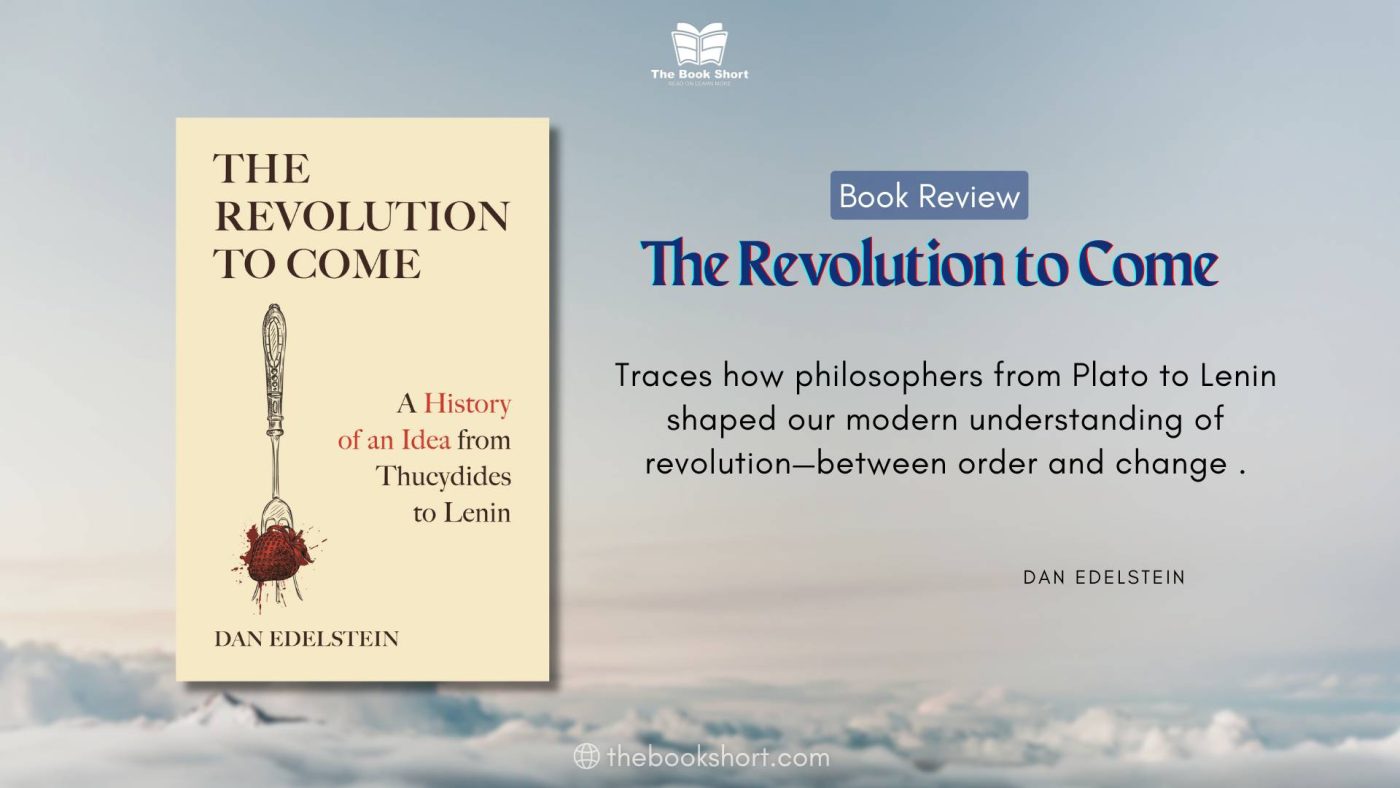
Why do societies undergo radical shifts? Dan Edelstein redefines revolution by tracing the profound changes in core political concepts.
Basic Information About The Revolution to Come: A Conceptual History of the French Revolution
- Title: The Revolution to Come: A Conceptual History of the French Revolution
- Author: Dan Edelstein
- Year of publication: 2018
- Genre: History / Political Theory / Intellectual History / Conceptual History
- Number of pages: Approx. 480 (hardback)
- Target audience: Scholars, graduate students, and serious readers interested in the history of political thought, the French Revolution, and the theory of revolution.

The Revolution to Come: A History of an Idea from Thucydides to Lenin
The Revolution to Come Book Summary: Tracing Conceptual Shifts in Revolutionary France
Dan Edelstein’s The Revolution to Come: A Conceptual History of the French Revolution offers a pioneering redefinition of what we mean by “revolution.” Moving beyond interpretations that focus solely on the violent overthrow of regimes or the clash of social forces, Edelstein argues compellingly that the revolution’s true heart beats in a fundamental transformation of the conceptual landscape—the foundational ideas and principles that structure a political order. Using the French Revolution as his central, meticulously explored case study, the book traces how bedrock concepts like sovereignty, the nation, legitimacy, and law were understood before, during, and after the tumultuous events of 1789 and beyond. His analysis reveals the revolution less as a singular event and more as a dynamic, often agonizing, process of profound conceptual rupture and renegotiation.
The book’s narrative is structured around these conceptual shifts, primarily using the French Revolution as its engine, while drawing upon a rich broader history of political thought.
Introduction: Redefining Revolution as Conceptual Transformation
Edelstein opens by challenging conventional narratives that zero in on the events of revolution (like the storming of the Bastille or the Reign of Terror) or the socio-economic forces at play. He posits that these are crucial aspects or mechanisms of change, but not its fundamental essence. The true revolutionary kernel, he argues, resides in the transformation of the basic political concepts through which a society understands itself and its governance. A genuine revolution, in his view, forges a new “political grammar,” rendering the old one not just obsolete, but often unintelligible or inherently illegitimate.
Part 1: The Old Regime’s Conceptual World: Stability and Strain
Before plunging into the revolutionary maelstrom, Edelstein painstakingly reconstructs the conceptual framework that buttressed the French Old Regime.
- Sovereignty: Power resided absolutely and indivisibly in the person of the monarch, justified by divine right and centuries of tradition. Law was understood as emanating from the king’s will, though guided by custom, counsel, and established privileges.
- Nation: The concept of the “nation” certainly existed, but it was largely understood geographically or dynastically – referring to the King’s subjects or his realm – rather than as a self-determining political entity holding inherent, collective rights.
- Legitimacy: The foundation of legitimacy rested on divine sanction, hereditary right, historical precedent, and the complex web of established institutions and orders. Challenges to the existing power structure were typically framed as demands for the restoration of ancient liberties or critiques of specific abuses, not as calls for a fundamentally new political order based on different principles.
Edelstein masterfully demonstrates how this seemingly stable conceptual world, though deeply rooted, contained internal tensions and was gradually eroded by the ferment of Enlightenment ideas and mounting political crises.
Part 2: The Revolutionary Rupture: The Seismic Conceptual Shift (1789-1792)
The core of Edelstein’s analysis centers on the dramatic period beginning in 1789. The fateful calling of the Estates-General and its audacious transformation into the National Assembly marked the true genesis of the conceptual revolution.
- Sovereignty Transferred: The most breathtaking shift was the transfer of sovereignty from the King’s person to the abstract, collective entity of the Nation. The Tennis Court Oath and the National Assembly’s declaration were not merely political acts; they were conceptual detonations, asserting that legitimate power resided not in the monarch, but in the collective body of the Nation, represented by its assembly. This was a radical, foundational break.
- The Nation as Sovereign: The concept of the Nation was utterly transformed. It ceased being merely a passive geographic or dynastic descriptor and became the active subject of history and politics, the exclusive source of all legitimate authority. Concepts like “the will of the nation” or “the general will” (borrowing heavily from Rousseau, albeit often adapted and reinterpreted) moved to center stage.
- Law Reimagined: Law was no longer the King’s command but became the sacred expression of the General Will of the Nation, articulated by its elected representatives. This fundamentally redefined the relationship between ruler, ruled, and the legal order, establishing the rule of law emanating from the collective.
- Legitimacy From Below: The basis of legitimacy shifted seismically from tradition, heredity, and divine right to popular sovereignty and the concept of the social contract (though often implicitly invoked as the philosophical underpinning rather than explicitly adopted as a rigid blueprint).
Edelstein underscores that this profound shift was neither instantaneous nor universally accepted, but it constituted the fundamental conceptual rearrangement that irrevocably defined the revolution. The Declaration of the Rights of Man and of the Citizen is presented as a pivotal textual embodiment of this burgeoning conceptual order, articulating a new understanding of the individual, the nation, and their intertwined relationship.
Part 3: Navigating the New Conceptual Terrain: Challenges and Radicalization (1792-1794)
Once sovereignty was conceptually rooted in the Nation, complex and urgent questions immediately arose: how does the Nation exercise its sovereign will? Who truly represents this indivisible Nation? How is unity maintained in a diverse populace? This period witnessed the inherent conceptual challenges within the new framework erupting into stark political realities.
- Defining the Nation: Fierce disagreements emerged over the very definition of the “Nation.” Was it limited to property owners? All male citizens? Could dissenting opinions legitimately exist within the conceptually “one and indivisible” Nation?
- Representing the General Will: The abstract ideal of the General Will proved extraordinarily difficult to translate into practical, factional politics. Different groups and leaders claimed to embody the “true,” unified will of the Nation, leading to brutal conflict and the dangerous justification of suppressing dissent as acting against the Nation itself.
- The Terror as Conceptual Consistency (Problematic): Edelstein offers a penetrating, unsettling analysis of the Reign of Terror, viewing it not solely as political paranoia or contingent circumstance, but as a desperate, chilling attempt to maintain the conceptual purity of the indivisible, sovereign Nation against perceived internal enemies. Dissent was conceptually equated with treason against the Nation-Sovereign; difference became existential threat.
- The Search for Stability: The radicalization and the Terror highlighted the immense difficulty of establishing stable, enduring institutions based on the dynamic new conceptual framework of continuous popular sovereignty. How could the ever-present potential of the sovereign people’s will be reconciled with the need for stable, effective government?
Part 4: The Thermidorian Reaction and the Directory: Negotiating the Conceptual Aftermath (1794-1799)
The fall of Robespierre and the Thermidorian Reaction represented a violent backlash against the radical interpretation of popular sovereignty and the excesses justified by the conceptual logic of the Terror.
- Attempts to Stabilize: This period saw frantic attempts to construct a more stable republic by recalibrating aspects of the political order, often seeking to constrain the direct expression of popular will and implement forms of checks and balances.
- Citizenship Redefined: Concerted efforts were made to redefine citizenship and political participation, frequently reintroducing property qualifications for voting, an attempt to anchor the nation in a narrower, less volatile conceptual space.
- Conceptual Ambiguity: The Directory era was plagued by inherent conceptual contradictions – a desire for a republic founded on the sovereignty of the Nation, yet a profound fear of actual popular power, caught between the specter of monarchy and the memory of the Terror’s mechanisms.
Part 5: The Napoleonic Era and Beyond: The Enduring Legacy of Conceptual Change
Edelstein concludes by examining how Napoleon Bonaparte, the “revolution on horseback,” solidified certain aspects of the conceptual revolution while simultaneously suppressing others.
- Solidifying the Nation-State: Napoleon cemented the Nation as the unshakeable foundational political unit, though sovereignty was effectively re-concentrated, now wielded in the name of the Nation rather than divine right or collective will.
- Legal System: The creation of the Napoleonic Code codified many revolutionary legal concepts, establishing a uniform legal framework across the nation based on the principle of law emanating from the state (understood as acting for the nation).
- Enduring Concepts: Crucially, even the eventual restoration of the monarchy could not entirely erase the fundamental conceptual shift regarding the Nation as the primary political entity, popular sovereignty (as a powerful ideal, if not always a reality), and the source of legitimate authority. The underlying language and grammar of French, and indeed European, politics had been irrevocably transformed.
Throughout The Revolution to Come, Edelstein argues persuasively that grasping the essence of the French Revolution necessitates seeing it as this arduous, complex, and often contradictory process of re-imagining the foundational concepts of politics itself. The “revolution to come” in the title points to the new conceptual world that the revolutionaries were striving, sometimes blindly, to bring into being – a future defined by the sovereignty of the Nation and the inherent rights of the individual, a conceptual terrain they partially constructed even as they grappled with its immense practical and theoretical difficulties. His analysis provides a sophisticated, powerful framework for understanding not just 1789, but the very nature and consequences of radical political change.
The Revolution to Come Book Analysis: A Paradigm Shift in Revolutionary Studies
Dan Edelstein’s The Revolution to Come stands out as a truly significant contribution to the vast body of French Revolution scholarship. By intentionally shifting the analytical lens from traditional focuses on events, social classes, or political factions to the dynamic realm of ideas and concepts, Edelstein presents a compelling new paradigm. His central thesis—that the true revolution was a conceptual one, a fundamental alteration in the very language and grammar of politics centered on the ideas of sovereignty and the nation—provides a powerful, clarifying framework for understanding the radical nature of the French Revolution and its enduring global legacy.
Key Arguments & Structure: Following the Thread of Conceptual Change
The book’s strength lies in its structure, built around a meticulous tracing of the evolution and radical transformation of core political concepts. Edelstein doesn’t just describe these concepts; he dissects their meaning within the framework of the Old Regime—monarchy, divine right, hierarchy, and privilege—showing how terms like “sovereignty,” “nation,” “constitution,” and “law” functioned in that world. He then demonstrates, with forensic detail, how these same concepts were redefined, hotly contested, and ultimately revolutionized starting in 1789. He argues, convincingly, that the conceptual transfer of sovereignty from the King to the Nation was the foundational, defining act of the revolution. Subsequent chapters delve into the complex implications of this conceptual rupture, exploring the challenges of realizing popular sovereignty, the chilling radicalization stemming from the idea of the “one and indivisible” Nation (leading to the Terror), and the difficult, messy process of attempting to stabilize the new conceptual order in the Thermidorian and Directory periods.
The structure is a masterful blend of thematic depth and chronological progression, tracing conceptual change through the specific periods of the revolution. This is not a narrative history of events, but rather a profound history of ideas in action, illustrating how abstract concepts didn’t just reflect but actively shaped political realities and were, in turn, shaped by them.
Writing Style & Content Quality: Rigorous, Demanding, and Profound
Edelstein’s writing is academically rigorous, precise, and dense, demanding focused attention from the reader. He engages deeply and intelligently with primary sources—revolutionary decrees, powerful speeches, influential pamphlets—and demonstrates a thorough command of the relevant secondary literature, particularly the philosophical texts that informed and challenged revolutionary thought. The language is analytical and intellectually demanding, requiring careful reading and engagement with complex theoretical arguments.
However, the quality of the content is consistently superb. Edelstein displays a profound understanding of both the history of political thought and the intricate specifics of the French Revolution. His analysis is nuanced, avoiding simplistic explanations and instead highlighting the inherent difficulties, contradictions, and often unintended consequences revolutionaries faced as they navigated uncharted conceptual territory. The depth of his research, the sophistication of his arguments, and the clarity of his conceptual framework are evident throughout the book, making it a landmark work.
How it Stands Out: Placing Concepts at the Revolution’s Core
What truly makes The Revolution to Come a distinctive and essential contribution is its unwavering commitment to conceptual history as the primary lens for understanding and defining revolution. While many historians acknowledge the influence of ideas, Edelstein places conceptual change—the very redefinition of political terms and principles—at the absolute heart of the revolutionary process. He argues persuasively that without understanding how the fundamental meanings of “sovereignty,” “nation,” or “law” were transformed, we cannot truly grasp the radical, world-altering break that occurred in 1789. This approach offers a powerful counterpoint or, perhaps better, a foundational layer of understanding to interpretations that prioritize social class conflict (like traditional Marxist accounts), the contingent roles of specific political leaders or factions, or simply the chaotic flow of events. Edelstein doesn’t dismiss these factors but argues they operate within or upon a conceptually defined political space that was itself undergoing radical flux.
His interpretation of the Terror is another area where the book stands out. By analyzing it through a conceptual lens—as a desperate, if horrifying, attempt to maintain the theoretical purity and indivisibility of the sovereign Nation’s will against perceived internal division—he offers a penetrating and unsettling explanation that goes beyond simple notions of madness or expediency, revealing a tragic conceptual logic at work.
Notable Quotes from the Book: The Power of Evolving Ideas
While The Revolution to Come is not a book built on easily extractable soundbites—its power lies in the cumulative force of its meticulously constructed argument—the essence of Edelstein’s thesis resonates through key ideas articulated throughout the text. Paraphrased, these core arguments convey the book’s groundbreaking perspective:
- (The central thesis): “The French Revolution was, at its most fundamental level, a conceptual revolution – a radical redefinition of political legitimacy and the very seat of sovereignty.”
- (Describing the core shift): “Sovereignty underwent a profound migration, relocating from the physical body of the king to the abstract, yet politically potent, entity of the Nation.”
- (On the Terror’s logic): “The relentless drive for conceptual purity, for a seamless, unified expression of the Nation’s will, played a crucial, terrifying role in justifying radical measures against any form of dissent.”
These ideas, developed through extensive historical and philosophical analysis, form the backbone of Edelstein’s significant contribution. The book’s impact comes from the comprehensive way it demonstrates how these conceptual shifts occurred and why they mattered so profoundly.
Evaluation & Expert Personal Review of The Revolution to Come: A Demanding but Essential Read
The Revolution to Come is a truly monumental work of scholarship – deeply impressive, intellectually challenging, and utterly essential for serious students of the period and political thought. My personal impression is that it doesn’t just contribute to the field; it reshapes a fundamental aspect of how we understand the French Revolution and, by extension, the very nature of revolutionary change. Edelstein’s central thesis, that the revolution was fundamentally a conceptual transformation, feels profoundly correct once articulated. It provides a necessary, often overlooked, lens that cuts through the complexity of events and social dynamics to reveal the underlying intellectual architecture of change.
Advantages:
- Unparalleled Conceptual Rigor: The book excels in its detailed, sophisticated analysis of political concepts and their historical evolution. Edelstein’s tracing of sovereignty from the monarch to the nation is not just described; it’s intellectually dissected, showing the complex layers of meaning and the radical implications of its shift.
- Originality and Insight: The unwavering focus on conceptual history as the essence of revolution is highly original and provides a powerful, clarifying framework for understanding radical political change. It shifts the paradigm away from purely sociological or event-based explanations.
- Depth and Nuance: Edelstein embraces complexity. He doesn’t offer easy answers but grapples with the inherent difficulties, contradictions, and intellectual struggles within revolutionary thought. His analysis of the Terror through a conceptual lens is particularly challenging but extraordinarily illuminating.
- Broad Significance: While rooted in the French Revolution, the methodology and core insights have significant implications for understanding other revolutionary periods, transitions of power, and the enduring power of ideas in shaping political reality across time and place.
Disadvantages:
- Density and Difficulty: This is not a book for the faint of heart or the casual reader. The academic style, deep engagement with historical political theory, and intricate arguments require significant intellectual effort, patience, and a solid grounding in the history of the period and relevant thinkers (from Bodin and Hobbes to Rousseau and Sieyes).
- Limited Narrative Appeal: Readers seeking a compelling story, vivid character portrayals, or a dramatic account of revolutionary events will likely find this book difficult. The focus remains steadfastly on abstract concepts and their evolution, not on narrative flow or personal drama.
Readability Level and Suitability:
The readability level is strictly high academic/postgraduate. It is suitable primarily for:
- Graduate students and established scholars in history (especially French history, intellectual history), political science, political theory, and philosophy.
- Highly motivated, advanced undergraduate students undertaking serious research in these areas who are prepared for a significant intellectual challenge.
- Exceptionally dedicated general readers with a strong existing background in history, philosophy, and political thought who are willing to invest substantial time and intellectual energy.
It is emphatically not suitable for someone looking for a general introduction to the French Revolution or a light, engaging read.
Practical Value: Reshaping How We See Political Change
The practical value of The Revolution to Come lies less in providing direct policy prescriptions and more in profoundly reshaping how one thinks about political change itself.
- Understanding “Revolution”: It fundamentally alters the understanding of what constitutes a revolution, highlighting the often slower, underlying work of changing foundational ideas that enables or underlies overt political and social upheaval.
- The Power of Concepts: It lays bare the immense, often unseen, power of abstract political concepts (like sovereignty, legitimacy, the nation, liberty) in structuring political reality, justifying actions (even extreme ones), and limiting or expanding possibilities.
- Analyzing Contemporary Politics: The framework provides a powerful tool for analyzing contemporary political debates, urging us to look beyond policy disagreements or personality clashes to identify the underlying, often unstated, conceptual disagreements about the nature of power, representation, citizenship, and community. What fundamental concepts are being challenged or redefined in current political discourse?
- Historical Context: It reinforces the crucial insight that historical events unfold not in a vacuum but within specific, evolving conceptual frameworks that enable or constrain possibilities.
Overall, The Revolution to Come is a demanding but exceptionally rewarding read for those equipped and prepared to engage with its complex, far-reaching arguments. It doesn’t just teach you about the French Revolution; it changes the way you think about the deep architecture of political thought that underpins all societal order and its potential, terrifying, transformation.
Comparison with Similar Books on Conceptual History and the French Revolution
The Revolution to Come firmly establishes itself within the tradition of intellectual history and conceptual history (Begriffsgeschichte), particularly as applied to periods of radical political transformation. It shares concerns and methods with several key works, while carving out its own distinct and significant territory.
- Conceptual History Tradition: The book is deeply indebted to the pioneering work of thinkers like Reinhart Koselleck, who developed the methodology of Begriffsgeschichte—the study of how the meaning of key political and social terms changes over time, and how these semantic shifts reflect and shape historical experience. Edelstein explicitly employs and masters this rigorous approach to analyze the revolutionary period.
- François Furet’s Interpreting the French Revolution: Furet’s landmark revisionist work, which argued that the French Revolution was primarily driven by political and ideological dynamics, particularly the radicalizing force of the concept of popular sovereignty, is a clear intellectual predecessor. However, Edelstein offers a more granular, historical-conceptual analysis of how specific terms and ideas like sovereignty and nation actually evolved and were deployed, rather than focusing primarily on ideology as a broader force. Edelstein’s book can be seen as building upon and providing a deeper conceptual foundation for some of Furet’s core arguments.
- Works on Revolutionary Ideologies and Thinkers: Books that delve into the specific political philosophies or ideologies of the revolutionaries (e.g., detailed studies of Rousseau’s influence, analyses of the ideas of Sieyes, Robespierre, or the Girondins) cover related ground concerning the role of ideas. However, Edelstein’s book is distinct in its focus on the concepts themselves as they are used, contested, and transformed by various actors and through specific political acts, rather than primarily analyzing the coherent doctrines of key thinkers.


If readers have grappled with and appreciated The Revolution to Come, they might find these related works particularly rewarding:
- Reinhart Koselleck, Futures Past: On the Semantics of Historical Time: The seminal text for understanding the methodology of conceptual history (Begriffsgeschichte). While also dense, it lays out the theoretical framework and applies it to terms like “history,” “progress,” and “revolution,” providing the intellectual bedrock for Edelstein’s approach.
- François Furet, Interpreting the French Revolution: A classic, challenging account that emphasizes the political and ideological ruptures of the revolution, offering a powerful, albeit different, perspective on the role of ideas, particularly the concept of popular sovereignty, in driving radicalization.
- Quentin Skinner, Liberty Before Liberalism: A more accessible, shorter example of intellectual history that traces the evolution of the concept of “liberty” from a neo-Roman idea to a liberal one. Skinner’s methodological writings on understanding political thought contextually are also highly relevant to Edelstein’s approach.
- J.G.A. Pocock, The Machiavellian Moment: Florentine Political Thought and the Atlantic Republican Tradition: A monumental work that traces the concept of republicanism through centuries of Western thought, demonstrating how foundational political languages shape historical possibilities. While vast in scope, it shares Edelstein’s deep concern with the long-term history and impact of political concepts.
Edelstein’s book distinguishes itself by applying the rigorous method of conceptual history with exceptional depth and focus to a single, transformative event, arguably making it one of the most compelling examples of this approach in recent historical scholarship on the French Revolution.
The Revolution to Come Book Conclusion & Recommendations: A Profound Read for the Dedicated Student
Dan Edelstein’s The Revolution to Come offers an invaluable, indeed essential, perspective on the French Revolution. By arguing convincingly that the revolution’s essence resided in a fundamental conceptual transformation of political ideas—most crucially, the migration of sovereignty from monarch to nation—Edelstein provides a powerful new lens. Through his meticulous tracing of the evolution of key terms and concepts, he reveals the profound intellectual rupture that didn’t just accompany, but fundamentally underpinned, the political and social upheaval of the late 18th century.
The book’s outstanding value lies in its rigorous methodology and the sophisticated framework it provides for understanding radical political change. It forces readers to look beyond the surface of events and social forces to see the deeper renegotiation of the foundational ideas—the “political grammar”—that define political community, legitimacy, and power. It is a compelling demonstration of the profound historical weight carried by seemingly abstract terms like “sovereignty,” “nation,” and “law.”
Is it worth reading? Yes, absolutely, if you are a serious student, scholar, or dedicated reader with a strong interest in the history of political thought, the French Revolution, or the theory of revolution. For the right reader, it is profoundly rewarding.
Who should read it? This book is indispensable for academics, graduate students, and advanced undergraduates specializing in French history, intellectual history, political theory, and the history of political thought. It is suitable for anyone with a robust background in these fields who is prepared for a challenging, deep dive into complex ideas. It is decidedly not recommended for casual readers or those seeking a narrative introduction to the French Revolution.
For those ready to engage with its intellectual demands, The Revolution to Come offers a transformative experience, providing a sophisticated and lasting shift in how one understands one of history’s most pivotal events and the very nature of political transformation itself. It is a book that will make you think differently about the power of concepts in shaping our world.
Have you read this challenging and insightful book? Share your thoughts and impressions in the comments below!