
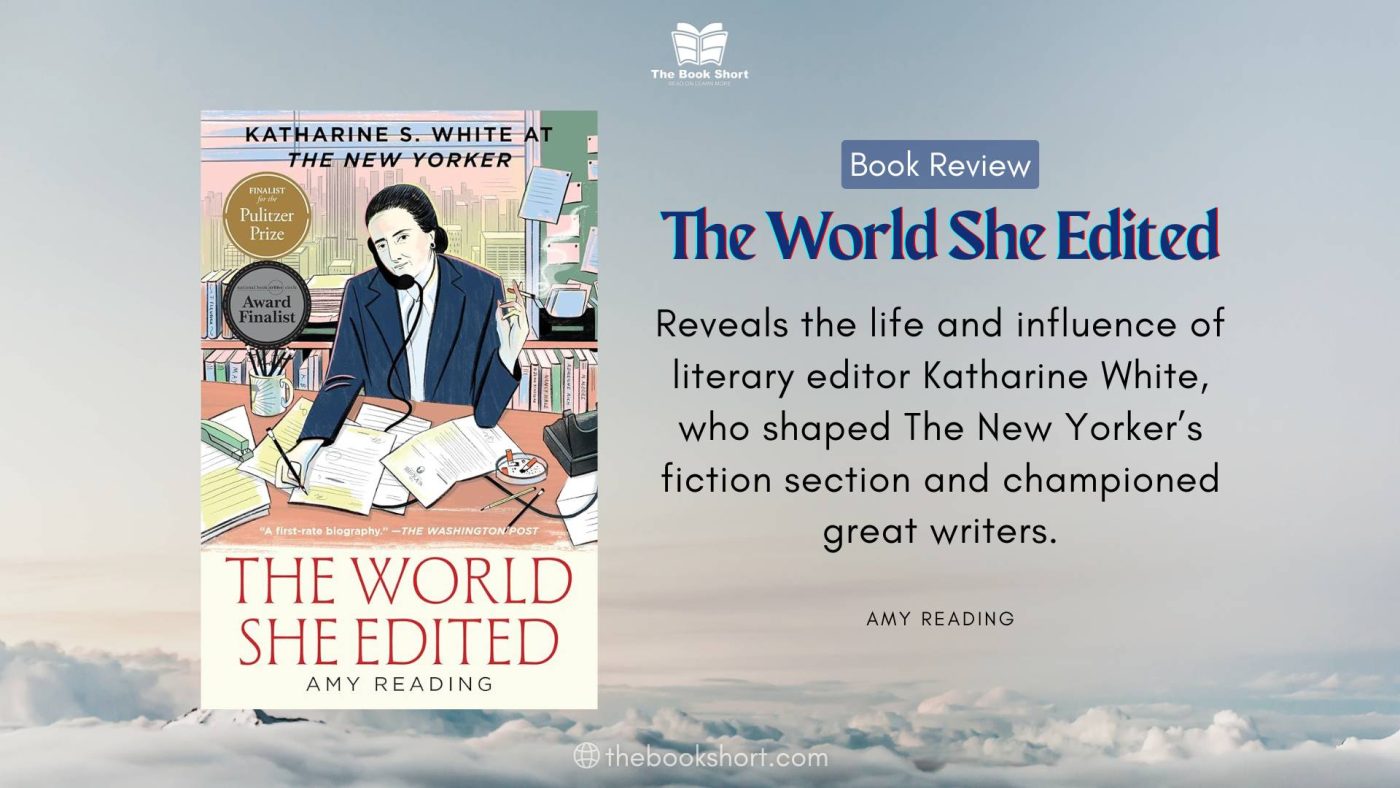
Exploring the indispensable influence of Katharine White on The New Yorker. A penetrating look at the editor who shaped an era.
Step behind the legendary masthead of The New Yorker and discover the quiet force who helped define its voice. Amy Reading’s The World She Edited: Katharine White at The New Yorker is a captivating journey into the professional life of one of the 20th century’s most pivotal, yet often unsung, literary figures. Rather than focusing on the celebrated writers, Reading spotlights the editor, offering a unique perspective on the intricate, often invisible, process of refining words into enduring literature and journalism. This book reveals the profound power and artistry wielded by the hands that polish, rather than originate, the final published text.
Basic Information on The World She Edited: Katharine White at The New Yorker
- Title: The World She Edited: Katharine White at The New Yorker
- Author: Amy Reading
- Year of publication: 2021
- Genre: Literary Biography, History, Non-fiction, Publishing History
- Number of pages: 320 (approx.)
- Target audience: Anyone fascinated by literary history, the inner workings of The New Yorker, biography, the publishing world, and the critical role of editors.
A Deep Dive into The World She Edited: Katharine White at The New Yorker – A Summary
Amy Reading’s The World She Edited transcends the conventional biography format, offering a meticulously researched exploration of Katharine White’s immense professional impact as a foundational editor at The New Yorker, a role she held from the magazine’s birth in 1925. Reading makes a compelling case: White was no mere proofreader or sentence polisher; she was a visionary shaper of literary talent, a dedicated curator of the magazine’s distinctive intellectual and stylistic tenor, and an essential conduit between brilliant writers and their readership. The book meticulously reconstructs White’s demanding daily work, her unwavering editorial philosophy, and her complex, often intense, relationships with some of the literary giants whose work she championed, including E.B. White (her husband), John O’Hara, Vladimir Nabokov, Marianne Moore, and Rachel Carson.
The narrative unfolds thematically, skillfully organizing White’s career through the specific genres and notable writers she meticulously guided and elevated.
Forging the Foundations of an Editorial Eye
Reading sets the scene by detailing White’s early life and her arrival at the nascent New Yorker under its pioneering founder, Harold Ross. This section vividly portrays the magazine’s unique, demanding environment and how White, initially undertaking fact-checking and proofreading, rapidly demonstrated an almost unparalleled acuity for detail, structural integrity, and stylistic precision. It lays the groundwork for understanding the extraordinarily rigorous standards that would become her hallmark and fundamentally influence the magazine’s quality.
Cultivating Literary Fiction: Shaping O’Hara, Nabokov, and Others
A substantial and fascinating portion of the book delves into White’s crucial work with fiction writers. Reading provides intricate accounts of her deep collaborations, illustrating her uncanny ability to identify raw talent and then engage in years-long partnerships, sometimes navigating countless drafts. The relationship with John O’Hara is examined in illuminating detail, showing how White patiently helped him refine his distinctive prose style and shape his narratives. Equally compelling is her pivotal role in bringing Vladimir Nabokov’s groundbreaking work to the magazine, showcasing her skill in navigating the complexities of his unique voice and ambitious themes. This section powerfully demonstrates that White wasn’t afraid to challenge even established authors, pushing them with unwavering determination to clarify, deepen, and refine their stories while fiercely respecting their artistic vision.
Championing Poetry and Incisive Reportage
White’s far-reaching influence extended significantly beyond fiction. Reading explores her profound dedication to poetry, a genre she nurtured despite its often-marginal status in mainstream publications. White cultivated a distinguished roster of poets, painstakingly selecting and editing their work for maximum clarity and emotional resonance. The book also highlights her substantial contributions to non-fiction, particularly the iconic “Reporter at Large” features and detailed profiles that became synonymous with The New Yorker‘s immersive style. Her meticulous work on Rachel Carson’s seminal articles, which would later form the basis of Silent Spring, stands out as a powerful example of White’s ability to tackle complex scientific or environmental subjects and render them both accessible and profoundly compelling to a wide readership.
The Unexpected Art of the Garden Piece
Perhaps one of the most charming and revealing sections is dedicated to White’s personal passion for gardening and how she cultivated and edited the magazine’s influential garden column. This seemingly niche interest unveils a crucial aspect of White’s editorial philosophy: her belief that any subject, no matter how specialized, could be elevated to a high art form through precise language, thoughtful observation, and an editor’s careful hand. It demonstrates her remarkable range and the subtle personal touch that infused her professional life, proving that her editorial acumen was deeply intertwined with her own intellectual curiosity and personal enthusiasms.
The Invisible Hand: Unpacking White’s Editorial Philosophy
Weaving throughout these thematic explorations, Reading consistently returns to and illuminates White’s core editorial principles. These included an absolute, almost zealous, insistence on factual accuracy, an unyielding focus on clarity, conciseness, and elegance, a keen sensitivity to the rhythm and flow of prose, and a deep, if demanding, respect for the writer’s unique voice. The book meticulously reveals the painstaking process of marginal notes, detailed letters, and iterative discussions that defined her work, often requiring multiple rounds of revision before a piece met her exacting standards. Reading masterfully argues that White’s editing was a collaborative art form of the highest order, demanding not only immense patience and intellectual rigor but also profound diplomacy and psychological insight.
By presenting White’s remarkable career through the prism of her work across different genres and with specific, often legendary, writers, Reading constructs a deeply compelling portrait of an editor whose impact was not just significant, but truly foundational, shaping not merely individual published pieces but the very identity, standards, and enduring legacy of one of the world’s most revered literary magazines.
In-depth Analysis of The World She Edited: Katharine White at The New Yorker
Amy Reading’s The World She Edited stands as a meticulously researched and profoundly insightful examination of the editorial craft personified by Katharine White. The book’s central, powerful argument is that editing is far from a technical exercise; it is a vital, creative, and intellectually rigorous act, absolutely essential to the birth and enduring power of great literature and journalism. Reading compellingly makes the case that editors, particularly figures of White’s caliber, deserve far greater recognition for their crucial, transformative contributions, effectively elevating the editor from mere technician to essential literary collaborator and architectural force.
Navigating Characters, Structure, and Core Arguments
While the book centers on Katharine White herself, brought vividly to life through extensive excerpts from her correspondence, marginalia, and the recollections of her colleagues and writers, the authors she edited function as crucial, dynamic supporting characters. Their varied relationships with White serve to illustrate the different facets and demands of her multifaceted editorial approach. The book’s thematic structure, focusing on genres like fiction, poetry, reportage, and even gardening, and highlighting key writer-editor relationships, proves highly effective. It allows Reading to group examples of White’s work, showcasing the remarkable breadth and depth of her influence across a diverse landscape of writing.
A key argument, powerfully supported throughout the book, is that White was absolutely instrumental in forging The New Yorker‘s unparalleled reputation for literary excellence, intellectual sophistication, and unimpeachable factual accuracy. Reading persuasively argues that her famously rigorous standards and deep intellectual engagement with every text were foundational elements that shaped the magazine’s distinctive voice and elevated its quality to international renown. Another significant and resonant theme is the concept of the editor as an “invisible hand” – indispensable yet rarely visible or celebrated, a historical oversight that Reading directly aims to rectify by placing White firmly in the spotlight she so clearly deserves.
Evaluating Writing Style and Content Quality
Reading’s writing style is admirably clear, precise, and academically grounded yet consistently accessible and engaging. She navigates the complex terrain of editorial interactions, literary analysis, and historical context with impressive skill and clarity. The content quality is exceptionally high, rooted in extensive and deep archival research. Reading draws heavily and effectively from White’s personal papers, correspondence, and, most compellingly, her heavily annotated manuscripts. She masterfully weaves together historical context, biographical details, and specific, granular examples of White’s editorial interventions, often quoting White’s own sharp, insightful words, to build a powerful and persuasive case.
What truly distinguishes The World She Edited from more traditional literary biographies is its unwavering focus on the process of creating and publishing, specifically viewed from the editor’s perspective. Most literary studies center on the author and the finished masterpiece. This book performs a crucial shift in gaze, directing attention to the essential intermediary. It vividly reveals the immense intellectual labor, razor-sharp critical judgment, deep psychological acumen, and sheer persistence required to shepherd a piece from a raw draft to its final, polished form. This is not just a story about what appeared in print, but a compelling narrative of how it got there, illuminating the often-tense, always-demanding, and fundamentally collaborative process of high-level editing. This emphasis on the dynamic, often challenging, nature of artistic refinement is what truly sets the book apart.
Capturing White’s Voice Through Annotated History
While The World She Edited doesn’t rely on singular, easily quotable aphorisms from Katharine White, its strength lies in the cumulative power of Reading’s chosen examples. The book extensively quotes from White’s letters and, most revealingly, her direct annotations on manuscripts, providing readers with a genuine sense of her voice, her standards, and her unwavering focus. Reading effectively demonstrates White’s core belief – not always stated explicitly, but evident in every marginal note – that “details matter” and that true literary quality emerges from relentless precision and thoughtful refinement. The book itself functions as an extended, evidence-driven argument for the profound artistry inherent in the editorial role, illustrated by countless instances of White’s demanding yet transformative interventions, her unparalleled eye for the perfect word, the necessary cut, or the clarifying question that unlocked a writer’s best work.
Evaluation & Expert Personal Review of The World She Edited
The World She Edited is an utterly fascinating and undeniably important contribution to both literary history and the study of the publishing world. My personal experience reading the book was overwhelmingly positive and deeply rewarding. It succeeds brilliantly in illuminating a critical, often obscured, aspect of how great writing comes into being – the editor’s indispensable role – and does so through the compelling life and work of one of the 20th century’s most quietly influential figures in American letters.
Strengths:
- Provides an unprecedented, granular look at the intricate process of high-level editing, using specific, illuminating examples drawn directly from White’s work on iconic pieces.
- Effectively highlights the vital, yet often understated, contributions of a woman who, despite her immense influence in shaping literary history, has often remained in the historical shadows of the celebrated writers she edited.
- The research is exceptionally thorough, and the extensive use of archival material (letters, original manuscripts with White’s annotations) is not just compelling but serves as powerful primary evidence for Reading’s arguments.
- Offers invaluable insights into the specific history, unique culture, and demanding standards of The New Yorker magazine during its formative decades.
Considerations:
- For a general reader not intimately familiar with the specific authors or published pieces discussed, the highly detailed accounts of individual editorial exchanges, while informative, might occasionally cause the narrative pace to feel deliberate.
- The book’s focus remains almost exclusively on White’s professional life and editorial impact. Readers hoping for a comprehensive personal biography, delving deeply into her life outside the office (beyond her marriage to E.B. White and her renowned passion for gardening), may find that aspect less explored.
The book’s readability level could be described as moderately challenging, suitable for engaged readers. While Reading’s prose is clear and elegant, the subject matter—detailed literary analysis, the nuances of editorial practice, and historical context—requires a reader with a genuine interest in literature, publishing, or magazine history. It is ideally suited for:
- Students and scholars of literature, journalism, or publishing history.
- Aspiring and practicing writers eager to understand the editorial side of the publishing process.
- Anyone with a deep interest in the history and evolution of The New Yorker.
- Readers who appreciate biographies of influential figures, particularly those whose impact comes from shaping the work of others.
The practical and intellectual value of The World She Edited is significant. For writers, it serves as a powerful and humbling reminder of the indispensable value of revision and the profoundly collaborative journey towards achieving clarity and impact. For editors, it stands as an inspiring, though perhaps daunting, model of dedication, intellectual rigor, and the ethical responsibilities of the role. More broadly, the book fundamentally shifts our understanding of what constitutes “literary creation,” demonstrating with compelling evidence that the meticulous process of shaping, refining, and elevating text is just as crucial, and as artistic, as originating the words themselves. It powerfully underscores the often-unseen intellectual labor required to make complex ideas sing and to elevate prose to enduring art.
Comparison with Similar Works in Literary and Publishing History
The World She Edited occupies a unique and valuable space within the genres of literary biography and publishing history. While it shares ground with books on authors and magazines, it distinguishes itself profoundly by focusing so intently and thoroughly on the editor’s perspective, making that often-invisible role its central subject.
Comparable books might include:
- Biographies Focused on Editors: While less common than author biographies, works exploring the editor-author dynamic, such as A. Scott Berg’s Maxwell Perkins: Editor of Genius (focusing on his work with Hemingway, Fitzgerald, and Wolfe), share The World She Edited‘s interest in influential editors. However, Reading’s book is specifically contextualized within The New Yorker and centers on a female editor whose influence, while different from Perkins’, was equally transformative for her domain.
- Histories of The New Yorker: Books like Thomas Kunkel’s Genius in Disguise: Harold Ross of The New Yorker or Ben Yagoda’s About Town: The New Yorker and the World It Made provide broader histories of the magazine, often mentioning White’s significance. Reading’s book offers an unparalleled, granular, and comprehensive deep dive specifically into her contributions and the world she cultivated.
- Studies on the Craft of Editing: While guides exist on the principles of editing, The World She Edited is a compelling narrative study of high-level editing in practice, offering concrete examples from the work of a true master of the craft.
Readers who found The World She Edited compelling would likely also appreciate:
- Maxwell Perkins: Editor of Genius by A. Scott Berg, for another fascinating look at a foundational figure in American editing and his work with literary giants.
- Genius in Disguise: Harold Ross of The New Yorker by Thomas Kunkel, to gain a fuller understanding of the idiosyncratic genius and the environment in which Katharine White thrived and worked.
- Selected biographies of the key writers White edited (such as E.B. White, Rachel Carson, or Vladimir Nabokov) to see the other side of the complex and crucial editor-author relationship she navigated.
Conclusion & Recommendations for The World She Edited
The World She Edited: Katharine White at The New Yorker is a book of outstanding value, successfully bringing the crucial, often overlooked, art of literary and journalistic editing into sharp, illuminating focus through the exemplary career of Katharine White. It stands as a compelling testament to the power of precision, intellectual diligence, unwavering standards, and the profound intellectual partnership required in the creation of enduring literature and insightful journalism.
Is it worth reading? Absolutely, for anyone with a genuine interest in the fundamental mechanics of how great writing is forged, the rich history of a landmark cultural institution like The New Yorker, or the fascinating stories of the often-unsung heroes who shape the literary landscape from behind the scenes.
Who should prioritize reading it? This book is an essential read for aspiring writers, editors, and journalists seeking to understand the demanding realities and immense rewards of the craft. It is equally highly recommended for students and enthusiasts of 20th-century American literature, cultural history, and the vital dynamics of the publishing industry. While not a quick or light read, it is an exceptionally rewarding one, offering insights that will genuinely change how you perceive the books and articles you consume.
Have you delved into The World She Edited and its portrayal of Katharine White’s influence? Share your thoughts and reflections in the comments below!