
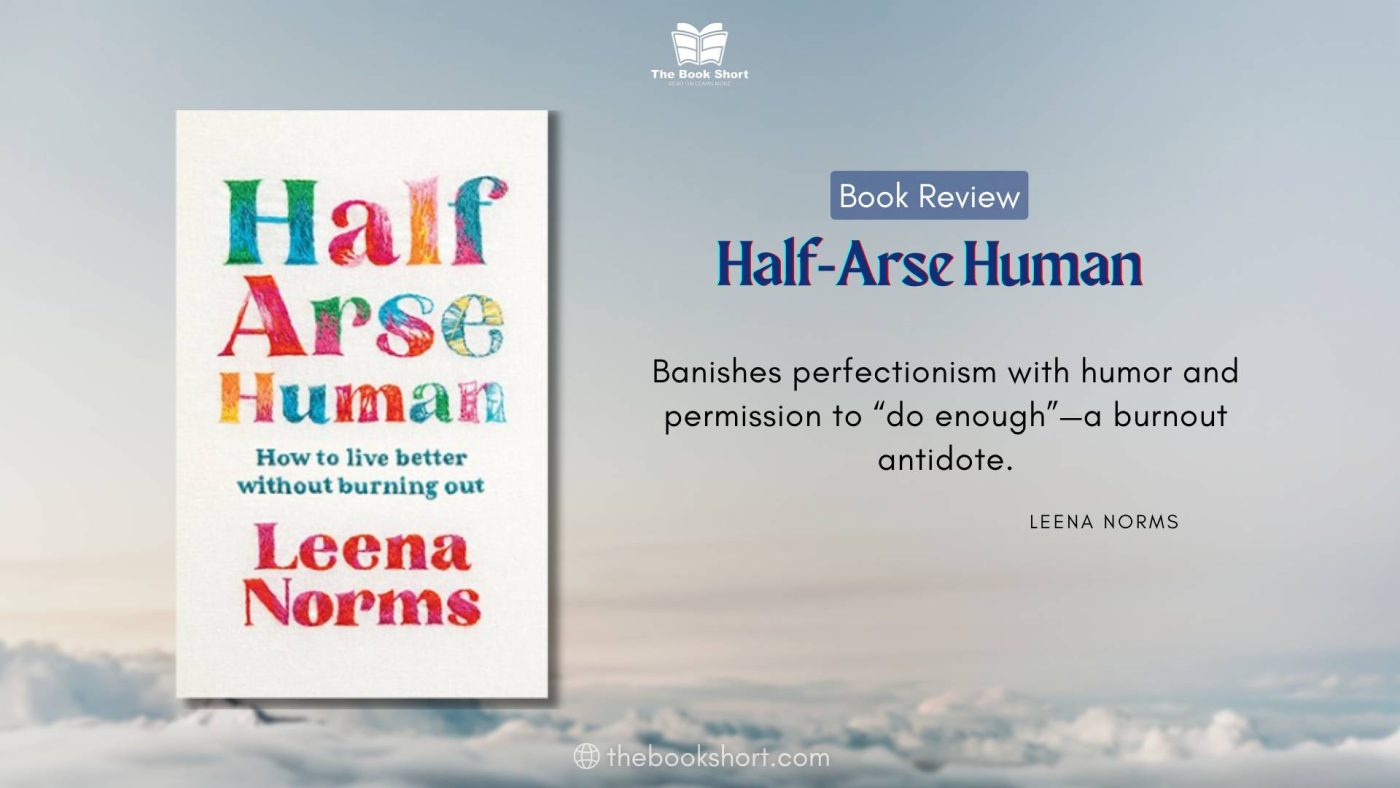
Navigating the relentless demands of modern life? Feeling like you’re perpetually falling short? Leena Norms’ Half-Arse Human offers a lifeline. This collection of insightful, unvarnished essays confronts everything from the suffocating grip of productivity guilt and the corrosive nature of social media anxiety to the heavy weight of climate change dread and the messy reality of navigating relationships. With brutal honesty, piercing wit, and surprising heart, Norms articulates the pervasive feeling that many of us share – the sense that we’re just not quite mastering this “adulting” thing. Her voice is a rare blend of profound vulnerability and sharp intellectual curiosity, offering not just commiseration, but genuine insight into the anxieties that define our era. Reading Half-Arse Human feels like a validation; it makes you feel less alone in your beautifully imperfect existence and offers quiet permission to embrace the perfectly acceptable “half-arsed” parts of yourself.
Half-Arse Human Book: Essential Details
- Title: Half-Arse Human
- Author: Leena Norms
- Publication Year: 2021
- Genre: Essays, Non-fiction, Contemporary Social Commentary, Unconventional Self-Help
- Approximate Page Count: 288
- Target Audience: Young adults and adults grappling with the pressures, anxieties, and existential questions of 21st-century life. Ideal for readers interested in essays on mental health, digital culture, and productivity critique.

Half-Arse Human: How to live better without burning out
Half-Arse Human Book Summary: Exploring the Contemporary Condition
Half-Arse Human is more than just a book; it’s an invitation into the mind of Leena Norms, the popular UK YouTuber and writer, as she unflinchingly examines the chaotic, messy reality of simply being a person in the 21st century. Far from a conventional self-help manual offering neat solutions, this is a shared exploration of anxieties, imperfections, and the often-overwhelming pressures of modern life, approached with striking intellectual curiosity, mordant wit, and profound vulnerability. The book unfolds as a series of thematic essays, each delving into a specific facet of what it means to navigate the world as a “half-arsed” human.
Dissecting the Pressure to Be Perfect
Norms spends significant time meticulously dissecting the pervasive cultural imperative to be constantly productive, endlessly optimized, and outwardly perfect. She launches a sharp critique against the relentless hustle culture, the seemingly infinite pursuit of self-improvement, and the nagging feeling that one should always be doing more, achieving more. This section resonates deeply with anyone who has felt inadequate in the face of curated online lives or has struggled with the debilitating weight of burnout.
- The Tyranny of Productivity: She lays bare the anxiety that arises from not constantly working or being visibly ‘productive,’ the sense that any moment of leisure is somehow wasted unless it contributes to a tangible goal.
- Exposing the Illusion of Effortlessness: Norms deftly debunks the myth that success and happiness arrive effortlessly for others, highlighting the hidden struggles, immense effort, and often sheer luck behind polished facades.
- Internalized Capitalism and Self-Worth: She touches upon how societal value is increasingly tied to economic output, leading to a toxic feeling of worthlessness if one isn’t constantly contributing, earning, or visibly climbing a ladder.
Navigating the Perilous Digital Landscape
As someone who has built a significant platform online, Norms offers keenly observed reflections on the profound impact of social media and the internet on our mental health, sense of self, and relationships.
- Social Media and the Comparison Trap: She details the deeply corrosive effect of constantly comparing one’s messy, behind-the-scenes reality to others’ meticulously edited highlight reels.
- The Performance of Online Identity: The complex struggle to reconcile one’s authentic offline self with the curated, often performative, online persona, and the subtle pressure to present an ‘authentic’ version that is still palatable and likeable.
- Information Overload and Digital Drowning: How the relentless, unfiltered stream of news, opinions, and content contributes to pervasive anxiety and a feeling of being perpetually overwhelmed or intellectually inadequate.
Candid Conversations on Anxiety and Mental Health
A raw and significant thread weaving through the entire book is Norms’ candid discussion of her own lived experiences with anxiety and broader mental health challenges. She bravely normalizes these struggles and thoughtfully explores their roots within the context of modern society’s pressures.
- Understanding Generalized Anxiety: Delving into the pervasive, often directionless worry that feels like the background hum of modern existence.
- Grappling with Existential Dread: Facing and articulating the anxieties tied to larger, overwhelming concerns like the climate crisis, political instability, and the uncertain future of humanity, and how these global issues impact personal well-being.
- The Elusive Search for Meaning: Exploring the fundamental human need for purpose in a seemingly chaotic and often indifferent world, and the anxiety that arises when that purpose feels frustratingly out of reach or undefined.
The Complexities of Relationships and Connection
Norms reflects on the intricate tapestry of human connection in the digital age, examining everything from the dynamics of friendships and romantic relationships to the unique ways online interactions foster (or hinder) genuine connection.
- Maintaining Meaningful Friendships: The conscious effort and emotional labor required to nurture and maintain deep connections amidst busy schedules, geographical distances, and the superficiality of digital interactions.
- Dating in the Digital Age: Thoughtful, often humorous, reflections on the peculiar challenges, awkwardness, and shifting expectations of online dating and modern romantic pursuits.
- The Fundamental Need for Community: The exploration of the innate human need for belonging and the thoughtful consideration of how to cultivate genuine community in an increasingly isolated and individualistic world.
Grappling with the World’s Big Issues
The book courageously doesn’t shy away from larger societal and environmental concerns, deftly weaving personal anxieties into the fabric of global issues.
- Articulating Climate Change Anxiety: Norms gives voice to the profound dread, helplessness, and moral conflict many feel in the face of the accelerating climate crisis, while exploring personal ways to cope and find pockets of agency.
- Consumerism, Ethics, and Guilt: Examining the often-paralyzing guilt associated with consumer choices and the constant, difficult struggle to live ethically within the constraints of a dominant capitalist society.
- Finding Hope Amidst the Overwhelm: While brutally honest about the immense challenges facing both individuals and the planet, Norms consistently seeks out and highlights ways to find pockets of hope, resilience, and meaning even when the world feels overwhelmingly bleak.
Throughout these explorations, Norms employs a distinctive conversational, almost stream-of-consciousness style, seamlessly interweaving deeply personal anecdotes with philosophical musings, scientific facts, cultural commentary, and humorous asides. The narrative doesn’t follow a neat, chapter-by-chapter progression of points, but rather flows organically, reflecting the often messy, non-linear nature of the human experience she describes. It’s fundamentally a book designed to make you feel deeply seen and understood in your struggles, rather than providing a prescriptive guide to fixing your perceived flaws. The quiet, powerful core message is that perhaps being a “half-arse human” is not a failure state, but a perfectly normal, valid, and even necessary way to exist in a world that unrealistically demands too much.
Half-Arse Human Book Analysis: Voice, Insight, and Structure
Leena Norms’ Half-Arse Human distinguishes itself within the bustling landscape of millennial-focused non-fiction through its unflinching honesty, unexpected intellectual depth, and utterly distinctive voice. It’s a book that doesn’t merely talk about anxiety; it often feels like a direct immersion into the anxious thought process itself, albeit one filtered through a highly articulate, witty, and deeply self-aware consciousness.
Structure and Core Arguments
While not a narrative with traditional characters, the central presence, the guiding voice, is Norms herself, presented with striking, often uncomfortable, vulnerability. The reader implicitly becomes a fellow traveler, addressed as someone likely navigating similar anxieties and questions.
The structure is quintessentially essayistic and deliberately loosely thematic rather than strictly linear or argumentative. Each essay serves as a jumping-off point into a broad topic area (e.g., productivity culture, climate change anxiety, dating in the digital age), but Norms allows herself to freely meander through related thoughts, unexpected facts, philosophical tangents, and personal stories. This non-linear, associative structure deliberately mirrors the often-disjointed way our minds jump between anxieties, observations, and fleeting thoughts, significantly contributing to the book’s relatable, stream-of-consciousness feel.
Key arguments woven throughout the collection include:
- The relentless societal pressure to be constantly productive, optimized, and superficially happy is not only unrealistic but actively detrimental to genuine well-being.
- Social media fundamentally exacerbates feelings of comparison, inadequacy, and anxiety, fostering distorted and often harmful perceptions of both self and others.
- Mental health struggles like chronic anxiety and overwhelm are often valid, logical responses to the inherent complexities, uncertainties, and pressures of modern life, rather than isolated personal failings.
- Grappling honestly with overwhelming global issues like the climate crisis is emotionally taxing but a necessary part of conscious existence; finding small, personal ways to act and cope is crucial for maintaining psychological equilibrium.
- Cultivating authenticity and seeking genuine human connection, even imperfectly or awkwardly, serve as vital antidotes to the pervasive feelings of isolation and inadequacy fostered by modern life.
- Ultimately, embracing imperfection – accepting and even finding peace with being a “half-arse human” – is not a form of giving up, but a radical act of self-compassion and a more realistic, sustainable way of inhabiting the world.
Writing Style, Tone, and Content Quality
Norms’ writing style is arguably the book’s most compelling attribute. It is immediately conversational, frequently laugh-out-loud humorous (often darkly so), relentlessly self-deprecating, and yet simultaneously deeply personal and intellectually robust. She possesses a rare ability to seamlessly blend candid anecdotes about her own everyday struggles (burning toast, getting lost in social media scrolls, navigating awkward dates) with insightful references to philosophy, psychology, sociology, environmental science, and cultural theory.
- Voice: Her voice is undeniably authentic and sharply distinct – it feels like listening to a brilliant, funny, slightly chaotic friend unload, but one who has done extensive reading and thinking. She uses slang, colloquialisms, and openly acknowledges her own contradictions and uncertainties, ensuring the writing feels incredibly current, genuine, and approachable.
- Humor: Dark, self-effacing humor is a crucial tool throughout the book, acting as both a coping mechanism and a way to make potentially heavy, overwhelming topics more digestible and relatable, creating a shared sense of the inherent absurdity in modern challenges.
- Depth and Research: Despite the accessible, informal style, the content is surprisingly dense and clearly grounded in rigorous research and deep thought. Norms doesn’t just state her anxieties; she actively explores their societal roots, historical context (where relevant), and underlying psychological mechanisms. She frequently weaves in statistics, academic findings, and references from diverse fields to support her points, elevating the essays far beyond mere personal opinion or observation.
- Vulnerability: Norms is remarkably open and unafraid to share her struggles, anxieties, perceived failures, and awkward moments. This raw vulnerability builds an immediate and deep trust with the reader, making the book profoundly resonant and cathartic.
The overall quality of the content is exceptionally high. Norms clearly thinks deeply and critically about the complex issues she discusses and articulates nuanced feelings and ideas with remarkable precision and clarity.
Memorable Quotes Capturing the Essence
While Norms’ fluid, associative style doesn’t always lend itself to easily extractable short quotes, several core sentiments and memorable lines effectively capture the book’s unique blend of wit, insight, and honesty:
- (On the pressure to be busy): “The cult of productivity is not about getting things done. It’s about the performance of getting things done, the appearance of being a person who gets things done.”
- (On living with anxiety): “My anxiety brain is like a really enthusiastic, but wildly misinformed, personal assistant who keeps shouting ‘DANGER!’ at pigeons.”
- (On facing global issues): “It’s hard to feel like a functioning adult when the house is quite literally on fire and everyone’s arguing about whether to use a bucket or a teacup.”
- (On self-acceptance): “Maybe the opposite of ‘perfect’ isn’t ‘failure’. Maybe the opposite of ‘perfect’ is ‘human’.”
These lines, and the longer passages they represent, perfectly encapsulate her distinctive voice and perspective.
What truly sets Half-Arse Human apart from other books in this genre (e.g., self-help for millennials, essay collections on contemporary life) is its fundamental refusal to offer prescriptive advice. It doesn’t pretend to tell you how to fix your life; instead, it offers a profound, validating explanation for why it feels so broken and overwhelming in the first place. It’s much more about critical observation, shared experience, and intellectual wrestling than it is about actionable steps or neat solutions. Norms’ intellectual curiosity and willingness to integrate diverse fields of knowledge ground her personal reflections in a broader, more substantial context than is typical. Furthermore, her comfort with ambiguity, her acceptance that some questions have no easy answers, and her refusal to provide tidy, conclusive statements feel refreshingly honest in a genre often driven by the promise of simple fixes. It courageously embraces the inherent messiness of being a human consciousness in a messy, complicated world.
Half-Arse Human Book: Evaluation and Personal Review
Half-Arse Human was, for me, a profoundly relatable, validating, and often unexpectedly comforting read. My personal impression is overwhelmingly positive. Leena Norms possesses a rare gift for articulating anxieties, frustrations, and existential niggles that I, and so many people I know, experience on a daily basis but often struggle desperately to put into coherent words.
Key Strengths:
- Unrivaled Relatability: This book’s superpower lies in its ability to make the reader feel utterly seen. Reading it felt less like consuming content and more like having a deeply honest, rambling, affirming conversation with a friend who genuinely gets it. The specific anxieties she dissects – the soul-crushing productivity guilt, the relentless social media comparison, the weight of climate dread – are incredibly timely, widespread, and captured with painful accuracy.
- Radical Authenticity: Norms’ brave willingness to share her vulnerabilities, awkward moments, perceived failures, and internal contradictions makes the book feel astonishingly genuine and trustworthy. It’s abundantly clear she isn’t performing perfection or pretending to possess all the answers.
- Surprising Intellectual Depth: This is not merely a navel-gazing exercise in personal feelings. Her ability to seamlessly weave in research, philosophical concepts, psychological insights, and broader societal context elevates the personal reflections into something much richer and more substantial. It feels like she has genuinely thought deeply about why we feel this way, not just that we feel this way.
- Pitch-Perfect Humor: The humor is perfectly calibrated – dark, witty, often self-deprecating, and genuinely laugh-out-loud funny. It provides essential, cathartic levity for essays that delve into potentially heavy, overwhelming topics.
- Powerful Validation: At its core, the central message – that it’s not only okay but perhaps necessary not to be perfectly productive, constantly happy, or always on top of things – is incredibly validating and feels powerfully counter-cultural in the best possible way.
Minor Drawbacks (Subjective):
- Structure and Flow: The deliberate non-linear, stream-of-consciousness essay structure, while contributing to the book’s authentic voice, can occasionally feel a little disjointed or meandering. Readers accustomed to or preferring a more rigidly structured argument or clear-cut chapter divisions might find this challenging at times.
- Density of Ideas: While the writing style is highly accessible, the content itself can be quite dense with layered ideas, diverse references, and interwoven thoughts. It requires a certain level of focus from the reader to fully appreciate the nuances.
- Absence of Direct Solutions: For readers specifically seeking concrete, step-by-step advice or actionable techniques to “fix” their anxieties or improve productivity, the book’s focus on understanding and coping mechanisms rather than prescriptive solutions might feel like a disadvantage.
Readability Level and Suitability:
Despite the intellectual depth, the book is highly readable thanks to Norms’ engaging, conversational style and distinctive voice. However, the topics discussed are aimed at a more mature audience comfortable with introspection, nuanced societal critique, and potentially heavy existential themes. I would rate the readability as moderate – the language is accessible, but the density and complexity of the ideas require thoughtful engagement.
It is particularly well-suited for:
- Young adults and adults in their 20s and 30s who are actively grappling with career pressures, the complexities of digital life, and existential uncertainty.
- Anyone who feels perpetually overwhelmed by the demands of modern life and the societal pressure to appear effortlessly successful or happy.
- Readers who appreciate essay collections that skillfully blend deeply personal reflection with broader cultural, psychological, and societal commentary.
- Individuals dealing with anxiety, burnout, or mental health challenges who are seeking validation, understanding, and a sense of shared experience.
Practical Value:
While it consciously avoids being a prescriptive self-help book, Half-Arse Human offers significant, albeit unconventional, practical value, primarily through:
- Profound Validation and Normalization: Its greatest practical contribution is making readers feel less alone in their struggles. It normalizes anxiety, imperfection, the feeling of not being ‘enough,’ and the chaos of modern existence. This psychological comfort and normalization can be incredibly powerful and freeing.
- Encouraging a Mindset Shift: The book actively encourages a shift away from harsh self-criticism, unrealistic expectations, and the pursuit of impossible perfection towards greater self-compassion and acceptance. By validating the concept of being a “half-arse human,” it implicitly provides permission to simply be imperfectly human.
- Stimulating Critical Thinking: Norms prompts readers to think more critically about the origin and impact of pervasive societal pressures (like productivity culture, hustle culture, and the curated nature of social media) on their mental and emotional well-being.
- Implicit Coping Mechanisms: While not offering explicit “how-to” guides, the book models healthy (though sometimes messy) ways of coping through acknowledging difficult feelings, seeking intellectual understanding, finding humor in struggle, and connecting with shared experiences.
Overall, Half-Arse Human stands as a valuable, insightful, and deeply human read for its ability to articulate the contemporary human condition with such honesty, intelligence, and wit. It doesn’t offer a simple cure for the anxieties of modern life, but it offers something arguably more valuable: profound understanding, resonant validation, and the comforting realization that you are far from alone in your perfectly “half-arsed” struggles.
Half-Arse Human Book Comparison with Similar Titles
Half-Arse Human fits comfortably within the burgeoning genre of essay collections and non-fiction aimed at millennials and young adults grappling with the specific anxieties of the 21st century, yet it undeniably carves out its own distinct and memorable space.
Compared to:
- Traditional Self-Help Books: It fundamentally diverges from books offering prescriptive steps, routines, or formulas for achieving success, happiness, or optimal productivity (e.g., titles focused on habit building, time management, or positive thinking). Norms is far more interested in deconstructing the why behind our anxieties and validating the struggle itself rather than providing a simple how-to for fixing perceived flaws.
- Purely Personal Essay Collections (e.g., works by Sloane Crosley, Samantha Irby, David Sedaris): While sharing the personal, often humorous essay format, Norms uniquely integrates a much higher degree of intellectual analysis, philosophical pondering, and societal critique alongside her candid personal anecdotes. Her essays frequently delve deeper into the research, the sociology, and the psychology underpinning her observations about modern life, elevating them beyond purely personal reflection.
- Journalistic Books on Millennial Anxiety/Burnout (e.g., Anne Helen Petersen’s Can’t Even): There is significant thematic overlap, as both explore the systemic roots of burnout and the pressures placed upon younger generations. However, Norms’ approach feels more deeply personal, introspective, and deliberately meandering, weaving in philosophical and psychological insights with a more fluid, less structured approach than a purely journalistic or academic exploration.
- More Abstract Existential Non-Fiction: Some essays touch upon profound themes explored in more philosophical or existential works, but Norms brilliantly grounds these abstract ideas in the everyday reality of social media scrolling, dating app fatigue, and pop culture references, making them incredibly accessible and relatable to a contemporary audience.
What truly sets Half-Arse Human apart is its specific and potent cocktail of deeply personal vulnerability, surprising intellectual rigor (drawing effortlessly from science, philosophy, and cultural theory), sharp social commentary, and a genuinely funny, stream-of-consciousness writing style. It feels less like a carefully curated argument or a polished collection of anecdotes and more like a true, unfiltered exploration of a brilliant, messy mind wrestling openly with the overwhelming complexities of being human in a messy world.
Half-Arse Human: How to live better without burning out
If readers connected with Half-Arse Human for its:
- Deeply relatable anxiety, honesty, and mental health focus: They might also find resonance in Matt Haig’s work (Reasons to Stay Alive, Notes on a Nervous Planet) or books by Adam Kay (This Is Going to Hurt – different genre, similar dark humor/honesty).
- Humorous, essayistic take on modern life and personal struggles: Consider the essay collections of Nora Ephron or the self-deprecating humor of Jenny Lawson (Let’s Pretend This Never Happened).
- Blend of personal reflection and insightful societal critique (especially on digital culture): Jia Tolentino’s Trick Mirror offers a similarly sharp, essayistic examination of modern life, though with a more journalistic lens.
- Intellectual depth delivered in an accessible, blunt style: Mark Manson’s The Subtle Art of Not Giving a F*ck shares a blunt, counter-cultural perspective on happiness and societal expectations, though with a more direct ‘self-help’ framework.
Half-Arse Human stands out for its unique synthesis of intellectual curiosity, unfiltered emotional honesty, cultural commentary, and that distinct, validating voice that feels uniquely Leena Norms.
Half-Arse Human Book: Final Evaluation and Recommendations
Leena Norms’ Half-Arse Human is an exceptional, deeply resonant collection of essays that brilliantly captures the pervasive feeling of navigating the relentless demands of modern life while feeling perpetually underprepared, overwhelmed, and fundamentally flawed. Its most outstanding value lies in its radical, often uncomfortable, honesty, its unexpected intellectual depth cleverly masked by a conversational, relatable style, and its profoundly validating message for anyone feeling less-than-perfect in a world that seems to demand constant, effortless optimization. It deliberately offers no easy answers or quick fixes, but in their place, it provides something arguably more valuable: profound understanding, shared experience, and the immense comfort of realizing that you are absolutely not alone in your very human, very real “half-arsed” struggles.
Is Half-Arse Human worth reading? Unequivocally yes, particularly if you find yourself resonating with the anxieties of productivity culture, the corrosive nature of social media comparison, the weight of existential dread, or simply the feeling that you’re not quite coping as well as everyone else seems to be. It’s a book that provides genuine comfort through shared experience and powerfully encourages a kinder, more accepting perspective towards yourself and your inherent imperfections.
Who should pick up this book? This collection is particularly recommended for young adults and adults navigating their 20s and 30s – a demographic acutely familiar with the pressures Norms describes. However, frankly, anyone feeling the immense weight of modern expectations, the pressure to be constantly perfect, or the simple fatigue of trying to keep up with an overwhelming world will likely find it insightful, validating, and surprisingly comforting. If you appreciate essay collections that skillfully blend candid personal anecdotes with broader cultural, psychological, and philosophical commentary, and you welcome a healthy dose of dark, self-aware humor, then Half-Arse Human should be at the top of your reading list.
Have you read Leena Norms’ Half-Arse Human? What were your thoughts on its take on modern anxieties and the pursuit of perfection? Share your perspective in the comments below!