
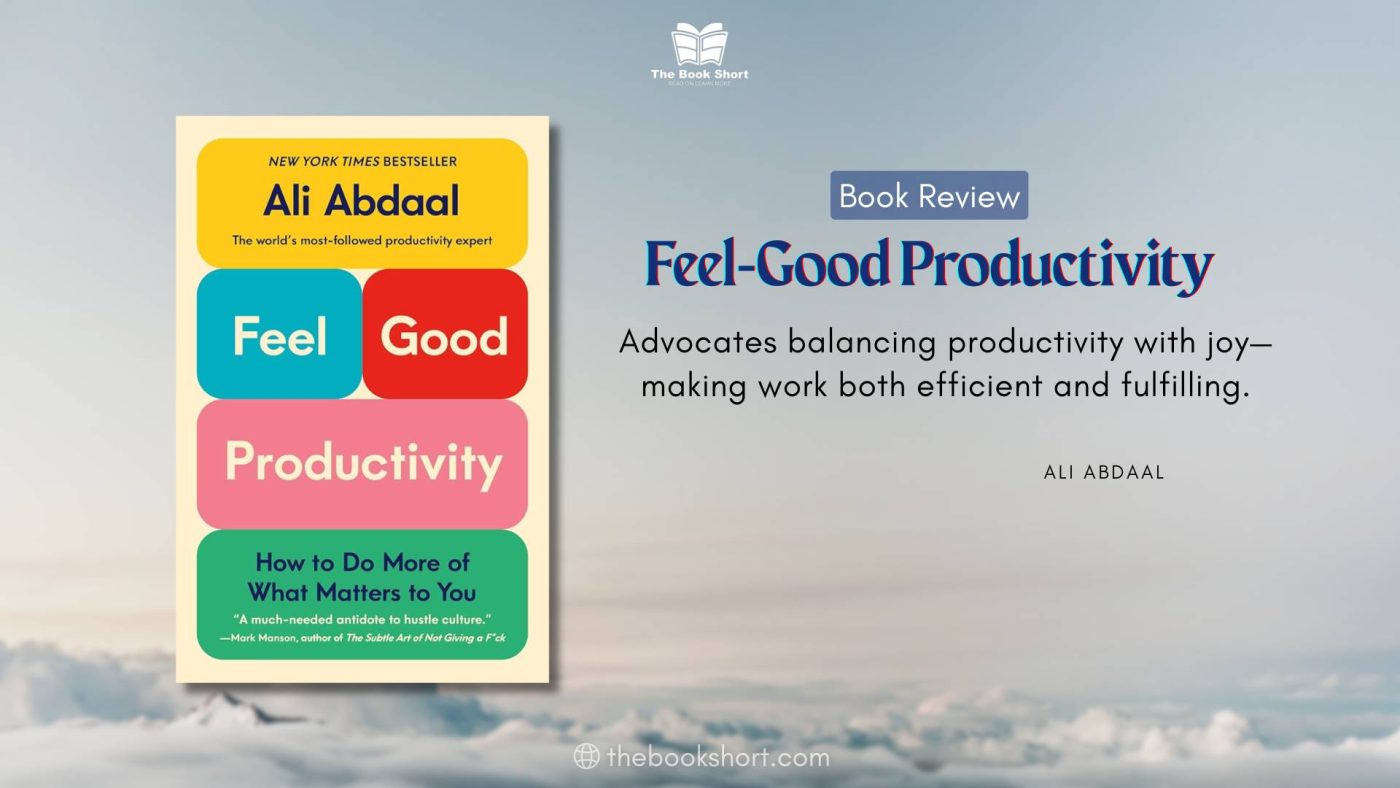
Unlock joyful productivity! Ali Abdaal’s guide makes achieving more feel effortless and fun. Find flow without the burnout.
Feeling perpetually overwhelmed or chained to the grind in the name of productivity? What if achieving your goals didn’t require constant struggle but could actually feel good? Ali Abdaal’s Feel-Good Productivity offers a revolutionary perspective, showing how to accomplish more of what truly matters while genuinely enjoying the process. Forget the relentless hustle; discover the secrets to sustainable success rooted in energy, ease, and enjoyment.
Essential Details: Feel-Good Productivity by Ali Abdaal
Delving into the core information about this groundbreaking book:
- Title: Feel-Good Productivity: How to Achieve More of What Matters to You
- Author: Ali Abdaal
- Year of publication: 2024
- Genre: Self-Help, Productivity, Personal Development
- Number of pages: Approximately 352 pages (may vary by edition)
- Target audience: Individuals seeking effective, sustainable productivity methods, students, professionals, entrepreneurs, anyone interested in personal growth and avoiding burnout.
I chose to analyze Feel-Good Productivity because its central premise directly challenges the exhausting narrative that equates achievement with sacrifice and constant effort. Ali Abdaal, widely known for his insightful content on learning and productivity, dares to propose a different path – one deeply connected to energy, ease, and enjoyment. This fresh angle makes the book a vital subject for exploration, offering a powerful alternative in a saturated genre and urging readers to fundamentally reconsider their relationship with work, achievement, and well-being.

Feel-Good Productivity: How to Do More of What Matters to You
Feel-Good Productivity Book Summary: The Energize, Ease, Enjoy Framework
Ali Abdaal’s Feel-Good Productivity presents a much-needed antidote to the often-stressful pursuit of getting things done. Moving beyond rigid discipline and relentless time management, the book champions a vibrant framework centered on energy, ease, and enjoyment. Abdaal’s core argument is simple yet transformative: true, sustainable productivity doesn’t stem from grinding harder, but from working smarter in a way that genuinely feels good and aligns with our natural states. When we feel good, we’re not just more capable; we’re more creative, resilient, and effective.
The book is masterfully structured around Abdaal’s signature three-part framework: Energize, Ease, and Enjoy. Each section offers practical strategies, insightful mindsets, and actionable techniques designed to tap into these states, shifting productivity from a dreaded chore to a natural, rewarding flow.
Part 1: Energize Your Productivity – Fueling Your Potential
This foundational section tackles the critical, yet often overlooked, need for robust physical and mental energy as the bedrock of effective work. Abdaal argues compellingly that willpower is a finite resource, easily depleted, but energy is renewable and can be cultivated. He explores various avenues to boost and sustain energy levels throughout your day and week.
- The Energy Equation: Abdaal introduces the paradigm shift: productivity is fundamentally more about managing your energy than just your time. He illuminates the different forms of energy – physical, mental, emotional, spiritual – and how their interplay impacts your ability to perform and feel good.
- Fueling Up: This covers the essential, non-negotiable pillars: sleep, nutrition, hydration, and movement. The book provides actionable guidance on optimizing these foundational elements, specifically linking them back to their profound impact on productivity and focus, rather than just general health. For instance, understanding how quality sleep directly sharpens focus and improves decision-making is crucial.
- Managing Your Energy: Beyond the basics, Abdaal dives into sophisticated techniques for navigating energy fluctuations. This includes strategic breaks, understanding your personal chronotype (whether you’re a morning lark or a night owl), and intelligently scheduling tasks during your peak energy periods.
- Dealing with Drains: A vital step is identifying and actively mitigating the activities, people, or environments that deplete your precious energy. This involves establishing healthy boundaries, decluttering both physical and digital spaces, and reducing unnecessary cognitive load and decision fatigue.
The powerful takeaway from “Energize” is clear: optimizing your physical and mental state isn’t a self-indulgent luxury; it’s an absolute prerequisite for high-quality, sustainable output. Productive work flows most naturally when you feel capable, vital, and well.
Part 2: Ease Your Workflow – Removing Friction and Flowing Forward
This part elegantly shifts focus from internal energy to optimizing external systems and processes. Abdaal posits that a significant source of struggle in productivity comes from unnecessary friction, resistance, and complexity in our workflows. Easing your process means diligently removing obstacles and constructing systems that actively support your work, rather than inadvertently hindering it.
- Reducing Friction: The first step is identifying bottlenecks, redundant steps, and common sources of procrastination within your tasks. Abdaal encourages readers to conduct an honest audit of their tasks and workflows to pinpoint exactly where things tend to get stuck or feel difficult.
- Creating Systems: The book places strong emphasis on building repeatable systems and intuitive routines for common or recurring tasks. This could involve using templates, batch processing similar activities together, or leveraging automation for repetitive actions. The overarching goal is to significantly reduce the mental effort and resistance required to simply start and complete tasks.
- Organizing Your Life: Practical, tangible advice is offered on organizing digital files, streamlining email inboxes, and optimizing your physical workspaces. A well-organized environment isn’t just aesthetically pleasing; it actively reduces mental clutter, minimizes distractions, and makes it easier to find what you need to focus.
- Delegation and Saying No: A key strategy for easing your own burden is wisely understanding which tasks can be delegated to others or, importantly, eliminated entirely. Learning to confidently say no to non-essential commitments is paramount to protecting your time and energy for what truly matters and aligns with your goals.
- Batching and Time Blocking: These widely-used productivity techniques are presented through the refreshing lens of ease – grouping similar tasks together minimizes disruptive context switching, and allocating specific blocks of time reduces decision fatigue about ‘what to work on next’.
The profound essence of this section is about thoughtfully designing your environment and processes to make the actual doing of the work feel as effortless and intuitive as possible, dissolving the mental and logistical hurdles that often stand in your way.
Part 3: Enjoy Your Journey – Finding Fulfillment in the Process
This final part delves into the crucial psychological and emotional dimensions of productivity, focusing on finding genuine fulfillment and pleasure in the work itself. Abdaal powerfully argues that enjoyment isn’t merely a reward after productivity has been achieved, but a potent and sustainable driver of it. When you enjoy the journey, productivity ceases to be a means to an end and becomes a vibrant, self-reinforcing cycle.
- Finding Your Why: Deeply connecting your work to your intrinsic values, passions, and larger life goals inherently makes it more motivating, meaningful, and enjoyable. Understanding the purpose or impact behind your daily tasks transforms potential drudgery into inspired, meaningful effort.
- Gamifying Your Work: Abdaal explores creative techniques like injecting elements of challenge, meticulously tracking progress, and creating small, timely rewards to make tasks more engaging and fun. Framing work as a game can alleviate pressure, boost intrinsic motivation, and make even tedious activities feel lighter.
- Cultivating Flow States: The book discusses the essential conditions required for entering a state of flow – that deeply immersive experience where time seems to melt away, and the work feels almost effortless and profoundly enjoyable. Achieving flow often involves striking the right balance between your skill level and the challenge of the task.
- Celebrating Progress: Actively acknowledging and celebrating small wins and milestones along the way provides vital positive reinforcement, maintains momentum, and builds confidence. Focusing exclusively on the distant final outcome can make the journey feel excessively long, daunting, and discouraging.
- Connecting with Others: Collaboration, mentorship, and building a supportive community around your work can significantly enhance enjoyment and provide invaluable support and motivation. Sharing experiences, challenges, and progress with others fosters a sense of connection and shared purpose.
This section makes a compelling case that by actively seeking out and cultivating enjoyment within your work, you forge a powerful positive feedback loop that naturally fuels continued productivity and acts as a potent shield against burnout.
Throughout Feel-Good Productivity, Abdaal skillfully weaves together personal anecdotes, accessible explanations of scientific research, and relatable case studies to vividly illustrate his points. He strongly encourages experimentation and personalization, acknowledging that the path to feel-good productivity is unique for everyone. The book’s overarching message is one of radical self-compassion, sustainable effort, and the profound joy of finding fulfillment in the process of achieving meaningful goals. It transcends mere hacks and tricks, aiming instead to fundamentally reshape the reader’s relationship with productivity, transforming it from a source of stress into a wellspring of fulfillment.
Deep Dive Analysis of Feel-Good Productivity by Ali Abdaal
Feel-Good Productivity by Ali Abdaal stands out in the crowded landscape of self-improvement literature by fundamentally reorienting the conversation around getting things done. It boldly shifts the focus from relentless output metrics and rigid discipline towards the crucial internal states that make work sustainable, enjoyable, and ultimately, more effective. The central thesis is deceptively simple yet carries immense weight: when you feel good – energized, at ease, and engaged – you produce higher quality work with less internal resistance. This represents a significant departure from traditional time-management or willpower-centric models, arguing convincingly that energy, ease, and enjoyment are the true, enduring drivers of effective, long-term productivity and well-being.
Structure and Key Arguments Explored
The book’s structure is a direct reflection of its core philosophy, logically dividing its content into three distinct, yet beautifully interconnected, parts: Energize, Ease, and Enjoy. This tripartite foundation provides a clear, progressive path for the reader, building from the fundamental physiological and mental readiness (energy) to optimizing the external environment and processes (ease), and finally integrating the internal with the external through perspective, motivation, and connection (enjoyment).
- Energize: This foundational part compellingly argues that physical and mental well-being are not ancillary benefits but absolute, non-negotiable prerequisites for peak productivity. Key arguments here center on the idea that managing energy is paramount, surpassing mere time management. It delves into optimizing sleep, nutrition, movement, and critically, identifying and strategically eliminating ‘energy vampires’ from your life. This section reframes self-care not as a break from work, but as an essential, integrated component of truly effective work.
- Ease: This section directly confronts the pervasive friction and resistance inherent in many modern workflows. The core argument is powerful: complexity is the insidious enemy of execution. By actively simplifying systems, automating routine tasks, thoughtfully organizing your environment, and developing the skill to delegate or eliminate unnecessary demands, you dramatically reduce the mental and logistical burden. This makes it significantly easier to initiate and maintain consistent, focused work. It’s about intentionally engineering your environment and processes for seamless success.
- Enjoy: The final part courageously explores the vital emotional and psychological connection to our work. The key argument is revolutionary for many: enjoyment isn’t an optional bonus or a future reward; it is a powerful, intrinsic motivator. Finding deep purpose, strategically incorporating elements of playfulness (gamification), actively seeking and cultivating flow states, and consciously celebrating progress creates a virtuous, positive feedback loop. This cycle fuels sustained effort, enhances creativity, and acts as a potent safeguard against burnout. It elevates work from a grudging necessity to a potential source of profound fulfillment.
The structure is exceptionally effective because it systematically moves from the fundamental internal resources (energy) to optimizing the external world we interact with (ease), and finally integrates the internal motivation and perspective (enjoy) to create a holistic and sustainable approach. Each section is rich with actionable strategies grounded firmly in the book’s core principles.
Writing Style and Content Quality Appraisal
Ali Abdaal’s writing style is remarkably accessible, warm, and genuinely engaging. He successfully translates the friendly, conversational tone that resonates with millions on his YouTube channel into the written word. This imbues the book with a sense of supportive guidance rather than a stern, prescriptive lecture.
- Clarity and Approachability: Complex concepts, even those drawn from psychology or neuroscience, are explained with admirable clarity and simplicity. Technical jargon is intentionally minimized or carefully elucidated, ensuring the book is accessible to a broad audience.
- Authenticity and Relatability: Abdaal generously shares numerous personal anecdotes detailing his own evolution, struggles, and triumphs with productivity – from the intense pressures of medical school to the demands of building a successful online presence. This personal vulnerability makes the advice feel deeply authentic and highly relatable, demonstrating that he not only understands the challenges but actively practices the principles he advocates.
- Integration of Research: While maintaining its conversational tone, the book is clearly well-researched. Abdaal skillfully weaves in references to relevant scientific studies, established psychological principles (like Csikszentmihalyi’s flow theory, research on energy management), and insights from other respected experts in the field. This academic grounding lends significant credibility to his feel-good framework.
- Actionable Advice: Crucially, each section is densely packed with practical tips, immediately applicable exercises, and tangible frameworks that readers can implement right away. The book is not merely theoretical; it is fundamentally designed for real-world application and experimentation.
- Content Quality: The overall content is of high quality, logically organized, and comprehensive within the scope of its chosen framework. It masterfully synthesizes ideas from disparate fields – productivity, psychology, habit formation, well-being – and presents them through Abdaal’s distinctive and timely “feel-good” lens.
What Truly Stands Out and Differentiates Feel-Good Productivity
What genuinely elevates Feel-Good Productivity above many other books in the genre is its explicit, central focus on feeling good as the fundamental engine driving productivity. Most existing literature tends to emphasize external actions: discipline, efficiency techniques, time management hacks, or battling procrastination primarily through willpower. Abdaal fundamentally shifts the paradigm, suggesting that when you consciously optimize for energy, ease, and enjoyment, discipline and efficiency become less of a struggle and more of a natural, emergent outcome.
- Prioritizing Energy: While some productivity discussions mention energy levels, Abdaal places it front and center as the absolutely essential first pillar. He emphasizes energy’s renewability and the critical skill of managing it, contrasting this with the often-frustrating over-reliance on finite willpower.
- Emphasis on Enjoyment: Many traditional productivity methods implicitly (or explicitly) view enjoyment as a distraction or even antithetical to serious, hard work. Abdaal positions enjoyment not as an optional add-on, but as a crucial driver and a key metric for both sustainable success and personal fulfillment. He actively advocates for cultivating pleasure within the very process of working.
- Holistic Integration: The book avoids presenting disjointed hacks. Instead, it brilliantly integrates physical well-being, environmental design, system thinking, and psychological factors into a cohesive, unified framework that addresses the individual as a whole person.
- Permission to Feel Good: By naming and centering the concept of “feel-good,” the book implicitly grants readers powerful permission to seek out methods that genuinely work for them, align with their personal well-being, and feel sustainable. This is a direct and much-needed pushback against the often-damaging hustle culture narrative that equates productivity with suffering or constant self-denial.
Notable Paraphrased Ideas from the Book
While pinpointing exact quotes without the text is challenging, the book’s core philosophy and memorable ideas can be captured through paraphrasing the concepts frequently emphasized:
- “Productivity isn’t ultimately about doing more; it’s about doing more of what truly matters to you, in a way that genuinely feels good.” (Encapsulating the core message and shift)
- “Your energy is your most valuable and renewable resource, far more critical than simply managing your time.” (Highlighting the fundamental shift in focus)
- “Make it radically easier to simply start the work, and you’ve already overcome half the battle.” (Reflecting the potent ‘Ease’ principle)
- “Enjoyment isn’t the reward you get after being productive; it’s the essential fuel that drives sustainable productivity.” (Capturing the revolutionary essence of the ‘Enjoy’ section)
- “Instead of striving to be a cold, efficient productivity machine, focus on being a fulfilled human who finds joy in doing meaningful things.” (Articulating the underlying humanistic philosophy)
These paraphrased ideas powerfully encapsulate the unique, compassionate, and human-centric approach that Feel-Good Productivity advocates, setting it apart from more traditional, output-driven guides and making its message particularly resonant in today’s demanding world.
Evaluation & Expert Personal Review: Feel-Good Productivity’s Impact
As someone who has navigated the vast landscape of productivity literature, Feel-Good Productivity offers a breath of fresh air and a genuinely transformative perspective. My personal impression is overwhelmingly positive, finding Abdaal’s central premise not only compelling but remarkably practical and deeply resonant.
Key Advantages:
- A Necessary Paradigm Shift: The idea that productivity should feel good is not just appealing; it’s a vital counter-narrative to the prevalent culture of burnout and relentless hustle. It validates the reader’s often-ignored intuition that constant struggle is neither sustainable nor desirable.
- Holistic and Integrated Framework: The Energize, Ease, Enjoy structure is a stroke of genius. It provides a comprehensive yet incredibly easy-to-grasp model that connects disparate elements of well-being and work. It effectively moves beyond singular hacks to address the interconnectedness of our physical state, mental clarity, emotional resonance, and environmental influence.
- Highly Practical and Immediately Actionable: Abdaal doesn’t dwell in abstract theory. The book is generously filled with concrete tips, simple exercises, and clear frameworks that readers can easily understand and begin implementing the very same day. It’s built for real-world application.
- Relatable, Engaging, and Compassionate Tone: Abdaal’s authentic voice is one of the book’s greatest strengths. The writing is friendly, encouraging, and refreshingly devoid of the preachy or guilt-inducing tone found in some self-help books. His willingness to share his own journey makes the advice feel earned, trustworthy, and deeply human.
- Emphasis on Sustainable Well-being: By placing “feeling good” at the core, the book inherently promotes a model of productivity that actively prevents burnout. This focus on sustainability is crucial in our fast-paced, demanding world and represents a significant contribution to the conversation.
Potential Considerations (Not Necessarily Disadvantages):
- Risk of Oversimplification for Some: While the framework’s clarity is a strength, some readers facing particularly challenging or inherently unpleasant work might find the connection between “feeling good” and productivity slightly oversimplified at times. The book acknowledges difficult tasks but the emphasis remains strongly on finding avenues for positivity and ease.
- Integration of Existing Concepts: Many of the individual techniques discussed (like time blocking, batching, organization systems, sleep hygiene) are not entirely novel inventions. The true innovation and value lie squarely in Abdaal’s unique framing of these tools and their brilliant integration into the cohesive “feel-good” philosophy. For readers extensively familiar with productivity literature, certain sections might feel like a review of familiar concepts, though the fresh angle adds significant perspective.
- Requires Active Self-Awareness: Effectively applying the book’s advice relies heavily on the reader’s willingness and ability to develop self-awareness – to honestly identify energy drains, recognize sources of enjoyment, and pinpoint workflow friction. The book provides guidance for this introspection, but the journey of discovery is ultimately personal.
Readability and Suitability Assessment:
The book is exceptionally readable. Abdaal’s clear, conversational language, engaging stories, and avoidance of jargon make it highly accessible to a wide audience, regardless of their prior knowledge of productivity concepts. It’s ideally suitable for:
- Anyone feeling overwhelmed, stressed, or genuinely burned out by traditional, grind-focused productivity approaches.
- Students, professionals, entrepreneurs, or creatives actively seeking more sustainable, enjoyable, and humanistic ways to approach their work and goals.
- Individuals interested in personal development who are looking for a fresh, evidence-informed perspective on achievement and well-being.
- Those who feel societal pressure to constantly “hustle” and need explicit permission, along with practical guidance, to prioritize their well-being alongside their ambition.
Practical Value and Transformative Potential:
The practical value of Feel-Good Productivity is substantial and goes beyond mere tips and tricks. It is fundamentally designed to facilitate a profound shift in mindset and approach.
- Core Lessons: The enduring lessons center on the critical importance of prioritizing your energy as much as your time, simplifying your systems to reduce unnecessary effort, and actively cultivating enjoyment within the process of work. It powerfully teaches that feeling good isn’t contrary to productivity; it is a fundamental, potent component of it.
- Immediate Application: Readers can immediately begin applying strategies, from simple actions like optimizing their sleep environment or restructuring their morning routine to implementing more complex techniques like strategic task batching or actively seeking ways to gamify tedious parts of their work.
- Lasting Mindset Change: The most significant and lasting impact for many readers will likely be the shift away from a guilt-ridden, effort-centric model of productivity towards one that is more compassionate, experimental, and deeply focused on finding flow, fulfillment, and sustainable well-being. It empowers readers to trust their own experience and find what truly makes them feel good and genuinely productive.
Overall, Feel-Good Productivity is a genuinely valuable and timely contribution to the self-help landscape. It offers a much-needed, human-centric, and sustainable alternative to the often-damaging narratives surrounding productivity, making it an essential read for anyone looking to achieve more of what matters without sacrificing their well-being.
Feel-Good Productivity Compared to Similar Books in the Productivity Genre
Feel-Good Productivity enters a densely populated literary space, sharing shelves with countless books on efficiency, habit formation, and personal success. However, its distinct central thesis – the unwavering focus on feeling good as the engine of productivity – establishes its unique position relative to many traditional and even contemporary titles.
Compared to foundational texts like David Allen’s Getting Things Done (GTD) or Stephen Covey’s The 7 Habits of Highly Effective People, which provide robust external systems for task management, organization, and principle-centered living, Abdaal’s work places a far greater emphasis on the internal state and subjective experience of the individual doing the work. While GTD offers a comprehensive system for capturing and organizing tasks, and 7 Habits focuses on character development and foundational principles, Feel-Good Productivity delves into the crucial why and how of maintaining the intrinsic motivation, energy, and psychological well-being necessary to actually engage with and sustainably utilize those external systems effectively. It addresses the human element behind the system.
Books like James Clear’s ubiquitous Atomic Habits brilliantly dissect the mechanics of habit formation, emphasizing incremental progress through tiny, consistent steps. Abdaal’s framework beautifully complements this by providing the underlying energy, ease, and motivation that makes sticking to those small habits feel less like a discipline enforced upon oneself and more like a natural, enjoyable extension of feeling capable and engaged. While Clear teaches you how to build habits reliably, Abdaal helps you cultivate the internal conditions that make the habit-building process feel more sustainable, effortless, and rewarding.
Authors such as Cal Newport, known for Deep Work and Digital Minimalism, compellingly advocate for focused work, minimizing distractions, and structuring your environment for maximum cognitive output. Abdaal certainly aligns with the need for focused work (which is significantly facilitated by reducing friction and boosting energy), but his scope expands beyond just optimizing output to deeply include the subjective, qualitative experience of working. Newport might equip you with strategies for how to focus deeply; Abdaal helps you cultivate the foundational conditions (ample energy, minimal resistance, genuine enjoyment) that make entering and sustaining deep focus significantly more likely and far less draining.
Perhaps the closest conceptual overlaps might be found in works that explore flow states or the intrinsic psychology of motivation, but Abdaal successfully integrates these psychological insights into a practical, holistic, and actionable productivity system explicitly centered around the transformative “feel-good” element.


For readers who found value and resonance in Feel-Good Productivity, they might also deeply enjoy exploring:
- Atomic Habits by James Clear: Excellent for understanding the foundational mechanics of habit formation and behavioral change that can effectively support Abdaal’s motivation and energy frameworks.
- Flow: The Psychology of Optimal Experience by Mihaly Csikszentmihalyi: A seminal work for a deeper, more academic dive into the psychological science behind the enjoyment and flow states Abdaal discusses as critical drivers of fulfillment and effective performance.
- The Power of When: Discover Your Chronotype–and the Best Time to Eat, Sleep, Work, and Exercise by Michael Breus: Offers detailed insights into understanding your personal biological clock and aligning your activities, particularly work, with your natural energy cycles – a perfect complement to the ‘Energize’ section.
- Building a Second Brain: A Proven Method to Organize Your Digital Life and Unlock Your Creative Potential by Tiago Forte: Provides highly practical and powerful strategies for organizing information and managing knowledge, which directly contributes to reducing mental load and friction, fitting seamlessly into the ‘Ease’ principles.
- Burnout: The Secret to Unlocking the Stress-Cycle by Emily Nagoski and Amelia Nagoski: Offers essential understanding and actionable strategies for processing stress and managing emotional energy, highly relevant to preventing burnout and maintaining the overall ‘Feel-Good’ state Abdaal advocates.
These suggested reads offer opportunities to delve deeper into specific components of Abdaal’s comprehensive framework or provide complementary systems that enhance habit formation, information management, and energy optimization, all while supporting a more sustainable and enjoyable approach to achieving goals.
Conclusion & Recommendations on Embracing Feel-Good Productivity
Feel-Good Productivity by Ali Abdaal is far more than just another guide to getting things done; it stands as a compelling manifesto for cultivating a more humane, sustainable, and genuinely fulfilling way to navigate work and life. Its most outstanding value lies in its courageous and timely reframing of productivity, shifting the focus from the often-damaging pursuit of relentless output to the intentional cultivation of energy, ease, and enjoyment as the fundamental drivers of effective and truly meaningful work. Abdaal builds a powerful and convincing case that when you consciously prioritize feeling good, achieving what truly matters ceases to be a draining struggle and becomes a natural, enjoyable outcome.
Is this book worth your time? Unequivocally, yes. Feel-Good Productivity offers a vital, much-needed counterpoint to the often-unhealthy and unsustainable narratives surrounding achievement in modern society. It provides not only a compelling philosophical perspective but also a treasure trove of practical, accessible strategies designed for real-world implementation.
Who stands to benefit most from reading it? Anyone who has ever felt overwhelmed, stressed, or fundamentally burnt out by their efforts to be productive will find immense value and relief within these pages. This includes students juggling academic pressures, professionals managing demanding careers, entrepreneurs building their ventures, creatives pursuing their passions – essentially, anyone seeking a healthier, more joyful path to achieving their goals without sacrificing their well-being. It is particularly resonant for those who feel pressured by hustle culture and are seeking both permission and practical guidance to forge a more compassionate and effective path.
Feel-Good Productivity serves as a timely and empowering reminder that productivity should ultimately serve our lives and enhance our well-being, rather than consume us. It is a practical and inspiring guide to working smarter, living better, and discovering genuine joy and fulfillment in the dynamic process of creation, growth, and meaningful achievement.
Have you experienced the shift towards feel-good productivity? Share your thoughts and insights in the comments below!