
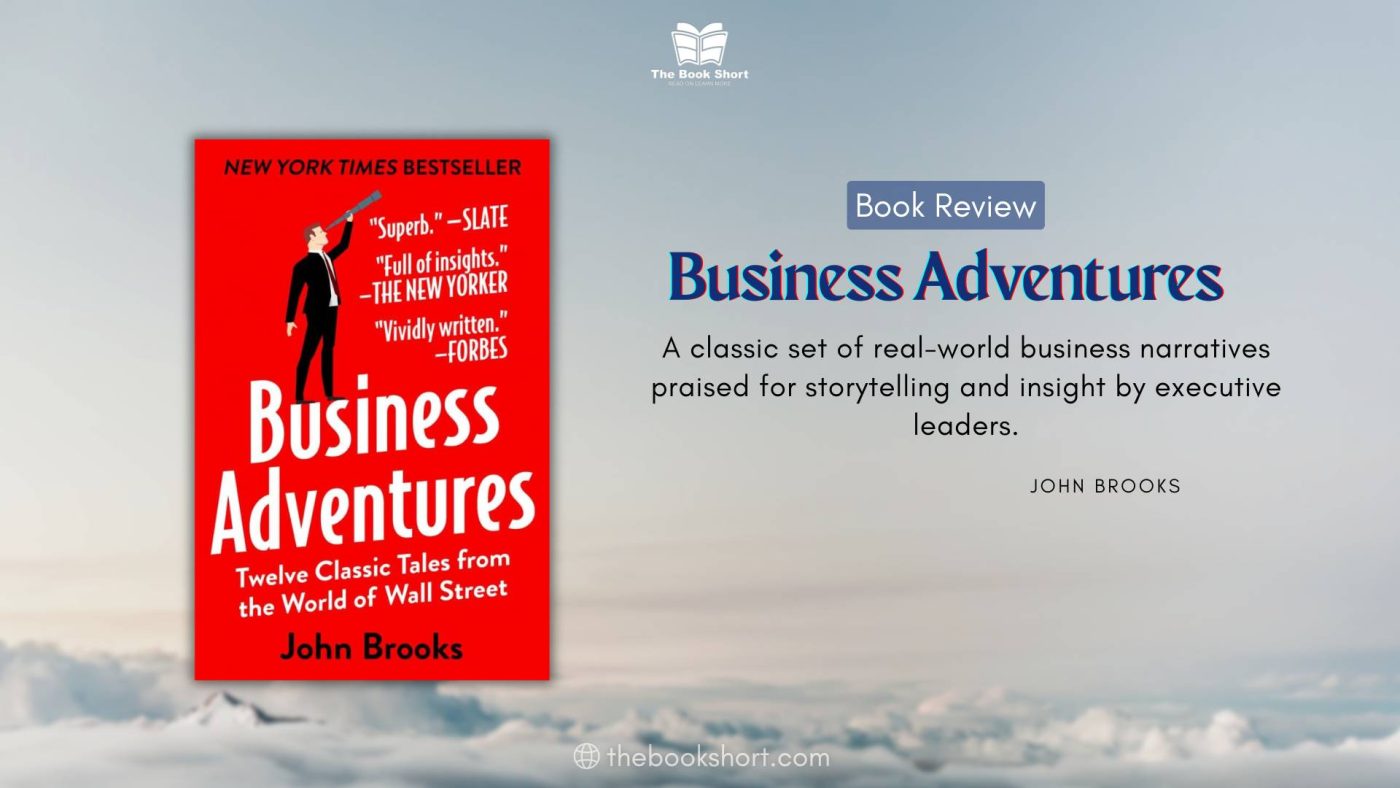
A deep dive into John Brooks’ Business Adventures. Get a full book summary, analysis, and review of this timeless classic, a favorite of Gates and Buffett.
Why do business titans like Bill Gates and Warren Buffett famously call a book written in 1969 “the best business book ever written”? This analysis explores what makes John Brooks’ Business Adventures not just a classic, but a living piece of wisdom that transcends time.
Business Adventures at a Glance: Key Book Facts
- Title: Business Adventures: Twelve Classic Tales from the World of Wall Street
- Author: John Brooks
- Year of publication: 1969
- Genre: Business, Narrative Nonfiction, History
- Number of pages: Approx. 400-460 pages (depending on the edition)
- Target audience: Investors, entrepreneurs, business leaders, students of finance and history, and anyone fascinated by the human side of commerce.

Business Adventures: Twelve Classic Tales from the World of Wall Street
A Business Adventures Book Summary: Twelve Classic Tales
John Brooks’ Business Adventures is not a business book in the modern sense—it offers no seven-step frameworks or prescriptive roadmaps to riches. Instead, it is a masterfully curated collection of twelve long-form stories, originally penned for The New Yorker, that plunge the reader into the American corporate and financial world of the 1950s and ’60s. Each chapter is a time capsule, exploring pivotal moments through the eyes of the people who lived them. At its heart, the book is a profound study of human nature—our pride, greed, irrationality, and occasional integrity—set against the high-stakes backdrop of Wall Street and corporate America.
Chapter Summaries: The Twelve Adventures
The book is structured as twelve independent, deeply researched narratives, each a compelling case study in itself.
- The Fluctuation: Brooks delivers a gripping, minute-by-minute account of the “Flash Crash” of May 28, 1962. He transports the reader to the chaotic floor of the New York Stock Exchange as a sudden, inexplicable market plunge sows panic and confusion. More than a financial report, this is a human story about herd mentality and the terrifying irrationality that can seize the market at any moment.
- The Fate of the Edsel: This is the legendary tale of a corporate catastrophe. Brooks dissects how Ford Motor Company, despite mountains of market research and a colossal budget, launched one of the biggest product flops in history. The failure wasn’t just a miscalculation; it was a story of corporate hubris and an internal culture so insulated it couldn’t see the truth right in front of it.
- The Federal Income Tax: In a feat of literary alchemy, Brooks spins the dry U.S. tax code into a fascinating drama of loopholes, moral quandaries, and unintended consequences. He reveals the endless cat-and-mouse game between lawmakers trying to create a fair system and the brilliant minds dedicated to navigating its complexities, often for the benefit of the rich and powerful.
- A Reasonable Amount of Time: This chapter investigates the landmark Texas Gulf Sulphur insider trading scandal. After the company discovered a monumental mineral deposit, its executives quietly bought up stock before the news went public. The ensuing legal battle centered on a crucial question: what is “insider information,” and when is it fair to use it? The case forged legal precedents that define market ethics to this day.
- Xerox Xerox Xerox Xerox: The quintessential story of explosive success in the collection. Brooks charts the astonishing rise of Xerox, from a company peddling an obscure technology called xerography to a corporate behemoth that utterly dominated the new photocopier industry. It’s a brilliant chronicle of disruptive innovation, immense risk, and the birth of a market nobody knew they needed.
- Making the Customers Whole: This story recounts the dramatic collapse of the brokerage firm Ira Haupt & Co. after the “Salad Oil Scandal,” where a client defaulted on loans secured by phantom vats of soybean oil. Fearing a catastrophic loss of public trust, the NYSE orchestrated a bailout of the firm’s clients. Brooks captures a rare moment of collective responsibility, where the system acted to protect its integrity.
- The Impacted Philosophers: Brooks delves into the General Electric price-fixing scandal of the early 1960s, where executives colluded with competitors in secret. The story is a chilling look into a corporate culture of “winks and nods” that tacitly encouraged illegal acts, leading to a crisis of conscience and jail time for men who saw themselves as loyal employees. It’s a masterclass in diffused responsibility.
- The Last Great Corner: Here we find the story of Piggly Wiggly founder Clarence Saunders, a brash entrepreneur who tried to “corner” the market on his own stock to punish short-sellers. His audacious gamble against Wall Street backfired in spectacular fashion, leading to his financial ruin. It’s a timeless lesson on the dangers of letting ego drive financial decisions.
- A Second Sort of Life: A unique chapter profiling David E. Lilienthal, a former public servant who embarked on a mission to bring private, capitalist development to a poverty-stricken region of Iran. Brooks explores the complex and often fraught intersection of Wall Street finance, public good, and international development.
- Stockholder Season: With a light, satirical touch, Brooks paints a portrait of the annual corporate shareholder meeting. He captures the unique theater of these events—from the passionate gadflies challenging management to the glossy presentations—revealing the strange and sometimes comical relationship between a giant corporation and its disparate owners.
- One Free Bite: This is a technical but fascinating look into the intricacies of corporate governance. Brooks examines a legal skirmish over a loophole that allowed a stockholder to gain a seat on a company’s board without a messy proxy fight, exposing the hidden power struggles that shape corporate America.
- In Defense of the Pound: The final chapter chronicles the dramatic international effort to save the British pound from a speculative attack. Brooks details the high-stakes, back-channel coordination between central banks to defend a currency, illustrating the fragile interconnectedness of the global financial system and the immense power it wields.
An In-Depth Analysis of Business Adventures: Themes and Style
The genius of John Brooks’ Business Adventures is that it reveals timeless truths about business by focusing on the one variable that never changes: human nature. The book’s incredible staying power comes from its narrative depth, literary grace, and unwavering focus on the people at the center of the balance sheet.
Characters / Structure / Key Arguments
Rather than a single, overarching thesis, Business Adventures is an anthology of human drama. Each of the twelve chapters stands alone as a rich case study, populated not by theoretical archetypes but by a real-life cast of characters: the overconfident Ford executives, the shell-shocked NYSE traders, the ethically conflicted GE managers. Brooks is a master storyteller who reveals character through action, decision, and consequence, treating each business event as a miniature epic.
This structure gives Brooks the freedom to explore a vast corporate landscape, from marketing (The Edsel) and innovation (Xerox) to ethics (GE), finance (The Fluctuation), and law (Texas Gulf Sulphur). An implicit argument emerges not through lecture but through evidence: business is, and always will be, a fundamentally human endeavor. Success and failure are born not just from strategies and spreadsheets, but from psychology, ego, miscommunication, and moral courage (or the lack thereof). The Edsel didn’t fail because of faulty data; it failed because a rigid corporate culture refused to listen to what the data was truly saying.
Writing Style & Content Quality
As a celebrated writer for The New Yorker, Brooks’s prose is in a league of its own. He practices a brand of narrative nonfiction that feels more like literature than journalism. His writing is elegant, witty, and rich with detail, yet maintains a cool, ironic distance. He doesn’t just give you the facts; he builds worlds, develops characters, and creates a palpable sense of suspense.
This literary approach is what makes Business Adventures so distinct. Where modern business books are often prescriptive—”The 5 Rules of…”—Brooks is descriptive. He lays out the messy, complicated, and often absurd reality of a situation and trusts the reader to glean the wisdom. The quality of his work is a testament to his journalistic rigor; he interviewed the key players, pored over records, and reconstructed events with a historian’s precision and a novelist’s eye for the telling detail. The result is a collection of stories that feel as vital and immediate today as they did half a century ago.
Notable Quotes from the Book
Brooks’s writing is filled with incisive observations that cut to the core of a story.
- On the Edsel’s spectacular failure: “Although the Edsel was a failure, it was a supremely stylish one.” This dry, witty line perfectly captures the car’s fatal flaw: a triumph of surface-level design over genuine consumer understanding.
- On the GE price-fixing scandal: “[They] were not evil men… They were not rebels; they were organization men, and they were acting, as they saw it, in the company’s best interests in a difficult situation.” This quote brilliantly illuminates the central ethical tragedy—how ordinary people can commit wrongdoing when guided by a corrupting corporate culture.
- On the stubborn irrationality of markets in “The Fluctuation”: “The striking thing about the stock market is that it is not just a barometer of the economy but a barometer of itself.” This insight explains how markets can become self-referential, driven by fear and greed rather than fundamentals.
- On the nature of innovation at Xerox: “To be sure, the Xerox machine is a mighty engine of change, but a benign one. It has done little to alter the essential nature of man.” A classic Brooks observation, reminding us that even world-changing technology operates within the fixed parameters of human nature.
Evaluation & A Personal Book Review
Business Adventures is a masterpiece precisely because it transcends its genre. It is not a business book; it is a collection of profound and endlessly fascinating stories about people, power, ambition, and folly. Its primary strength lies in its timelessness. The technology is vintage, but the human dynamics—the hubris, the panic, the greed, and the rare glimmers of genius and integrity—are eternal.
Advantages:
- Superb Storytelling: Brooks writes with the flair of a novelist, transforming complex corporate sagas into utterly gripping page-turners.
- Deep Human Insight: The book’s relentless focus on the human element provides a rich, qualitative understanding of business that data alone can never capture.
- Enduring Relevance: The lessons from the Edsel’s hubris, the market’s panic, and GE’s ethical collapse are arguably more relevant in today’s fast-moving world than they were in the 1960s.
Disadvantages:
- Dated Context: For some readers, the specific dollar amounts and mid-century social norms can feel like artifacts from another era, requiring a mental adjustment.
- No Easy Answers: If you’re looking for a “how-to” guide with actionable checklists, this isn’t it. The book offers wisdom, not instructions.
Readability and Audience:
For a book tackling such complex subjects, the readability is extraordinary. Brooks’s clear, elegant prose makes it a genuine pleasure to read. The audience is exceptionally broad. While executives, investors, and entrepreneurs will find immediate relevance, anyone with an interest in history, psychology, or simply masterful storytelling will be captivated. No prior financial expertise is needed.
Practical Value:
The practical value of Business Adventures lies not in tactics, but in cultivating wisdom. The key takeaways are subtle yet powerful:
- Cultivate Humility: The spectacular flameouts of the Edsel and Clarence Saunders are potent warnings against the dangers of arrogance and overconfidence.
- Prioritize People and Culture: The book is a constant reminder that strategy is secondary to the culture and character of the people executing it.
- Maintain Ethical Vigilance: The GE and Texas Gulf stories are stark cautionary tales about how easily moral lines can be crossed in the name of corporate goals.
- Respect Market Psychology: Brooks provides an intuitive, human-centered feel for market forces that is the perfect complement to quantitative analysis.
Business Adventures won’t give you a blueprint for building a company, but it will endow you with the perspective and character to be a wiser leader, a smarter investor, and a more discerning observer of the world.
Comparison with Similar Books in the Genre
While Business Adventures occupies a unique space, readers who appreciate its narrative-driven approach will find similar satisfaction in these other classics of the genre.
- Liar’s Poker by Michael Lewis: If Business Adventures is the genre’s elegant classical symphony, Liar’s Poker is its brash rock-and-roll anthem. Lewis uses his own experiences at Salomon Brothers to paint a vivid, cynical, and hilarious portrait of 1980s Wall Street. It shares Brooks’s focus on character, greed, and high-finance absurdity.
- The Smartest Guys in the Room: The Amazing Rise and Scandalous Fall of Enron by Bethany McLean and Peter Elkind: This is a direct spiritual successor to Brooks’s style of deep-dive journalism. It meticulously unpacks the Enron disaster by focusing on the arrogant personalities and toxic corporate culture that fueled one of history’s greatest corporate frauds. It reads like a lost chapter of Business Adventures.
- Barbarians at the Gate: The Fall of RJR Nabisco by Bryan Burrough and John Helyar: Another landmark of narrative business journalism, this book chronicles the frenzied leveraged buyout of RJR Nabisco. Like Brooks, the authors have a keen eye for dramatic detail and the larger-than-life egos that turn a financial transaction into a gripping corporate thriller.


If you love Business Adventures, these titles offer that same potent blend of meticulous reporting and high drama, proving that the most compelling business stories are always about people.
Conclusion & Recommendations: A Book Review Summary
Business Adventures by John Brooks is far more than a business book—it is a collection of timeless fables about capitalism, told with wit, elegance, and profound insight into the human heart. By rejecting simple formulas in favor of rich, character-driven storytelling, Brooks created a work of enduring wisdom that has outlasted generations of management fads.
Is it worth reading? Unquestionably. It is essential reading for anyone in a position of leadership and highly recommended for anyone who simply loves brilliant nonfiction. It is the ultimate proof that while circumstances change, human nature is the one constant in the chaotic world of business.
Who should read it?
- Leaders and Managers: To grasp the profound impact of culture and the mortal danger of hubris.
- Investors and Finance Professionals: To gain a qualitative perspective on market psychology that no chart can provide.
- Students of Business and History: To experience pivotal economic events as compelling human dramas, not dry case studies.
- Curious General Readers: To enjoy masterful storytelling about ambition, power, and the fascinating complexities of human behavior.
Have you read this book? Share your thoughts in the comments below.