
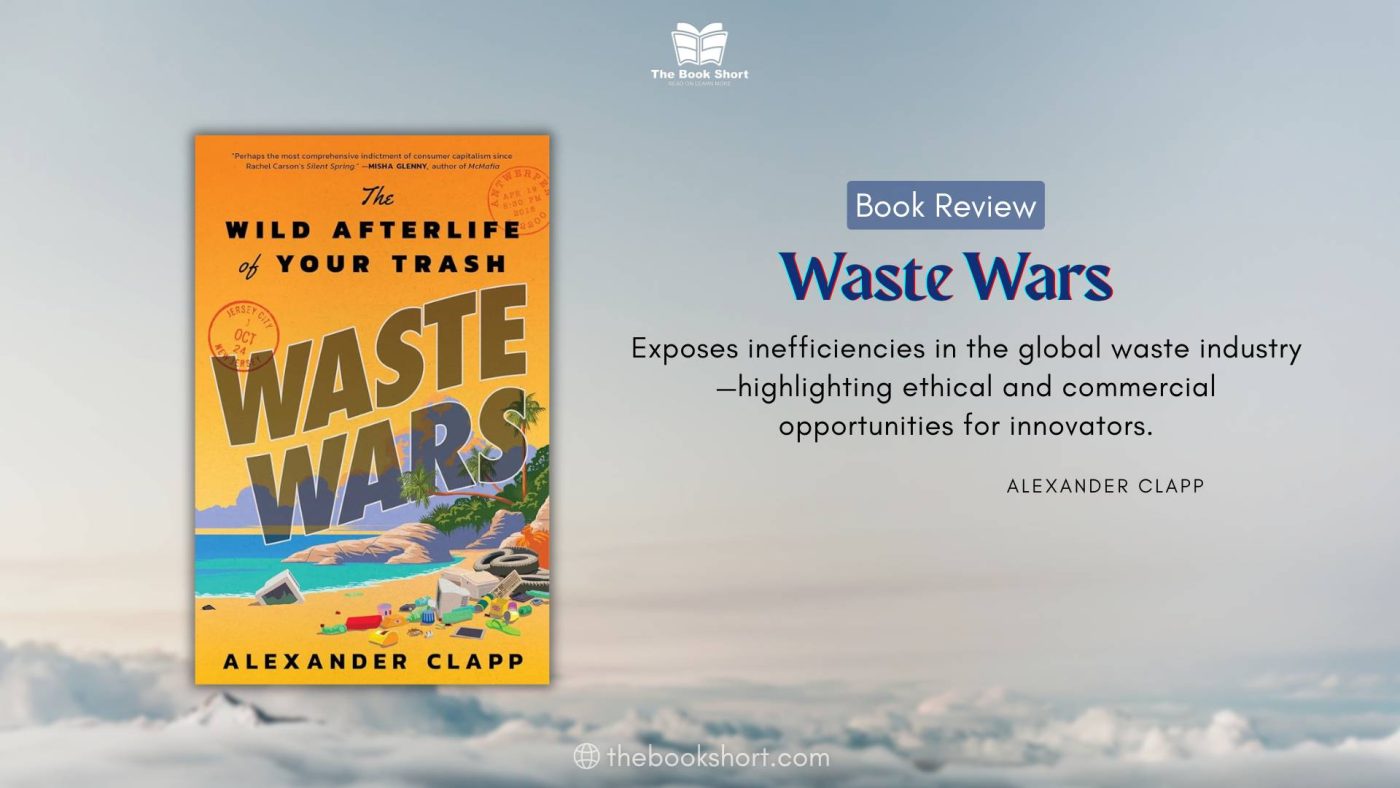
A searing exposé of the global waste trade, this book uncovers the dirty, dangerous secret of what truly happens to your trash after you throw it “away.”
Alexander Clapp’s Waste Wars is a landmark piece of investigative journalism that follows the toxic trail of our garbage across continents. I chose this book for review because it shatters the comforting myth of recycling, exposing the systemic, often criminal, machinery of the international waste trade. Its profound power comes from its unflinching, on-the-ground reporting, which transforms an abstract environmental crisis into a series of gripping, deeply human stories. It is a book that makes it impossible to ever look at your recycling bin the same way again.
Book Information: A Snapshot of Waste Wars
- Title: Waste Wars: The Future of Trash on a Shared Planet
- Author: Alexander Clapp
- Year of publication: 2024
- Genre: Non-fiction, Investigative Journalism, Environmental Justice
- Number of pages: 336
- Target audience: Readers interested in environmental justice, global economics, international policy, and deep-dive investigative journalism.

Waste Wars: The Wild Afterlife of Your Trash
Waste Wars Book Summary: A Global Trash Odyssey
Alexander Clapp’s Waste Wars is no sterile academic overview; it is a boots-on-the-ground descent into the labyrinthine world of the global garbage trade. The book unfolds as a series of interconnected dispatches from the front lines of the planet’s trash crisis, revealing how the refuse of wealthy nations systematically poisons the landscapes and communities of poorer ones. Clapp follows the money and the muck, exposing a global system riddled with corruption, exploitation, and environmental devastation masquerading as a “circular economy.”
The Illegal Landfills of the Balkans
The journey begins in the Balkans, which Clapp chillingly portrays as Europe’s “open-air landfill.” In Romania and Bulgaria, he uncovers a vast, illicit network where Italian mafias and corrupt local officials conspire to dump tons of toxic waste from industrial Northern Italy. Instead of being safely processed, this refuse—frequently mislabeled as harmless—is buried in illegal pits or openly burned, releasing a torrent of carcinogens into the air, soil, and water.
- Key Findings: Clapp interviews beleaguered local activists, outgunned environmental inspectors, and even unrepentant waste traffickers to paint a damning portrait of state-sanctioned negligence. He demonstrates how EU regulations intended to promote recycling are cynically exploited to facilitate a lucrative and deadly trade, making a mockery of Europe’s green ambitions. The human cost is staggering, as communities suffer from soaring rates of cancer and respiratory disease.
Britain’s Plastic Lie and the Turkish Dumpsites
From the backwoods of Eastern Europe, Clapp turns his gaze to the United Kingdom’s plastic hypocrisy. He methodically dismantles the myth of British recycling, proving that a vast portion of household plastic collected by councils is simply baled, sold, and exported. A primary destination is Turkey, where Clapp walks through surreal landscapes: mountains of plastic packaging from UK supermarkets like Tesco and Sainsbury’s festering under the sun. This imported waste overwhelms local infrastructure, with much of it burned in makeshift incinerators or dumped into rivers that flow directly into the Mediterranean Sea. The investigation is a stark indictment of developed nations that champion environmentalism at home while callously outsourcing their pollution abroad.
The Digital Graveyard in Ghana
The book then travels to Accra, Ghana, and the infamous Agbogbloshie scrapyard—one of the world’s largest and most toxic e-waste dumps. Here, Clapp documents a dystopian reality for thousands of workers, including young children, who smash and burn discarded electronics from Europe and the US to scavenge for valuable metals like copper and aluminum. This crude process unleashes a poisonous cocktail of lead, cadmium, and mercury, creating what one scientist dubs “the most concentrated toxic square mile on Earth.” Clapp masterfully contrasts the sleek, progressive marketing of Big Tech—which thrives on a culture of constant upgrades and disposability—with the hellish conditions their products create at the end of their lives.
The “National Sword” and the Shifting Trash Tsunami
A seismic shift in the global waste trade occurred with China’s 2018 “National Sword” policy, which abruptly banned the import of most foreign plastic and other scrap. For decades, China had been the world’s recycling bin. Clapp expertly explains how this policy didn’t solve the waste crisis but merely diverted the tsunami of trash. He traces the new routes to Southeast Asian nations like Thailand, Malaysia, and Indonesia, where illegal recycling plants sprouted in jungles and villages, creating a new wave of environmental sacrifice zones. This part of the Waste Wars summary brilliantly illustrates the parasitic adaptability of the global waste network and its relentless hunt for the path of least resistance—and least regulation.
Clapp’s inescapable conclusion is that the modern recycling system, on a global scale, is a lie. It is a convenient story that allows affluent consumers to feel virtuous about their consumption, while a complex and often criminal network profits from exporting the environmental fallout to the world’s most vulnerable people.
Waste Wars Book Analysis: Unpacking the Global Garbage Crisis
Alexander Clapp’s Waste Wars elevates the conversation by framing the global trash trade not merely as an ecological problem, but as a crisis of geopolitics, organized crime, and profound human injustice. The book’s power flows from its meticulous, evidence-based argument and the raw narrative force of its delivery.
Key Arguments, Structure, and Characters
Clapp’s central thesis is that the international waste trade is a modern form of colonialism. Wealthy nations, unable or unwilling to confront the toxic legacy of their own hyper-consumption, have engineered a system to export their pollution to the developing world under the fraudulent banner of “recycling.” This entire system is propped up by a rickety scaffolding of legal loopholes, corporate malfeasance, and organized crime.
The book’s structure is its greatest strength. By abandoning a single, linear narrative for a collection of immersive regional investigations, Clapp powerfully demonstrates the global, systemic nature of the crisis. Each chapter—from the Balkans to Ghana to Southeast Asia—serves as a damning piece of evidence in his indictment. This journalistic, almost episodic, approach makes a vast and complex subject both digestible and unforgettable.
The “characters” are not archetypes but real people, their lives irrevocably shaped by waste:
- The Victims: Farmers in Romania watching their land turn barren, mothers in Ghana whose breast milk is contaminated with heavy metals, and fishing communities in Thailand whose livelihoods are choked by plastic.
- The Perpetrators: Shadowy waste brokers, complicit port officials, and amoral corporate giants who see human suffering as a line item on a balance sheet.
- The Fighters: Underfunded environmental activists, courageous journalists, and principled customs agents waging a desperate, asymmetric war against a tidal wave of garbage.
Writing Style and Content Quality
Clapp’s prose is sharp, visceral, and deeply immersive. He writes in the finest tradition of Ryszard Kapuściński, blending painstaking research with vivid, novelistic storytelling. He sidesteps dry academic jargon for a narrative style that often reads like a high-stakes thriller. His descriptions land like a punch to the gut: the “acrid stench” of burning plastic, the “sepulchral grey” of polluted rivers, the “mountains of First World refuse” colonizing a Third World landscape.
This narrative-first approach is what distinguishes Waste Wars from a crowded field of environmental books. Clapp doesn’t just present data; he breathes life into it through human stories, making the stakes feel personal, urgent, and undeniable. The quality of the content is extraordinary; it is clear that every chapter is built on years of dangerous and meticulous research, fortified by interviews, leaked documents, and Clapp’s own courageous eyewitness accounts.
Notable Quotes from the Book
The book is seeded with powerful lines that capture its moral clarity. While best experienced in context, their essence conveys these searing themes:
- On the illusion of recycling: Clapp demolishes the comforting myth that our neatly sorted plastics are reborn into new products. He reveals them as a toxic burden, arguing we are “exporting a problem, not a resource.”
- On environmental injustice: He reframes the crisis as the powerful “waging a war on the environment of the poor,” exposing the gross inequality at the heart of the global economy.
- On the human cost: Through his interviews, he gives voice to those who experience the global waste trade not as an economic opportunity, but as a “death sentence” for their communities and a theft of their children’s future.
Personal Review and Evaluation of Waste Wars
Waste Wars is a masterpiece of investigative journalism—a difficult, infuriating, and profoundly necessary book. Its greatest virtue is its uncompromising honesty. Clapp offers no easy solutions or comforting platitudes about “shopping ethically” or “recycling better.” Instead, he forces the reader to confront the agonizing truth that our consumption-driven society is built upon a system of global environmental apartheid.
The book’s core strength is its masterful synthesis of deep reporting and unforgettable narrative. It forges an unbreakable link between a plastic bottle dropped in a recycling bin in London and a child suffering from lead poisoning in Accra. This global perspective is both staggering and transformative. The only potential drawback is the sheer bleakness of the material. The scale of the corruption and devastation can feel crushing, and readers searching for a hopeful, solution-oriented book may feel unmoored. This is not a book of answers; it is a book of harrowing, essential questions.
Readability and Audience:
Despite its heavy subject matter, Waste Wars is compulsively readable. Clapp’s urgent, journalistic prose pulls you forward. The book is essential for a wide audience, but will especially resonate with:
- Students and academics in environmental studies, international relations, and sociology.
- Policymakers and activists working on environmental and trade regulation.
- Anyone who considers themselves a conscious consumer and wants to understand the true lifecycle of the things we own.
- Fans of high-stakes investigative journalism in the vein of Patrick Radden Keefe or Anand Giridharadas.
Practical Value:
The practical value of Waste Wars is not a ten-step guide to saving the planet. Its value is in rewiring your brain. After reading this book, you will never see the small, triangular recycling symbol in the same way again. It instills a powerful, necessary skepticism toward corporate greenwashing and hollow government promises about a circular economy. The book empowers readers with knowledge, demanding a more critical examination of our consumption patterns and the global systems that enable them. It is a clarion call for systemic change, not just individual tweaks.
Comparison with Similar Books to Waste Wars
While Waste Wars is a singular achievement for its global scope and journalistic verve, it joins a vital canon of literature on waste and consumption.
If you found Waste Wars compelling, you might also value:
- Junkyard Planet: Travels in the Billion-Dollar Trash Trade by Adam Minter: Coming from a family in the scrap industry, Minter offers a fascinating, business-focused perspective. While Clapp zeroes in on the criminality and injustice, Minter explores the legitimate, innovative, and often surprising world of global scrap recovery. Reading it alongside Waste Wars provides a more complete, if not always contradictory, picture of the industry.
- Garbology: Our Dirty Love Affair with Trash by Edward Humes: Humes’s work is a brilliant deep-dive into America’s own staggering production of waste (the average American generates 102 tons of it in a lifetime). It’s an excellent primer on the history and scale of the problem, serving as the perfect domestic companion to Clapp’s international investigation.
- The Waste of a Nation: Garbage and Growth in India by Assa Doron and Robin Jeffrey: This book provides a focused case study on the waste crisis within a single, complex nation. It explores the intricate social hierarchies of waste-picking and the immense challenges of managing garbage in a rapidly developing economy, wonderfully complementing Clapp’s focus on the international trade that connects us all.


Conclusion and Final Recommendation: Is Waste Wars Worth Reading?
Waste Wars is an essential, urgent, and brilliantly executed book. Its singular value lies in its unflinching exposé of the hypocrisy at the core of the Global North’s environmental narrative. It masterfully reveals how our throwaway culture directly fuels a criminal underworld that preys on the world’s most vulnerable populations. Alexander Clapp has delivered a landmark work of journalism that is simultaneously a global crime thriller, a travelogue from hell, and a profound moral indictment of our times.
Yes, Waste Wars is absolutely worth reading. It should be required reading for anyone concerned with environmental justice, global inequality, or the true cost of modern consumerism. This is a book that will haunt you, change you, and stay with you long after you turn the final page. It will forever alter how you see the simple, everyday act of taking out the trash.
Have you read this book? Share your thoughts in the comments below.