
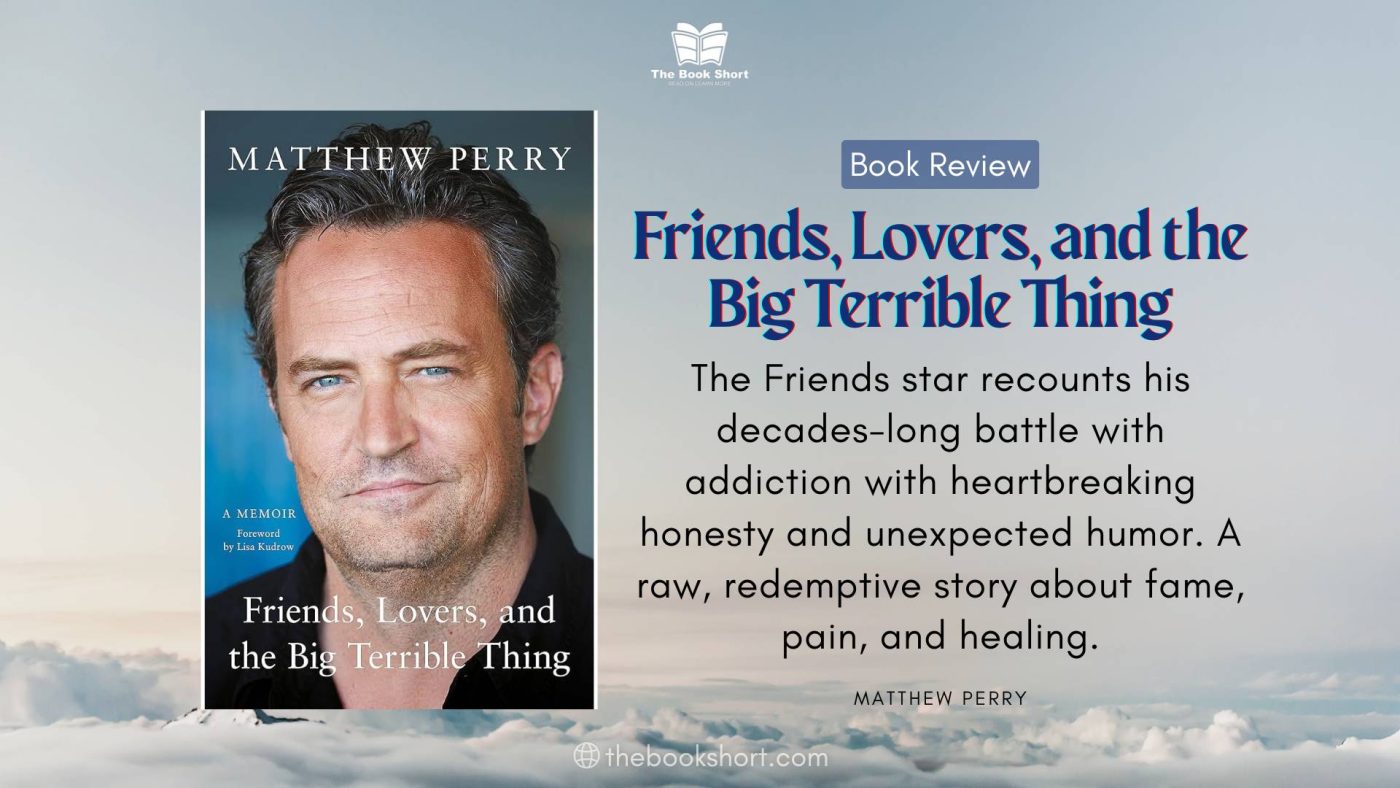
A raw, unflinching look inside addiction from a beloved star. Matthew Perry shares his painful journey with honesty and dark humor.
Friends, Lovers, and the Big Terrible Thing: A Memoir Summary & Review
Step inside a memoir that courageously peels back the layers of global fame, intense personal struggle, and the relentless pursuit of sobriety. We’re diving into Friends, Lovers, and the Big Terrible Thing by Matthew Perry, a book chosen for its searing honesty and unique perspective from a man who navigated life under an intense public gaze while battling a devastating, private war against addiction. Its profound value lies in its candid portrayal of the disease’s grip, offering vital insight into the depths of despair it can inflict and the enduring, fragile hope for recovery, making it an undeniably compelling and important read.
About Friends, Lovers, and the Big Terrible Thing
- Title: Friends, Lovers, and the Big Terrible Thing: A Memoir
- Author: Matthew Perry
- Publication Year: 2022
- Genre: Memoir, Autobiography, Addiction & Recovery
- Page Count: Approximately 250-300 pages (varies by edition)
- Target Audience: Fans of Friends interested in Matthew Perry’s story, readers seeking authentic celebrity memoirs, individuals wanting to understand addiction from a first-person perspective, those in recovery or supporting loved ones affected by substance use disorder.
Friends, Lovers, and the Big Terrible Thing Summary
Matthew Perry’s memoir, Friends, Lovers, and the Big Terrible Thing, is a deeply personal and chronological account of his life, anchored by his decades-long, harrowing battle with alcohol and opioid addiction. It’s a narrative woven with moments of trademark humor, profound heartbreak, and astonishing candor, detailing the stratospheric highs of achieving global fame balanced against the crushing, life-threatening lows of his disease.
Early Life and the Genesis of Addiction
The book opens with Perry’s childhood, describing his upbringing split between divorced parents in Canada and Los Angeles. He recounts an early sense of unease and anxiety, feelings he suspects contributed significantly to his later struggles. We learn about his promising early talent in tennis, becoming a nationally ranked junior player, before his path shifted toward acting. He touches on his initial acting roles and the burgeoning desire for fame, which he naively hoped might fill an internal void. The narrative clearly establishes that his relationship with substances began early, starting with alcohol in his teenage years, which he quickly discovered offered a potent, albeit temporary, escape from his anxieties.
The Friends Phenomenon and the Escalation of Addiction
A substantial portion of the memoir intimately details his experience landing the iconic role of Chandler Bing on Friends. Perry openly shares the initial excitement, the genuine camaraderie among the cast, and the immense, unprecedented pressure that accompanied starring in one of the most successful television shows globally. He vividly captures the surreal whirlwind of becoming instantly and universally famous.
Crucially, he masterfully interweaves the story of the show’s meteoric rise with the parallel, terrifyingly escalating narrative of his addiction. He reveals how his alcoholism spiraled during the early seasons of Friends, leading to blackouts and increasingly dangerous behavior, often occurring just hours after taping in front of a live audience. He recounts periods where his physical appearance and weight fluctuated dramatically and visibly due to drug use, broadcast weekly to millions of viewers worldwide, a stark, silent indicator of his hidden struggle. The memoir powerfully emphasizes the profound, painful contrast between his public persona as the witty, seemingly carefree Chandler and his private reality of being severely ill with a progressive disease.
Perry is relentlessly honest in describing his devastating reliance on prescription painkillers, particularly Vicodin, which began after a jet ski accident in 1997. This incident marked a catastrophic turning point, leading to a brutal opioid dependency that would torment him for decades. He details the elaborate, often desperate lengths he went to obtain pills, the constant, gnawing fear of running out, and the horrific physical and psychological toll the addiction exacted on his body and mind.
A Cycle of Relapse, Recovery Attempts, and Near-Death Experiences
The emotional core of the book revolves around Perry’s numerous, courageous attempts at sobriety and the heartbreaking, exhausting cycles of relapse that followed. He recounts approximately 15 stints in rehabilitation centers and countless hospital stays, including a near-fatal ruptured colon in 2018, a direct consequence of opioid overuse. This life-altering event is described with startling, graphic detail, underscoring the dire severity of his condition and the stark reality that doctors gave him only a slim chance of survival.
He shares poignant, sometimes darkly humorous, stories from his time in rehab, the brutal challenges of detoxification, the revelations in therapy sessions, and the fleeting periods of hard-won sobriety he managed to achieve. He candidly discusses the specific substances he was addicted to at different points and the ever-changing, cunning nature of his battle. He does not flinch from detailing the immense financial cost, estimating he spent millions of dollars in his desperate efforts to get sober.
Throughout this arduous journey, Perry describes the devastating impact of his addiction on his relationships – with his supportive yet often helpless family, his Friends castmates (who offered unwavering, albeit sometimes distant, support), romantic partners (addressed in the “Lovers” part of the title, though this aspect is less central than his addiction narrative), and friends. He expresses profound regret for the opportunities lost, the trust broken, and the pain caused due to his disease.
Life After Friends and the Search for Purpose
The memoir covers the period after Friends concluded in 2004, detailing his continued struggles with addiction while attempting to navigate post-sitcom life, pursuing other acting roles, and venturing into playwriting with The End of Longing. He speaks movingly about his later efforts to channel his painful experiences into helping others, including opening a sober living facility, highlighting his deep-seated desire to find meaning and purpose in his suffering.
He reflects honestly on the complexities of fame, the persistent feeling of emptiness it ultimately failed to fill, and the dawning, crucial realization that sobriety, not fame or success, was the one true, elusive goal. The book concludes with Perry in a state of relative sobriety, looking back on his extraordinary, turbulent journey with a blend of weariness, profound gratitude, and a sober, enduring awareness of the fragility of recovery. He emphasizes that the struggle is not a past event but an ongoing, daily commitment, and that finding sobriety, coupled with a fervent desire to help others facing similar battles, has finally given his life true meaning. The “Big Terrible Thing” is revealed in its full, monstrous form: addiction itself, a relentless, cunning force he fought with every fiber of his being throughout his adult life.
In-depth Analysis: Inside Matthew Perry’s Memoir
Friends, Lovers, and the Big Terrible Thing transcends the typical celebrity autobiography; it is a raw, intensely focused excavation of one man’s life-or-death battle with addiction played out against the most public of stages. Its undeniable power stems from its raw vulnerability, relentless honesty, and the author’s distinctive, unforgettable voice.
Narrative Structure, Themes, and Key Arguments
The central “character,” dominating every page, is Matthew Perry himself, locked in a brutal, existential fight against his true antagonist: addiction. While significant people in his life—his parents, the Friends cast, romantic partners—appear, they primarily function as mirrors reflecting his internal turmoil or witnesses to his core struggle. The structure follows a largely chronological path through his life, yet it constantly circles back to and emphasizes the dark moments of substance use, the desperate recovery attempts, and the crushing relapses. This cyclical structure, mirroring the very nature of addiction, powerfully conveys the pervasive, inescapable reality of his disease.
Key arguments and insights woven throughout Perry’s narrative include:
- Addiction is a cunning, powerful, and potentially fatal disease that respects no boundaries of success, wealth, or status.
- Fame and external validation offer no protection from internal demons; in fact, they can provide the resources and isolation that fuel addiction.
- Sobriety is not a destination but a daily, hard-fought battle and the most significant achievement of all.
- Hope for recovery is possible, even after numerous devastating relapses and near-death experiences.
- Finding purpose beyond oneself, particularly in helping others, is a vital component of sustained sobriety and finding meaning in past pain.
Writing Style & Literary Quality
Perry’s writing style is remarkably candid, characterized by the familiar, self-deprecating humor that endeared him to millions as Chandler Bing. However, this humor is often a thin veil over layers of profound sadness, regret, and brutal self-awareness. He employs wit not to lighten the subject matter but often as a coping mechanism, even when recounting his most harrowing experiences. This creates a unique, affecting tone – darkly funny, deeply moving, and surprisingly insightful, sometimes shifting between these registers within a single paragraph. The emotional quality and candor of the content are extraordinarily high. Perry refuses to sugarcoat his actions, his pain, or the devastating consequences of his addiction. He provides unflinching, often difficult-to-read details about his drug use, withdrawal symptoms, and terrifying medical crises, hammering home the severity and reality of his illness.
What truly distinguishes this memoir within the genre is the unique juxtaposition of the sheer magnitude of global fame with the terrifying depth of his personal struggle. While many memoirs courageously discuss addiction, few are authored by an individual whose physical decline and erratic behavior were literally visible to hundreds of millions of viewers weekly for an entire decade. Perry’s account offers an unparalleled insight into the paradox of intense celebrity: the isolation, the lack of true privacy, and the crushing weight of expectation while battling a hidden, life-threatening condition. Moreover, the book maintains an almost relentless focus on the addiction itself, refusing to let celebrity anecdotes overshadow the central theme, which gives the narrative a powerful, resonant thematic coherence.
Memorable Quotes from the Memoir
- “Hi, my name is Matthew, although you may know me by another name. My friends call me Matty.” (An immediate acknowledgment of his dual existence – public figure vs. private person – setting a tone of vulnerability and intimacy).
- “I would fake injuries to get painkillers. I would forge prescriptions. I would go to five different doctors in five different cities on the same day to get what I needed. This is the part of the book where you begin to worry about me.” (Revealing the lengths and cunning required by active addiction, directly addressing the reader).
- “Addiction is far too powerful for anyone to defeat alone. But together, maybe, just maybe, we can beat it.” (A poignant expression of the need for community and support in recovery).
- “The Big Terrible Thing was the addiction. It was the demon in my head that told me I wasn’t enough, that I wasn’t lovable, that I needed something from the outside to feel okay on the inside. And that demon was loud.” (A powerful, direct definition of the memoir’s central theme and antagonist).
- “I’ve had a lot of ups and downs in my life. I’m not going to pretend I haven’t. But the best thing about me is that if an alcoholic comes up to me and says, ‘Will you help me stop drinking?’ I will say, ‘Yes. I know how to do that.'” (Highlighting his hard-won wisdom and profound, driving purpose in helping others find sobriety).
Evaluation & Professional Book Review
Friends, Lovers, and the Big Terrible Thing is an undeniably gripping, often harrowing, and ultimately deeply moving read. My personal impression is that its most compelling strength lies in Matthew Perry’s courageous, almost brutal, honesty about the all-consuming nature of his addiction and its devastating consequences. There are moments of profound sadness, frustration, and sheer terror, particularly when recounting repeated relapses after periods of hard-won hope. The characteristic Perry humor, while present, often feels like a fragile defense mechanism against overwhelming pain, but it also undeniably makes the difficult subject matter more approachable and human. A potential critique is that the narrative, by necessity mirroring the cyclical nature of addiction, can feel somewhat repetitive in its structure, and certain aspects of his life (the “lovers” element, for instance) feel less developed compared to the intense focus on his substance use disorder.
The readability level is commendably high. Perry writes in an accessible, conversational, and straightforward style, pulling the reader into his confidence. The language is clear and direct, making his complex emotional and physical struggles understandable for a wide audience.
This Matthew Perry memoir is highly suitable for:
- Devoted fans of Friends seeking genuine insight into the man behind the beloved character of Chandler Bing.
- Readers interested in celebrity memoirs that offer substance and vulnerability beyond surface-level anecdotes.
- Anyone seeking a raw, first-person account to better understand the lived experience of addiction.
- Individuals in recovery, their families, or professionals in addiction treatment, who may find his story resonant, validating, and insightful.
The enduring practical value of this book lies in its power to cultivate empathy, dismantle stigma, and foster a deeper understanding of addiction as a complex disease rather than a moral failing. It bravely demystifies the illness, illustrating with stark clarity that it can afflict anyone, regardless of their success or resources, overriding logic, love, and self-preservation. It serves as a powerful warning about the insidious dangers of substance abuse and emphatically highlights the critical importance of seeking help. For readers, it offers a perspective shift on judging others’ struggles and provides a powerful reinforcement of the value of perseverance, self-forgiveness, and the enduring possibility of hope, even in the face of repeated failure. It reminds us that recovery is a continuous journey, not a final destination.
Comparing Friends, Lovers, and the Big Terrible Thing with Similar Memoirs
While Friends, Lovers, and the Big Terrible Thing fits within the broader categories of celebrity memoirs and addiction narratives, its unique intersection of extraordinary fame and equally intense, life-threatening struggle truly sets it apart.
Compared to celebrity memoirs primarily focused on career highlights, behind-the-scenes anecdotes, and the glitz of Hollywood (even those by his Friends co-stars, which often touch on personal challenges), Perry’s book is almost singularly, relentlessly focused on his internal battle with addiction. It’s less about the “making of Friends” and far more about the near “unmaking of Matthew Perry” by his disease.
Within the genre of addiction memoirs, it shares the raw, often brutal honesty found in powerful works like Dry by Augusten Burroughs or Beautiful Boy by David Sheff (or his son Nic Sheff’s perspective in Tweak). However, Perry’s narrative layers this with the surreal, isolating experience of battling a devastating illness while being one of the most recognizable faces on the planet. This unique context adds a compelling dimension exploring fame’s impact, the illusion of privacy, and the burden of public perception that is inherently different from memoirs by less publicly known individuals.
If Matthew Perry’s Friends, Lovers, and the Big Terrible Thing memoir resonated with you for its candor, its blend of humor and pain, and its deep dive into addiction and the struggles behind a public persona, you might also find insight and connection in:
- Dry by Augusten Burroughs: A darkly comedic yet profoundly honest account of battling alcoholism and the experience of rehab.
- Beautiful Boy: A Father’s Journey Through His Son’s Addiction by David Sheff: Offers a deeply emotional perspective on addiction from the viewpoint of a parent, complementing Perry’s first-person account. (Consider also Nic Sheff’s companion memoir, Tweak).
- The Addiction Inoculation: Raising Healthy Kids in a Culture of Dependency by Jessica Lahey: A valuable non-fiction resource that explores the science of addiction prevention, providing practical insights after reading a deeply personal story like Perry’s.
- Wishful Drinking by Carrie Fisher: Another iconic celebrity memoir that tackles addiction, mental health, and Hollywood with acerbic wit and unflinching honesty.
Conclusion & Recommendations: Is Friends, Lovers, and the Big Terrible Thing Worth Reading?
Friends, Lovers, and the Big Terrible Thing stands as a powerful testament to the brutal, unyielding power of addiction and the remarkable, fragile resilience of the human spirit, even after being repeatedly knocked down. Its outstanding value lies in Matthew Perry’s courageous vulnerability in laying bare the full, often excruciating, scope of his disease alongside his arduous journey toward recovery. It offers a rare, invaluable glimpse into the private hell faced by someone living one of the most public lives imaginable.
So, is Friends, Lovers, and the Big Terrible Thing worth reading? Absolutely. It is a moving, important, and ultimately hopeful book that sheds crucial light on a disease that impacts millions globally.
Who should read it? This memoir is a must-read for fans seeking to understand the complex man behind Chandler Bing, anyone curious about the often-harsh realities of celebrity life, and, most importantly, anyone looking for a deeper, more empathetic understanding of addiction – its insidious nature, the immense difficulty of recovery, and the enduring flicker of hope that is always possible.
Have you read this powerful memoir by Matthew Perry? Share your thoughts and reflections in the comments below!