
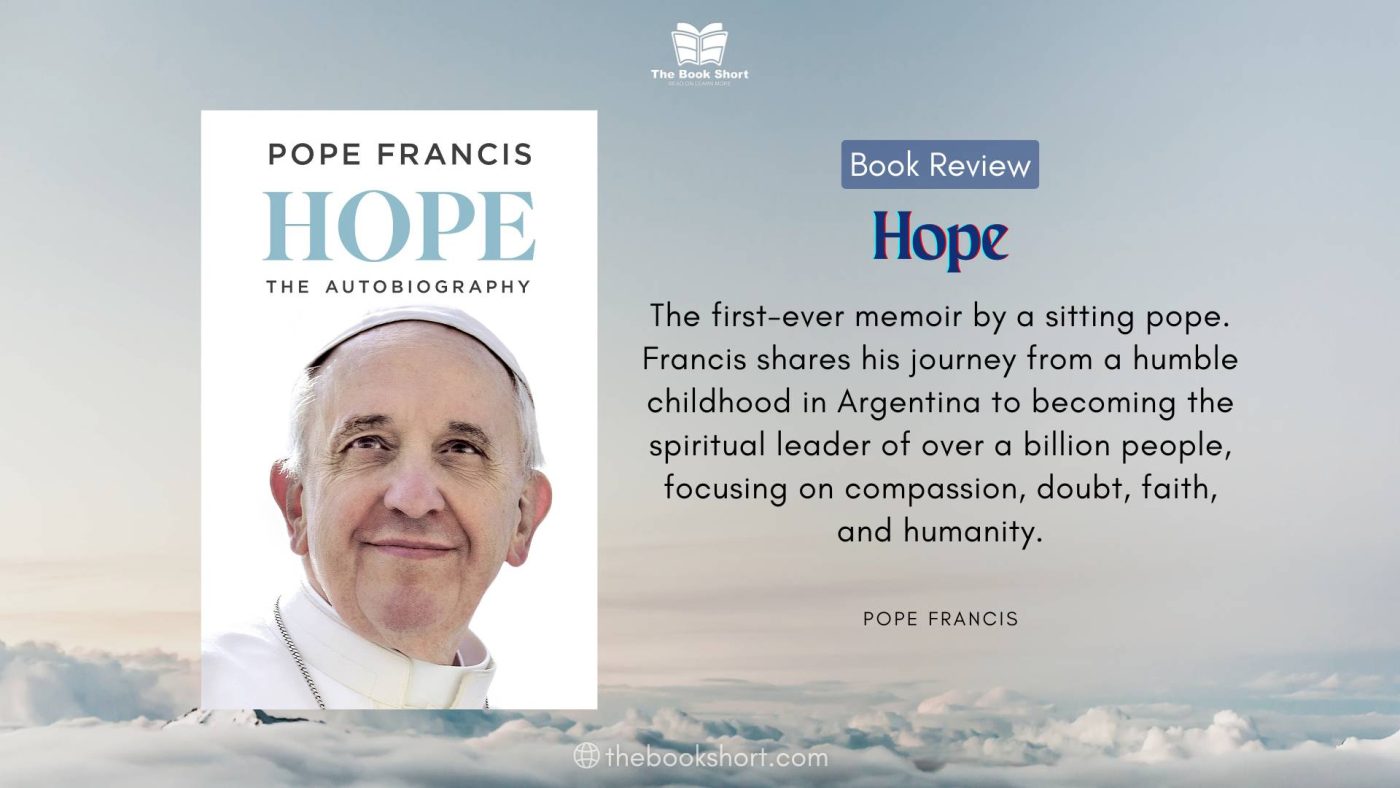
Find strength in challenging times. Pope Francis’s Hope guides readers through uncertainty with faith, offering a timely read for resilience.
Discovering Pope Francis’s book Hope felt less like finding a text and more like receiving a spiritual anchor during a storm. Its message resonates profoundly in a world still grappling with the aftershocks of uncertainty, offering not just comfort but a robust call to faith in adversity. I chose to delve into this book for review because its unique blend of deep spiritual insight and bracingly practical encouragement provides a rare beacon, urging readers to seek light and solidarity even in the deepest darkness.
Hope Book: Basic Information & Details
Here are the essential details for Pope Francis’s insightful book, Hope:
- Title: Hope
- Author: Pope Francis
- Year of publication: 2020 (Published amidst the early phase of the COVID-19 pandemic, making its message exceptionally timely)
- Genre: Spirituality, Religion, Christian Living, Pastoral Reflection
- Number of pages: Varies by edition, typically ranges from 100 to 150 pages, making it a relatively quick yet impactful read.
- Target audience: Broad audience, including general readers interested in spirituality, Christian faith, coping with challenging times, understanding Pope Francis’s perspective, or seeking spiritual guidance and resilience.
Summary of Pope Francis’s Hope Book Content
Hope by Pope Francis is not a conventionally structured book, but rather a carefully curated collection of excerpts and powerful reflections. Drawn from his homilies, speeches, and addresses delivered primarily during the intensely challenging early months of the COVID-19 pandemic in 2020, the book captures the pontiff’s spiritual response to a global crisis. It is organized thematically around the profound concept of hope, often referencing specific events of that time or timeless biblical passages relevant to periods of trial and uncertainty.
The central, unifying message woven throughout the book is a distinction between fleeting optimism and true Christian hope. Pope Francis defines hope not as mere wishful thinking or a passive expectation that things will simply get better, but as a theological virtue. It is depicted as an active, dynamic quality rooted deeply in unwavering faith in God’s loving presence and providential care, even when faced with overwhelming suffering, fear, and uncertainty. He consistently frames the global crisis as more than just a public health emergency; he sees it as a moment of profound spiritual testing, an urgent call for introspection, personal and societal conversion, and a rediscovery of what truly holds enduring value.
Key Themes Explored in Hope by Pope Francis:
- The Nature of Christian Hope: Pope Francis contrasts authentic Christian hope with transient worldly expectations. He portrays hope as an anchor, a steadfast gift from God that enables perseverance through life’s inevitable storms. It is not about passively waiting for difficulties to pass, but about active trust and forward-looking movement, embracing uncertainty even when the path ahead is obscured. A recurring connection is made between hope and the resurrection of Christ, presenting it as the ultimate foundation for hope, the definitive victory over death and despair.
- Solidarity and Fraternity: The pandemic starkly illuminated our global interconnectedness and shared vulnerability. The Pope places immense emphasis on the vital importance of solidarity – actively caring for one another, particularly the most vulnerable, and actively working to overcome crippling individualism and indifference. True hope, he argues, compels and empowers us to build a more just, equitable, and fraternal world together.
- The Indispensable Role of Prayer and Faith: In moments of helplessness and fear, prayer is presented as a crucial lifeline. It is depicted as the essential means by which we connect with God, articulate our deepest fears and place our trust, and receive the spiritual strength necessary to sustain hope. Faith, in this context, is the bedrock upon which hope stands, providing the unshakeable conviction that God is with us through everything and is actively working for good, even when unseen.
- Acknowledging Vulnerability and Fear: With profound empathy, Pope Francis acknowledges the very real human experience of fear, anxiety, grief, and vulnerability during crisis. He encourages readers to face and name these difficult emotions rather than suppressing them, bringing them into prayer before God and finding solace and strength in communal support. Vulnerability is reframed not as a weakness to be hidden, but as a shared human condition that can forge deeper empathy and connection between people.
- Conversion and the Opportunity for Change: The crisis is viewed through a spiritual lens as a “kairos” – a providential moment, a time of grace and a compelling opportunity for profound personal and societal change. It serves as a powerful catalyst, forcing humanity to reconsider priorities, challenge consumerism, confront inequality, and turn back towards what truly matters: our relationship with God, with each other, and with creation itself. Hope, in this dimension, includes the fervent hope for genuine personal and societal conversion.
- The Silence of God and His Presence: Addressing the difficult and age-old question of why God permits suffering, the Pope offers reflections on God’s presence. He suggests God’s presence is often found not necessarily in miraculous interventions as we might expect, but in accompanying us through pain, mirroring Jesus’ own suffering and death on the cross. Hope, therefore, can persist and even deepen, trusting in His ultimate plan even when God’s immediate action seems silent or hidden.
- Looking Towards the ‘New Normal’ and the Future: Looking beyond the immediate crisis, Pope Francis issues a compelling challenge: not to simply revert to the “old ways” that contributed to global fragilities (social, economic, ecological). Hope, he insists, involves actively working towards forging a “new normal” – one that is more humane, more equitable, more sustainable, and fundamentally guided by the transformative principles of the Gospel.
- Mary, Mother of Hope: The Virgin Mary is presented as a powerful and relatable model of hope. She is portrayed as someone who endured immense suffering and uncertainty yet maintained unwavering trust in God’s promises. Her steadfast faith and perseverance offer profound inspiration for believers facing their own trials and sorrows.
The book frequently draws upon rich biblical narratives, finding lessons and comfort in stories like the Passion and Resurrection of Christ, parables of watchfulness and perseverance, and the experiences of figures like the apostles struggling in storms on the sea. Pope Francis masterfully uses these stories to illuminate the enduring nature of hope and faith in the face of adversity.
While undeniably born out of a specific historical moment – the unprecedented global impact of the pandemic – the reflections on hope, suffering, faith, solidarity, and change possess a timeless resonance. They speak compellingly to anyone navigating personal or collective challenges, offering a spiritual compass. The book redirects focus away from panic and despair towards a grounded, resilient trust in God and active love for one’s neighbor. It stands as a powerful call to cultivate hope not just as a feeling, but as a foundational virtue that sustains us and empowers us to contribute to building a better future.
The structure often centers around meditations on specific Gospel readings, significant papal events (such as the moving extraordinary Urbi et Orbi blessing in March 2020 that captivated the world), or moments of collective reflection. This provides concrete context for the hopeful message derived from these specific points in time. The language employed is consistently accessible, deeply pastoral, and profoundly rooted in Christian tradition, aiming always to comfort, gently challenge, and inspire readers across a wide range of backgrounds.
In-depth Analysis of Hope by Pope Francis
Hope by Pope Francis functions less as a systematic theological treatise rigorously arguing a doctrine, and much more as a vital collection of pastoral reflections intimately connected by a unifying theme: the enduring power of hope in times of tribulation. The author’s primary objective is clearly not academic dissection but profound spiritual encouragement and compassionate guidance offered during a period of global vulnerability and crisis.
Structure, Key Arguments, and Guiding Figures:
The book’s structure is intentionally fluid, reflecting its origins as compiled addresses and homilies delivered organically during a specific period, rather than following a pre-planned narrative or academic outline. It consciously avoids traditional chapters or a linear progression. Instead, it is organized around thematic clusters, exploring the many facets of hope as viewed through the stark, illuminating lens of the pandemic and the ever-present foundation of faith.
- Core Arguments central to Hope:
- True hope is a divine grace, distinct from ephemeral human optimism.
- Experiences of suffering and acknowledging our shared vulnerability are not obstacles to hope, but often the very ground upon which resilient hope is forged.
- Faith and dedicated prayer are presented as essential, dynamic tools for cultivating, sustaining, and deepening hope in the face of difficulty.
- Authentic hope inherently demands active solidarity with others and a committed pursuit of the common good.
- Periods of crisis, while painful, are also potential ‘kairos’ moments – significant opportunities for profound personal and positive societal transformation.
- The Paschal Mystery – the suffering, death, and glorious resurrection of Jesus Christ – is highlighted as the ultimate wellspring and perfect model of Christian hope.
- “Guiding Figures”: While the book contains no fictional characters, it constantly references and draws inspiration from central biblical figures, most notably Jesus Christ, the Virgin Mary, and the Apostles. Their experiences of faith, suffering, doubt, and hope are used powerfully as relatable examples for the reader facing their own trials. The true “characters” the book engages with are, in a sense, the reader themselves and all of humanity grappling with shared crises, called to embody the timeless virtues discussed.
Writing Style & Content Quality:
Pope Francis’s writing style throughout Hope is unmistakably pastoral, deeply empathetic, and remarkably accessible.
- Language: He employs relatively simple, direct language, skillfully avoiding overly complex theological jargon whenever possible. His tone is consistently warm, deeply compassionate, and often feels profoundly personal, speaking directly to the reader’s potential fears, anxieties, and need for spiritual grounding. He frequently utilizes relatable metaphors and analogies drawn from everyday life or nature – such as hope being “like an anchor” or the experience of “weathering a storm” – making his message resonate immediately.
- Style: The overall style is reflective and gently meditative. He often poses poignant rhetorical questions, inviting the reader into personal self-examination and deeper thought. While the content is deeply rooted in Scripture and rich Catholic tradition, it is presented in a way that aims for broad spiritual appeal, transcending denominational boundaries for those seeking wisdom in adversity. There is a noticeable and strong emphasis on the practical, lived application of faith and hope in navigating real-world challenges and suffering.
- Content Quality: The significant quality of Hope lies precisely in its profound spiritual depth and its piercing, timely relevance. The reflections offer deeply insightful perspectives on the universal human condition under stress and the enduring, transformative power of faith. While the inherent lack of a rigid, linear structure might occasionally make it feel less cohesively organized than a book written from scratch with a single outline, this informal, compilation style also powerfully contributes to its feeling of raw authenticity and genuine pastoral care. The content remains entirely consistent with Pope Francis’s well-known theological priorities, particularly his emphasis on God’s mercy, his call to accompany the suffering and marginalized, and his unwavering commitment to social justice.
What Stands Out or Differs:
Compared to more academic theological works or purely philosophical discussions on the abstract concept of hope, Pope Francis’s Hope distinguishes itself notably due to several key factors:
- Its Genesis in Immediate Global Crisis: It is explicitly a spiritual reflection born directly from and within the context of a specific, unprecedented, shared global crisis (the COVID-19 pandemic). This origin story infuses its message with a unique sense of urgency and immediate relevance to that experience and the lingering uncertainties that followed.
- Its Overwhelmingly Pastoral Tone and Purpose: The book doesn’t primarily set out to define hope exhaustively or systematically. Instead, its central aim is to actively instill, encourage, and nurture hope within the heart of the reader facing concrete difficulties. It functions more as intimate spiritual accompaniment and guidance than as a detached academic treatise.
- The Distinct and Compassionate Voice of Pope Francis: The reflections are deeply infused with his characteristic evangelical simplicity, his consistent focus on the dignity of the marginalized, and his powerful call for a “revolution of tenderness.” This unique authorial voice gives the book a flavor and impact distinct from other spiritual writers exploring similar themes.
- Its Integral Link to Social and Global Issues: Hope is explicitly not presented as a purely individual, internal emotional or spiritual state. It is shown to be inextricably linked to active solidarity, compassionate care for creation, and a commitment to building a more just and equitable world – themes central to Pope Francis’s consistent social teaching documented in encyclicals like Laudato Si’ and Fratelli Tutti.
In essence, Hope distinguishes itself as a living document of faith dynamically responding to a moment of profound global vulnerability, offered with the accessible, empathetic, and challenging voice of the spiritual leader of over a billion people.
Notable Ideas and Phrases from the Book:
(Note: As this book is a compilation of addresses, specific, single widely-quoted lines might be harder to pinpoint than from a unified, written work. However, the core power of its message can be captured through representative ideas and phrases that reflect his recurring themes):
- “Hope is like an anchor… keeping the ship steady amid the storm.” (A frequent and relatable metaphor)
- “We have realized that we are on the same boat, all of us fragile and disoriented, but at the same time important and needed, all of us called to row together, each in need of comforting the other.” (Captures the essence of his powerful Urbi et Orbi address)
- “Faith gives us the strength to look ahead and to hope, even when everything seems lost.”
- “Crisis reveals what is in our hearts. We must use this time to discern, to choose wisely.”
- “This is the time to choose what matters and what passes away, a time to separate what is necessary from what is not.” (A call to re-evaluate priorities)
- “Hope is humble, born not in triumph but in the stable of Bethlehem, navigating its journey through the cross, and culminating in the quiet power of the resurrection.”
- “Let us look upon the wounds, the open wounds, of the sick, of the poor, of the discarded. This is where authentic hope is found and put into action.”
These powerful ideas and phrases collectively capture the core essence of the book: finding strength and solidarity in shared vulnerability, the grounding, anchoring power of faith, the urgent call to re-evaluate life’s priorities during crisis, and the inseparable connection between genuine hope and compassionate, active concern for the suffering world.
Evaluation & Expert Personal Review of Hope Book
Hope by Pope Francis offers a deeply comforting, yet simultaneously challenging, read for anyone navigating times of uncertainty, whether the challenges are personal, communal, or global. My personal impression is that the book’s remarkable strength lies precisely in its piercing timeliness and the powerfully authentic, compassionate, and deeply pastoral voice of Pope Francis himself.
Advantages of Reading Hope:
- Profound Timeliness: Arriving during the initial, intensely disorienting phase of the COVID-19 pandemic, its reflections speak directly, authentically, and empathetically to the pervasive feelings of fear, isolation, grief, and helplessness that defined that period for many.
- Exceptional Accessibility: The language is intentionally simple, direct, and warm, making complex spiritual ideas and theological concepts remarkably understandable and relatable to a broad audience, regardless of their religious background or prior knowledge.
- Authentic and Comforting Voice: The book feels less like a formal academic treatise and more like a series of heartfelt addresses and intimate conversations from a spiritual father actively accompanying his global flock through a shared valley of difficulty. This personal touch significantly enhances its impact.
- Rich Biblical Grounding: It is profoundly informed and enriched by Scripture, offering readers familiar with the Bible deeper layers of meaning related to suffering, faith, and hope, while also providing newcomers with accessible entry points into timeless biblical wisdom applicable to modern trials.
- Integration of Action and Solidarity: Hope is never presented as passive waiting or detached optimism. Instead, it is dynamically linked to active faith, persistent prayer, and, crucially, embodied in concrete solidarity and compassionate care for others. This emphasis gives the book a vital, practical, and ethical dimension.
Potential Considerations (Not Necessarily Disadvantages):
- Occasional Thematic Repetition: As a compilation drawn from various addresses and reflections delivered over time, there is some natural repetition of key themes, core messages, and sometimes specific phrases. While this serves to reinforce the central message, it can occasionally feel a bit redundant if the book is read straight through in one or two sittings.
- Non-Linear Structure: The thematic, non-linear organization, reflecting its origin as gathered talks, might feel less conventionally structured or satisfying for readers who strongly prefer a tightly argued narrative flow or a systematic presentation of ideas. However, this can also be seen as an invitation to dip in and out for reflection.
Readability Level & Who Is This Book Suitable For:
The readability of Hope is exceptionally high, making it accessible to a very wide audience. It is particularly suitable for:
- General Readers Seeking Meaning: Anyone interested in exploring spirituality, finding ways to cope with uncertainty and difficult times, or gaining insight into the perspective of Pope Francis on global and personal challenges. No prior theological background is necessary.
- Christians (of any denomination): It offers a powerful deepening of understanding of Christian hope, the role of faith in adversity, and the call to solidarity from a deeply Catholic perspective, drawing heavily and effectively on biblical narratives and tradition.
- Individuals Navigating Challenges: Whether facing personal loss, illness, economic hardship, relationship struggles, or general anxiety about the state of the world, the book offers profound spiritual solace, a resilient framework for understanding suffering, and practical encouragement for finding meaning and strength amidst trials.
- Book Clubs & Discussion Groups: Its clear themes and accessible language make it an excellent choice for groups seeking meaningful discussion on faith, hope, and responding to crisis together.
It might be less suited for someone primarily seeking a purely academic theological analysis or a strictly philosophical exploration of hope divorced from faith.
Practical Value and Enduring Impact:
The practical value of reading Pope Francis’s Hope is significant and far-reaching:
- Transformation of Mindset: It actively encourages a shift away from crippling despair or naive, unfounded optimism towards a grounded, resilient, and active hope firmly rooted in faith and a clear-eyed view of reality. It compellingly reframes suffering not merely as something to be passively endured, but as a potential catalyst for profound personal and communal growth and deeper connection.
- A Powerful Call to Solidarity: The book is a resounding call to recognize that hope is not a solitary endeavor but is lived out most authentically in community and through compassionate action. It strongly urges readers to look beyond their own immediate concerns and extend care, empathy, and support to the vulnerable, providing a tangible, ethical application for spiritual belief.
- A Resource for Reflection and Prayer: The individual reflections serve as powerful prompts for personal prayer, meditation, and spiritual journaling, helping readers process their own fears, doubts, and experiences of suffering within a faith context and find spiritual grounding.
- Enduring Wisdom for Any Crisis: While prompted by the pandemic, the core lessons on faith, resilience, solidarity, and finding hope amidst vulnerability are timeless. They offer enduring wisdom applicable to navigating any crisis, big or small, personal or collective, providing a spiritual toolkit for life’s inevitable storms.
In essence, Hope helps readers understand that authentic hope isn’t about wishfully waiting for the storm to pass, but about learning how to prayerfully, faithfully, and compassionately navigate it together. It’s a powerful, necessary reminder that even in profound darkness, the light of faith and the possibility of love and renewal remain.
Comparison with Similar Books on Hope
Pope Francis’s Hope occupies a distinct space within the vast landscape of spiritual and theological writings on the virtue of hope, a cornerstone concept in numerous religious traditions. However, its specific historical context (the pandemic), its unique authorial voice, and its pastoral intention clearly set it apart from many other works on the topic.
Compared to classic theological texts that systematically define and dissect hope (such as those by Saint Thomas Aquinas’s scholastic approach or Josef Pieper’s philosophical-theological exploration), Hope by Pope Francis is vastly more accessible, existential, and pastoral. It prioritizes instilling and encouraging hope in the lived experience of the reader facing hardship rather than presenting a purely academic or systematic doctrine. While it may lack the rigorous academic structure of these classics, it gains immeasurably in relatable warmth, immediate spiritual comfort, and direct applicability to contemporary life.
Compared to the many self-help books that discuss hope primarily from a psychological, motivational, or neuroscientific perspective, Hope is fundamentally rooted in theological virtue. While it offers practical encouragement and calls for active response, its ultimate source and grounding for hope is explicitly transcendent – placing faith in God’s providential love, the reality of the resurrection, and the enduring power of grace – rather than solely relying on human capacity, mindset techniques, or positive thinking strategies.
Hope shares common ground with collections of spiritual reflections or homilies by other religious leaders who have offered guidance during times of crisis. For instance, sermons delivered during wartime, periods of political upheaval, or following natural disasters often touch upon similar themes of faith, perseverance, the meaning of suffering, and the call to communal support. However, Pope Francis’s signature emphasis on the interconnectedness of faith, global solidarity, care for the marginalized, and ecological responsibility (hallmarks of his papacy) gives Hope its particular contemporary relevance and distinguishes its message.
The book also resonates with works that explore the meaning of suffering from a faith perspective, such as C.S. Lewis’s thoughtful The Problem of Pain or theological reflections on the Book of Job. Yet, Francis’s approach is more focused on the active, faith-filled response of cultivating hope within the experience of suffering, rather than attempting a comprehensive theological explanation for its existence.
Readers who found solace, challenge, or inspiration in Pope Francis’s Hope might also appreciate exploring:
- Other writings by Pope Francis: Particularly Let Us Dream: The Path to a Better Future (which directly builds upon the reflections from the pandemic crisis, exploring how we can emerge better) or his foundational exhortation, The Joy of the Gospel (Evangelii Gaudium), which articulates his vision for a missionary church grounded in the joyful proclamation of faith.
- Works by Henri Nouwen: Especially books like The Wounded Healer or The Inner Voice of Love, which empathetically explore vulnerability, the transformative potential of suffering, and finding God’s presence in challenging interior spaces with profound spiritual depth and compassion.
- Writings by Richard Rohr: Such as Falling Upward: A Spirituality for the Two Halves of Life, which offers wisdom on finding grace, growth, and meaning through life’s inevitable challenges, “failures,” and necessary transitions.
- Collections of spiritual wisdom for difficult times: Many anthologies of prayers, meditations, or reflective essays from various Christian or interfaith traditions address themes of resilience, trust in God amidst adversity, and finding spiritual grounding in uncertainty.
Ultimately, Hope serves as a poignant, powerful, and exceptionally timely example of spiritual guidance offered from a position of global moral leadership during a shared moment of profound vulnerability. Its accessibility, authentic voice, and integrated call to both personal faith and communal action make it a distinct and valuable contribution to spiritual literature on hope.
Conclusion & Recommendations for Hope Book
Pope Francis’s Hope stands out as a vital beacon of spiritual resilience offered to a world reeling from global turmoil and persistent uncertainty. Its outstanding value lies in its remarkable ability to translate profound theological insights about the virtue of hope into accessible, deeply comforting, and gently challenging reflections specifically tailored for contemporary readers grappling with fear and change. The book serves as a powerful reminder that true Christian hope is not a passive or naive optimism, but an active, faith-fueled, and grace-given virtue that calls us beyond ourselves – towards prayer, authentic solidarity with others, and a concrete commitment to building a more just and compassionate world, even amidst suffering and hardship.
Is Pope Francis’s Hope worth reading? Unequivocally, yes. It is a relatively short book in terms of page count, but its message is extraordinarily powerful, timely, and enduring. It offers genuine solace for those feeling fearful or overwhelmed, provides essential perspective for the anxious mind, and issues a clear, compelling call to action for anyone tempted towards complacency in the face of global need.
Who specifically should make time for this book? Anyone seeking spiritual guidance, comfort, and perspective during difficult or uncertain times will find immense value here. It is highly recommended for individuals interested in understanding Pope Francis’s pastoral heart and his response to global challenges. It is particularly relevant for those grappling with the meaning of suffering or looking for a deeper, more robust understanding of Christian hope that transcends superficial definitions. While its origin is rooted in the pandemic, its lessons on faith, vulnerability, and solidarity are universal, making it a valuable read for anyone seeking spiritual resilience in any era.
In summary, Hope is more than just a book; it is a spiritual companion that invites deep reflection, strengthens faith, and inspires compassionate action. It serves as a practical spiritual compass, consistently pointing the way towards resilient trust, illuminating light, and the transformative power of love, even when the path ahead is shrouded in darkness.
Have you read Pope Francis’s Hope? Share your thoughts, reflections, or how its message resonated with you in the comments below!