
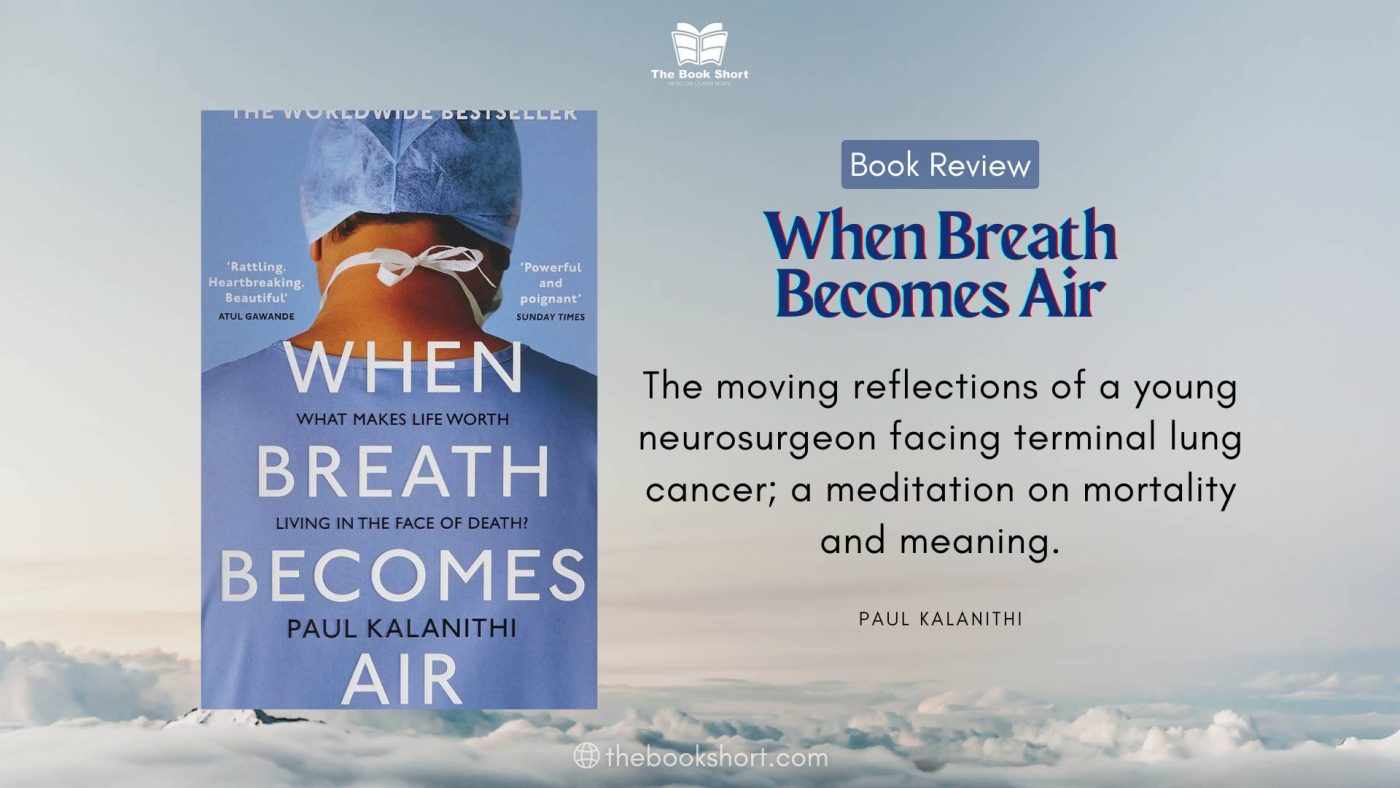
A brilliant young neurosurgeon, on the cusp of a promising career, faces a sudden, terminal diagnosis. This is the stark reality at the heart of Paul Kalanithi’s When Breath Becomes Air, a memoir that transcends the genre to become a profound exploration of life, death, and meaning itself. It’s a powerful, unforgettable account written from the unique vantage point of someone who dedicated his life to navigating the fragile boundary between the two, only to find himself abruptly on the other side. We delve into this remarkable book because its raw honesty, intellectual rigor, and lyrical prose offer an unparalleled meditation on the human condition, resonating deeply with readers long after the final page is turned.
Basic Information About the Book When Breath Becomes Air
- Title: When Breath Becomes Air
- Author: Paul Kalanithi
- Year of publication: 2016 (Posthumous)
- Genre: Memoir, Autobiography, Medical Literature, Philosophy, Existentialism
- Number of pages: Approximately 224 pages (varies by edition)
- Target audience: Readers interested in life’s big questions, memoirs of illness, medical ethics, philosophy, and deeply human stories of resilience and vulnerability.
Main Content Summary of When Breath Becomes Air Book
When Breath Becomes Air is the posthumously published memoir of Dr. Paul Kalanithi, a neurosurgical resident diagnosed with stage IV metastatic lung cancer at the age of 36, just as his demanding decade of training was drawing to a close. The book is structured in two main parts, mirroring the seismic shift in his identity and perspective from dedicated physician to vulnerable patient. It is framed by a brief, poignant introduction and an epilogue by his wife, Dr. Lucy Kalanithi.
Part I: In Perfect Health I Begin
This section traces Paul’s intellectual and professional journey, beginning with his early fascination with literature and philosophy. He sought to understand what makes a meaningful human life, initially through words and narrative. Dissatisfied with purely abstract answers, he pivoted to medicine, drawn to neurosurgery for its intimate connection to the physical organ responsible for consciousness, identity, and personality – the brain.
- Early Quest for Meaning: Paul reflects on his formative years, his deep intellectual curiosity, and his passion for great literature. He discusses how writers like T.S. Eliot fueled his early ponderings on existence, morality, and the soul, driving his initial academic pursuits in English and Human Biology.
- From Books to Bodies: He explains his transition to medicine, viewing the human body, particularly the brain, as the ultimate frontier for understanding life itself. Neurosurgery called to him not just for its technical challenge but for its direct engagement with the core of human identity and the high stakes of life and death decisions.
- The Crucible of Medical Training: This part vividly portrays the relentless grind of medical school and neurosurgery residency. Paul details the punishing hours, the emotional exhaustion, the complex surgeries, and the constant, crushing weight of responsibility for human lives. He shares deeply affecting anecdotes about patients – successes and tragedies – illustrating the profound ethical dilemmas and the desensitization required, yet often resisted, when confronting mortality daily.
- Forging an Identity as Doctor: He describes his transformation from student to skilled surgeon. He learns not only the technical mastery but also the art of navigating complex conversations with patients and families about devastating diagnoses and uncertain futures. He reflects on the unique privilege and burden of his role, feeling on the verge of building a life dedicated to both clinical practice and research, a future he had sacrificed so much to achieve.
Part II: Cease Not till Death
This section opens with brutal abruptness: Paul receives his own diagnosis. The world flips. The doctor, the one delivering difficult news, becomes the patient receiving a terminal prognosis. This sudden, disorienting reversal forces him to confront the very questions he had explored intellectually and professionally, but now from the raw, intensely personal perspective of someone whose future has evaporated.
- The Doctor Becomes Patient: Paul recounts the surreal experience of being diagnosed within the walls of the hospital where he worked. He details the physical symptoms, the initial denial, the difficult conversations, and the confirmation of stage IV metastatic lung cancer. He unflinchingly shares the emotional devastation for himself, his wife Lucy (a fellow physician), and their families.
- Navigating the Illness: He describes entering the confusing, often dehumanizing world of cancer treatment – the cycles of chemotherapy, scans, side effects, and consultations. He experiences the loss of physical strength, the indignity of dependency, and the constant psychological burden of living with a ticking clock. He gains a new, critical perspective on the healthcare system from the other side of the bed.
- Identity in Dissolution: With his expected future as a neurosurgeon gone, Paul grapples with the fundamental question of who he is now. What is his identity when the professional role that defined him is stripped away? He confronts mortality not as a concept but as his imminent reality, pondering how to find meaning and purpose in drastically limited time.
- Life in the Shadow of Death: Despite the grim prognosis, Paul and Lucy make the profound decision to have the child they had planned. Their daughter, Cady, is born just eight months before Paul’s death. This act of creating new life amidst impending death adds an extraordinary layer of depth and complexity to his reflections on time, love, and legacy. He briefly attempts to return to surgery, but his weakened body makes it impossible, underscoring his changed reality.
- The Final Pursuit: Writing: Unable to continue medicine, Paul turns to writing this memoir. The act of crafting his story becomes his last major endeavor, a way to process his experience, organize his thoughts on life and death, and leave a testament to his journey. Writing becomes his renewed purpose in the face of his diagnosis.
- Facing the End: Paul writes movingly about his declining health and the increasing difficulty of living with the disease. He shares his thoughts on preparing for death, achieving a difficult peace, and his final days, leading into Lucy’s poignant epilogue.
Epilogue by Lucy Kalanithi:
Lucy’s epilogue provides a heartbreaking yet hopeful continuation, detailing Paul’s final moments and the immediate aftermath of his passing. She offers her perspective on their shared journey, the depth of their love, and the enduring legacy of Paul’s courage and wisdom. Her words add a crucial layer of intimate grief, love, and a forward-looking perspective, bringing a sense of closure while emphasizing the lasting impact of Paul’s life and the book itself.
The memoir unfolds as a powerful, deeply human narrative, moving from the heights of aspiration and intellectual pursuit to the depths of devastating illness and profound existential reflection. It is a remarkable testament to human resilience, the unending search for meaning, and the ultimate confrontation with mortality, rendered with exceptional clarity, intellectual honesty, and emotional resonance.
In-Depth Analysis of When Breath Becomes Air Book
When Breath Becomes Air distinguishes itself within the memoir genre by offering a uniquely layered perspective. Paul Kalanithi approaches his story not only as a patient but also as a highly trained physician and a lifelong student of literature and philosophy. This confluence of viewpoints elevates the book from a simple account of illness into a profound meditation on what it means to live, suffer, and die.
Characters, Structure, and Core Themes
The undeniable central figure is Paul Kalanithi himself. We witness his transformation across the narrative arc: from an intellectually curious young man driven by existential questions, to a rigorously disciplined and compassionate surgeon, and finally, to a vulnerable patient grappling with the disintegration of his physical self and professional identity. While not a central “character” in the traditional sense, his wife, Lucy, is a vital presence, her unwavering support providing an emotional anchor, culminating in her essential epilogue.
The book’s structure, divided into the “doctor” and “patient” halves, is not merely organizational; it is the core engine driving the narrative’s philosophical force. This chronological, two-part division starkly highlights the dramatic reversal of roles that forces Paul to turn his professional knowledge and philosophical inquiries inward. It creates a powerful dramatic tension where the protagonist’s deep understanding of death and the human body, gained through years of treating others, suddenly becomes his personal reality.
Key arguments and resonant themes woven throughout the memoir include:
- The Shifting Nature of Identity: The book forcefully asks: What remains of “you” when the roles and capabilities that defined your life (like being a neurosurgeon) are stripped away by illness? Paul’s struggle is one of redefining himself in the absence of his professional purpose.
- Finding Meaning in Finite Time: A central inquiry is how a terminal diagnosis reconfigures the search for a meaningful life. Kalanithi explores finding value not in the length of time, but in the quality of presence and connection, particularly in his relationships and the act of writing.
- The Doctor-Patient Dynamic: Paul’s experience as a patient offers critical insights into the vulnerabilities and needs of those receiving care. It serves as both a subtle critique and a deeper understanding of the medical profession’s profound responsibility to engage with the person behind the pathology, addressing fear and uncertainty alongside physical symptoms.
- Navigating Hope and Acceptance: The narrative delicately explores the tension between maintaining hope for recovery or extended time and the difficult process of accepting one’s mortality. Paul’s journey is one of moving towards a difficult, earned peace, finding solace in present moments rather than clinging to an impossible future.
- The Power of Narrative: Coming from a literary background, Paul deeply understands the human need to construct meaning through stories. Writing this memoir becomes his final, vital act – a way to impose order on chaos, articulate his experience, and leave a lasting legacy of his thoughts and feelings.
Writing Style & Content Quality
Kalanithi’s prose is nothing short of remarkable. It possesses a rare combination of intellectual clarity, lyrical beauty, and profound emotional honesty. Despite tackling complex medical realities and weighty philosophical questions, his writing remains accessible, deeply moving, and utterly devoid of self-pity.
- Elegant and Reflective: His background in literature is palpable in the sophistication of his language and the contemplative rhythm of his sentences. The prose is precise, evocative, and often beautifully poetic.
- Intellectually Rigorous: The memoir seamlessly integrates philosophical musings and references, demonstrating the deep connection between his intellectual pursuits and his personal journey. He confronts life’s hardest questions head-on, without simplification.
- Emotional Candor with Restraint: While the subject matter is inherently heart-wrenching, Kalanithi writes with a striking lack of overt sentimentality. He describes harrowing experiences in the operating room and his own suffering with a directness and quiet dignity that makes the emotional impact even more profound. The power comes from the gravity of his situation and his candid reflection, not from manufactured emotion.
- Exceptional Content: The memoir offers an unparalleled firsthand account from an individual uniquely positioned to bridge the worlds of medicine, philosophy, and personal experience. His dual perspective – physician and patient – provides insights simply unavailable in most memoirs of illness. The blend of medical reality, existential inquiry, and raw human vulnerability is expertly balanced.
Notable Quotes from the Book
- “I began to realize that the answers to questions of meaning were not to be found in books, or in classrooms, or in labs, but in the world, in the encounters between human beings.” (Reflecting his move from literature to medicine)
- “Science provides an operating manual for reality… But it cannot tell us what it means to be a fulfilled human being.” (On the limits of science in defining purpose)
- “The physician’s duty is not to avert death or restore health — and yet it is just these things that he is called to do. The physician’s duty is to help patients confront their mortality and go on living.” (Insight gained from treating patients, turned inward)
- “When I was a kid, I ‘liked’ verbs and nouns. In high school, I ‘liked’ Dostoyevsky and T.S. Eliot. In college, I ‘liked’ the brain and the mind. By the time I was a man, I ‘liked’ death.” (A powerful statement on the changing focus of his intellectual life)
- “There is a moment, a lightning flash, when the ties between person and world snap. I had done it before, in the operating room. I did it again, now, on the other side of the scalpel.” (Describing the shift in perspective upon receiving his diagnosis)
- “You can’t ever reach perfection, but you can believe in an asymptote toward which you are ceaselessly striving.” (Applying a mathematical concept to his life’s pursuits, both professional and personal)
What truly sets When Breath Becomes Air apart is this specific, potent fusion of clinical knowledge, literary grace, and the direct, lived experience of facing death from both sides of the medical equation. It’s not merely a story about having cancer; it’s a story about what it fundamentally means to be human when confronted with the inescapable limit of our time.
Evaluation & Expert Personal Review
When Breath Becomes Air is, without hyperbole, an extraordinary and profoundly affecting book. Its singular power stems directly from Paul Kalanithi’s vantage point – a brilliant neurosurgeon abruptly thrust into the role of a patient with a terminal illness. This dual perspective offers insights into life, death, and the practice of medicine that are simply unparalleled. The intellectual depth, seamlessly integrated with raw, personal vulnerability, is another immense strength. Kalanithi’s background in literature and philosophy elevates the writing beyond a mere recounting of events; it becomes a deep, moving meditation on existence itself.
If there’s a potential challenge for readers, it lies in the sheer emotional and existential weight of the subject matter. The book deals directly with suffering, loss of identity, and the inevitability of death, which can be difficult terrain to navigate emotionally. However, it is precisely this unflinching honesty that makes the book so impactful, meaningful, and, ultimately, a source of profound reflection rather than despair.
Readability Level and Suitability
Despite its complex themes and occasional medical terminology, the book is remarkably readable. Kalanithi writes with a clarity and elegance that make even the most difficult subjects accessible. His prose is sophisticated but never unnecessarily academic or dense, inviting readers into his world and his mind.
This memoir is highly suitable for a broad readership, making it an excellent choice for book clubs, students, and general readers alike. Specific audiences who will find it particularly resonant include:
- Anyone interested in deeply human memoirs, especially those confronting significant life challenges.
- Medical professionals at any stage of their career, offering invaluable insight into the patient experience and the emotional landscape of illness.
- Students of philosophy, ethics, or literature interested in the intersection of abstract thought and lived experience.
- Anyone grappling with questions about life’s purpose, mortality, and how to live meaningfully in the face of uncertainty.
Practical Value
The practical value of When Breath Becomes Air isn’t found in actionable steps or self-help platitudes, but in its capacity to provoke deep introspection and cultivate empathy.
- A Masterclass in Living: By confronting his own mortality, Kalanithi forces the reader to consider theirs. The book is a powerful, albeit somber, reminder to prioritize what truly matters – relationships, presence, purpose – rather than getting lost in the trivialities of expectation.
- Cultivating Empathy: For medical professionals, the book is essential reading for fostering a deeper understanding of the patient’s experience, illuminating the fear, uncertainty, and loss of agency that comes with illness. For all readers, it builds profound empathy for those facing serious health challenges.
- Shifting Perspective: Reading Kalanithi’s journey can fundamentally alter one’s view of time, success, and suffering. It encourages a re-evaluation of personal values and a deeper appreciation for the fragile beauty of life.
- Finding Agency in Uncertainty: Paul’s struggle to find meaning and continue living fully despite an unpredictable and truncated future offers powerful lessons on navigating uncertainty and finding purpose even when circumstances are beyond one’s control.
Ultimately, When Breath Becomes Air is far more than a book about dying; it is a profound, beautifully written testament to the indomitable human spirit’s quest for meaning and connection, told with rare wisdom and grace by someone uniquely positioned to understand the delicate balance between life and death.
Comparison with Similar Books
While When Breath Becomes Air holds a distinct place due to Paul Kalanithi’s unique perspective as both physician and patient, it shares thematic territory with other powerful books exploring illness, mortality, and the human spirit.
Compared to other notable works in this space:
- Tuesdays with Morrie by Mitch Albom: Both feature a narrative centered around learning from a dying individual. However, When Breath Becomes Air is Kalanithi’s direct, intellectual, and intensely personal account as the patient, whereas Albom’s is an observational memoir of a teacher-student relationship. Kalanithi’s book is generally seen as less sentimental and more philosophically rigorous.
- The Last Lecture by Randy Pausch: Similar in that both are reflections from professionals facing terminal illness, sharing life lessons. Pausch’s tone is notably more optimistic and focused on achieving dreams and living passionately in the time remaining. Kalanithi’s is more introspective, grappling profoundly with identity, purpose, and the medical realities of dying.
- Being Mortal: Medicine and What Matters in the End by Atul Gawande: This book is directly relevant as Gawande was a mentor to Kalanithi. However, Gawande’s book is primarily an exploration of aging, dying, and how the medical system often fails people at the end of life, drawing on professional experience and research. While deeply insightful on similar themes, it is not a personal memoir from the patient’s perspective, which is the defining characteristic of Kalanithi’s work.
If readers were moved by When Breath Becomes Air, they would likely also appreciate:
- Being Mortal: Medicine and What Matters in the End by Atul Gawande (for a physician’s insightful examination of end-of-life care and quality of life).
- The Bright Hour: A Memoir of Living and Dying by Nina Riggs (a poet’s beautifully written, insightful, and often witty memoir about facing metastatic cancer).
- When Death Becomes Life: Notes from a Transplant Surgeon by Joshua Mezrich (another physician’s perspective on the high-stakes world of surgery, life, death, and human connection).
- Mortality by Christopher Hitchens (a renowned intellectual’s raw, unflinching, and fiercely intelligent reflections on facing esophageal cancer).
These comparisons underscore that while the themes of mortality and illness are shared, Kalanithi’s specific blend of medical expertise, literary sensibility, and direct personal experience as both doctor and patient makes When Breath Becomes Air a unique, indispensable, and particularly powerful contribution to the literature grappling with life’s ultimate questions.
Conclusion & Recommendations for When Breath Becomes Air
When Breath Becomes Air is an indispensable book because it courageously confronts the questions we often shy away from: What makes life meaningful? How do we find purpose when our envisioned future collapses? Paul Kalanithi’s journey, recounted with remarkable candor, intellectual depth, and literary grace, offers not easy answers but profound insights gleaned from walking the fine line between doctor and patient, life and death. Its immense value lies in this extraordinary dual perspective, the elegance of its prose, and the raw, unflinching honesty with which it navigates the most fundamental human challenge – our own mortality.
Without question, this book is essential reading. It is a powerful, moving testament to human vulnerability, resilience, and the enduring quest for meaning in the face of the inevitable.
Who should read it? When Breath Becomes Air is vital reading for anyone seeking a deeper understanding of the human experience, particularly those contemplating questions of purpose, life, death, identity, and how to live fully when time is precious. It is especially resonant for medical professionals, patients and their families, and anyone who values writing that is both intellectually stimulating and deeply emotionally resonant.
Have you read this powerful memoir by Paul Kalanithi? What were your key takeaways? Share your thoughts on When Breath Becomes Air in the comments below!