
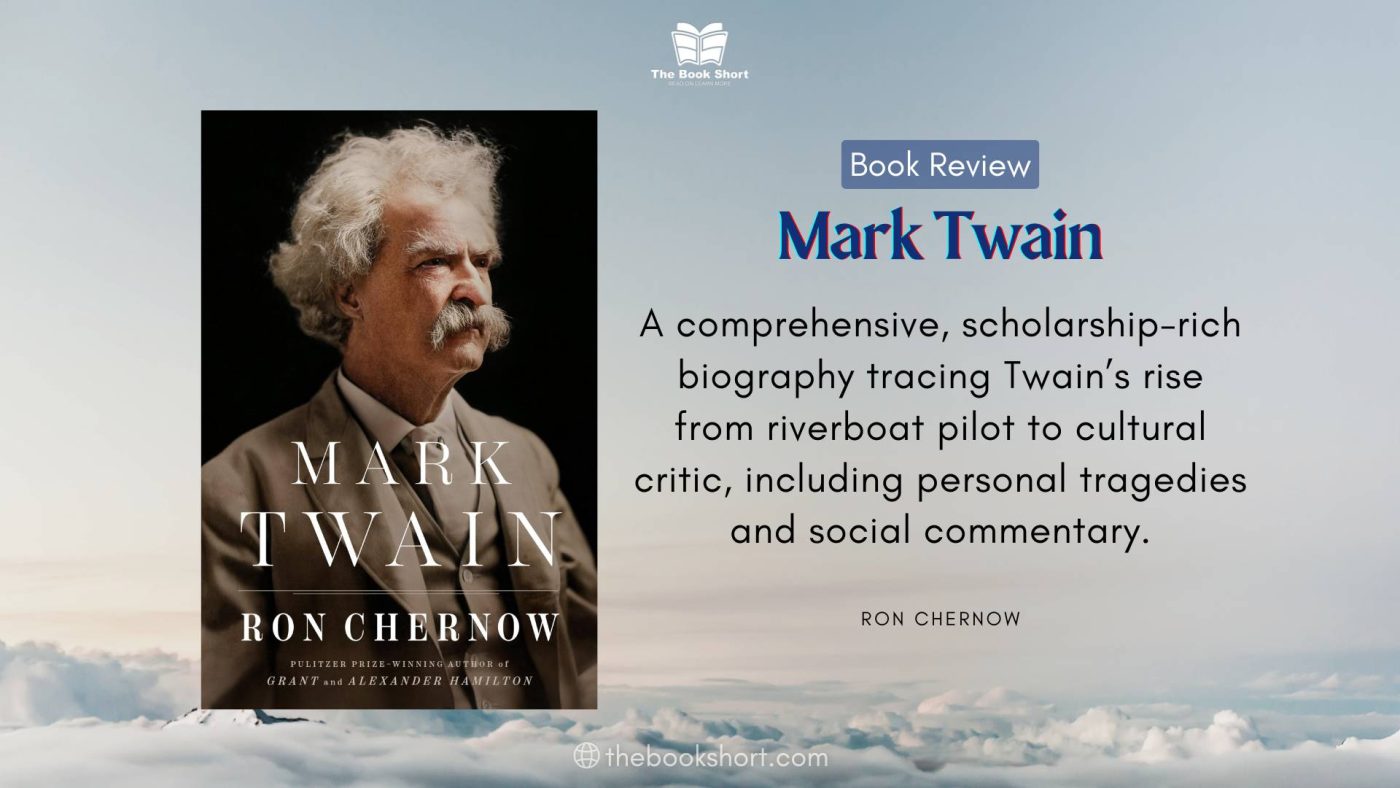
Explore the complex life of Mark Twain through Ron Chernow’s lens. Discover the man behind the myth in this revealing, authoritative biography.
Essential Details: Ron Chernow’s Mark Twain Biography
Here are key facts about Ron Chernow’s acclaimed biography of the iconic American author:
- Title: Mark Twain
- Author: Ron Chernow
- Year of publication: 2010
- Genre: Biography, History, American Literature
- Number of pages: Approximately 976 (page count may vary slightly by edition)
- Target audience: Readers captivated by American history, classic literature, in-depth biography, and the fascinating life of Samuel Clemens, known to the world as Mark Twain.
Mark Twain Book Summary: Unveiling Samuel Clemens
Ron Chernow’s monumental biography, Mark Twain, is far more than a simple recounting of historical dates and events. It is a masterful deep dive into the soul and struggles of Samuel Clemens, the man woven into the fabric of the Mark Twain persona. Chernow brilliantly intertwines the public life of the celebrated humorist and literary titan with the often turbulent, contradictory, and deeply private existence of Clemens. The narrative meticulously traces his improbable journey from a modest boyhood on the edges of the American frontier to unprecedented global fame, dissecting the wellsprings of his legendary wit, plumbing the depths of his recurring despair, and laying bare the labyrinthine business ventures that both built and shattered his fortunes.
The biography is structured to follow the sweeping arc of Clemens’s life, with Chernow dedicating meticulous attention and historical context to each transformative period.
Early Life and the Genesis of Mark Twain
Chernow opens by painting a vivid, sensory portrait of Clemens’s formative years in Hannibal, Missouri – the very town that would later become the mythic setting for The Adventures of Tom Sawyer and Adventures of Huckleberry Finn. He probes the profound influences of family, particularly his resilient mother, Jane Clemens, and the pervasive societal norms of the antebellum South, including the deeply ingrained, morally corrupt system of slavery that would scar and shape his conscience and, subsequently, his most powerful writing. The biography charts his early trajectory as a printer’s apprentice, his restless wandering across a burgeoning nation, and his pivotal years as a steamboat pilot navigating the mighty Mississippi. This river experience not only christened him with his immortal pen name (a term indicating a safe depth) but also immersed him in a vibrant, diverse cross-section of American life, language, and folly. This initial period is presented as the crucible that forged the raw material for his boundless creative energy.
The Humorist Finds His Voice and Soars to Fame
The narrative seamlessly transitions to Clemens’s foray into journalism, first in the rough-and-tumble Nevada Territory and then the bustling literary scene of California. It was in this crucible of Western journalism that the Mark Twain persona began to coalesce and sharpen through his distinctive humorous sketches and stories. Chernow highlights early breakthroughs like “The Celebrated Jumping Frog of Calaveras County,” the short work that rocketed him to national attention. He details Twain’s groundbreaking lecture tours, which established him as a magnetic, captivating public speaker, and his transformative journey abroad, chronicled in The Innocents Abroad. This travelogue not only solidified his international reputation but also showcased his sharp, often satirical, gaze upon culture and hypocrisy. This section underscores how Twain, with remarkable skill, cultivated his public image, striking a delicate balance between authentic, spontaneous wit and a calculated, masterful performance.
Love, Loss, and Reckless Ventures: Marriage, Family, and Finance
A substantial, emotionally resonant portion of the biography is dedicated to Twain’s enduring marriage to Olivia Langdon. Chernow presents their relationship not merely as a domestic detail but as the central emotional and intellectual anchor of his often-tempestuous life. He explores Livy’s profound influence on his work, serving frequently as his astute editor, moral compass, and anchor against his darker impulses. The book confronts the devastating tragedies the couple endured with sensitivity and clarity, including the heart-wrenching deaths of several of their beloved children, losses that cast a long, melancholic shadow over Twain’s later years and undoubtedly fueled his increasing pessimism and cynicism. Parallel to his soaring literary career, Twain was perpetually entangled in a dizzying array of business schemes and investments, from the infamous, costly Paige Compositor (a complex mechanical typesetter) to ambitious publishing ventures. Chernow painstakingly chronicles these often disastrous financial follies, revealing a striking, almost painful, contrast between Twain’s literary genius and his profound, sometimes baffling, business naiveté. These repeated financial sinkholes led to significant debt, public humiliation, and ultimately, bankruptcy.
Crafting Masterpieces and Confronting Later Shadows
Chernow devotes significant analytical attention to Twain’s major literary achievements, centering, as any definitive biography must, on Adventures of Huckleberry Finn. He provides rich historical and personal context for its creation, dissects its controversial, enduring themes of race, freedom, morality, and the American conscience, and explores its monumental, if sometimes debated, legacy. The biography analyzes how Twain’s lived experiences, his sharp observations of humanity, and his evolving views on society, politics, and the human condition were distilled into his most significant, timeless works. The later years of Twain’s life, marked by the persistent weight of financial hardship, profound personal loss, and a deepening, often bitter, cynicism, are explored with poignant sensitivity. Despite these immense challenges, he continued to write with a sharper edge and lecture to adoring crowds, solidifying his status as an unparalleled national treasure and a true global celebrity. Chernow examines the distinct shift in his writing towards darker, more overtly satirical themes, reflecting his growing disillusionment with humanity’s capacity for folly and cruelty.
The Enduring Duality: Public Icon vs. Private Man
Running like a powerful current throughout the entire book is the central, fascinating tension between the public figure, “Mark Twain”—the quick-witted, seemingly optimistic, endlessly entertaining humorist—and the private man, Samuel Clemens, who could be irascible, prone to deep depression, financially irresponsible, and profoundly wounded by loss. Chernow navigates this complex duality with remarkable skill and empathy, leveraging extensive archival research, including Twain’s voluminous letters, notebooks, and previously unpublished writings. He masterfully peels back the layers of the carefully constructed persona to reveal the complex, often contradictory, and deeply human individual beneath. The biography courageously confronts Clemens’s flaws – his notorious temper, his financial recklessness, the occasional sting of his wit, and his moments of ingrained prejudice – presenting a complete, warts-and-all portrait rather than a sanitized hagiography. This unflinching exploration of the chasm between the public image and the often-troubled private reality forms the beating heart of Chernow’s biographical achievement.
In sum, Mark Twain is a comprehensive, deeply researched, and psychologically insightful exploration of one of the most towering figures in American culture and literature. It spans the full, tumultuous arc of his life, from the muddy banks of the Mississippi River to the heights of international renown, meticulously examining his influences, his unique creative process, his most intimate personal relationships, his bewildering business misadventures, and his unparalleled literary legacy, all while keeping a keen eye on the fascinating, persistent dichotomy between the celebrated public humorist and the complex, burdened private man.
Deep Dive: An In-Depth Analysis of Ron Chernow’s Mark Twain
Ron Chernow’s Mark Twain is widely regarded as a masterclass in biographical writing, distinguishing itself through its rigorous, meticulous research, its fluid, compelling narrative, and its keen, penetrating psychological insight into the mind of its subject. This book transcends simple chronology; it is an immersive deep dive into the inner life, motivations, and contradictions of one of America’s most iconic and enigmatic figures.
Character, Structure, and Chernow’s Key Arguments
Chernow’s central “character” is, of course, the protean Samuel Clemens/Mark Twain himself. Chernow presents him not as a fixed historical statue but as a dynamic, evolving, frequently contradictory personality, profoundly shaped by his environment, his often-painful experiences, and his persistent internal struggles. Other crucial “characters” are brought vividly to life: his devoted wife Olivia; his children, whose lives and deaths deeply impacted him; a wide array of fellow writers, shrewd publishers, and dubious business associates. Each is rendered with sufficient depth to illuminate Twain’s complex interactions and vital relationships.
The structure of this voluminous biography is fundamentally chronological, but it is skillfully punctuated and enriched by insightful thematic explorations. Chernow frequently pauses the timeline to analyze the broader significance of specific life periods, key relationships, or the crushing weight of a particular financial fiasco, constantly connecting these threads back to Twain’s prolific creative output and his continuously evolving, often darkening, worldview. He masterfully weaves together the deeply personal, the immensely public, the professional ambitions, and the sweeping historical context of 19th-century America.
A core argument Chernow posits is that the ebullient, witty humorist “Mark Twain” was simultaneously an authentic extension of Clemens’s personality and a deliberately crafted, sometimes fragile, shield against the complex and often deeply troubled man beneath. He compellingly argues that Twain’s most profound works, particularly the revolutionary Adventures of Huckleberry Finn, emerged directly from the searing tension between his direct experiences in the morally compromised antebellum South and his later, more progressive, abolitionist views – views significantly influenced and reinforced by his wife, Olivia. Another significant argument is that Twain’s almost compulsive pursuit of wealth and his repeated, devastating business failures were intrinsically linked to his creative anxieties, his deep-seated desire for complete financial independence to write as he pleased, and perhaps, a restless energy that couldn’t be contained by writing alone. Chernow also powerfully highlights the overwhelming impact of loss – the deaths of loved ones, the collapse of fortunes – on Twain’s later, darker, more satirical writings and his palpable increase in misanthropy.
Chernow’s Writing Style and the Book’s Content Quality
Chernow’s writing style is a significant strength: it is both deeply engaging and remarkably accessible, even when navigating intricate historical details, complex financial maneuvers, or nuanced literary analysis. He possesses a rare gift for synthesizing vast, disparate amounts of information culled from private letters, intimate diaries, dry business records, and published works into a cohesive, compelling, and vibrant narrative tapestry. His prose is consistently clear, insightful, and infused with a subtle, intelligent wit that occasionally echoes Twain’s own charm without attempting mimicry.
The content quality is nothing short of exceptional. Chernow’s research is demonstrably exhaustive, drawing heavily on primary sources to construct a nuanced, detailed, and authoritative portrait. Crucially, he doesn’t shy away from the less flattering, more challenging aspects of Clemens’s personality – his famous temper, his astonishing financial recklessness, his sometimes biting and cruel wit, his moments of prejudice, and his profound depressions. He presents a full, human, warts-and-all picture rather than a mere hagiography, which is the hallmark of great biography. The analysis of Twain’s groundbreaking literary works is particularly strong, consistently placed within the dynamic context of his life and the tumultuous times he lived through, immeasurably enriching the reader’s understanding of his creative output.
What elevates this biography is Chernow’s unparalleled ability to handle the fundamental duality of the man and the meticulously constructed persona. Unlike biographies that might cleave strictly to literary criticism or isolated personal anecdotes, Chernow seamlessly integrates both realms, demonstrating how they constantly influenced, conflicted with, and illuminated each other. His portrayal of the devastating, soul-crushing impact of Twain’s financial failures and successive personal losses on his psyche and his writing is particularly powerful, adding a layer of profound pathos and human vulnerability often missing in more superficial accounts.
Insights Characterizing Chernow’s Analysis (Not Direct Quotes)
While a non-fiction biography doesn’t contain “quotes” by the author in the way a novel might, the power of Chernow’s work lies in his consistent, penetrating insights about Twain. Passages that exemplify the essence of Chernow’s analytical approach might include:
- Descriptions that starkly illustrate the chasm between the public Twain’s ebullient optimism and Clemens’s frequent private despair and melancholy.
- Incisive analysis showing how specific, crippling financial failures mirrored, fueled, or directly influenced themes and moods in his creative writing.
- Detailed passages illuminating the profound, sometimes challenging, influence of Olivia Langdon on every facet of his life and work, portraying her as both muse, anchor, and occasional censor.
- Chernow’s nuanced interpretation of Twain’s world-famous wit, viewing it as both an authentic, irrepressible expression of his genius and a strategically deployed performance tool, a defense mechanism, and a means of social commentary.
- Sections dedicated to dissecting the enduring relevance, complexity, and historical controversies surrounding Adventures of Huckleberry Finn, placed firmly within the context of Clemens’s evolving views on race and morality.
These are not verbatim quotations but thematic pillars that Chernow articulates, explores, and supports throughout the text, serving as the intellectual framework for his definitive interpretation of Mark Twain’s extraordinarily complex and fascinating life.
Expert Personal Review & Evaluation of Mark Twain by Ron Chernow
Ron Chernow’s Mark Twain is, without hyperbole, a magisterial achievement in the field of biography. My personal experience of reading this book was overwhelmingly positive and deeply rewarding. It stands as a triumph, succeeding on multiple critical levels: as a comprehensive, meticulously researched historical account; as insightful, contextualized literary analysis; and, perhaps most importantly, as a profoundly compelling and moving human story.
Strengths:
- Unparalleled Depth and Detail: Chernow’s research is simply breathtaking. He unearths and presents details about Twain’s intricate life, particularly his bewilderingly complex financial dealings and the crushing impact of successive personal tragedies, that paint a far richer, more nuanced, and ultimately more human portrait than many preceding biographies.
- Masterful Balancing Act: The book achieves a brilliant equilibrium, constantly weighing and contrasting the public spectacle of “Mark Twain” with the complex, often troubled private reality of Samuel Clemens. This revelation of the fascinating, sometimes painful, tension between the two is the biography’s core strength.
- Engaging, Fluent Narrative: Despite its considerable length and the sheer density of historical information and biographical detail, Chernow’s writing style is remarkably engaging and keeps the reader utterly absorbed. His prose flows beautifully, and he structures the vast narrative effectively, ensuring that even complex topics remain accessible.
- Exceptional Historical Contextualization: Chernow excels at placing Twain squarely within the vibrant, tumultuous context of 19th-century America. He expertly explains how the sweeping social, economic, technological, and political forces of the era shaped Clemens’s life, his perspectives, and his groundbreaking literary work.
- Honest and Human Portrayal: The biography is refreshingly unflinching in depicting Clemens’s flaws, contradictions, moments of cruelty, and periods of intense suffering. This honesty creates a deeply believable, relatable, and ultimately more resonant human portrait, rescuing Twain from mere literary idolatry and presenting him as a complex man.
Considerations (Potential Disadvantages):
- Considerable Length: At nearly 1000 pages in many editions, this is a significant undertaking. While the narrative is consistently engaging, the sheer size might be daunting for readers seeking a quicker introduction to Twain.
- Intensity of Detail, Particularly Financial: At times, the highly detailed accounts of Twain’s numerous and often convoluted business ventures can become quite intricate and require focused attention to follow the threads of investment, loss, and subsequent impact on his life and work.
Readability Level and Suitability:
The readability level can be described as moderate to challenging. While Chernow’s prose is lucid and engaging, the complexity of the subject matter, the intricate historical context, and the wealth of detailed information require a reader who is prepared to invest significant time, attention, and intellectual engagement. This book is ideally suited for:
- Dedicated, experienced readers of in-depth biography and history.
- Serious students and scholars of American literature, history, and culture.
- Anyone with a deep, abiding interest in understanding Mark Twain far beyond his most famous novels, seeking a comprehensive view of his life and times.
- Readers who genuinely appreciate meticulously researched, authoritative, and intellectually rigorous accounts of major historical figures.
It would likely be less suitable for someone looking for a light, casual read or a brief introductory overview of Twain’s life.
Practical Value and Enduring Lessons:
While Mark Twain is not a self-help book in the conventional sense, it offers profound and lasting practical value and insights into the human condition:
- Understanding Human Nature: Through Clemens’s remarkable contradictions, soaring triumphs, and crushing failures, the book offers deep insights into the complexities of human nature, the relentless drive of ambition, the devastating impact of loss, and the perpetual, often painful, tension between the public face and the private reality.
- Insights into the Creative Process: For writers, artists, and creatives, the biography provides a fascinating, if sometimes cautionary, look at the creative process, the indelible influence of life experiences on art, the challenges of managing a creative career alongside practical, often harsh, financial realities, and the sheer discipline required to produce a body of work under immense pressure.
- Vivid Historical Perspective: The book provides a remarkably vivid, textured portrait of 19th-century America – its social dynamics, its rapid technological changes, its evolving (or stubbornly unchanging) attitudes on race and class, and its raw energy. It offers invaluable historical context for understanding the nation during a pivotal era.
- The Power of Resilience: Despite enduring immense personal tragedies, crippling financial setbacks, and periods of deep despair, Twain consistently returned to his work, producing some of his most powerful literature even in his later, darker years. His story, while often marked by sadness, is also a powerful testament to the capacity for resilience in the face of relentless adversity.
- Cultivating Critical Thinking: By presenting a genuinely multi-dimensional figure, complete with genius and glaring flaws, the book implicitly encourages readers to think critically about public figures, the narratives constructed around them, and to appreciate that complexity, contradiction, and vulnerability are often inherent in the lives of truly remarkable individuals.
In essence, Ron Chernow’s Mark Twain offers far more than a simple recitation of facts about a famous author. It is a deep, moving, and intellectually stimulating exploration of a remarkable human life, rich with lessons on creativity, the nature of genius, the enduring power of both humor and tragedy, and the perennial mystery of personality.
Comparing Chernow’s Mark Twain to Other Biographies
Comparing Ron Chernow’s Mark Twain to earlier or alternative biographies of the author reveals Chernow’s specific strengths and unique contributions, particularly his forensic attention to the interplay between Twain’s turbulent financial life, his profound personal struggles, and the evolution of his groundbreaking literary output. While other biographies might have focused more exclusively on literary criticism or presented a simpler chronological account, Chernow, leveraging his background as a renowned financial journalist (author of Pulitzer-winning biographies like Titan and The House of Morgan), brings a sharp, insightful, and almost unprecedented perspective to Twain’s legendary business fiascos. He frames these not merely as amusing anecdotes but as central, often devastating, drivers of Clemens’s life, his anxieties, and even his art. His remarkable ability to dissect complex financial situations and illuminate their profound psychological toll on his subject truly sets this biography apart.
For readers who have been engrossed by Chernow’s Mark Twain and are seeking similar immersive experiences in biographical writing, several avenues offer comparable depth and insight:
- Other Biographies by Ron Chernow: Exploring Chernow’s other works, such as Alexander Hamilton, Washington: A Life, or Grant, offers a similar intellectual rigor, meticulous research, and engaging narrative style applied to other foundational American figures. Chernow consistently delves into the complexity and contradictions of his subjects, placing them firmly within their historical epochs.
- Pulitzer Prize-Winning Biographies: Many biographies recognized with the Pulitzer Prize share the hallmarks of Chernow’s work: exceptional depth of research, compelling narrative skill, and penetrating analytical insight, covering a vast range of historical figures across different fields and eras.
- Biographies of Complex Literary Figures: Delving into biographies of other literary giants whose personal lives were inextricably intertwined with their creative output – authors like Ernest Hemingway, F. Scott Fitzgerald, or Virginia Woolf – often explores similar themes of genius, internal struggle, the burden of fame, and the fascinating, sometimes painful, tension between the artist and the person.
Conclusion & Final Recommendation on Reading Mark Twain
Ron Chernow’s Mark Twain stands as a definitive, deeply human, and utterly absorbing portrait of America’s most beloved and complex author. Its outstanding value lies in its comprehensive scope, its rigorous, unparalleled research, and its sensitive, yet unflinching, portrayal of the contradictory man behind the enduring legend. Chernow masterfully navigates the vast gulf between the public performance and the private pain, the soaring literary genius and the crippling financial woes, the ebullient humorist and the melancholic individual, revealing with profound insight how these forces shaped both Samuel Clemens and the immortal “Mark Twain.”
Is this book worth reading? Unequivocally, yes. For anyone seeking a profound, nuanced, and comprehensive understanding of this literary giant, the era he inhabited, and the complex interplay between life and art, this biography is not merely recommended; it is indispensable. It transcends the genre of biography; it is a captivating cultural history, a penetrating psychological study, and a powerful testament to the enduring power of both humor and tragedy within a single, remarkable life.
Who should make the commitment to read this book? This biography is highly recommended for serious, dedicated readers of biography, enthusiastic students of American history and culture, scholars of American literature, and anyone who deeply appreciates meticulously researched, beautifully written, and intellectually stimulating accounts of complex historical figures. If your acquaintance with Mark Twain is primarily through his iconic novels, this book will open your eyes to the fascinating, tumultuous, and deeply moving life of the man who created them, revealing the rich, often painful, soil from which his timeless stories grew.
Have you read Ron Chernow’s Mark Twain? Share your thoughts and impressions of this monumental biography in the comments below!